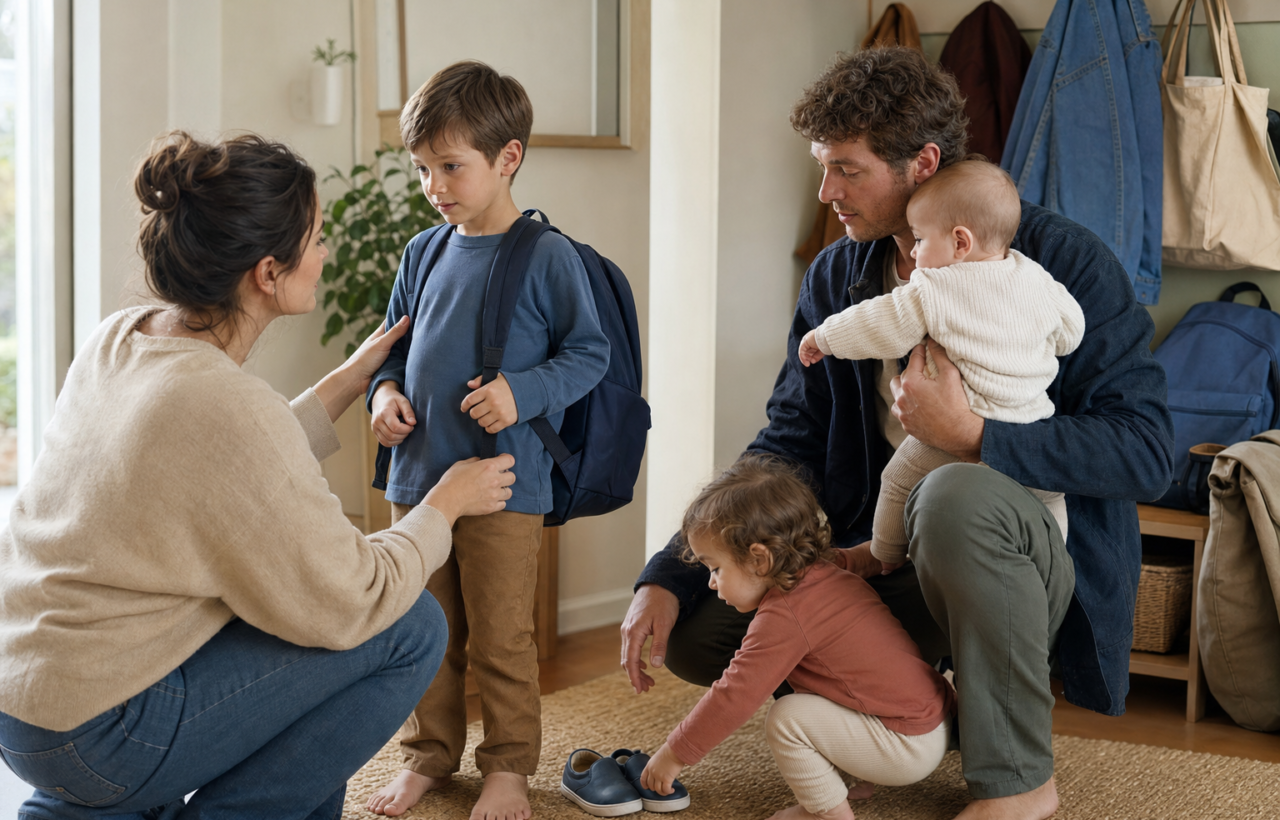
The bag is ready, the route is planned, and you are still bracing for the goodbye. Maybe your toddler is returning to child care, your preschooler is starting somewhere new, or an older child’s school routine is about to reshape life with a baby at home.
You do not have to eliminate every anxious feeling before the first morning. The useful goal is smaller: keep adult worry from setting the family’s agenda, give your child a predictable plan, and watch what actually happens instead of trying to predict every possible problem.
Deal with the adult worry before preparing your child

Back-to-school nerves do not stop at the classroom door. Parents can carry their own anxiety into the transition, and children may take their cues from how adults talk, check, hesitate, and say goodbye.
The common trap is trying to obtain certainty from your child. You ask whether they are nervous, explain every possible difficulty, promise that everything will be fine, and then ask again because the first answer did not settle you. That can turn an ordinary unknown into a problem the child assumes they should fear.
Put the worry through an adult-only filter before you discuss school:
- Name the specific fear. Replace a broad thought such as school will be hard with the actual concern: the goodbye, a new caregiver, transportation, toileting, naps, or coordinating the morning with a younger sibling.
- Separate action from uncertainty. If you need information, ask the school or caregiver a direct question. If there is no action to take, treat the remaining discomfort as yours to manage rather than something your child must resolve.
- Choose an adult outlet. Talk to your partner, a friend, or another trusted adult away from the children. Do not make the child heading to school prove that they are confident enough for you to feel calm.
- Prepare one honest sentence. Try: It can take time to get used to a new routine, and the grown-ups have a plan to help you.
You do not need to act delighted if you are not. Calm honesty is more useful than a performance. With a child old enough to notice your feelings, you might say that you are getting used to the change too, while making clear that adult worries are for adults to handle. A baby or young toddler usually needs less explanation and more consistency in your voice, movements, and routine.
Give your child a plan they can picture
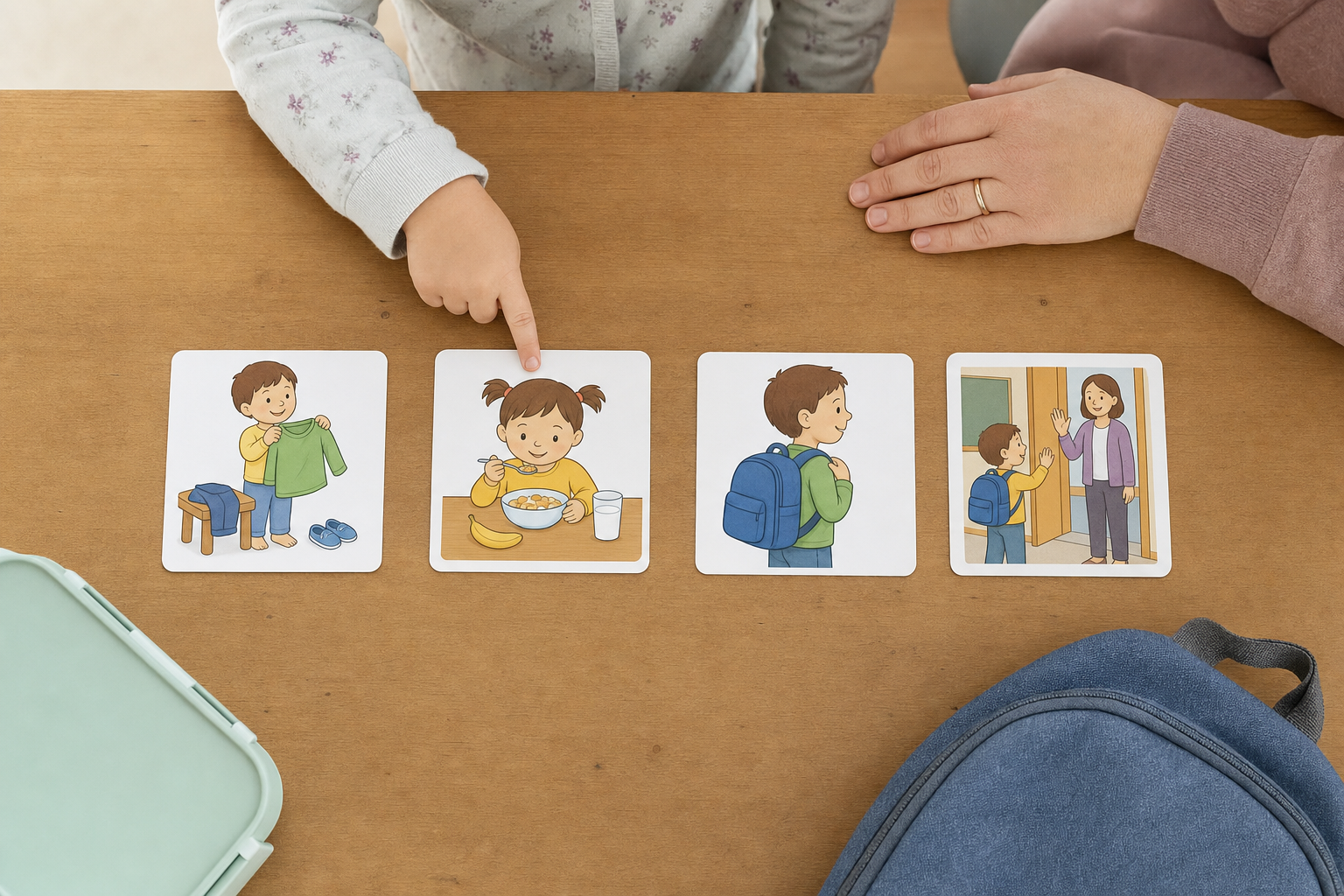
Preparation works best when it answers practical questions. Endless discussion does not make an uncertain event more predictable; a simple sequence does.
Walk through the parts of the day your child will actually experience: who will wake them, what happens after breakfast, how they will travel, who will meet them, what the goodbye will look like, and who will return. If an older sibling is going back to school while you also care for a baby or toddler, decide who handles shoes, bags, the stroller, and the younger child’s immediate needs. A rushed argument about logistics can create more tension than the school transition itself.
For a young child, describe time through familiar events rather than a clock. Use a landmark the caregiver has confirmed, such as after lunch, after rest time, or after the afternoon activity. Do not promise a pickup point unless you know it matches the day’s routine.
Rehearse only what can be rehearsed:
- Put on the clothes, shoes, or outerwear your child will need.
- Pack the bag together and keep it in the same visible place.
- Travel the route if it is unfamiliar.
- Practise the goodbye phrase once in a relaxed moment.
- Show your child which adult will take over when you leave.
Stop once the sequence is familiar. Repeating the rehearsal every time school comes up can make it feel as though a major threat requires constant preparation.
Keep your promises narrow and dependable. Do not promise that your child will not cry, will love every minute, or will have no problems. Promise what you control: you will take them to the agreed place, a named adult will receive them, and you or another named caregiver will return at the planned point in the day.
Use a short goodbye and a low-pressure reunion
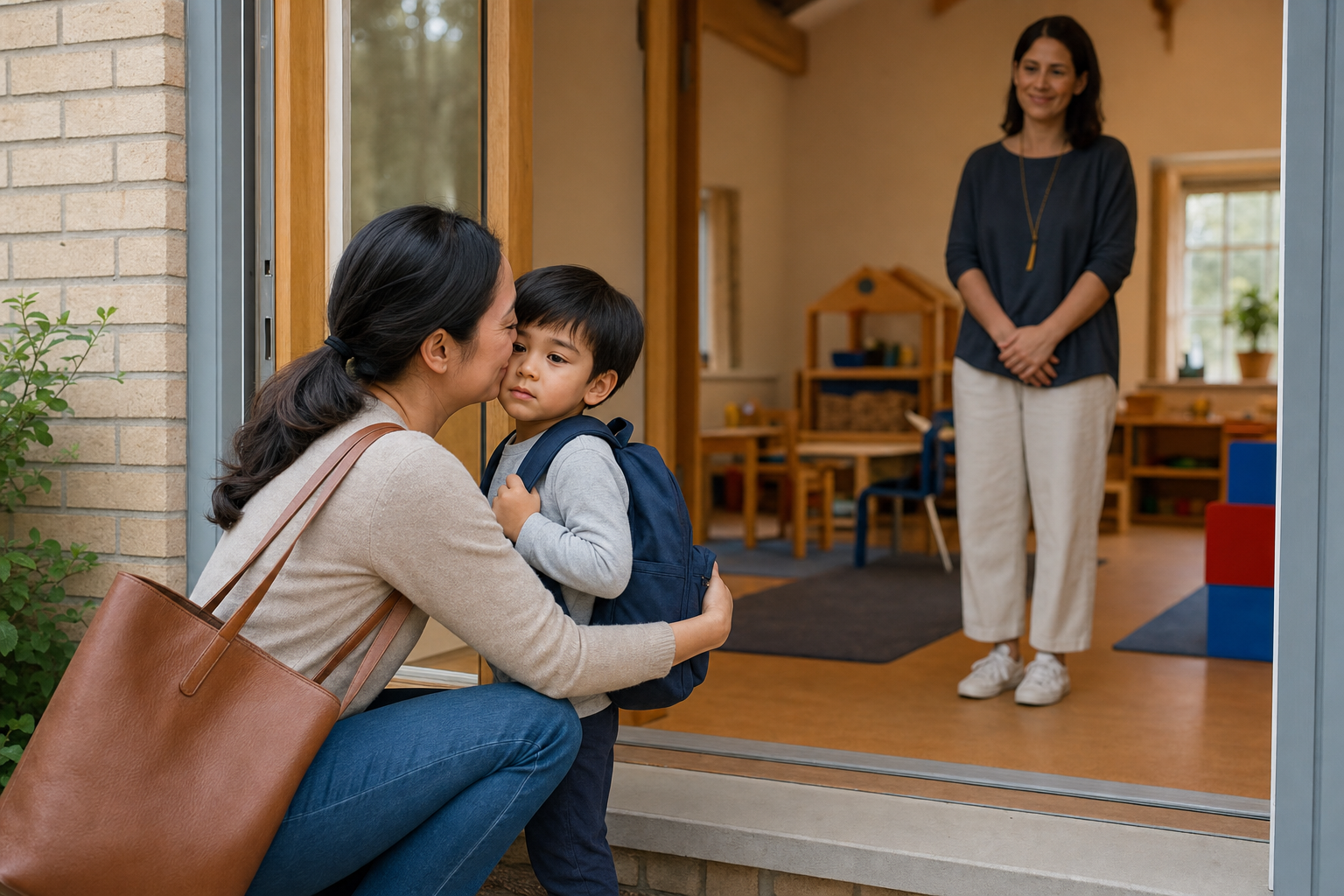
A difficult drop-off tempts parents to improvise. One more hug becomes several, the goodbye explanation grows longer, or the parent leaves and then reappears. The changing response makes the boundary less clear.
Agree on a brief ritual before you reach the door. It might be a hug, the same goodbye sentence, and a handoff to the receiving adult. For example: You are safe with Sam. I will come back after rest time. Once the caregiver has taken over, leave unless they ask you to stay or there is a genuine safety concern.
Do not disappear without saying goodbye. Sneaking away may avoid an immediate reaction, but it leaves the child without a clear moment of separation. It is also better to cry privately after leaving than to make your child responsible for comforting you at the door. Feeling emotional is not the problem; assigning the child a role in regulating that emotion is.
Crying during a handoff tells you that the handoff is hard. On its own, it does not tell you whether the whole day is unsafe, unsuccessful, or a poor fit. Ask the caregiver what happens after you leave: whether your child accepts comfort, begins an activity, eats, rests, plays, or remains distressed. That information is more useful than judging the day solely by the moment you witnessed.
At pickup, reconnect before investigating. A young child may first need a cuddle, a diaper change, food, water, movement, or quiet. An immediate series of questions can feel like another demand after a demanding day.
When your child is ready, use neutral invitations. Ask what they played with, who helped at snack, or what happened after rest time. Avoid leading questions such as Were you scared? or Did anyone make you cry? With a baby or toddler who cannot give a reliable verbal account, combine what you observe at home with specific information from the caregiver.
Judge the transition by patterns, not one hard moment
One smooth day does not settle every concern, and one tearful morning does not settle them either. Track the same small set of observations so that you can distinguish a difficult transition from a problem that needs attention.
- Before leaving: What did your child say or do, without interpreting it for them?
- After handoff: How did the caregiver say your child responded once you were gone?
- During the day: Was your child able to participate in ordinary care, play, meals, rest, and interaction?
- After pickup: What helped your child reconnect and recover at home?
- Across school days: Is the distress easing, staying the same, or becoming more disruptive?
Bring concrete observations to the school or child-care provider. My child cried at the door and settled with blocks after I left gives everyone something to work with. Drop-off is a disaster does not identify where support is needed. Ask whether a different receiving adult, arrival activity, entrance, or handoff sequence would make the transition clearer.
Keep the rest of family life workable while you assess the change. Prepare essential items before the morning rush, decide which adult owns each task, and avoid adding optional commitments to already crowded school nights. If a baby or toddler’s routine is disrupted by an older sibling’s schedule, plan the transition around feeding, naps, transportation, and pickup rather than expecting the youngest family member to absorb every change without support.
Do not assume that every physical or behavioural change is anxiety. If distress is persistent, worsening, or interfering with sleep, eating, daily care, or attendance, talk with the child’s pediatrician or family doctor and coordinate with the school or child-care provider. Seek prompt help for a sudden or severe change, a possible illness, or a safety concern. A qualified health or mental-health professional can help assess the individual child; a home routine is not a substitute for that assessment.
Key takeaways
- Take adult worries to another adult instead of repeatedly asking your child to reassure you.
- Prepare a short, concrete sequence for the morning, handoff, pickup, and return home.
- Make promises about what you control, not about how your child will feel.
- Use one clear goodbye and let the receiving caregiver take over.
- At pickup, reconnect first and ask neutral questions later.
- Assess patterns across the whole day, and get professional support when distress persists, worsens, or disrupts daily functioning.
Before the next school morning, choose the handoff adult, write down your one goodbye sentence, and decide what reconnection will look like after pickup. Then stop rehearsing. A plan your family can repeat is more useful than another attempt to guarantee a perfect day.