
If you are wondering whether the Maxi-Cosi Coral Slide Pro will make newborn outings easier, start with the moment after you park. The product is designed to separate the part you carry from the rest of the infant car-seat system, addressing one of the most awkward parts of the trip: moving your baby between the vehicle and your destination.
That idea can be genuinely useful, but the word lightweight is not enough to make this a good purchase. The seat still has to fit your vehicle, match the rules where you live, work for every regular caregiver and lock together clearly every time. Here is how to decide whether its removable carrier solves your actual problem.
What the removable carrier actually changes
The Coral Slide Pro’s defining feature is a lightweight, removable soft carrier intended to make newborn travel less physically demanding. Instead of treating the entire infant seat as the object you carry, the design lets the carrying component come away from the rest of the system.
This does not eliminate the handoff. It changes what you release, lift and reconnect. You still need to support the carrier properly, operate the release mechanism and confirm that everything is secured again before the vehicle moves. The design is most helpful when those actions feel simpler than lifting and managing a conventional infant carrier.
Do not compare seats using a single weight figure. Ask the retailer to identify exactly what each published weight covers. You need to distinguish the removable soft carrier from the complete car-seat assembly and from any base or other required component. Otherwise, two apparently similar numbers may describe entirely different things.
- Ask for the weight of the removable carrier by itself.
- Ask for the weight of the complete seat configuration you will lift, install or move.
- Find out which components normally remain in the vehicle.
- Confirm how the seat indicates that the removable carrier has been reattached correctly.
- Have every regular caregiver try the release, lift and reconnection sequence.
The last point matters more than it may seem. A mechanism that feels intuitive to one caregiver can be awkward for another because of hand size, reach, strength or the vehicle’s door opening. A demonstration watched from across the counter will not reveal that.
Which family routines are most likely to benefit
The Coral Slide Pro is best evaluated as a solution to repeated carrying, not as a collection of features. Think through your usual route from the vehicle to the place where your baby will settle. Count the lifts, turns, doors and awkward pauses in that route.
The removable carrier is more likely to make a noticeable difference when you regularly have a walk between the car and your front door, encounter stairs or narrow entrances, make frequent short stops, or share transport duties with caregivers who find a complete infant seat cumbersome. The advantage can accumulate because the same lifting motion happens at both ends of an outing.
It may matter less if you normally leave the car seat in the vehicle and lift your baby out directly, rarely travel by car, or have a very short and unobstructed path between the vehicle and home. It also loses its value if the release is difficult to reach in your car or if reconnecting the carrier introduces uncertainty.
Before shopping, conduct a simple transition audit during an ordinary outing. Each time you move your baby, note what you lift, where you put your other belongings, whether you have to open a door or climb steps, and where you pause. Do not count only the number of trips. Count the awkward handoffs. That record tells you whether a removable inner carrier addresses the burden you actually experience.
If lifting is already causing pain, treat that as a health concern rather than a product-selection problem. A lighter carrying arrangement may reduce a recurring burden, but it is not a substitute for advice from an appropriate health professional or for avoiding movements that aggravate an injury.
Run a complete fit test before paying
A showroom display can tell you how the fabric feels. It cannot tell you whether the seat works in your vehicle and in your routine. Ask to test the exact model under the retailer’s supervision, using the current instructions and a store-approved demonstration load rather than placing your baby in an unsecured display.
- Match the exact product. Compare the model name and identifying information on the display, packaging, unit label and manual. Do not assume that another seat in the same product family has identical instructions, limits or components.
- Confirm the market version. Make sure the unit is authorized and labelled for use in the country where you will use it. An overseas listing or review does not establish local approval.
- Test it in your vehicle. Use an allowed seating position and follow both the car-seat instructions and the vehicle manual. Check whether the door opening, roofline, front-seat position and surrounding space let you operate the seat as instructed.
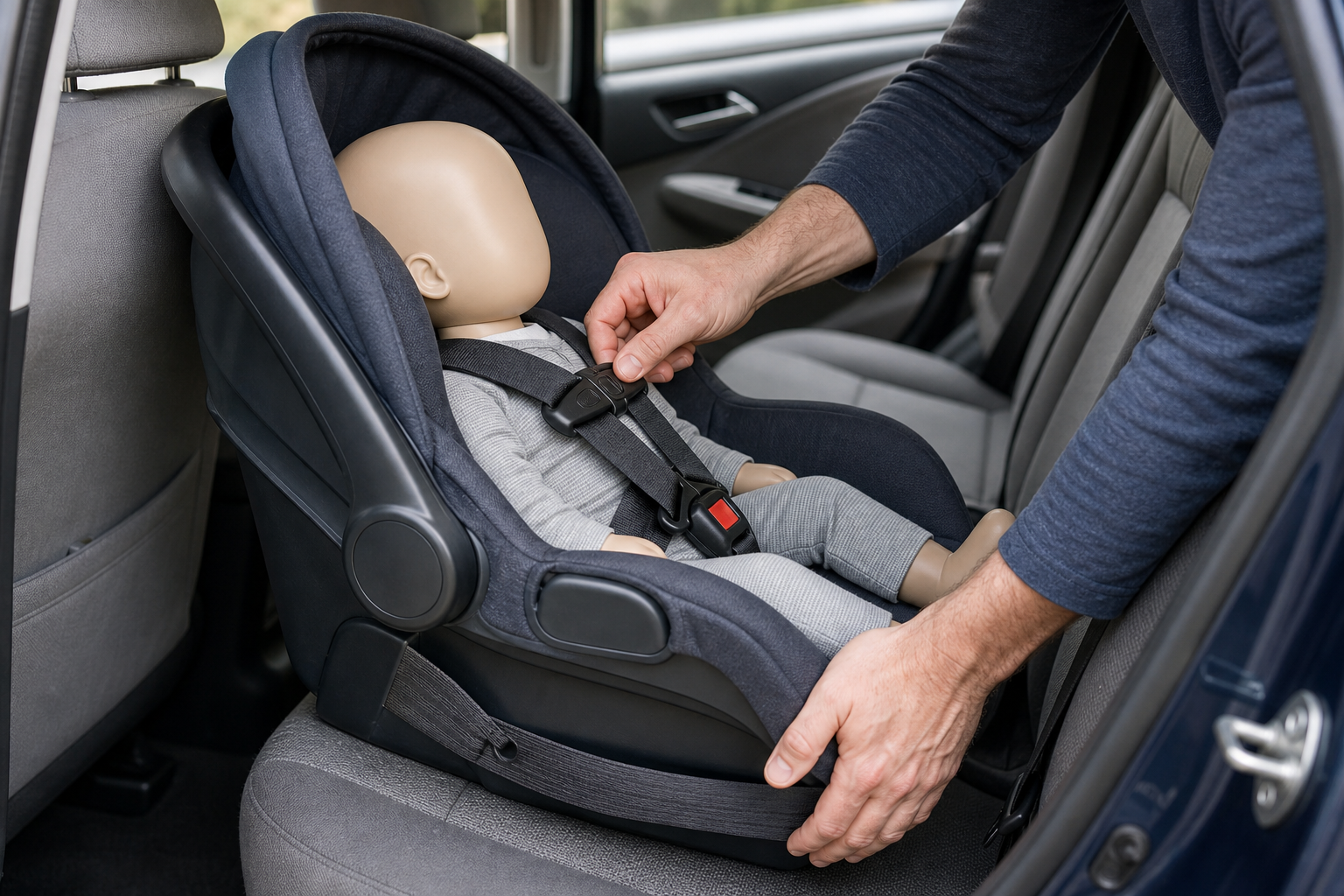
- Practise the entire cycle. Release the soft carrier, lift it clear, return it to the seat and verify the locked condition. Repeat the process until you know which visual, audible or tactile confirmation the manual tells you to check.
- Include every regular caregiver. Each person should perform the cycle rather than merely watch it. Pay attention to reach, wrist position, grip and whether the controls remain accessible from the side of the vehicle they will use.
- Recreate your real route. Think about the distance from your parking place, the doors you encounter and where you normally put keys, a changing bag or groceries. The carrier should simplify that route without encouraging you to overload your hands.
- Check the maintenance routine. Ask the retailer to show you the current instructions for removing, washing, drying and replacing the soft goods. Do not infer that a fabric part is machine-washable or dryer-safe unless the manual says so.
- Price the usable configuration. Confirm which components are included and which, if any, must be purchased separately for your intended installation. A display assembled with optional equipment can create a misleading impression of what is in the box.
Do the test slowly first, then repeat it at a normal pace. You are looking for repeatability, not a fast demonstration. If you cannot tell whether the carrier is secured, or if a control requires an uncomfortable reach, ask the retailer or manufacturer to clarify the instructions before you buy.
Safety and compatibility questions come before convenience
A removable carrier is a convenience feature. It is not proof that the complete seat fits your child, your vehicle or the requirements where you live. Use the carrier only in the configurations allowed by the exact manual. In particular, do not assume that removable means the soft carrier can function by itself as a vehicle restraint.
Obtain the current manual and inspect the labels on the actual unit you intend to buy. Confirm all of the following before placing your baby in it:
- The permitted child size range and every stated condition of use.
- The approved vehicle installation methods and seating positions.
- Whether a base is required, optional or included in your chosen configuration.
- How the instructions tell you to confirm the installation angle and tightness.
- How the removable carrier indicates that it is fully attached to the surrounding seat structure.
- How to position and adjust the harness for your child.
- The manufacturing information, usable-life instructions and crash-replacement guidance for the exact unit.
- How to register the seat so the manufacturer can contact you about relevant safety notices or recalls.
- Which accessories are explicitly approved for use with this model.
Pause the purchase if the seller cannot provide the current instructions, the unit lacks the required local labels, or you cannot achieve an installation allowed by both the car-seat and vehicle manuals. The safe next step is clarification from the manufacturer, an appropriately qualified child-passenger-safety professional or both. Convenience should never be used to rationalize an uncertain installation.
The same rule applies each time the carrier returns to the vehicle. Develop a deliberate check based on the manual’s stated indicators. Do not rely only on familiarity, a quick push or the sound you remember from a showroom demonstration.
Key takeaways
- The Coral Slide Pro is designed around a removable soft carrier that may reduce the burden of carrying a complete infant-seat assembly.
- Its practical value depends on how often your routine involves awkward car-to-door handoffs.
- Ask for separate weight information for the soft carrier, complete seat and any other required component.
- Test the release, lift and reconnection process in your own vehicle with every regular caregiver.
- Verify the exact model’s local approval, child limits, installation method, locking indicators and maintenance instructions before buying.
- Walk away if the seat cannot be installed exactly as instructed or if you cannot reliably confirm that the carrier is secured.
Go into the shop with your vehicle, your usual route and your hardest handoff in mind. If the exact Coral Slide Pro unit passes the regulatory, vehicle-fit, caregiver-use and locking checks, its removable carrier can address a real daily frustration. If it fails any of those checks, choose the seat that fits safely and works reliably, even if its headline feature sounds less convenient.


References