
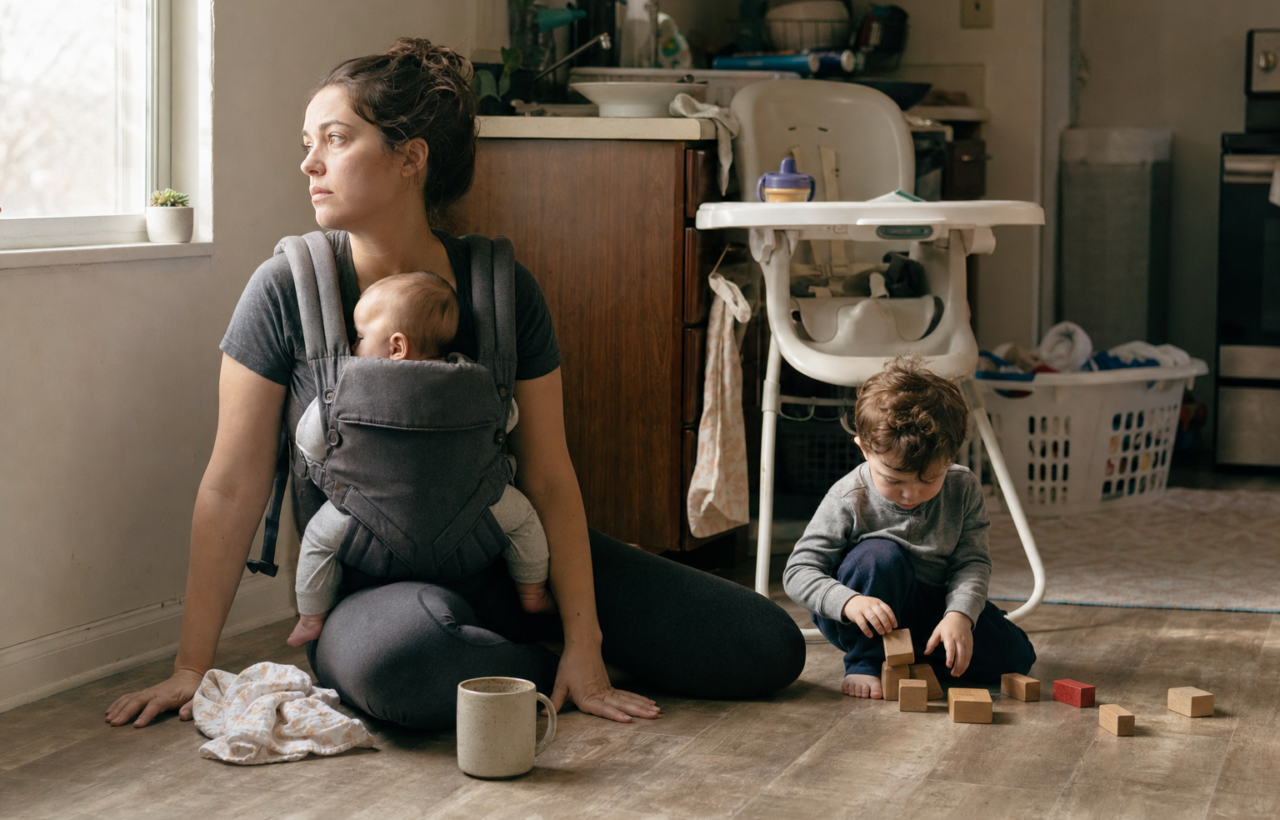
You can love your baby or toddler and still dread the day ahead. When feeding, settling, carrying, cleaning, and responding never seem to stop, even a small interruption can feel like one demand too many. That does not make you ungrateful. It means the way your days are currently set up may be asking more of you than you can keep absorbing.
The goal is not to become more efficient at meeting everyone else’s needs. It is to make the day livable for you too. That starts by identifying the pressure underneath the overwhelm, reducing what the household expects, and arranging real relief before you reach your limit.
Name the part that is actually wearing you down

At-home motherhood can become intolerable in ways that look ordinary from the outside. You may stay in pajamas because getting dressed feels pointless, resent a partner for leaving the house, count the minutes until another adult returns, or react strongly to a mess that would not normally matter. You might feel emotionally distant from your children even while spending nearly every moment caring for them.
Those experiences do not automatically mean you dislike motherhood. It is possible to value being home while also struggling with isolation, resentment, comparison, anxiety, and loss of identity. Treat those feelings as information rather than evidence that you are failing.
Start with a sentence, not a verdict about yourself. Complete this prompt: “The day becomes hardest when…” Be concrete. “I’m bad at this” gives you nothing to change. “I cannot make lunch while the baby cries and the toddler pulls at me” identifies a real collision that can be redesigned.
If the answer is not obvious, use these questions:
- Which part of the day do you dread before it begins?
- Which recurring task makes a minor problem feel enormous?
- What do you resent another adult for being able to do?
- Are you missing rest, adult contact, privacy, movement, or control over your own time?
- Is the distress mainly about child care, household work, money, your relationship, comparison, or no longer recognizing yourself?
Choose the pressure that affects the day most. You do not have to solve your home, relationship, identity, and routine at once. One accurate problem is more useful than a long list of things you believe you should be handling better.
Overwhelm is a description, not a diagnosis. If your feelings are persistent or intense, or involve depression, anxiety, fear, or thoughts of harming yourself or someone else, contact a qualified mental health professional or trusted local care provider promptly. Journaling, routines, and household changes can support you, but they are not substitutes for appropriate care. If anyone may be in immediate danger, use your local emergency service and do not stay alone with the situation.
Build a minimum viable day instead of an ideal schedule
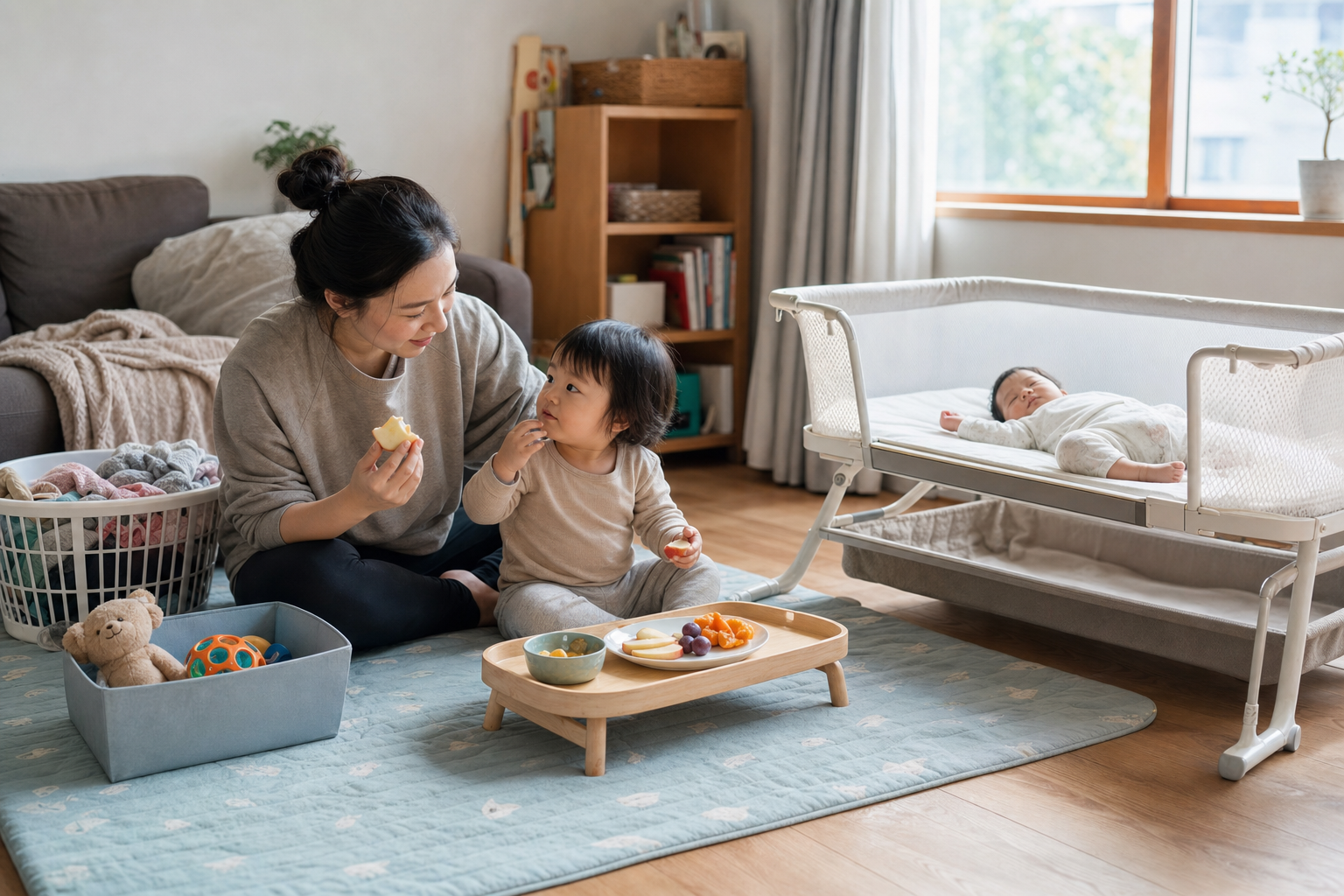
A minimum viable day is a deliberately reduced plan for periods when care is intensive. It separates what must happen from what would merely be nice to finish. This is not giving up on routines. It is choosing a routine that can survive a difficult morning.
Sort the day into three levels:
- Must happen: immediate safety and medical needs, feeding, diapering or toileting, appropriate sleep opportunities, and enough food, water, and bathroom access for you.
- Makes the next part easier: one simple meal, a cleared feeding area, clean essentials, or a short reset at the household’s main trouble spot.
- Can wait: deep cleaning, optional errands, elaborate food, perfectly folded laundry, social obligations that drain you, and jobs being done mainly because you feel judged.
Next, use recognizable anchors rather than trying to control every hour. Waking, the first meal, a rest attempt, the transition before dinner, and the bedtime routine can give the day shape even when infant sleep and feeding remain unpredictable. An anchor tells you what comes next; it does not punish you when the timing changes.
This matters even more when you have a newborn and a very young toddler. A child only 13 months older than a new baby is still a baby too. They may not be able to wait, follow several directions, or understand why the newborn suddenly occupies so much of you. A familiar pattern around meals, sleep, and safe play reduces the number of decisions you must make while both children need you.
Plan feeding windows before you are trapped in one. Decide where the older child can safely be, which age-appropriate activity is available, and what you need within reach before you start. Use only spaces and activities that are safe for your child’s current abilities, and maintain the supervision they require. The purpose is not to make a young child independent on command. It is to remove avoidable scrambling from a task you will repeat.
Protect any shared rest window you can create. When naps overlap, do not automatically spend the whole break restoring the house. Eat, shower, sit down, or do the small task that will genuinely improve the next stretch. Rest is not a reward for completing every chore.
Repair the point where the day repeatedly breaks
A whole-house overhaul is usually too large when you are already depleted. Look instead for the repeated collision: the same shoes missing at the door, the same feeding period becoming chaotic, or the same afternoon mess tipping you into anger. Then create the smallest system that interrupts it.
- If feeding one child leaves the other distressed: prepare the feeding spot and a safe nearby activity in advance. Reserve that activity for care periods if its familiarity helps the transition.
- If leaving home creates frantic searching: put the items you repeatedly need in one landing place near the exit. The system only has to serve your real outings; it does not have to organize the entire entryway.
- If the house becomes unbearable before dinner: choose one visible surface or floor area for a brief reset. Stop when that pressure point is usable, even if other rooms remain messy.
- If toys spread faster than you can collect them: reduce what is available at once and give an older toddler one cleanup action they can already manage. Participation is the goal, not a standard beyond their development.
- If errands consume the day’s remaining energy: combine, postpone, delegate, or remove the optional ones. A temporarily home-centred season can protect rest and reduce exhausting transitions.
- If staying home is becoming isolating: choose contact that restores more than it costs, such as a short walk, a phone call, or time with someone who does not require you to host or perform.
Judge each system by whether it reduces decisions, conflict, or physical work. A beautiful basket arrangement that everyone ignores is decoration, not a working system. A plain container in the place where clothes actually come off may be far more useful.
Use the same test for outings. Leaving home is worthwhile when it gives you connection, movement, pleasure, necessary care, or a meaningful change of scene. It is not automatically worthwhile because a good parent is supposedly out doing activities. If preparing, travelling, feeding, and recovering use more capacity than the outing returns, staying home can be a sound decision for that day.
Turn resentment into a specific transfer of responsibility

Waiting desperately for a partner to return often means the day contains no reliable handoff. The feeling may surface as anger about shoes, dishes, or lateness, but the underlying problem is that you have been continuously responsible and cannot see a clear endpoint.
“I need more help” is true but difficult to act on. Ask for a transfer that names the task, the start cue, and what completion means. For example: “When you come in, I need you to take over both children through their next meal. I am going to eat and be alone, and I need that time to remain uninterrupted unless there is a safety issue.”
A workable handoff answers these questions:
- Who is responsible for each child or household task?
- What event starts the handoff?
- What does the responsible person handle without further direction?
- When does responsibility change again?
- What protected need will the off-duty parent meet during that period?
The practical question is not which adult had the harder day. It is which responsibility must change hands so the household can get through the next part without one person collapsing. Try to make this agreement before the most difficult transition rather than negotiating it in the middle of an argument.
If you do not have a second parent available, make requests to relatives or trusted friends equally concrete. “Let me know if you need anything” often leaves the planning with you. “Could you take the stroller walk while I shower and eat?” gives the other person a defined way to help. If dependable help is scarce, reduce optional commitments accordingly; a schedule built for a supported household will not fit an unsupported one.
Resentment may also be pointing to an unresolved relationship, money, or household-labour problem that a single break cannot repair. Name that issue separately. Relief for tonight and a larger conversation about responsibility are both valid needs, but they are not the same conversation.
Protect a small part of yourself that is not a service

When nearly every action serves a child or the home, it becomes easy to experience yourself as a function rather than a person. The answer does not have to be a dramatic reinvention or an elaborate self-care routine. Start with one practice that gives you agency, expression, connection, or quiet.
- For agency: change into clean, comfortable clothes you chose intentionally. The point is not appearance. It is making one decision about your own body before the day defaults around everyone else.
- For expression: write what you feel without correcting it. Then ask, “What is this feeling asking for, what can I change, and what belongs to another adult?”
- For connection: contact someone with whom you can speak as yourself, not only report on the baby.
- For mental space: return to reading, music, prayer, a hobby, or something else that feels personally meaningful. Choose an activity that can begin without extensive preparation.
- For quiet: protect a rest period in which you are not cleaning, planning, or remaining available for non-urgent requests.
Watch what social media does to you during vulnerable parts of the day. If you finish scrolling with sharper resentment about another person’s home, clothes, travel, or parenting, the activity is not providing a break. Put friction between you and the feed by logging out, moving the app away from your home screen, or deciding in advance what you will do instead. A phone call, music, reading, or stepping outside brings you back into your own life rather than deeper into someone else’s edited one.
Do not turn identity-building into another performance target. The useful question is not whether an activity looks restorative. It is whether you feel more present, more like yourself, or better able to choose your next response after doing it.
Key takeaways
- Replace “I cannot cope” with a precise description of where the day breaks.
- Build the day around essential care and a few recognizable anchors; let optional standards drop.
- Fix one repeated friction point instead of attempting to reorganize the whole home.
- Ask another adult to own a defined responsibility, not merely to provide unspecified help.
- Protect one small practice that reconnects you with yourself outside caregiving.
- Seek qualified support when distress is persistent, intense, or connected to depression, anxiety, fear, or thoughts of harm.
Before the next demanding stretch, write one sentence naming the hardest collision. Choose one anchor that will remain, one expectation that can go, and one responsibility that someone else can take. That is enough for a real start. You are not trying to prove that you can carry the current load; you are changing the load so you no longer have to.
References
- diapr.ai Blog – When Stay-at-Home Motherhood Starts to Feel Desperate
- diapr.ai Blog – Two Babies 13 Months Apart: A Practical Survival Plan