
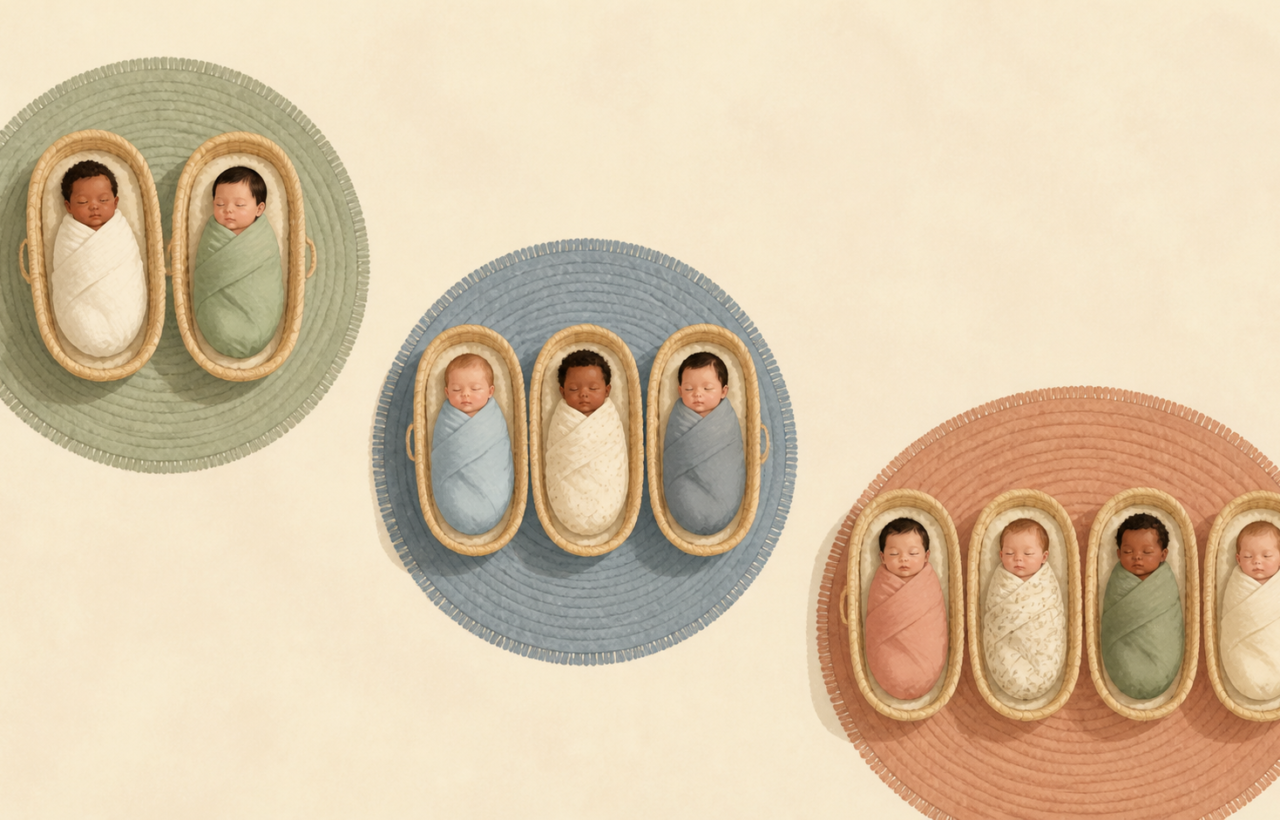
If you have just seen a word such as “septuplets” and need to work out how many babies it means, the answer should not require a lesson in medical vocabulary. The name is simply a count: septuplets are seven babies born as part of the same birth.
The point that causes more confusion is what these words do not tell you. “Triplets,” for example, tells you there are three babies. It does not tell you whether they are identical, fraternal or a combination. Keeping those two kinds of information separate makes birth announcements, family introductions and pregnancy conversations much clearer.
The number-to-name chart
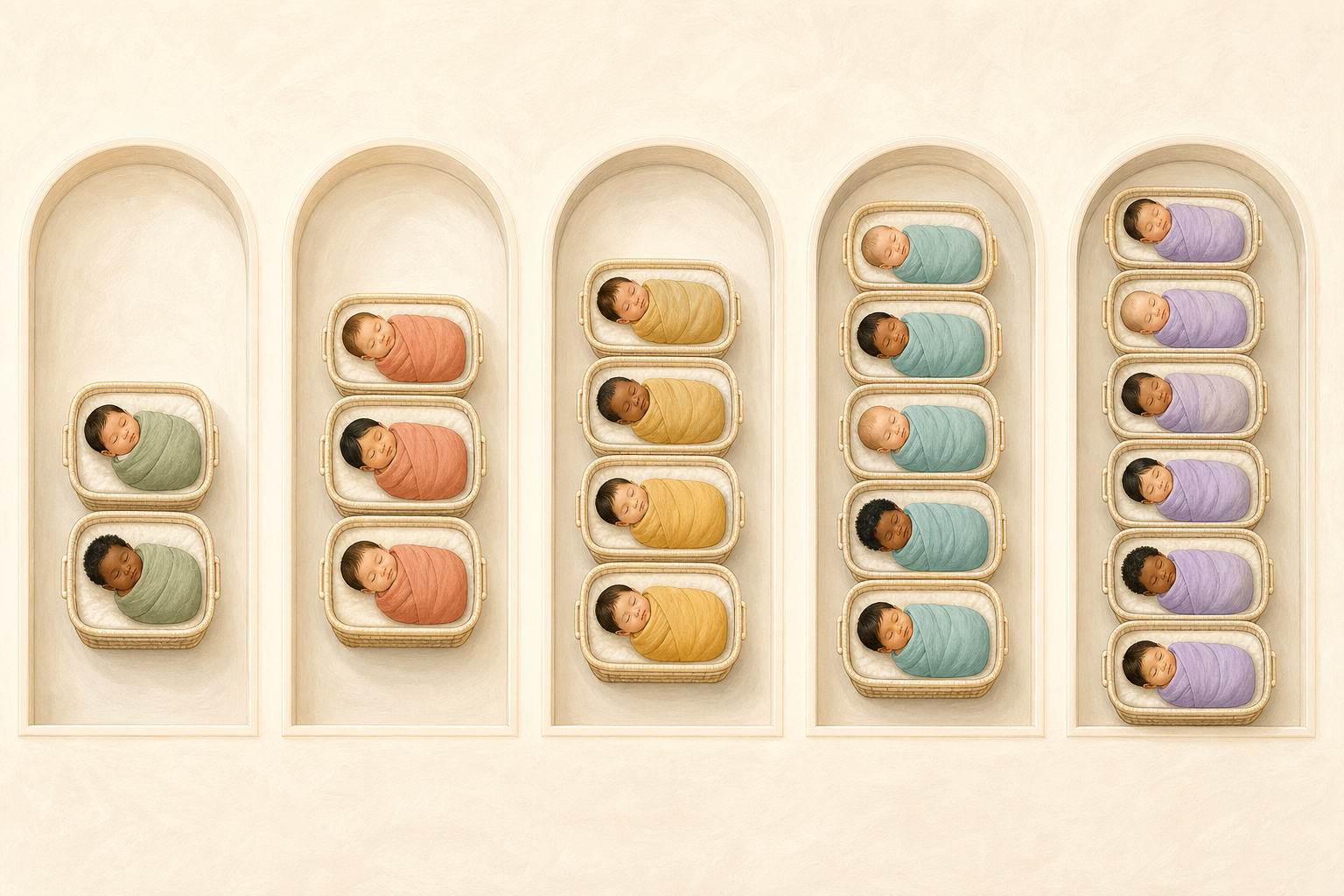
The standard count labels run from singleton for one baby through nonuplets for nine. A singleton is not a multiple, but including it makes the whole pattern easier to see.
| Number of babies | Term for the group | Common shortened form |
|---|---|---|
| 1 | Singleton | – |
| 2 | Twins | – |
| 3 | Triplets | – |
| 4 | Quadruplets | Quads |
| 5 | Quintuplets | Quints |
| 6 | Sextuplets | – |
| 7 | Septuplets | – |
| 8 | Octuplets | – |
| 9 | Nonuplets | – |
For four through nine, the opening part of the word is your clue: quad-, quint-, sext-, sept-, oct- and non- correspond to four, five, six, seven, eight and nine. “Quads” and “quints” are convenient in everyday conversation; the full words are clearer when you are writing for people who may not know the shorthand.
Count and biological relationship answer different questions
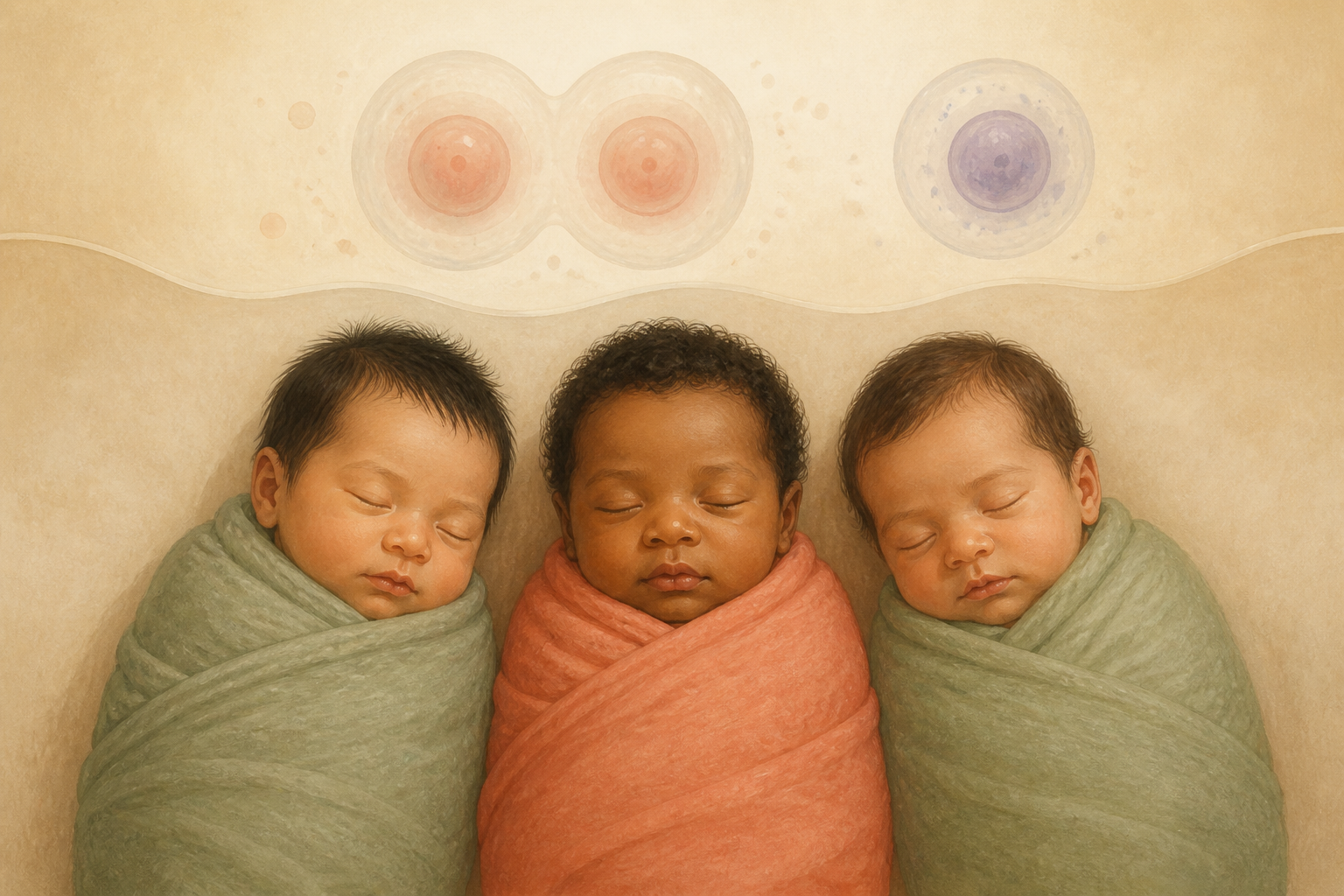
Start with the number. Then, only if it is known and relevant, add a word describing how the babies developed. “Twins” answers how many. “Identical twins” and “fraternal twins” add information about their biological relationship.
- Identical: One embryo splits into two or more embryos. This process can result in identical twins or a larger identical set.
- Fraternal: More than one egg is released and separately fertilized, forming distinct embryos. Fraternal twins can be the same sex or different sexes.
- Mixed: More than one egg can be fertilized and one of the resulting embryos can also split. A larger group can therefore contain an identical pair alongside babies who developed from other separately fertilized eggs.
This means that “quadruplets” does not promise that all four babies have the same biological relationship. It only establishes that the birth group contains four babies. If you need to describe a mixed group, a phrase such as “quadruplets, including an identical pair” is more accurate than trying to replace the count label.
The same rule helps when you do not know the biological details. You can confidently say “twins” or “triplets” based on the number without guessing whether the babies are identical or fraternal.
How to use the words in everyday sentences
The singular form refers to one member of the group. The plural form refers to the group. That small distinction prevents most awkward phrasing.
- One child: “Ari is a twin” or “Ari is one of the twins.”
- The pair: “Ari and Sam are twins.”
- One child in a group of three: “Nora is a triplet” or “Nora is one of the triplets.”
- During pregnancy: “We are expecting twins” or “This is a triplet pregnancy.”
- After birth: “They welcomed quadruplets” or, informally, “They welcomed quads.”
Avoid combining a singular article with a plural group word. One child is “a twin,” not “a twins.” One child is “a quadruplet,” while all four are “quadruplets.”
Be careful with “two sets of twins,” too. In ordinary family conversation, people usually hear that as two distinct pairs. If four babies came from one birth, “quadruplets” communicates the total immediately, even when the group includes an identical pair.
Labels that are related but not interchangeable
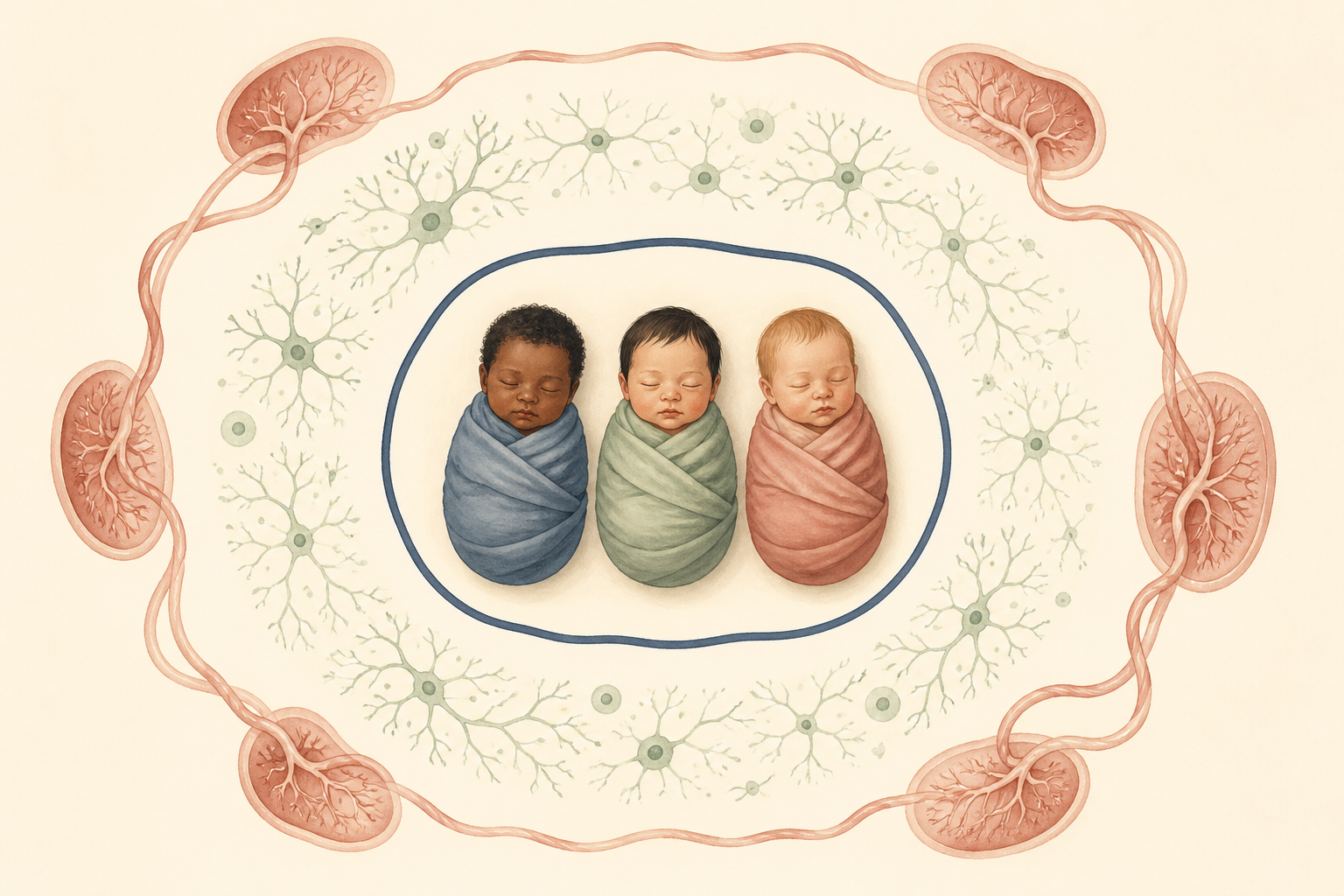
Several terms tend to appear in the same conversation, but each has a different job. Before correcting someone or completing a form, identify the question the label needs to answer.
- Singleton means one baby rather than a multiple group.
- Multiples is the umbrella term for twins and groups containing more babies.
- Higher-order multiples refers to triplets and larger groups. It distinguishes them from twins without specifying one exact number.
- Identical and fraternal describe how the embryos formed and how the babies are biologically related. These words do not replace the number label.
- Quads and quints are shortened forms of quadruplets and quintuplets. They change the register, not the meaning.
- Multiple pregnancy and multiple birth refer to different stages. While someone is pregnant, “expecting multiples” is natural; after delivery, the specific birth term can describe the group.
That distinction matters most when a sentence tries to carry more than one fact. “Fraternal” cannot tell a reader whether there are two babies or more, while “triplets” cannot tell them whether any babies in the group are identical. State the count first, then add the relationship if it helps.
Key takeaways
- Twins are two babies, triplets are three, quadruplets are four and quintuplets are five.
- Sextuplets are six, septuplets are seven, octuplets are eight and nonuplets are nine.
- A singleton is one baby and is included mainly as the contrast to a multiple pregnancy or birth.
- The count label does not establish whether the babies are identical, fraternal or part of a mixed group.
- Use the singular form for one child and the plural form for the whole group: “a triplet,” but “the triplets.”
- For the clearest description, give the number-based term first and add biological relationship information only when it is known and useful.
The next time you need to describe a multiple birth, begin with the simplest fact: the number of babies. “Twins,” “triplets” or “quadruplets” will usually be enough. If more detail matters, add it in a second phrase rather than asking one word to answer two different questions.
References