
You are standing in front of a shelf, comparing nearly identical labels: retinol, retinal, retinoid, retinaldehyde, retinyl palmitate, tretinoin. The names sound interchangeable, but they describe different members of the same vitamin A family.
The useful question is not, “Which one is strongest?” It is, “Which form can my skin tolerate well enough for me to use consistently?” Once you understand how many conversion steps each form requires, the labels become much easier to read.
Key takeaways
- Retinoid is the umbrella term for the vitamin A family. Retinol and retinal are both retinoids.
- Retinoic acid is the form the skin can use directly. Prescription tretinoin supplies this active form.
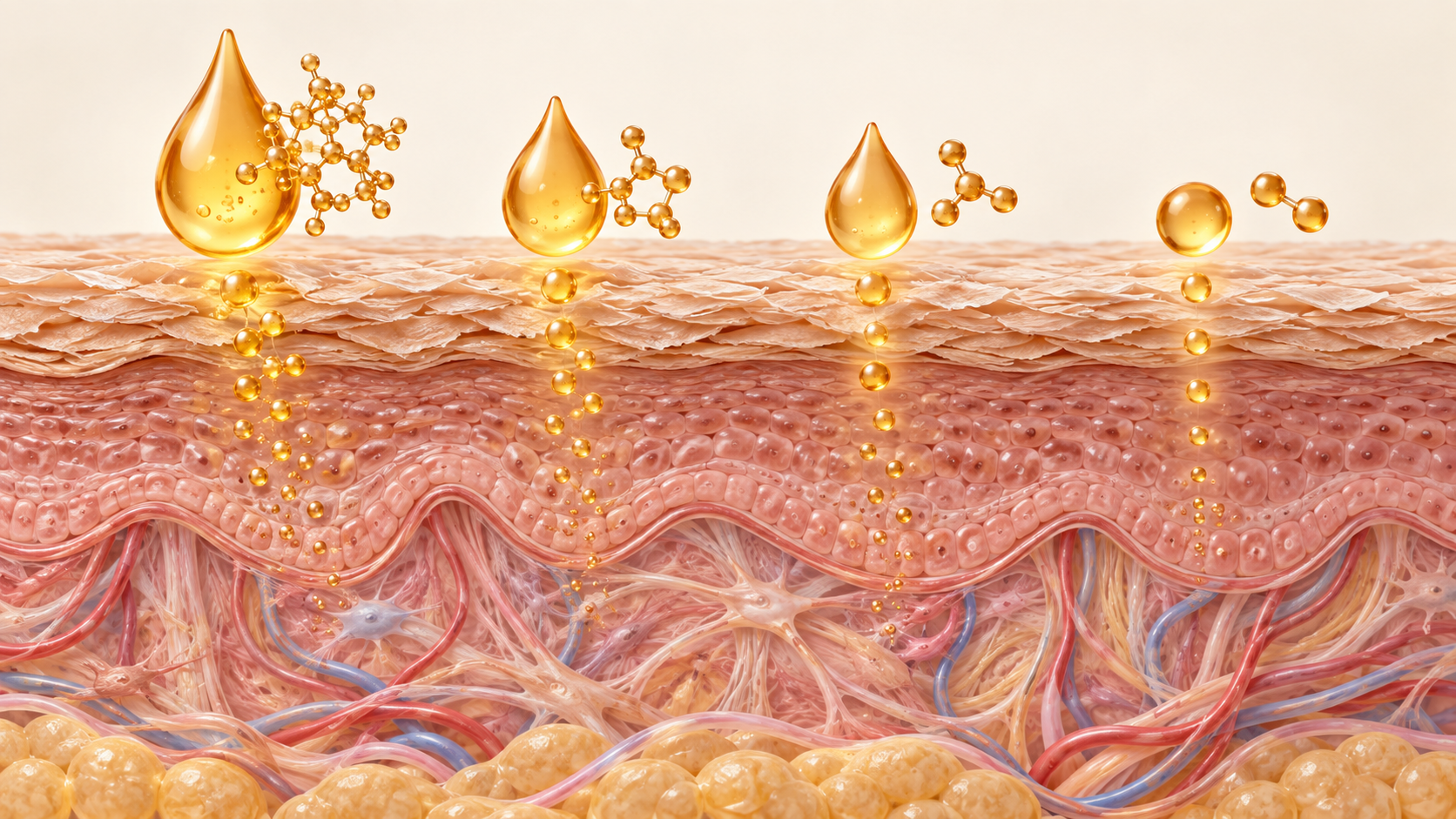
- Retinal, also called retinaldehyde, requires one conversion step to become retinoic acid. Retinol requires two, while retinyl esters require three.
- Forms farther from retinoic acid tend to be gentler because the skin must complete more conversion steps.
- The best option is not automatically the closest one to retinoic acid. It is the one you can use consistently without repeatedly upsetting your skin.
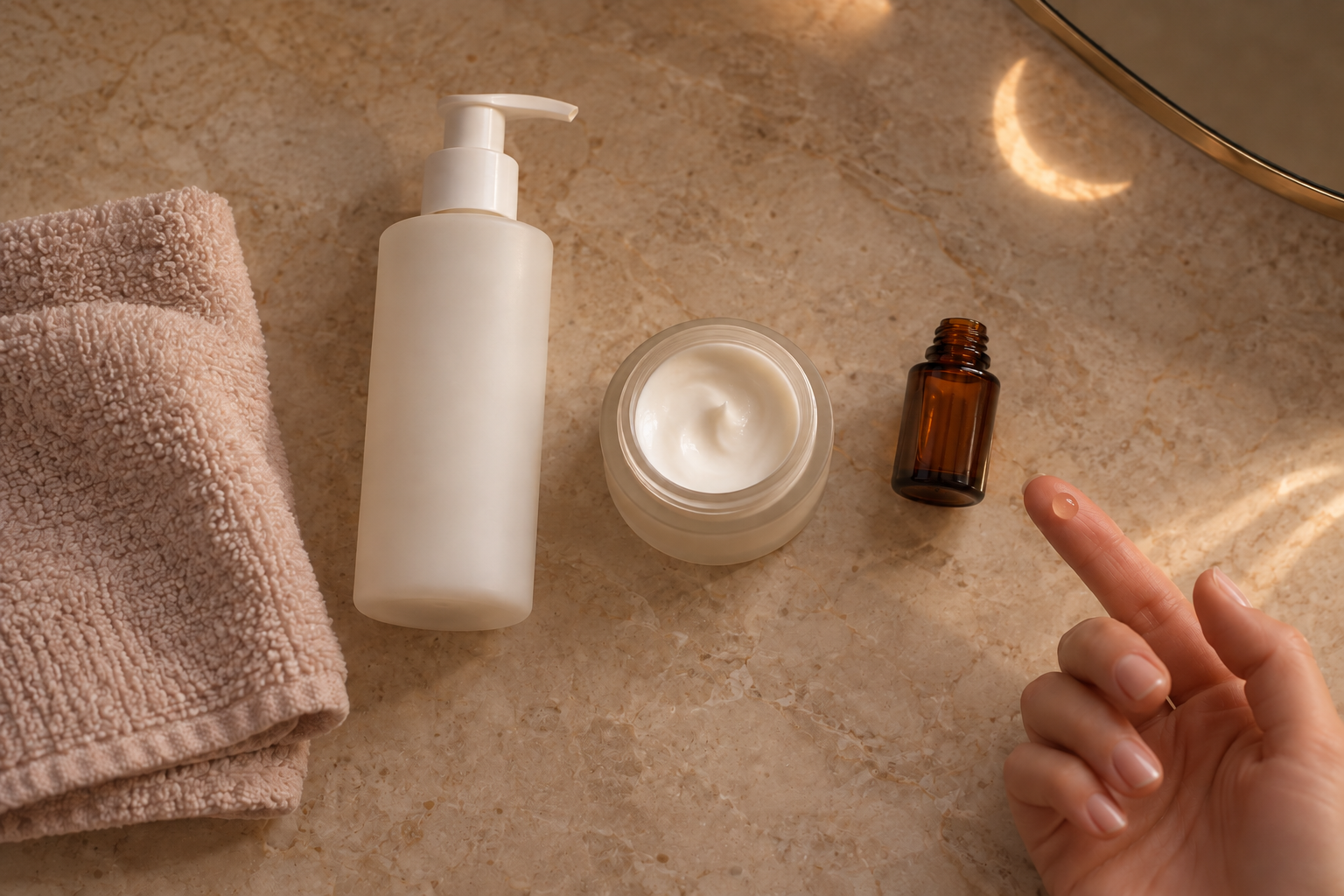
- To reduce irritation, start two or three times a week, use a pea-sized amount on dry skin, avoid another exfoliant that day, and consider putting moisturizer below and above the retinoid.
One family, four different distances from the active form
Retinoid is a category, not one specific ingredient. The category includes retinyl esters, retinol, retinaldehyde and retinoic acid. What separates these forms is how much conversion the skin must perform before it has retinoic acid.
| Label you may see | Relationship to retinoic acid | Practical meaning |
|---|---|---|
| Retinyl ester, including retinyl palmitate | Three conversion steps away | Farther from the active form and generally the gentlest place on this pathway |
| Retinol | Two conversion steps away | A common non-prescription starting point |
| Retinal or retinaldehyde | One conversion step away | Closer to the active form than retinol, without being retinoic acid itself |
| Retinoic acid, including prescription tretinoin | No conversion required | Already in the form the skin can use |
That sequence explains the central trade-off. A retinyl ester has more steps between application and the active form, so it is generally milder. Retinal has fewer steps than retinol, placing it between conventional retinol and prescription tretinoin on this pathway.
It also clears up two common label-reading mistakes. First, retinal is not a misspelling of retinol; retinal and retinaldehyde are names for the same form. Second, retinol is not a synonym for every retinoid. All retinols belong to the retinoid family, but not every retinoid is retinol.
Not every ingredient fits neatly onto this conversion ladder. Prescription adapalene and proprietary non-prescription compounds such as ethyl lactyl retinoate can activate retinoid receptors through a different route. If you see one of those names, do not try to rank it by counting the same conversion steps. Evaluate that particular ingredient and formulation instead.
Choose for tolerance, not for the most impressive label
Moving closer to retinoic acid may sound like an obvious upgrade. In practice, a product that leaves your skin too dry, flaky or sensitive to continue is a poor fit, however powerful its label appears. Consistency matters more than choosing the strongest available form.
Use this decision path when you shop:
- Find the exact vitamin A ingredient. Look past the large word on the front and read the ingredient description. Determine whether the product contains a retinyl ester, retinol, retinaldehyde, retinoic acid or a different retinoid.
- Match the starting point to your tolerance. Retinol is a practical first option for many new users. If your skin is very sensitive, retinyl palmitate may offer a gentler entry point. Retinal sits closer to retinoic acid and may suit someone looking beyond traditional retinol.
- Treat prescription retinoids as a clinical decision. Tretinoin contains retinoic acid in an already usable form. A dermatologist can help determine whether that level and a particular prescription are appropriate for your skin.
- Consider the formulation, not just the ingredient name. Encapsulation can slow the ingredient’s delivery and make a retinol product gentler. That means two bottles carrying the word “retinol” may not provide the same experience.
- Do not upgrade just because your skin can feel the product. Dryness and flaking are possible side effects, not proof that you selected the right strength.
Start by comparing ingredient identity, distance from retinoic acid and formulation. A prominent percentage cannot answer all three questions by itself, especially when you are comparing different forms of vitamin A.
A low-irritation routine is deliberately uneventful
Retinoids can cause dryness, flaking and sensitivity. Your first routine should therefore make it easy to control the amount, frequency and combination of products. You do not need a complicated schedule.
- Begin with two or three applications a week. This gives your skin time to become accustomed to the product before you consider using it more often.
- Apply it to dry skin. Do not put it on while your face is still wet.
- Use one pea-sized amount for your entire face. More product is not the same as better use.
- Use the moisturizer sandwich if you need a gentler approach. Apply moisturizer first, then the retinoid, followed by another layer of moisturizer. This slows the rate at which the retinoid contacts the skin.
- Skip other exfoliants that day. Combining them with a retinoid can be too much irritation at once.
Keep the rest of the routine stable while you assess the new product. If you change the retinoid, increase its frequency and introduce another exfoliant at the same time, you will have no clear way to identify what caused a reaction. Change one variable, observe how your skin responds, and only then decide whether another adjustment is worthwhile.
If your week with a baby or toddler makes a seven-step routine unrealistic, that is not a reason to abandon the ingredient. A pea-sized amount on two or three planned nights, with moisturizer already beside it, is a complete starting routine. Repeatability is the goal.
Know when the choice needs professional input
Some dryness or sensitivity can happen with retinoid use, but you do not need to push through significant or persistent irritation to make the product “work.” Stop using the product and speak with a dermatologist if reducing the frequency and simplifying the routine do not make it tolerable. A skincare professional can also help when a label uses an unfamiliar proprietary retinoid that does not fit the usual conversion pathway.
Pregnancy, trying to conceive and breastfeeding make product suitability an individual health question. Do not assume that a non-prescription label means a retinoid is appropriate for every life stage. Before starting or continuing one, show the exact ingredient list to your prenatal clinician, family doctor, pharmacist or dermatologist and follow their advice for your situation.
Your next step can be small: turn over the bottle you are considering and find the specific retinoid name. If it is retinol and you are new to the category, plan two or three applications a week on dry skin, measure one pea-sized amount, and keep your moisturizer close. If it is retinal, tretinoin or an unfamiliar retinoid, identify where it belongs before treating it as interchangeable with retinol.
References



