
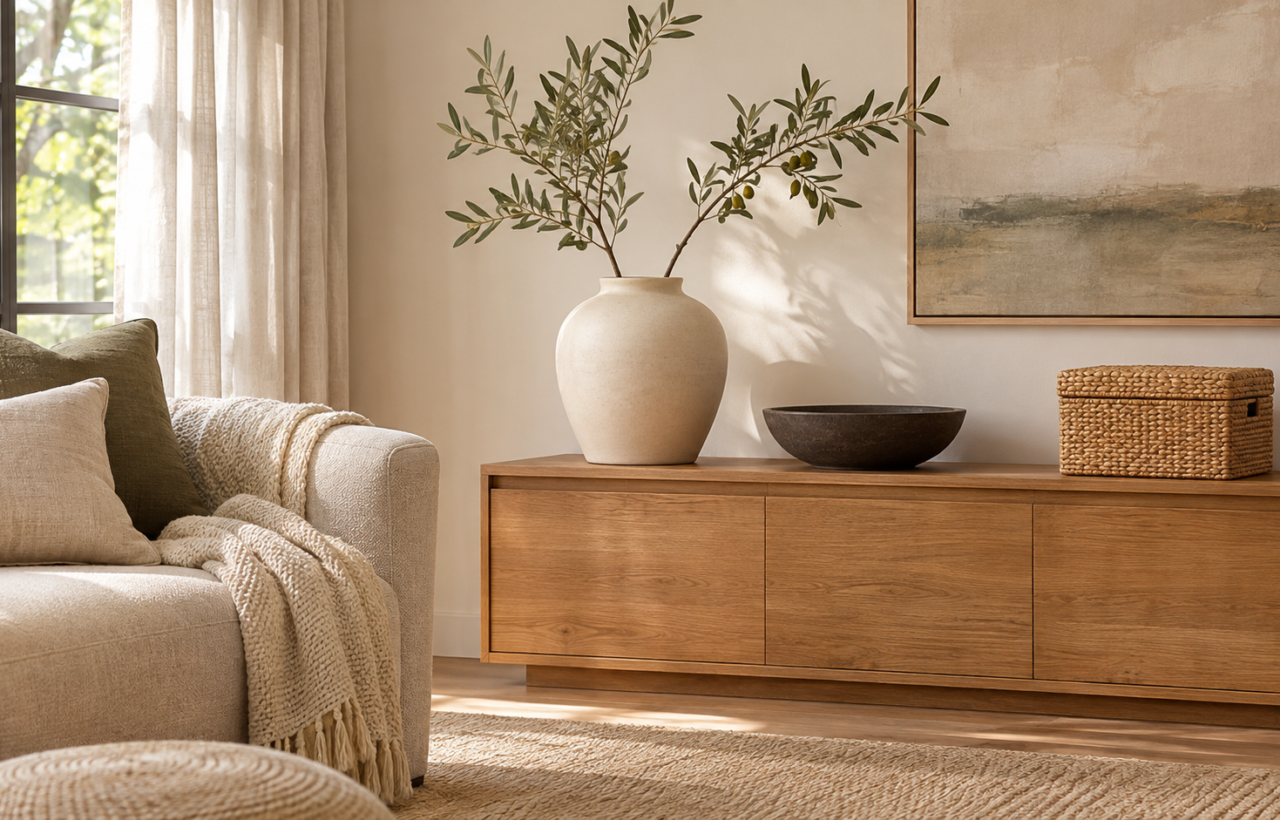
You do not need to make a dollar-store find pass for an expensive original. You need it to do the same visual job: add warmth, texture or order without making your home feel crowded.
That distinction matters when you live with a baby or toddler. The best decor is not merely attractive on the day you arrange it. It also fits your routine, tolerates ordinary family life and does not introduce a breakable, unstable or easily swallowed object within reach.
Start with the Crate & Barrel design language
The recognizable look comes from a restrained system rather than one magic product. Shapes tend to be simple. Colours are quiet. Woven texture, clear glass, warm wood tones and matte surfaces keep neutral rooms from feeling flat. Matching pieces appear deliberately repeated, while some of the surface remains empty.
Use those qualities as your shopping brief. Before entering Dollar Tree, photograph the area you want to change and decide what the new object must do. A placemat might soften a hard table, a basket might contain feeding supplies, and a plain frame might bring one family photo into an otherwise unused spot. If you cannot name the job, the object is likely to become clutter.
- Colour: Look for cream, warm white, tan, brown, black, clear glass or one muted accent already present in your room.
- Shape: Favour uncomplicated profiles over novelty forms, slogans and elaborate decoration.
- Texture: Woven, ribbed, fluted, hammered and matte finishes can add interest without requiring a bright pattern.
- Repetition: A coordinated row or table setting usually looks more intentional than several unrelated bargains.
- Negative space: The room needs somewhere for your eye to rest. Do not plan to cover every open surface.
Table settings show why this approach can save meaningful money. Six Artesia woven rattan placemats at $25 each come to $150 before plates, glasses or napkins enter the picture. A lower-cost mat does not have to be an exact replica to work. It needs a compatible colour, an even-looking weave and enough consistency across the set to create the same warm foundation.
Shop for useful categories, not promised inventory
Dollar Tree inventory can vary, so a rigid product list is less useful than a set of visual search terms. Scan the relevant aisles for the following categories, then judge the actual item in front of you.
- A tabletop foundation: Look for woven-look placemats, chargers and plain dishes in warm white or stone-like colours. A simple shape is easier to combine with pieces you already own. Use an item with food only when its label says it is intended for that purpose.
- A soft textile layer: Neutral napkins, tea towels and small cloths can introduce texture without adding another hard object. Compare multiples side by side; whites and beiges that appear identical at first can have noticeably different undertones.
- Storage that reads as decor: Woven-look baskets and quiet solid-colour bins can conceal diapers, bibs, toys or changing supplies. Check that trim, handles and decorative pieces are firmly attached before using them in a child-accessible area.
- Simple vessels: Matte planters, restrained vases and ribbed containers can imitate the silhouette of a more expensive piece. Decide what the vessel will hold before buying it, and keep glass or ceramic versions outside a child’s reach.
- Frames and trays: A thin black, natural-looking or warm metallic frame can work when its corners and backing are secure. Treat decorative trays as display pieces unless their labels specifically approve another use.
Once something catches your eye, put it through a cart test:
- Imagine it without the packaging. The silhouette and surface should still look good when the branding is gone.
- Inspect the finish from more than one angle. Skip visible glue, peeling film, rough edges, distorted printing or a faux finish that already looks worn.
- Compare every duplicate. Choose pieces with consistent colour, shape and pattern alignment rather than assuming the stack matches.
- Test the construction gently. A loose base, wobbly frame stand or detachable ornament will not improve once it reaches your home.
- Read the label. Decorative, food-contact, electrical and child-use products are not interchangeable categories.
- Name its destination. If you cannot point to a specific table, shelf or storage problem, leave it behind.
The last step is the one that protects your budget. A low price does not turn an unneeded object into a saving.
Build one finished zone instead of scattering small finds
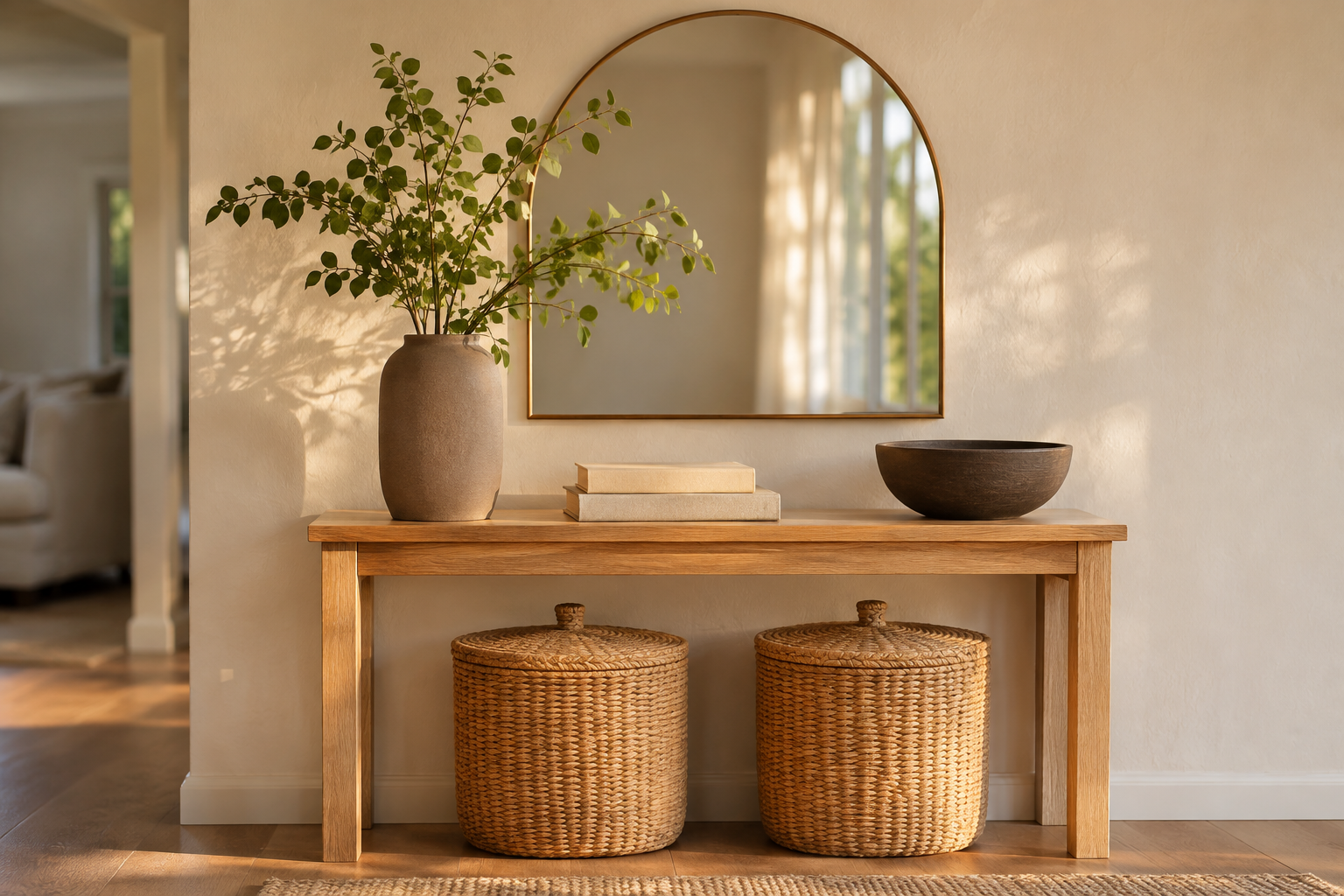
Small decor looks most convincing when several choices support one area. Spreading unrelated finds across the house can make every room feel busier while leaving none of them finished. Pick one zone and complete it before shopping for another.
- For the dining table: Let matching woven-look mats provide the texture, then add the plain dishes you already own and neutral napkins if they are useful to your family. Adult glassware can remain part of an adult place setting, while a child’s place uses the drinkware appropriate for that child. A permanent centerpiece is optional, especially when little hands can reach the table.
- For an open kitchen shelf: Combine a small basket with a plain vessel and one useful textile. Keep food, medicine and cleaning products in their proper containers rather than decanting them merely for appearance.
- For a living-room shelf: Use a lightweight basket for accessible toys and reserve secured, higher areas for breakable frames or vessels. Repeating a finish already in the room will make the new piece feel connected rather than random.
- For a family drop zone: Give keys, adult accessories and small daily items a defined container that children cannot access. The practical containment supplies the polished look; extra ornaments are unnecessary.
After arranging the zone, step back and remove the weakest item. This is often more effective than adding another accessory. A strong texture beside a plain shape usually has more impact than several competing finishes.
Be especially selective with imitation materials. One woven texture can look warm; several unrelated faux woods, metallic coatings and marble patterns can make the display feel fragmented. Match the overall material story, not every shade exactly.
Make every decor dupe pass the toddler test
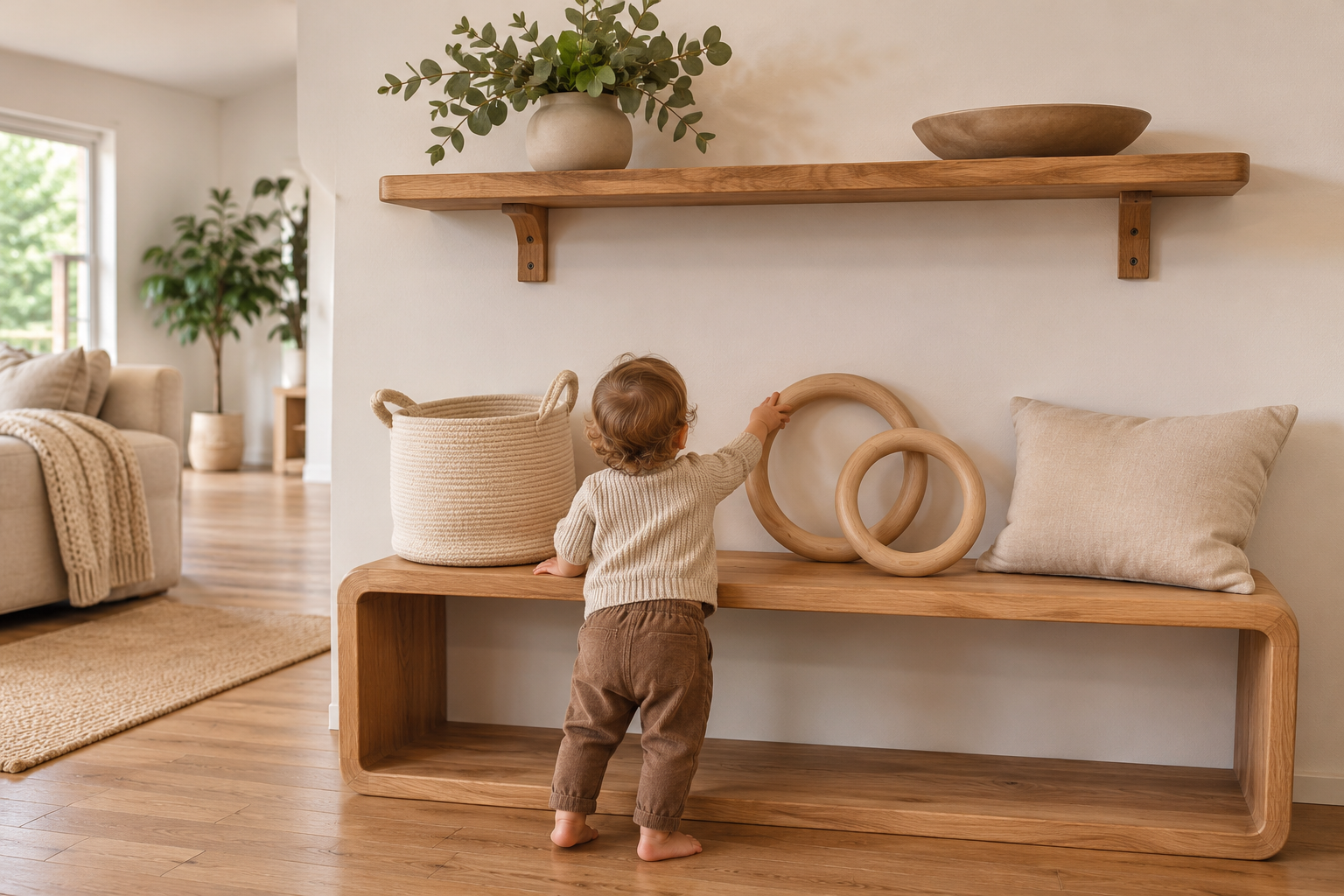
Decorate for your child’s next mobility stage, not only the stage you see today. A surface that is inaccessible to a newborn may become reachable once that child starts crawling, pulling up or climbing. Planning for that change is easier than repeatedly dismantling a room.
- Reach and pull: Check whether a child could grab the object directly or pull it down using a runner, tablecloth, cord or nearby item.
- Drop and break: Keep glass, ceramic and heavy decor out of accessible play and traffic areas. A higher location still needs to be stable rather than perched at an edge.
- Small components: Skip accessible decor with loose beads, stones, detachable ornaments, weak magnets or other pieces that could come away in a child’s hand.
- Tip and pinch: Avoid top-heavy objects and unstable stands where a child plays or cruises along furniture. Do not let a decorative basket or box obstruct doors, drawers or walking paths.
- Flame and power: Open flames do not belong in a child-accessible styling plan. Keep powered products, cords and battery compartments inaccessible, and stop using an item if its compartment or casing is damaged.
- Intended use: Do not assume a decorative bowl, tray, paint or adhesive is suitable for food contact or for something a baby may mouth. Follow the product label and leave food-contact surfaces unmodified.
An item that fails one of these checks does not need a clever workaround. Use it in a genuinely inaccessible adult area, store it until a later stage or do not buy it. The safest choice can also preserve the calm look you wanted by eliminating one more object from the room.
Dollar Tree decor dupe FAQ
Can Dollar Tree pieces sit beside more expensive decor?
Yes. They work best when the connection is visible: the same black finish, a repeated woven texture or a similar warm-white colour. Avoid arranging the room by price or store. Arrange it by colour, material and function so every object participates in the same design.
Is a DIY makeover necessary?
Usually not. Start with products whose shape and finish already suit the room. Paint, adhesive, tools and time can erase the value of a cheap base item, and a homemade coating may be inappropriate for food-contact surfaces or objects a child can reach. Do not modify electrical products, battery compartments or child-use items for decorative reasons.
What should you buy first?
Buy the piece that establishes the zone: the placemats for a dining table, the basket for visible storage or the frame for a planned photo display. Set up that anchor at home before adding companions. This lets the room, rather than the store shelf, tell you what is still missing.
Before your next trip, take a daylight photo of the chosen area and record its maximum usable dimensions. Buy for that space, set up the find promptly and look at it from across the room. If it does not add function, texture or order, returning it is a better design decision than trying to make it work.
References



