
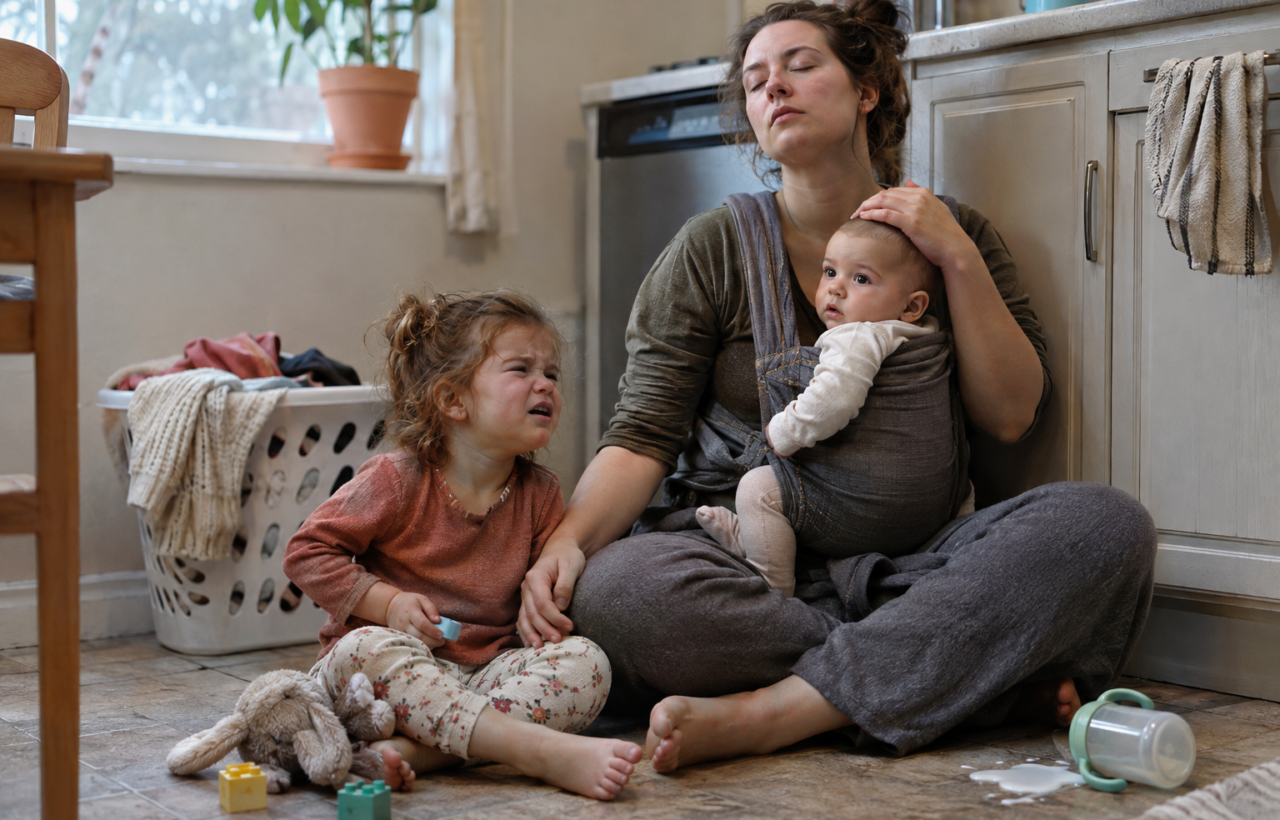
The baby will not settle, your toddler is resisting everything, and a small mess feels like the final insult. You do not need a new parenting philosophy in that moment. You need a way to make the rest of the day smaller.
Parenting can be challenging and overwhelming. A difficult day, however, is not a verdict on your relationship with your child. Use this plan to protect what matters, release what does not, repair a rough moment, and ask for help that is actually useful.
Key takeaways for a difficult parenting day
- Redefine success around safety, necessary care, and connection. Optional tasks can wait.
- Respond to the next need instead of trying to rescue the entire day.
- Treat crying, resistance, and tantrums as situations to handle, not grades on your parenting.
- If you lose your temper, repair plainly without making your child responsible for your feelings.
- Ask another adult for a specific action rather than saying only that you are overwhelmed.
- Get professional help when difficult days become a persistent pattern or anyone’s safety is at risk.
Decide what counts as enough today

A hard day gets heavier when you keep measuring it against the day you intended to have. The outing, bath, homemade meal, folded laundry, and cheerful bedtime may no longer fit. Continuing to chase all of them creates more decisions at the exact moment your patience is thinnest.
Sort the rest of the day into these practical categories:
- Must happen: immediate safety, necessary feeding, medication as directed, diapering or toileting, and essential care for you and your child.
- Can become easier: dinner can be simple, the routine can be shorter, and the environment can be quieter.
- Can wait: cleaning, non-urgent messages, optional errands, an unnecessary bath, and any plan that now costs more energy than it gives back.
This is triage, not failure. Lowering today’s workload protects the energy you need for the parts of parenting that cannot be postponed.
Then choose only the next useful action. Change the diaper. Offer the appropriate food or milk. Sit on the floor beside your toddler. Put something easy on your own plate. Do not solve bedtime while you are still trying to get through lunch.
Do not use your child’s mood as a parenting score
A baby can be fed, dry, held, and still cry. A toddler can feel secure and still reject the cup they requested moments ago. Your child’s distress is real, but it does not automatically mean you missed something or caused it.
When you feel yourself scrambling to make the crying or resistance stop, pause and ask:
- Is my child safe?
- Is there an immediate physical need I can meet?
- Could I reduce noise, light, choices, conversation, or demands?
- Am I trying to force a happy mood when my child may simply need calm company?
If there is no urgent need, use fewer words and change one thing at a time. With a baby, that might mean moving to a quieter room or returning to a familiar soothing routine. With a toddler, it might sound like, “You wanted the blue cup. You are upset. The green cup is what we have.” Acknowledging the feeling does not require you to reverse a reasonable limit.
This distinction matters: you are responsible for offering safe, attentive care. You are not responsible for producing a contented child on demand.
Repair the moment without abandoning the boundary

Sometimes the hard part is not the tantrum or the crying. It is hearing your own voice become sharper than you intended. Once everyone is safe and calmer, repair directly. You do not need a long speech.
For a toddler, try language like this:
- “I shouted. I am sorry I spoke to you that way.”
- “You were upset, and I became frustrated. My shouting was not your fault.”
- “The rule is still that we cannot hit. I will help you stop safely.”
- “We are having a hard moment. I am here.”
A baby will not understand an explanation, but repair can still shape what you do next: soften your voice, slow your movements, return to familiar care, and hold the baby if they welcome it.
Keep the roles clear. Do not ask your child to reassure you that you are a good parent, and do not make forgiveness a condition for moving on. The adult owns the behaviour; the child does not have to manage the adult’s guilt.
If crying is pushing you toward losing control, place your baby safely in their crib and step away briefly to regain control before returning. If you fear you may hurt yourself or your child, involve another adult immediately and use emergency services when the danger is immediate.
Ask for help in a form someone can act on

“I need help” is honest, but it still leaves the other person deciding what help means. On a difficult day, that extra negotiation can become another task for you. Name the action, the handoff, and any boundary that matters.
- “Please take over with the baby so I can shower and eat. Come get me if you think something is wrong.”
- “Could you bring something ready to eat? I do not have the capacity to choose a meal.”
- “Please handle the dishes and bottles. They do not need to be organized.”
- “I need you to listen while I say what happened. I am not ready for suggestions.”
- “Can you sit with me while I settle the baby? I need company more than advice.”
If no one can come in person, ask for a smaller form of support: a phone call while you reset the room, a meal left at the door, an errand taken off your list, or a message later to check that you have eaten.
When someone offers vague help, you are allowed to convert it into a request. “Let me know if you need anything” can become, “Yes, please pick up groceries,” or, “Please hold the baby while I rest.” Specific help is easier to give and easier to receive.
Prepare a bad-day note while the day is calm

Decision-making becomes harder when you are tired, overstimulated, or listening to prolonged crying. A short note on your phone can hold the plan when your mind cannot.
Include prompts that are personal enough to be useful:
- What usually settles my child: a familiar song, a quieter room, going outside, being held, or having fewer choices.
- What usually settles me: eating something, drinking water, washing my face, changing rooms, lowering the noise, or calling a trusted person.
- What I can cancel without debate: optional plans, chores, elaborate meals, or social obligations.
- Who I can contact: the people who can listen, bring food, take over care, or help in an urgent situation.
- What I need to remember: “My child can be upset and still be safe. I can have a hard day and still be a caring parent.”
Encouragement has limits. If you regularly feel unable to care for yourself or your child, the difficult days no longer lift, or you feel trapped in hopelessness, tell someone you trust and contact a healthcare professional. If you think you may harm yourself or your child, seek immediate emergency help. A bad-day plan can reduce pressure, but it is not a substitute for mental-health or medical care.
For today, choose the next necessary thing and let one optional thing go. You do not have to turn the whole day around. Make the next moment safer, simpler, or kinder, then begin again from there.
References



