

You need a bottle that another caregiver can offer without making every feed a struggle. The shelves make that sound like a problem of finding the most breast-like shape. In practice, the better question is simpler: can your baby latch, control the milk flow and finish comfortably?
You do not need to buy a cupboard full of bottles to find out. Start with a small, practical purchase, watch what happens during a calm feed and let your baby’s behaviour guide the next decision.
Choose for flow, latch and daily use
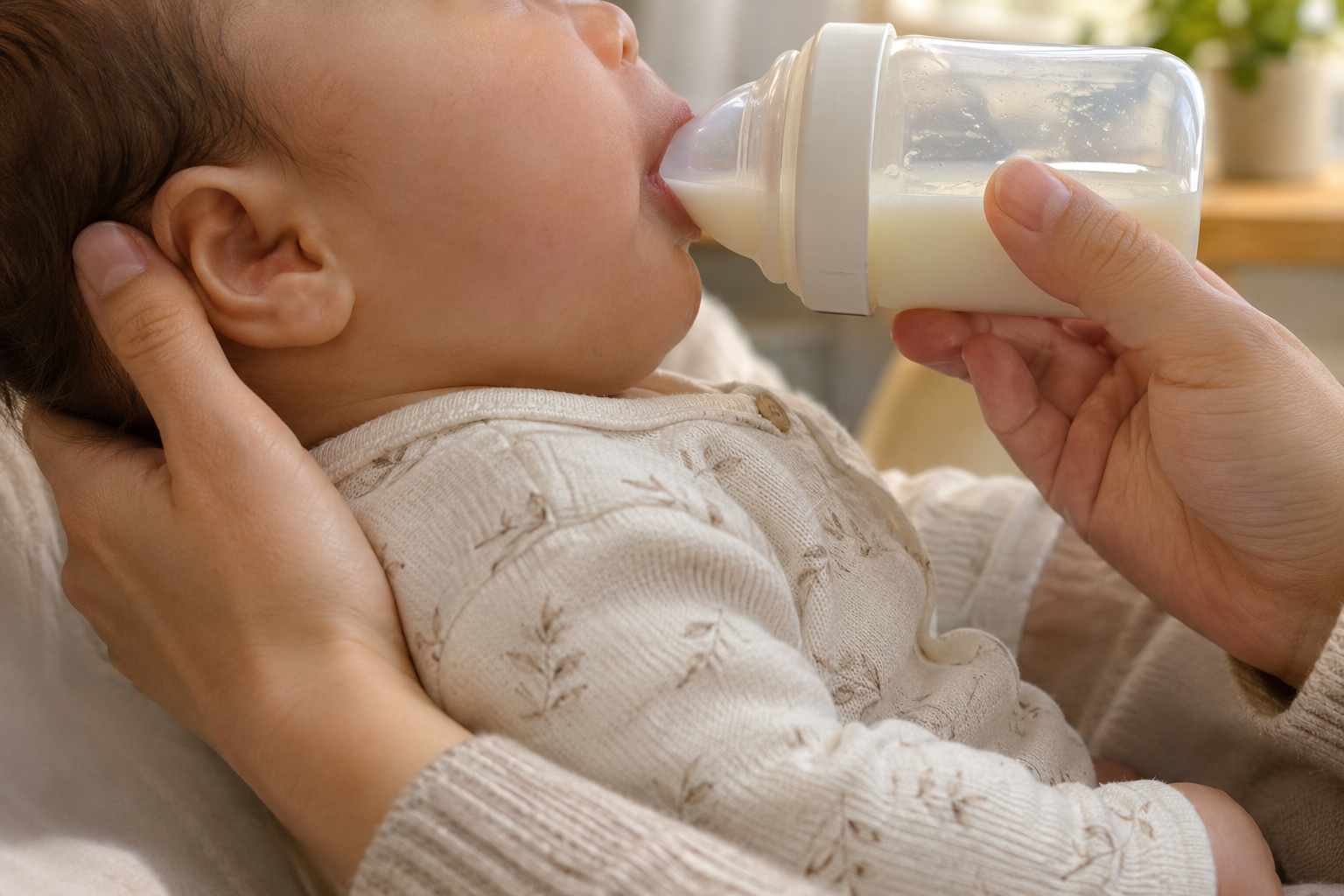
Product labels often frame a bottle as a way to prevent nipple confusion or colic. Treat those claims as prompts to inspect the design, not as performance guarantees. A baby may resist a bottle because of its flow, nipple feel, feeding position, caregiver, timing or an underlying feeding difficulty. The label cannot tell you which factor matters for your baby.
Use these practical filters instead:
- Controllable flow: Start with a flow that lets your baby suck, swallow and breathe without gulping. The correct flow is not automatically the one assigned to your baby’s age. Treat the age label as a starting point and watch the feed.
- A comfortable seal: Your baby should be able to take the nipple into their mouth and maintain contact around it without repeatedly slipping off. A wide base or breast-like appearance is not useful if the nipple’s length, firmness or shape prevents a comfortable latch.
- Manageable venting: A vent may help air move through the bottle rather than through the nipple. It also has to be assembled and cleaned correctly. If a design has several small parts, decide whether every caregiver can reliably put them together.
- A workable routine: Check whether measurement markings are easy to read, the bottle is comfortable to hold, replacement nipples are available and the parts fit the way you plan to prepare and store milk.
Buy a single bottle or the smallest available pack before committing to a full set. If your baby accepts it, you can add more. If not, you have learned something without paying for a collection of unused equipment.
Test the bottle without turning it into a battle

There is no magic introduction day that suits every breastfed baby. Your timing depends on why you need the bottle, how breastfeeding is going and whether another caregiver will soon take over some feeds. If a separation is coming, practise before the handoff so you have room to adjust.
Choose a time when your baby is alert and showing hunger cues but has not become frantic. A very upset baby is being asked to manage hunger and learn an unfamiliar feeding method at the same time.
- Hold your baby in a supported, semi-upright position with their head and neck aligned.
- Touch the bottle nipple to the upper lip and wait for your baby to open their mouth. Let them draw it in instead of pushing it past closed lips.
- Keep the bottle more horizontal than vertical while keeping milk in the nipple. This reduces the help gravity gives the flow and leaves more control with your baby.
- Watch the pattern of sucking, swallowing and breathing. Lower the bottle or pause when your baby stops sucking, splays their fingers, turns away, looks tense or needs a breath.
- Resume if your baby remains interested and settled. End the feed when they repeatedly turn away, relax their hands and mouth, or stop seeking the nipple.
Never force your baby to finish a bottle. Pressuring them to continue can turn a manageable equipment problem into distress around feeding.
If your baby refuses a bottle from you, try having another familiar caregiver offer it while you are out of immediate view. Treat this as an experiment, not a rule. Change only one variable at a time — such as the caregiver, nipple flow, feeding position or milk temperature — so you can tell what helped.
Read the feeding, not the packaging

Your baby’s behaviour is more useful than a claim printed on the box. The signs below are not diagnoses. They are clues about what to check before buying another bottle.
| What you notice | What to check | What to try |
|---|---|---|
| Coughing, gulping, milk leaking from the mouth or frantic swallowing | The flow may be faster than your baby can comfortably manage. | Stop if your baby is distressed. Try a slower-flow nipple, hold the bottle more horizontally and add pauses. |
| Strong sucking with little swallowing, a nipple that collapses or growing frustration | The vent may be blocked or incorrectly assembled, or the flow may be too slow. | Check the parts and nipple opening against the manufacturer’s instructions. If everything is clear, cautiously test the next available flow while watching for signs that it is too fast. |
| Clicking, repeated slipping or milk leaking at the lips | Your baby may not have a stable seal with that nipple shape or position. | Reset the latch and adjust the angle. If the problem continues, try a different nipple shape rather than repeatedly coaxing the same one. |
| A few sucks followed by turning away | Your baby may need a pause, may not be hungry or may be objecting to something about the feed. | Pause and offer again only if your baby continues showing hunger cues. Otherwise, end the attempt and retry later. |
| Fussiness or apparent discomfort after feeds | Look at flow, pacing, vent assembly and how often the seal breaks during feeding. | Correct the assembly, slow the feed and allow comfortable pauses. Persistent or severe discomfort needs professional assessment rather than another marketing claim. |
Do not cut, stretch or enlarge a nipple opening to change its flow. A homemade opening can release milk unpredictably. Use an intact nipple made for the bottle, and inspect it regularly for cracks, tears, stickiness or other deterioration.
Key takeaways
- The best bottle is one your baby can latch onto and drink from comfortably; it does not have to look most like a breast.
- Choose nipple flow by your baby’s sucking, swallowing and breathing, not by the age printed on the package alone.
- Test a single bottle before buying a large set.
- Offer the bottle when your baby is calm, keep the flow controlled and follow their signals to pause or stop.
- Change one variable at a time so you can identify whether the issue is flow, shape, position, caregiver or timing.
- Repeated coughing, choking, pain or poor feeding is a reason to seek clinical help, not to keep cycling through products.
Know when the bottle is not the real problem

Bottle refusal becomes a health concern when it affects hydration, growth, breathing or feeding comfort. Contact your baby’s health-care provider promptly if feeds regularly involve coughing or choking, obvious pain, repeated vomiting, unusual difficulty staying awake, poor intake, noticeably fewer wet diapers or concern about weight gain.
Breathing difficulty or blue or grey colouring around the lips requires urgent emergency help. Stop the feed and contact emergency services rather than testing another nipple or position.
If your baby is otherwise well but repeatedly cannot latch onto or transfer milk from a bottle, a qualified lactation consultant or feeding specialist can observe an entire feed. That direct observation can distinguish an equipment mismatch from a problem with coordination or swallowing. A bottle cannot diagnose or treat those difficulties.
Adding bottles and protecting milk supply are also separate jobs. If you want to continue breastfeeding while another caregiver gives expressed milk, ask a qualified lactation professional for a milk-removal plan suited to your schedule and your baby’s feeding pattern. Bottle shape alone cannot maintain supply.
For every feed, hold your baby and the bottle yourself; never prop the bottle or leave a baby feeding unattended. Clean and assemble every part according to its manufacturer’s directions. These routines matter more than whether the packaging uses words such as natural, breast-like or anti-colic.
Pick the smallest practical purchase and run a calm trial. Write down what you observed, then change one variable if needed. If your baby stays comfortable and can control the feed, you have found a workable bottle — it does not need to win a ranking.
References



