
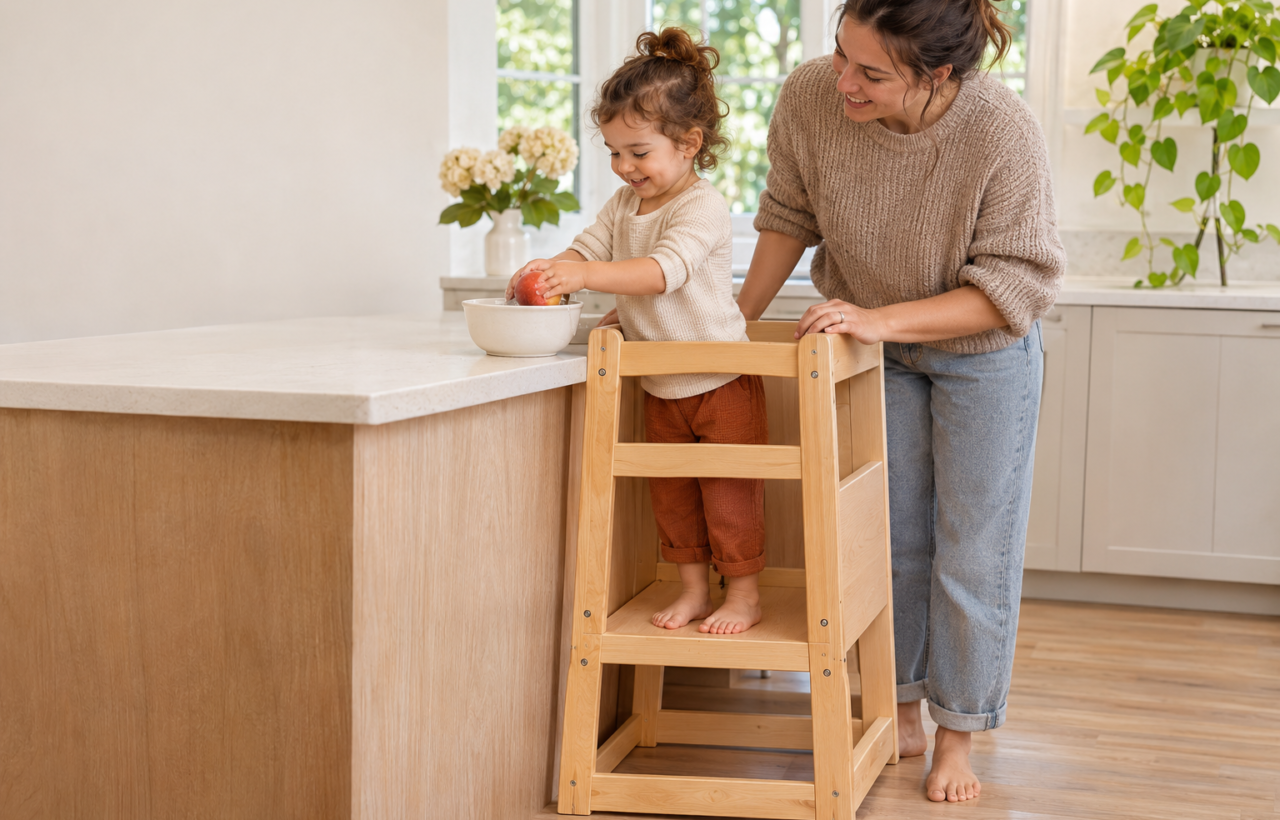
Your toddler wants to see what you are doing, your hands are full, and a dining chair suddenly looks like a tempting shortcut. A learning tower can give your child a more contained place at counter height, but it is still climbing equipment in a room with heat, water, sharp tools and breakables.
The right tower is not simply the one that fits your decor or folds smallest. It has to suit your child’s current abilities, fit your kitchen without obstructing traffic, and remain stable during real toddler movement. Here is how to make that decision and use the tower without mistaking access for safety.
Decide whether your toddler is ready before you shop
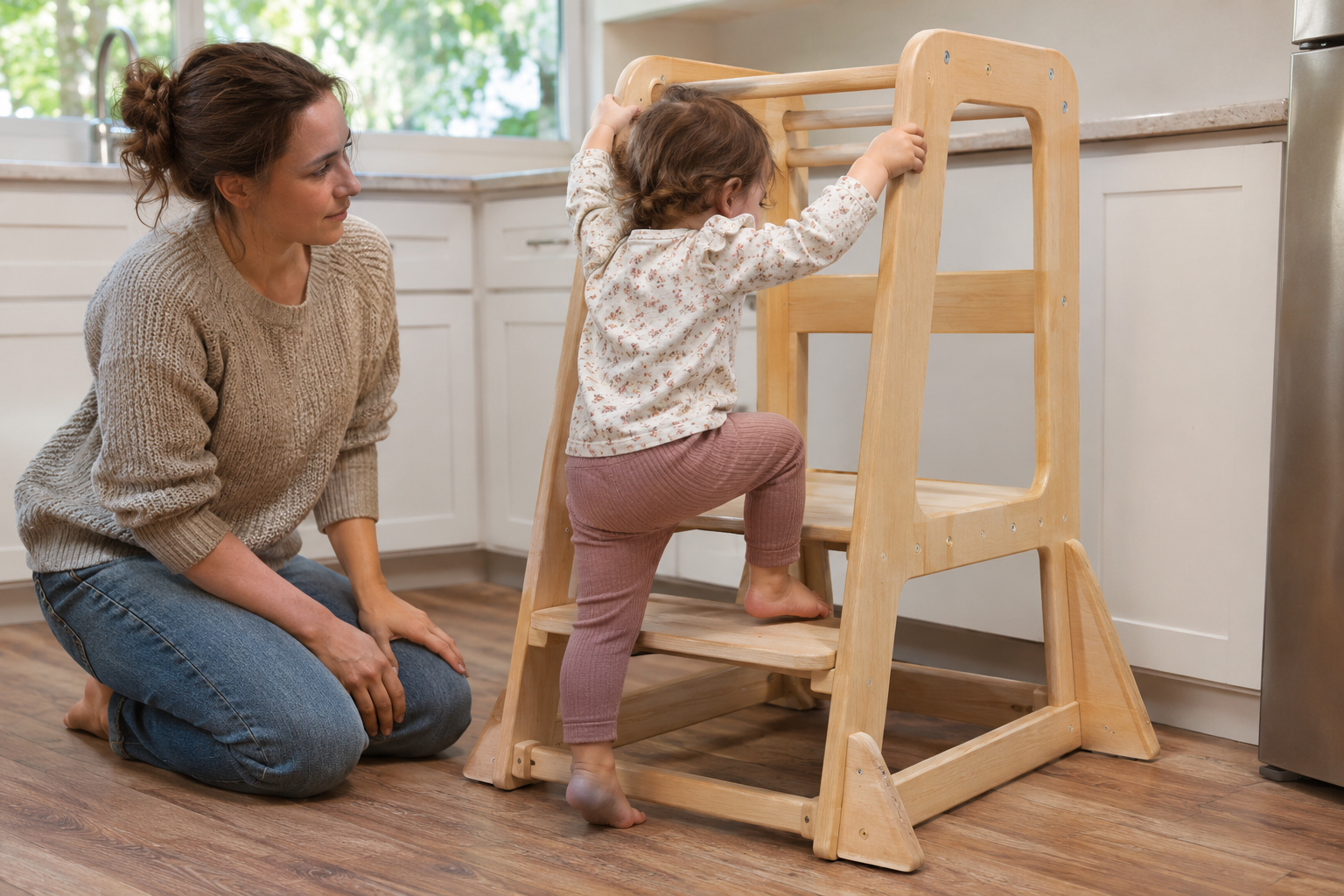
A learning tower is an elevated, enclosed structure that brings a child to counter height. Its rails provide more containment than an ordinary step stool, but they do not prevent every fall or unsafe reach.
There is no universal birthday at which every toddler becomes ready. Manufacturers use different age, height and weight limits, so the instructions for the exact model are your first gate. An age label is not proof of readiness, either. Your child also needs enough balance and coordination to stand on the platform and practise entering and leaving with your help.
Before buying, watch how your toddler handles a low step while you are beside them. Can they place a foot deliberately, hold on, stand without constant support and respond when you ask them to stop or wait? If climbing still looks more like lunging, or your toddler routinely leans over rails and tries to climb surfaces from the side, postpone the tower. Waiting is safer than expecting the enclosure to control behaviour your child cannot yet control.
Readiness also depends on your availability. A tower is not a place to park a toddler while you leave the room. Safe use requires an adult within arm’s reach, which means close enough to intervene immediately rather than merely able to see the child from across the kitchen.
Choose for stability, fit and access – in that order
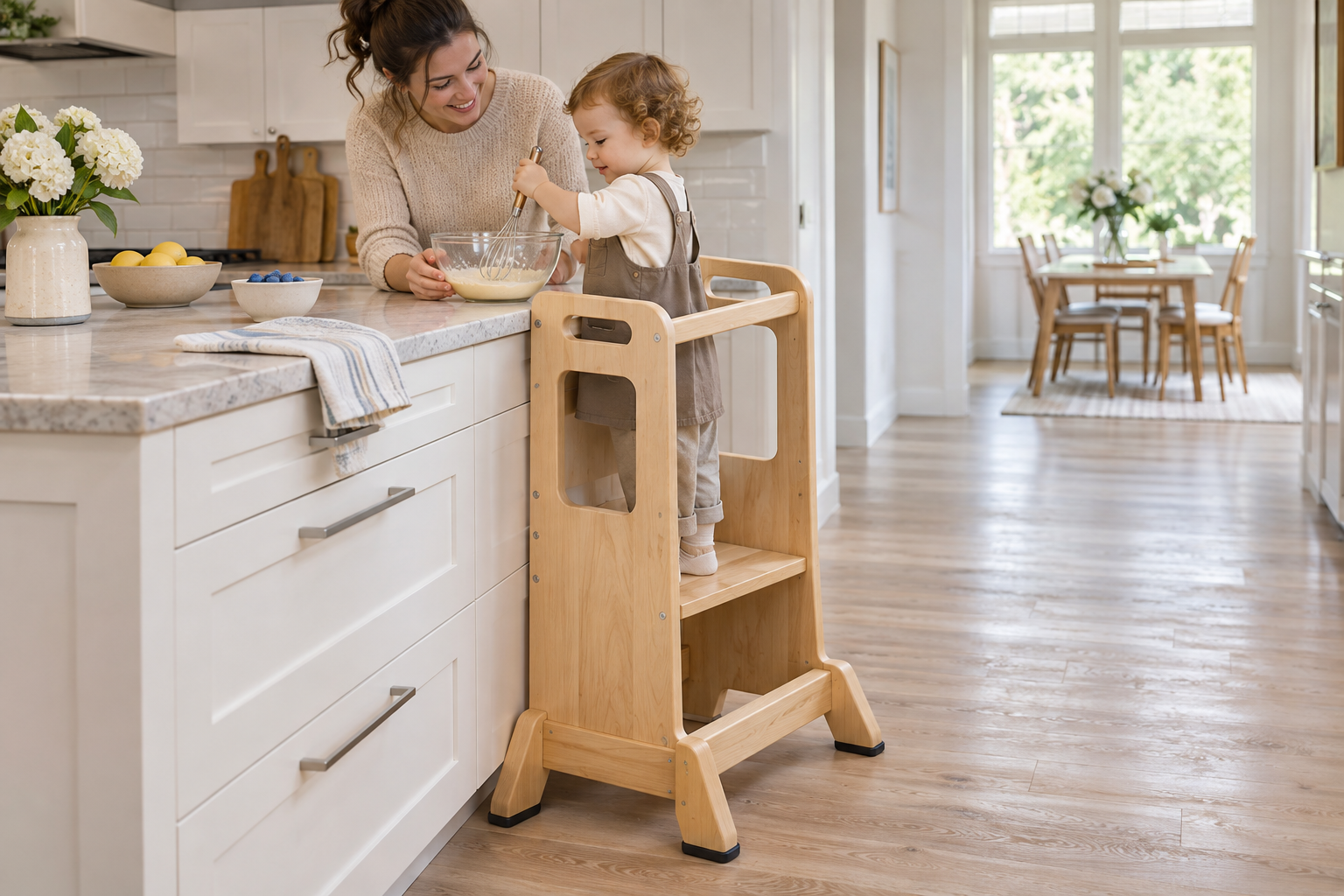
The main hazards are not mysterious: a tower can tip when a child leans beyond its base, a child can become trapped in an unsuitable opening, hardware can loosen, and socked feet can slip. Folding parts can also create pinch points. Evaluate those failure modes before considering colour, wood type or convertible features.
- Look for a wide base and low centre of gravity. Stabilizing feet or arms can add useful width at floor level. The tower should not rock on a flat surface when you press gently on its sides.
- Check the guardrail against your child, not just the product photo. When your child stands on the platform, the rails should reach at least as high as their navel. An adjustable platform can help maintain that relationship as your child grows.
- Inspect every opening. Avoid spaces where a head, neck or body could become trapped. Look at the entry, side panels and gap between the platform and rails from a toddler’s perspective.
- Study the route in and out. A broad, non-slip step is easier to negotiate than a narrow ledge. Your child should not have to squeeze through the entrance, duck under a loose bar or pull on the guardrail to climb.
- Treat folding as a feature with a trade-off. A folding tower may solve a storage problem, but its hinges and locks must not expose fingers to pinching or cutting. Confirm that it cannot fold while in use.
- Check how adjustments are secured. A platform is only useful if it seats firmly at every approved height. If changing the height requires partial disassembly, decide whether you are willing to do that correctly instead of leaving the platform in a poor position.
- Respect the exact limits. Follow the manufacturer’s age, height and weight instructions. Do not assume that sturdy-looking timber or a high weight rating makes a tower suitable for a younger child.
Then check the fit in your home. Measure the full base, including feet and stabilizers, and mark that footprint on the floor with removable tape. Stand where you normally prepare food and walk your usual route between the counter, sink and refrigerator. A stable base that sits in the household’s main traffic lane creates a different problem.
Storage deserves the same realism. A fixed tower may work well if it has a permanent, safe position. A folding model is more practical only if you have somewhere to put it and will actually store it. Secondary functions, such as converting into a table, are worthwhile only after the tower passes the stability, access and fit checks.
Set up the tower as carefully as you would other climbing equipment
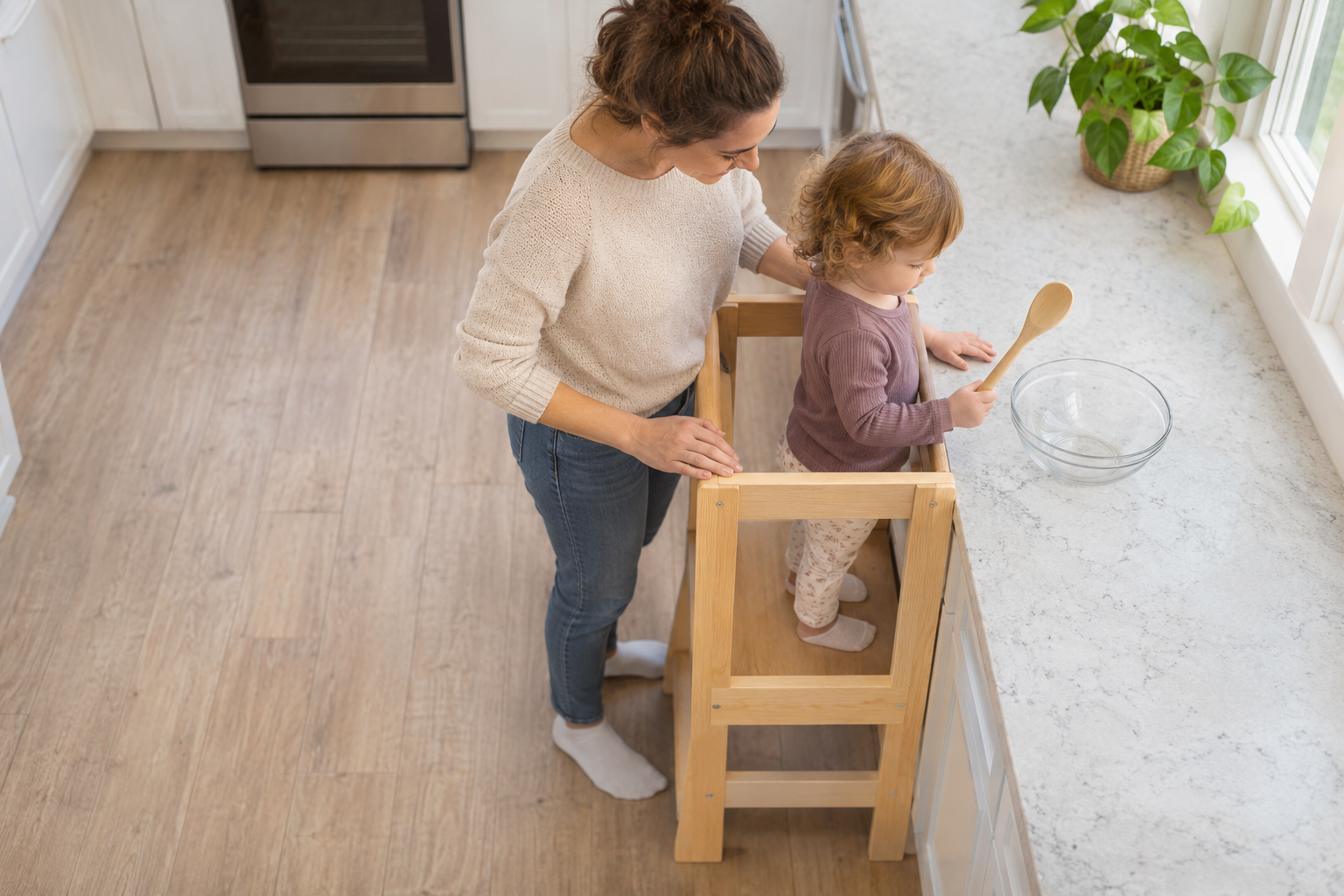
Assembly is part of the safety system. Use every required fastener, rail, dowel and locking component. Do not remove a bar to make entry easier or improvise a different platform position; altering the structure can reduce its stability. Once assembled, follow this sequence:
- Choose a flat, non-slip floor. Place the tower beside the approved counter, table or wall position described in its instructions. Do not use it on a rug edge, uneven tile or a wet floor.
- Set the platform height. Your child should be able to work without standing on tiptoe or climbing the rails, while the guardrails remain at or above navel height.
- Clear the new reach zone. The tower changes what your child can touch. Move knives, glassware, hot drinks, matches, medications, cleaning products, appliance cords and small choking hazards out of reach. Keep the tower away from the stove and any place where a child could reach a burner, hot pan or pan handle.
- Check the climb. Help your toddler enter and leave slowly. Teach them to use the intended step and opening, never the sides. Remove ordinary socks before climbing because they can slide on the platform; follow the manufacturer’s directions on suitable footwear.
- Make storage part of the setup. Decide where the tower will go after each use. If it folds, operate the mechanism yourself while your toddler is away from the hinges.
Stay within arm’s reach throughout this practice. A successful climb once does not mean your toddler will use the same sequence when excited, tired or holding an object.
Start with simple jobs and keep the dangerous work separate

The most useful first activity is usually a short, low-risk job at a cleared counter. Give your toddler one defined task while you remain beside them: move cut fruit into a bowl, rinse produce in a basin, tear lettuce, stir cool ingredients, wipe the counter or place napkins on a tray. The goal is participation, not speed.
Expect the task to take longer and create more mess. Independence at this age often means repeated scooping, pouring and wiping. Starting during an unhurried part of the day makes it easier to supervise properly and let your toddler finish rather than stepping away or rushing the climb down.
A tower can also support handwashing, crafts, puzzles, modelling dough and supervised water play. Keep materials within the work area so your child does not lean over a rail to retrieve them. Wipe up water promptly, including any spill on the platform or floor.
Keep hot cooking and sharp preparation in a separate zone. A child-safe utensil does not make the surrounding kitchen safe, and a guardrail does not limit how far curious arms can reach. If you need to turn to the stove, carry a hot pot, answer the door or leave the room, help your toddler climb down first.
Do not move the tower while your child is standing in it, and do not add a second child unless the manufacturer’s instructions explicitly permit that use. More weight, jostling and competing movement can change the tower’s stability.
Use a quick check before every climb
- Press gently on the tower to notice new wobbling.
- Check that screws, rails, safety bars and platform supports are tight and fully seated.
- Confirm that non-slip feet or pads are attached and clean.
- Look for cracks, splinters, bending or other structural wear.
- Make sure the platform and surrounding floor are dry.
- Scan the entire area your child can now reach, not only the object directly in front of them.
Stop using the tower if a structural part is loose, damaged or missing. Tighten or repair it only as the manufacturer directs. Routine hardware and wear checks matter because regular climbing, shifting and cleaning can change how the structure behaves over time.
When the activity ends, help your toddler climb down and put the tower away or block access to it. Leaving it beside an inviting counter turns supervised equipment into an unsupervised climbing opportunity.
Key takeaways
- A learning tower offers a contained counter-height platform, not passive supervision or guaranteed fall prevention.
- Use only a model whose stated age, height and weight limits fit your child, then judge whether your toddler has the balance and coordination to climb with help.
- Prioritize a wide base, low centre of gravity, secure platform, rails at least as high as the child’s navel, safe openings and a manageable entry step.
- Place the tower on a flat, dry, non-slip floor; clear the expanded reach zone; remove slippery socks; and remain within arm’s reach.
- Begin with one cool, simple task, inspect the tower regularly and store it where your toddler cannot climb it alone.
If you are shopping, tape the proposed footprint onto your kitchen floor before placing an order. If you already own a tower, remove it from service long enough to check the platform, rails, fasteners, feet and everything your child can reach. That small reset will tell you more than a long list of decorative features.
References



