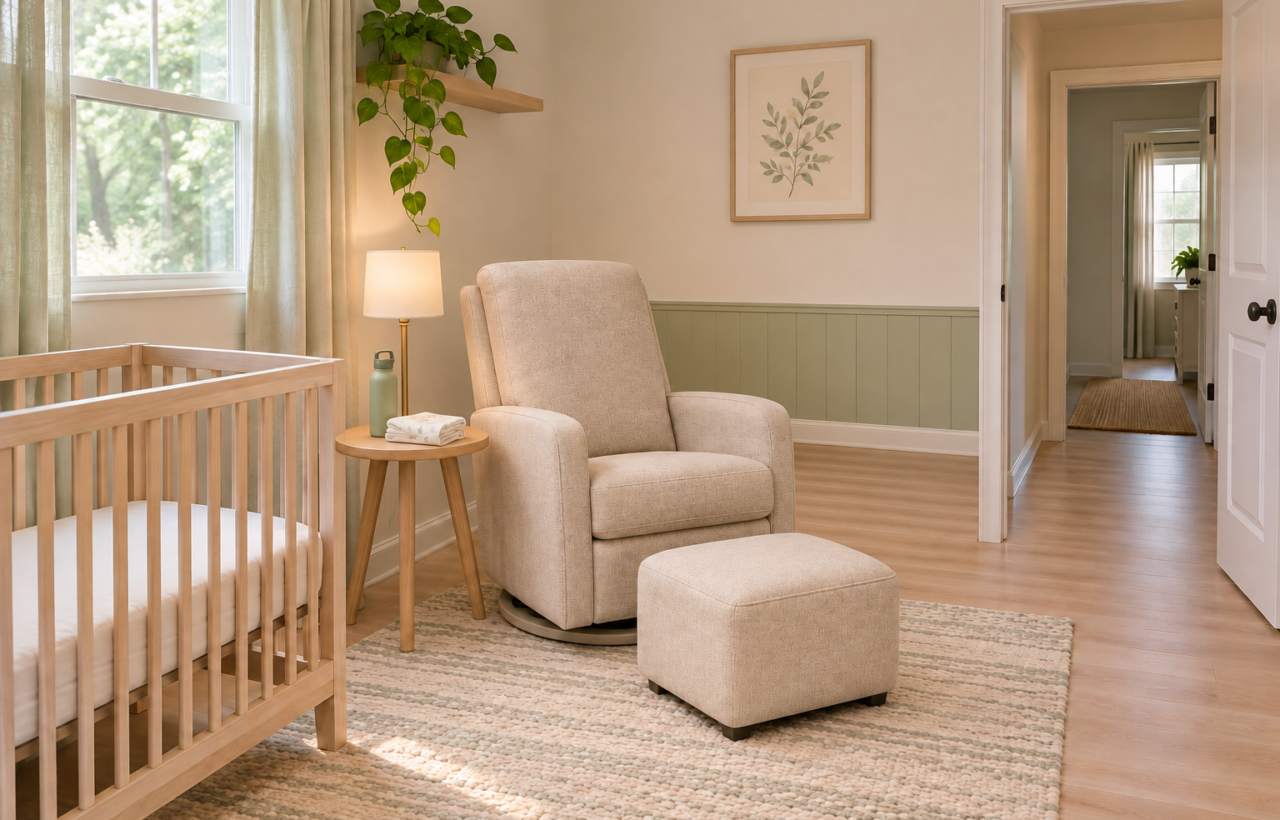
The wrong nursery chair can make a small room feel smaller and a long feeding session feel longer. A chair may look perfect beside the crib yet be uncomfortable for your body, awkward to stand up from, or impossible to recline without blocking the door.
Choose in this order: fit the room, fit the people using it, check how it cleans, and then consider the extras. That sequence will help you find a glider or rocking chair that works at 2 a.m. as well as it did in the showroom.
Key takeaways
- A glider moves on a fixed track, a rocker moves on curved runners, and a swivel chair turns to the side. Choose the motion that helps you reach what you need without making the room harder to use.
- Measure the chair’s full operating space, including its reclined depth, footrest, ottoman, swivel path, power cord, and the route through your home.
- Seat width alone does not determine comfort. Arm height, back support, seat depth, and how easily you can stand matter during feeding and soothing.
- Power recline is convenient, but it costs more, requires an outlet, and may make enough motor noise to disturb a light sleeper.
- A nursery chair is optional. If a model does not fit your body, room, or budget, powered controls and stylish fabric will not make it a sensible purchase.
Measure the chair in motion, not just at rest
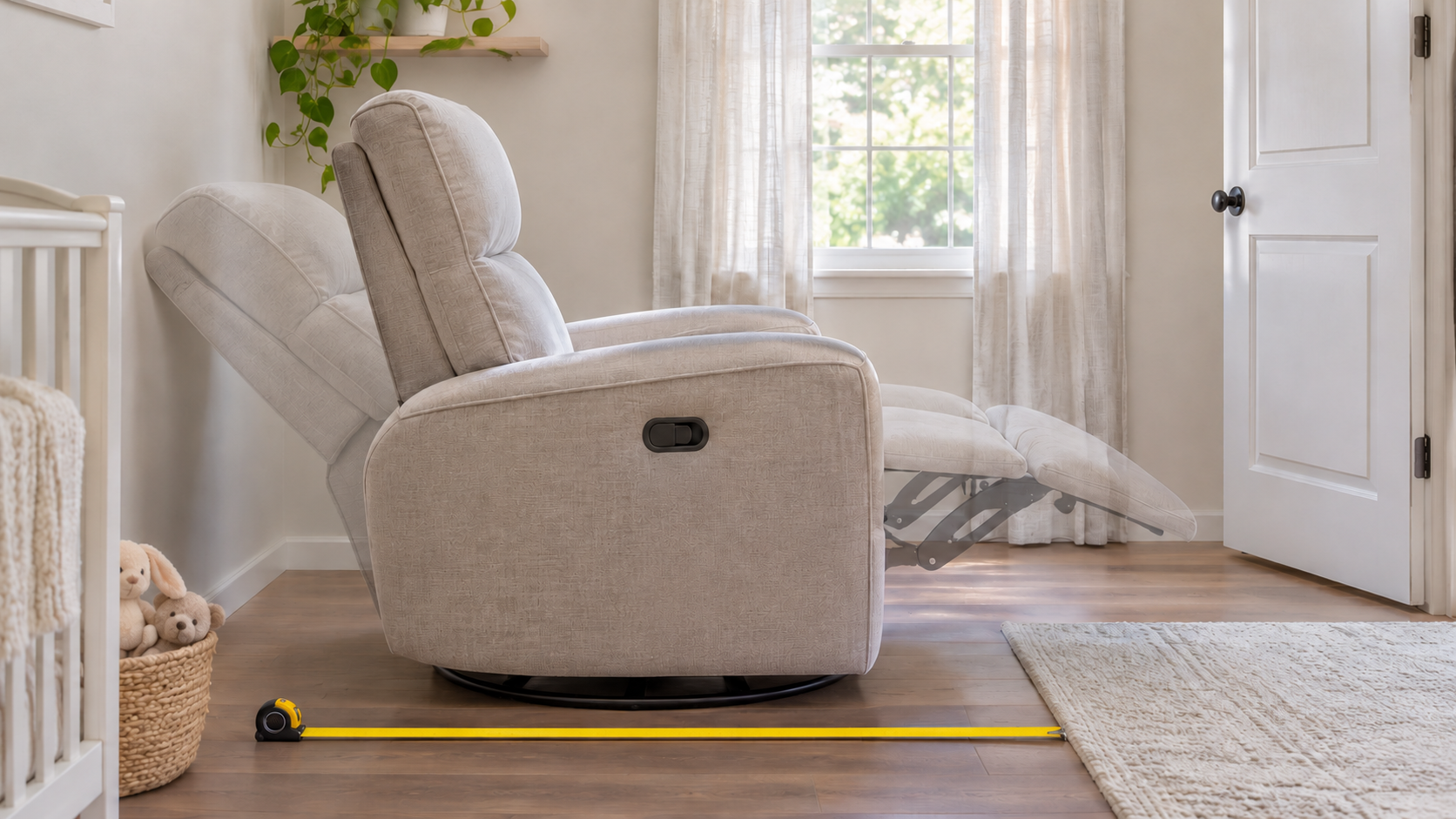
Furniture listings usually lead with overall width, depth, and height. Those figures are only the starting point. A recliner grows deeper when opened, an ottoman occupies its own patch of floor, and a swivel chair needs room to turn without striking a wall or table.
- Measure every doorway, hallway turn, stair landing, and elevator the chair must pass through. Check whether the chair arrives assembled and whether its back or base can be separated for delivery.
- Mark the chair’s resting footprint on the nursery floor with painter’s tape. Add the fully reclined footprint or the space required for an ottoman.
- Walk the normal routes around the taped area. Test the path to the crib, change station, closet, and door while imagining that you are carrying a baby.
- If the chair swivels, mark its turning area too. Make sure the arms and back will not hit nearby furniture.
- For a power chair, locate the outlet and plan the cord route. The cord should not cross a walking path or sit where a crawling baby can reach it.
- Check the manufacturer’s weight capacity for each adult who expects to use the chair. Do not assume that every nursery chair suits every body.
Do not confuse a narrow exterior with a comfortable seat. Nursery chairs can differ substantially inside the arms: tested examples included a 19-inch-wide seat and a 30-inch-wide chair-and-a-half seat. A smaller seat may preserve floor space but feel restrictive during a feeding hold. A wide seat may leave room for toddler story time but overwhelm a compact nursery.
The right size is therefore not the smallest chair you can find. It is the smallest chair that supports the regular users, permits the feeding positions they expect to use, and still leaves a safe route through the room.
Use a realistic sit test before you buy
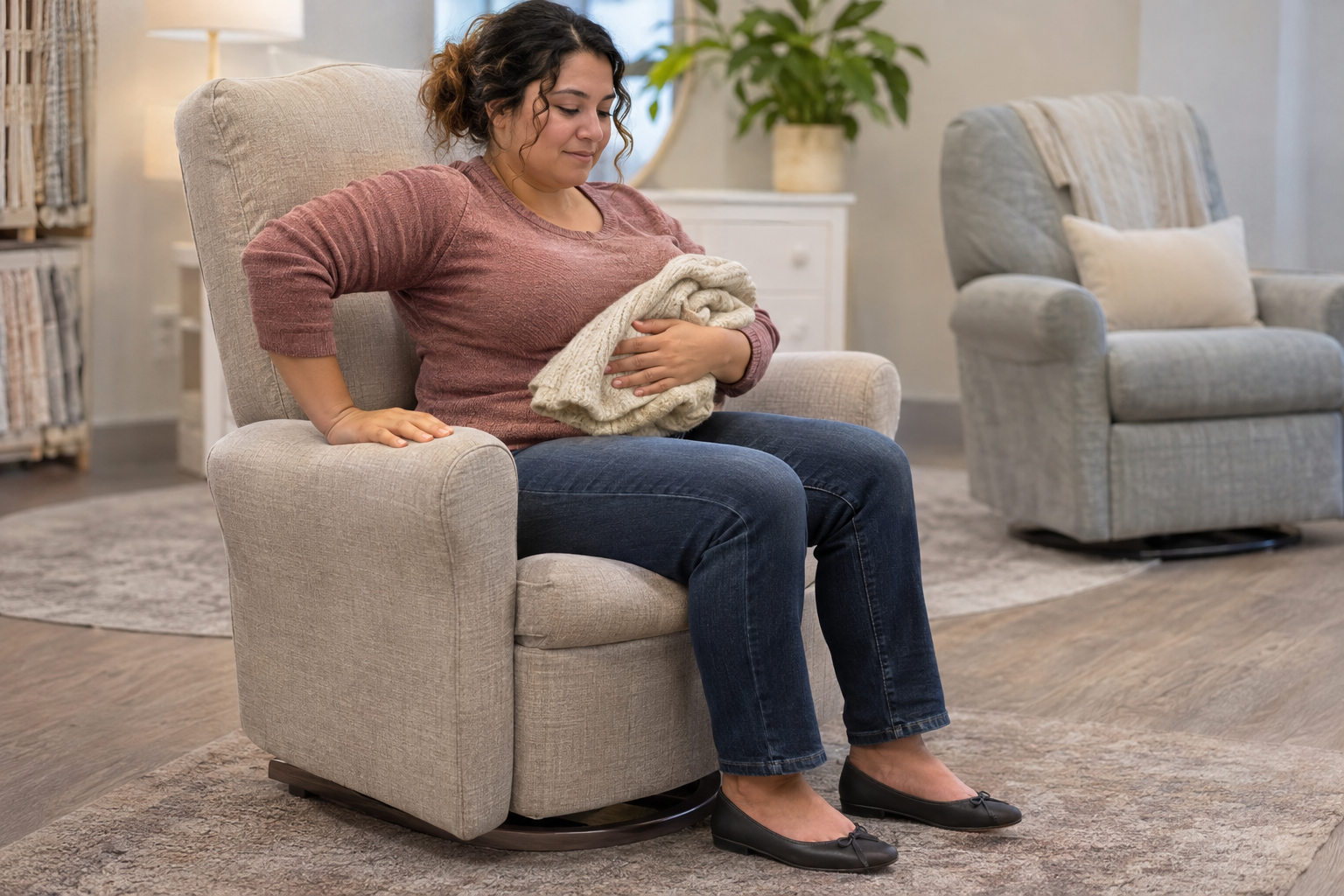
A quick showroom sit tells you whether the cushion feels pleasant. It does not tell you whether your shoulders will tense after a long feed or whether you can get up smoothly while keeping your upper body steady. Give the chair a more deliberate test, and have every regular caregiver try it.
- Sit all the way back rather than perching at the front. Notice whether the seat depth lets your back reach the backrest without uncomfortable pressure behind your knees.
- Check how your feet are supported. If they do not rest comfortably on the floor, confirm that the footrest or ottoman reaches you without making you slide forward.
- Use a folded blanket, feeding pillow, or similarly sized object to mimic the position of a baby. Try the positions you expect to use rather than holding your arms loosely in your lap.
- Rest your forearms on the chair arms. The arms should support you without pushing your shoulders upward or forcing your elbows too close together.
- Check the backrest at your lower back, shoulder blades, neck, and head. A plush-looking chair can still leave a gap where you need support.
- Operate the glide, swivel, and recline controls while seated. You should not need a hard twist, long reach, or sudden body movement to use them.
- Return the chair to its upright position and stand up empty-handed. The movement should feel controlled. Never use a baby as part of a furniture test.
- Listen to a power recliner as it opens and closes. Some motors are audible enough that parents have found the sound disruptive to a sleeping baby.
Arm shape deserves special attention. Narrow seating or high arms can interfere with football and cross-cradle feeding holds, while armrests at a useful height can reduce the effort required to support your arms. Neck support, back support, appropriate armrests, and a footrest or ottoman are more consequential than decorative piping or an on-trend silhouette.
If you can only shop online, compare the seat width, seat depth, arm height, back height, fully reclined dimensions, weight capacity, assembly requirements, and care instructions. Look for a return policy that gives you a realistic opportunity to assess the chair at home. Fabric swatches can help with colour and texture, but they cannot tell you whether the chair fits your body.
Choose features by the problem they solve
Gliding, rocking, and swivelling
A glider travels forward and backward on a fixed mechanism. A rocking chair tips on curved runners. A swivel function turns the seat, sometimes in addition to gliding or reclining. The practical difference is not which motion sounds most soothing; it is how that motion works in your room.
A swivel can help you turn toward a side table or reach a burp cloth without standing. A glider’s fixed path is predictable in a tight space. A traditional rocker may have a smaller-looking body, but its runners still move across the floor and can create contact points around feet, fingers, and pet paws. Try each mechanism slowly and look underneath before deciding.
Manual and power recline
A power recliner lets you change position and return upright with a button. That can make the transition out of the chair smoother when your arms are occupied. The trade-offs are a higher price, a nearby outlet, extra chair weight, and possible motor noise. Heavy power models may also be difficult to relocate after assembly.
A manual recliner avoids the outlet and motor, but it is not automatically easier to use. Test the lever or push-back mechanism yourself. If you have to jerk the chair, brace awkwardly, or use more force than feels manageable, it is the wrong mechanism for you.
Recline is not essential. An ottoman can provide leg support without adding a powered mechanism, and a supportive non-reclining chair may be the better fit for a limited room or budget. Nursery experts consistently describe a glider or rocker as a preference rather than a requirement.
Fabric, cleaning, and convenience
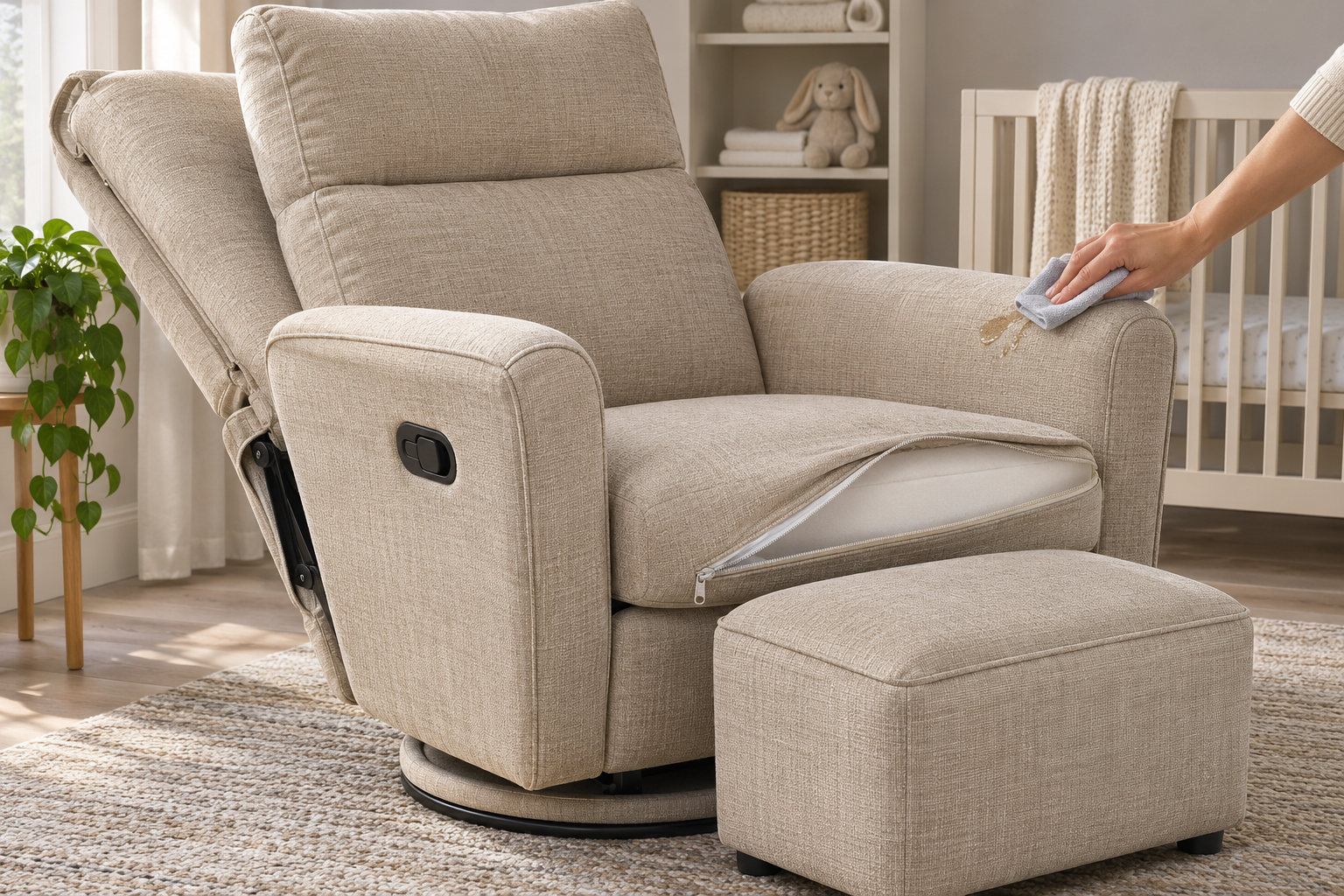
Assume the upholstery will encounter milk, spit-up, damp cloths, and later, toddler snacks. Before buying, read the exact care label. “Spot clean” and “machine-washable slipcover” are very different commitments. Water-resistant or stain-resistant fabric can make the first response easier, but it does not replace the manufacturer’s cleaning instructions.
- Look for removable, machine-washable covers if easy laundering matters more to you than a tightly upholstered finish.
- Check whether crumbs can be vacuumed from the gap between the seat, back, and arms.
- Find out whether cushions can be removed and whether both sides can be used.
- Save the care instructions before the first spill. Test any approved cleaner on a hidden area before treating a visible mark.
- Avoid choosing a pale or highly textured fabric unless its cleaning method fits the amount of maintenance you are willing to do.
Pockets, charging ports, cup holders, adjustable lumbar support, and a matching ottoman can all be useful. Buy them only when they solve a problem in your planned setup. A charging port has little value if the chair cannot reach an outlet, and a large ottoman is not convenient if you have to step around it on every trip to the crib.
Think beyond the newborn phase as well. If you want the chair to become a reading spot during the toddler years or move into another room later, choose a shape and fabric that can serve those uses. Longevity can justify spending more; a list of features you will rarely use cannot.
Set it up for tired adults and curious toddlers
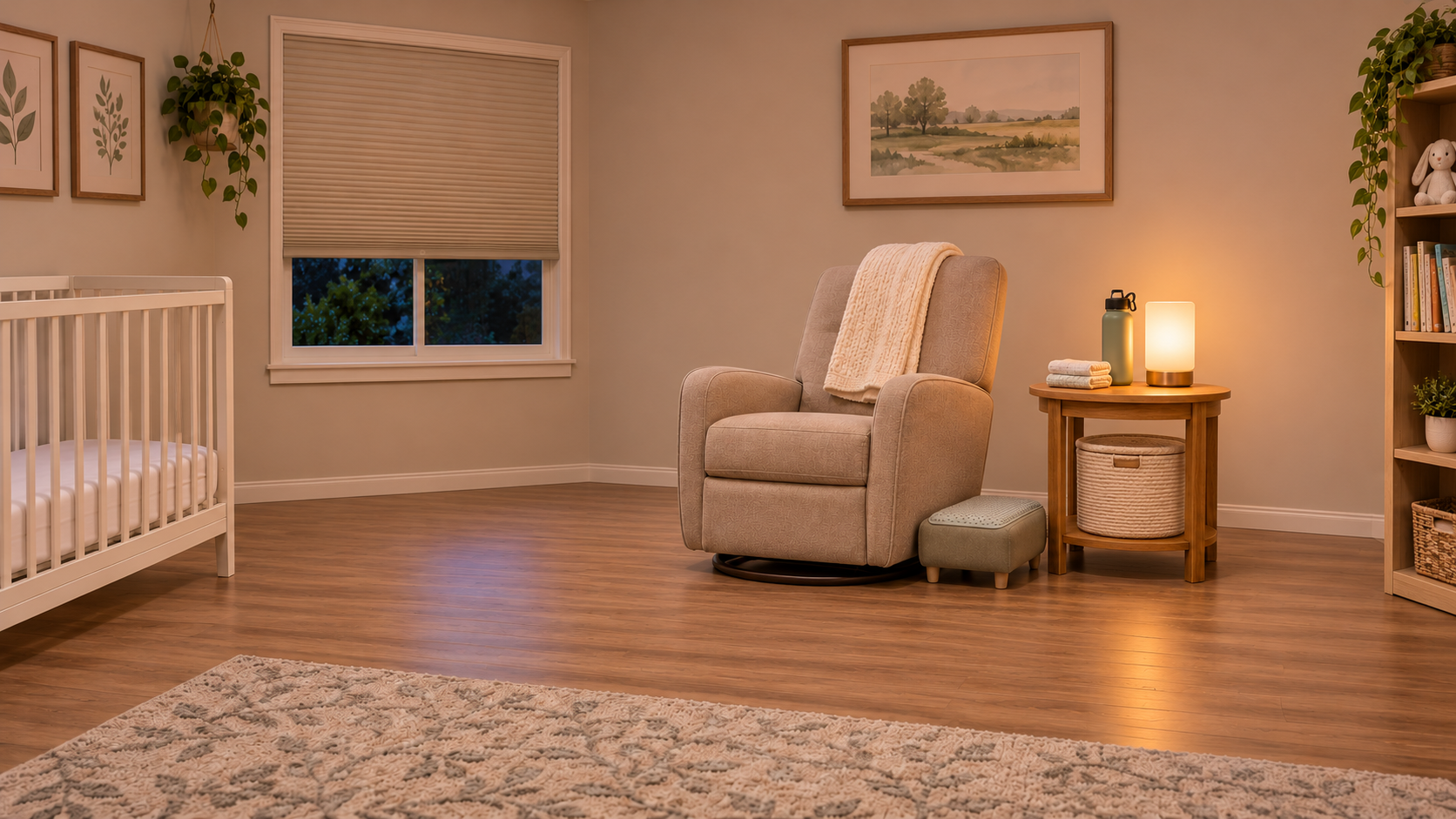
A comfortable chair can make feeding and soothing easier, but it is not an infant sleep space. Do not plan to sleep in it while holding or feeding your baby. If you notice yourself nodding off, stop and place your baby in their designated safe sleep space. The American Academy of Pediatrics recommends putting babies on their backs on a firm mattress.
- Lower a recliner’s footrest when it is not in use. Leaving it extended while the chair is upright may make the furniture unstable.
- Look under the footrest before closing it. A child, pet, toy, or blanket can enter the mechanism’s path without you noticing.
- Treat the footrest hinges, moving base, runners, and glide mechanism as pinch points. Keep hands and feet clear whenever the chair moves.
- Place the chair away from curtains, blind cords, heaters, and shelving that a child could reach or pull on.
- Route power cords behind furniture or through an appropriate cord-management solution so they do not become a trip or access hazard.
- Follow the assembly instructions and recheck accessible fasteners and moving parts as directed by the manufacturer.
- Once your baby becomes mobile, supervise the chair as moving furniture rather than treating it as another piece of nursery decor.
Set up the area before the first overnight feed. Put water for the caregiver, burp cloths, feeding supplies, and a phone or charger within easy reach, but keep the floor and chair mechanism clear. The goal is to avoid standing while holding the baby or twisting repeatedly toward something behind you.
Before you order, tape the full moving footprint onto the floor and complete the sit test with each regular caregiver. If the chair fails either test, keep looking. The right nursery chair should support the routine without creating a space, cleaning, or safety problem of its own.
References