When I was thinking about having kids, my algorithm seemed to know before anyone else did. Suddenly, my feed was packed with every pregnancy tip, warning, and hot take the internet could possibly serve me. Then my son was born, and just like that, I was buried in tummy time advice, sleep consultants, and baby schedules.
Now, apparently, my algorithm has decided I am “of a certain age,” because it keeps showing me videos about osteoporosis. More specifically, I keep seeing women marching in place while they cook dinner, stomping around the block, and adding little jumps to their walks, all with the goal of improving bone density. After seeing enough of these videos, I had to ask: does stomping actually help bone density?
Osteoporosis is not just something I associate with daytime TV medication commercials. According to the Bone Health & Osteoporosis Foundation, about 10 million Americans have osteoporosis, and another 44 million have low bone density. It happens when bone mineral density and overall bone mass decline, leaving bones weaker and more vulnerable to fractures. In some cases, a fracture can happen from something as ordinary as bending over, coughing, or lifting an object.
Women over 50 face a higher risk of osteoporosis. Nearly 1 in 5 women will be diagnosed, compared with about 1 in 20 men. The big prevention message is fairly straightforward: support healthy bone density through weight-bearing movement, strength training, and activities like walking, dancing, or lifting weights. But on social media, stomping seems to be having a moment.
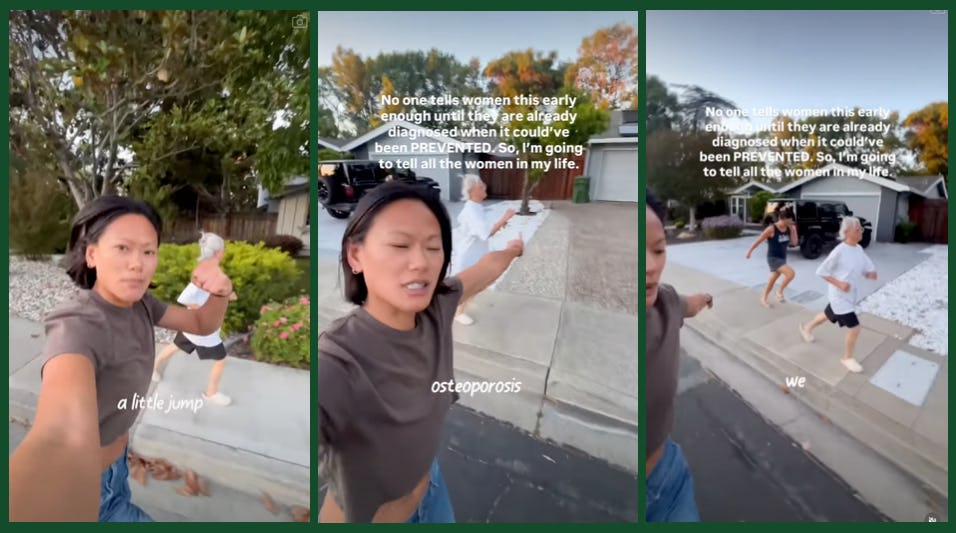
One of the videos that landed in my feed came from Dr. Laura Kuan, known as @drlaurakuan on Instagram. In the clip, she and her mom appear to be out for an evening walk, deliberately stomping through the neighborhood and adding the occasional small jump. The goal, according to the post, is to challenge the bones enough to help fight bone and muscle loss.
In her caption, Kuan explained that resistance training and bone-impacting exercises can help slow, and sometimes even stop, bone and muscle loss, especially when people start early. Her point was that bones and muscles need a strong enough physical signal to adapt. Once an exercise feels easy, the challenge has to increase gradually if the goal is to keep building strength.
Kuan also shared that her 72-year-old mother has osteoporosis and recently learned that her medication had not worked as hoped, leaving her at high risk for fractures. That personal context is what made the video feel less like a random trend and more like a serious attempt to take bone health into her own hands.
So why would stomping help at all? The basic idea makes sense. Activities that place stress on bones, including walking and weight lifting, can stimulate calcium deposits and signal the body to build stronger bone in response to that stress. In theory, more impact means a stronger signal.
There is also some research behind impact-based movement. A few studies have found that jumping may increase bone density in premenopausal women. Still, after talking to experts, I would not treat that as permission to start forcefully stomping or jumping without knowing what my bones and joints can handle.
Dr. Alexandra Reese, a rheumatologist at Cleveland Clinic, told me that walking, jogging, and dancing are generally considered safe weight-bearing exercises, but she would be cautious about jumping straight into stomping. Her concern is that people often do not know they have osteoporosis until they fracture something.
That is what makes this trend tricky for me. The videos may be well-intentioned, and they are pointing people toward weight-bearing movement, which matters. But if someone already has osteoporosis, forceful stomping on concrete could put extra strain on the joints and bones instead of protecting them.
Reese explained that common osteoporosis-related fractures include the wrist, hip, spine, and ankle. Often, those fractures are how people discover they have osteoporosis in the first place. So if the whole goal is to prevent breaks, I would not assume that stomping hard around the neighborhood is automatically a safe first step.
The CDC recommends that women get a DEXA scan to evaluate bone density at age 65, or between ages 50 and 64 if they have certain risk factors, such as a family member who has broken a hip. But experts made it clear to me that prevention should start much earlier than that. Ideally, strength training, resistance work, and bodyweight exercises become part of the routine in your 20s, 30s, and 40s, long before menopause accelerates bone loss.
Colleen Scordato, PT, DPT, of Orlando Health Outpatient Rehabilitation, told me that peak bone density usually happens around age 30. That means I should be thinking about weight-bearing strengthening work in my 30s, 40s, and 50s, including exercising with weights two to three times per week.
Balance work matters too. Both Scordato and Reese emphasized that preventing falls is a major part of preventing fractures. Scordato suggested exercises like tandem stance, where one foot is placed in front of the other, single-leg standing, single-leg standing with eyes closed, and yoga poses such as warrior pose. She also pointed out that free weights can be useful because they naturally bring balance into strength training.
For me, the takeaway is not that stomping is completely useless or that every impact exercise is dangerous. It is that bone health is more personal than an Instagram trend can make it seem. Jogging, lifting, pilates, pickleball, dancing around the house, or structured resistance training may all have a place, depending on your body and your risk level.
Before I start any high-impact routine, especially if I know or suspect my bone density is low, I would talk to a doctor first. Reese recommends checking with a primary care doctor or rheumatologist if osteoporosis is already part of the picture, so you can find out which exercises are actually safe for you.
Inspired by this post on Scary Mom.