
You can love Athena on a baby-name list and still hesitate when you imagine saying it at daycare pickup. That is the real decision with a mythology name: not just whether it sounds beautiful, but whether you want its story, pronunciation and cultural weight to travel with your child.
As The Odyssey returns to pop-culture attention, names from Greek myth may feel newly visible. Visibility is not a reason to choose one, though. The goal is a name you can explain in one honest sentence and use comfortably for an infant, a teenager and an adult.
Choose the story before you choose the sound
A mythological name rarely has one neat meaning. Athena is not simply a synonym for wisdom, for example; she is a goddess associated with wisdom, strategy and warfare. Cassandra is connected to prophecy, but her story is also about being condemned to tell the truth without being believed. The character matters at least as much as the dictionary-style definition.
Before a name reaches your shortlist, answer three questions:
- Who or what carries the name? A deity, Titan, hero, mortal, nymph, creature and place do not carry the same kind of story.
- Which part of that story appeals to you? Name the quality or image precisely. Wisdom, resilience, the moon, epic poetry and victory are clearer reasons than simply loving mythology.
- Can you accept the whole association? Many figures are admirable in one episode and troubling in another. Read beyond the flattering one-line description before committing.
Key takeaways
- Choose a mythological figure whose full story you are comfortable discussing, not just a name with an appealing sound.
- Decide how visible you want the connection to be: Iris and Jason are quieter references, while Apollo and Odysseus announce themselves.
- Test pronunciation, spelling, initials, nicknames and the complete name in every language your family regularly uses.
- Keep the explanation simple. If you cannot say why you chose the name in one sincere sentence, it may not be ready for the final list.
A practical shortlist, from quiet references to bold choices
The most usable choice depends on how much mythology you want other people to notice. Start with the group that matches your comfort level, then investigate the individual stories. These groupings describe how conspicuous the reference may feel in everyday use; they are not rules about who may use a name.
Names with a quieter mythological connection
- Iris: A rainbow goddess and divine messenger. The mythological connection is clear once explained, but the name also stands comfortably apart from it.
- Maia: One of the Pleiades and the mother of Hermes. It offers a gentle connection to myth without immediately sounding like the name of a major deity.
- Penelope: The wife of Odysseus and a central mortal figure in The Odyssey. Her intelligence, patience and resourcefulness give you more substance to consider than the name’s familiar sound alone.
- Daphne: A nymph transformed into a laurel while escaping Apollo. It sounds understated, but the pursuit and transformation at the centre of her story deserve a closer reading.
- Clio: The Muse of history. It is concise and has a focused association, although you may need to decide whether you prefer the pronunciations people use in different languages.
- Hector: A Trojan prince and warrior in The Iliad. It can function as a familiar given name even when listeners do not immediately recognize the classical reference.
- Jason: The leader of the Argonauts on the quest for the Golden Fleece. Its everyday familiarity makes the mythological connection easy to overlook unless you choose to emphasize it.
Names that make the mythology unmistakable
- Athena: The goddess associated with wisdom, strategy and warfare. It is recognizable, direct and strong, but it carries more complexity than the shorthand label goddess of wisdom suggests.
- Apollo: A major god associated with music, prophecy, healing and archery. The name has a bright, expansive sound and an equally large mythological presence.
- Atlas: The Titan condemned to support the sky or heavens. Modern images often show him holding the Earth, so decide whether the original myth or the familiar modern image is the association you care about.
- Orion: A hunter whose varied stories became connected with the constellation bearing his name. It works particularly well if both the mythological and celestial associations appeal to you.
- Perseus: The hero who kills Medusa and rescues Andromeda. It is overtly classical, and people may shorten it to Percy whether or not that is the nickname you planned.
- Ariadne: The princess who gives Theseus the means to escape the labyrinth. Her intelligence and decisive help are compelling, but later parts of her story differ across versions and should not be reduced to the thread alone.
- Rhea: A Titan and mother of several Olympian gods. The name is compact, but its pronunciation may not be obvious to everyone, so test it outside your immediate family.
- Selene: The goddess or personification of the moon. It gives you a more specifically Greek lunar reference than choosing a name merely because it sounds celestial.
- Calliope: The Muse associated with epic poetry. Its rich literary connection comes with a pronunciation that some people will need to learn.
Beautiful names with heavier story baggage
A difficult story does not automatically disqualify a name. It does mean that you should know what people may bring up and decide whether you are comfortable answering them.
- Cassandra: She receives true prophecy but is cursed so that others will not believe her. The name can evoke insight and truth, yet disbelief and powerlessness are inseparable from the myth.
- Artemis: The goddess of the hunt and wilderness. It is distinctive and forceful, with a much more obvious divine identity than a subtle classical reference.
- Ares: The god of war. Its brevity may be attractive, but the connection to violence and conflict is immediate and should not be treated as a minor footnote.
- Ajax: The name of prominent Greek warriors whose stories include courage, conflict and tragedy. It also has strong modern commercial associations in some places, so test what people around you notice first.
- Odysseus: The complicated hero of The Odyssey, known for cunning and a long, difficult return home. It is culturally rich but conspicuous, and it asks more of the child who will repeatedly spell and explain it.
- Andromeda: A princess whose story involves captivity and rescue, later represented among the constellations. The celestial image is striking, but it should not erase the darker part of the myth.
- Echo: A nymph deprived of independent speech and left able only to repeat the words of others. The modern word is appealing and familiar, while the original character’s loss of voice gives the name a sadder foundation.
Correct the Greek and Roman mix-ups before you commit
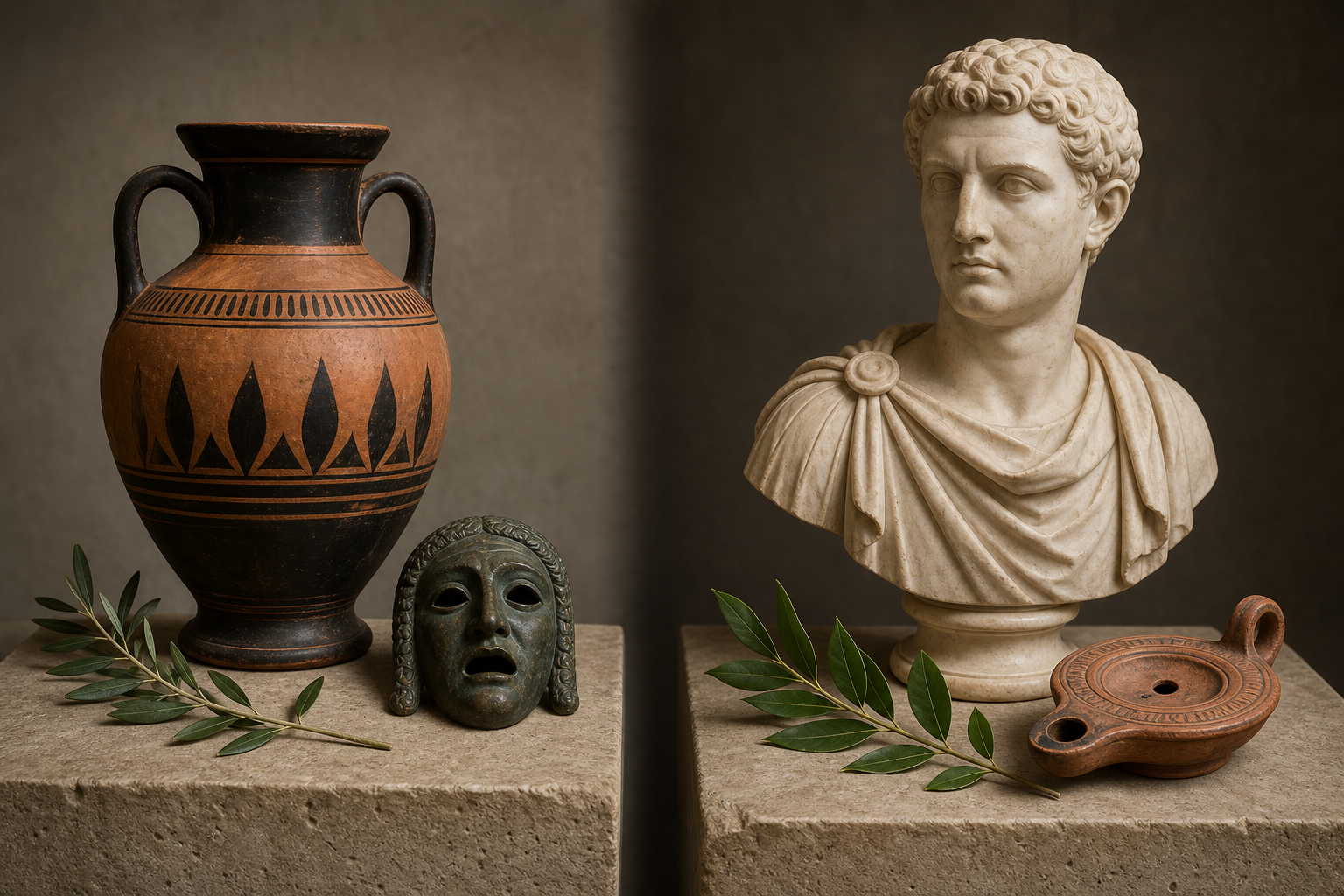
Baby-name lists often place Greek and Roman mythology in one classical bucket. The traditions overlap, but the names are not always interchangeable spellings. Roman retellings also reshaped some figures and stories. If a specifically Greek connection matters to you, check which form you are using.
- Heracles is the Greek name; Hercules is the Roman form. Hercules may be more familiar in English, but it is not the Greek form of the hero’s name.
- Odysseus is Greek; Ulysses is the Latin form. Your choice signals which literary and cultural tradition you mean to invoke.
- Athena and Minerva are Greek and Roman counterparts. They are associated with similar domains, but choosing Minerva is not choosing a Greek mythology name.
- Ares and Mars are counterparts, not alternate spellings. They belong to different traditions and are portrayed differently within them.
- Artemis and Diana follow the same distinction. If you are drawn to one particular story, confirm which figure appears in the version you read.
Transliteration adds another layer. Ancient Greek names can appear in more than one English form, while families may use a modern Greek pronunciation, an established English pronunciation or one shaped by another home language. None of that can be solved by looking at the letters alone. If heritage is part of the choice, ask a fluent speaker how the name is said and used rather than treating an English-language naming page as the final authority.
Run each finalist through an ordinary day

A name can look perfect on a list and become awkward when combined with your surname, repeated over the phone or used in a bilingual setting. Give every finalist the same practical test so that a dramatic name does not receive more generosity than a quieter one.
- Say the complete name at normal speed. Include every middle name and your actual surname. Listen for repeated sounds, accidental rhymes and initials you missed on the page.
- Use it in several stages of life. Imagine the name on a daycare cubby, a class list, a teenager’s introduction and an adult’s work email. The point is not to make the name conventional; it is to notice whether you only like it on a baby.
- Test the likely nicknames. Write down the obvious short forms, including ones you do not plan to use. You can express a preference, but you cannot fully control what friends or your child will choose later.
- Ask other people to read it without coaching. Show the written name to a few trusted people separately. Their first attempts will reveal recurring pronunciation or spelling issues more clearly than a group discussion will.
- Check every language that will shape your child’s week. If your family, childcare or community moves between English, French, Greek or another language, say the name in each one. Look for a version you can accept even when accents and sounds change.
- Check current associations. Search the exact name, common spelling variants and the name with your surname. A mythological figure may not be the association most people encounter first because businesses, products and fictional characters reuse classical names.
- Explain the choice in one sentence. Try a plain answer such as: We chose Iris because we loved its connection to the rainbow and the messenger goddess. If your explanation requires defending or disguising the story, pay attention to that discomfort.
If two parents are stuck, rank the candidates separately on four things: story, sound with the surname, ease of everyday use and cultural or family significance. Compare the scores only after both of you finish. That turns a vague disagreement about which name feels right into a clearer conversation about which criterion each person values.
Leave room for your child to make the name their own
A mythology name is a reference, not a prediction. A child named Athena does not have to be unusually wise, Atlas does not have to carry everyone else’s burdens, and Calliope does not owe anyone a literary personality. Avoid choosing a name as an assignment your child will be expected to fulfil.
The strongest final choice usually has two layers: a story that matters to you and enough flexibility for your child to define the name differently. Narrow your list to three, use each one through an ordinary day, then keep the name whose full story and daily reality both feel welcome. That is a sturdier basis for a decision than trend visibility or a flattering one-line meaning.