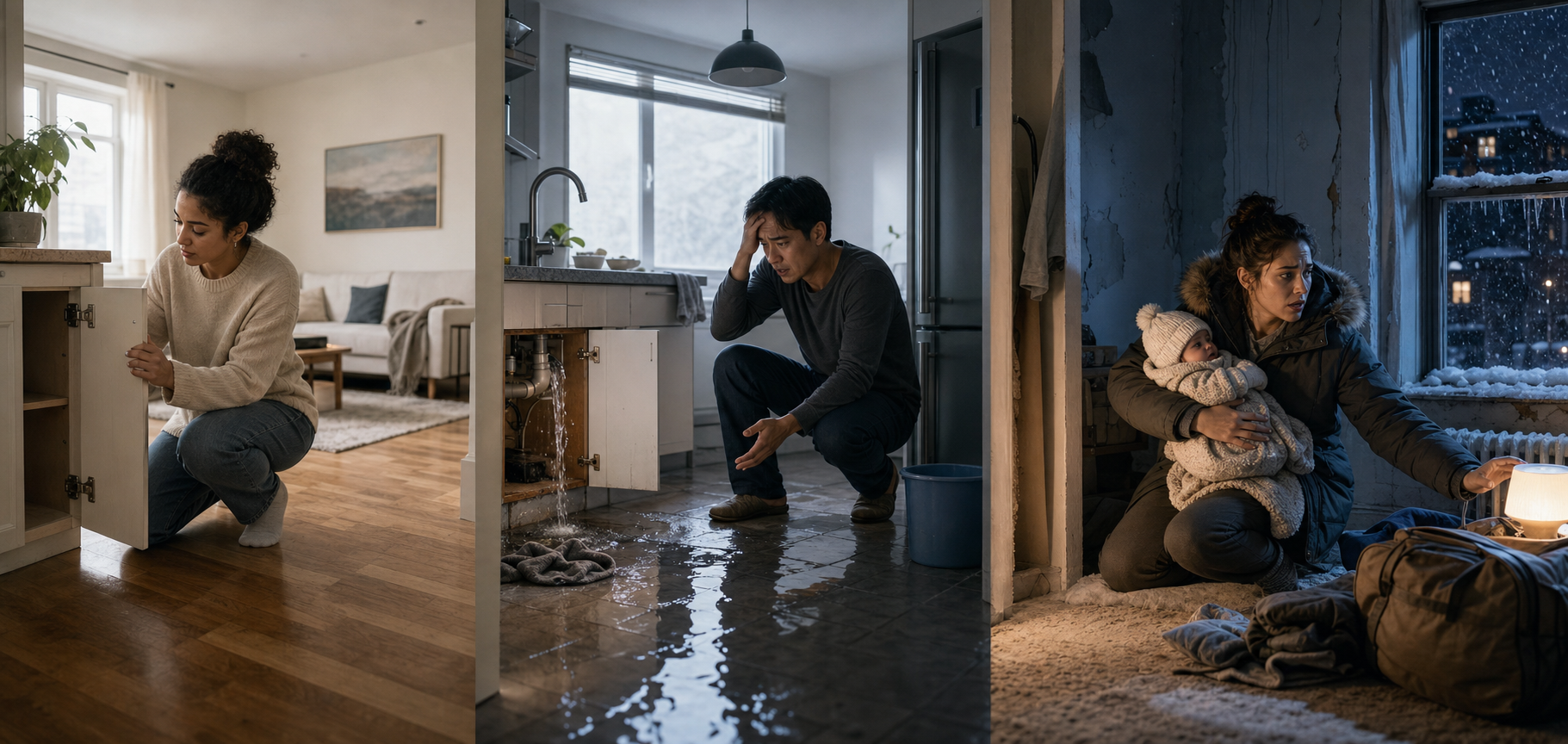
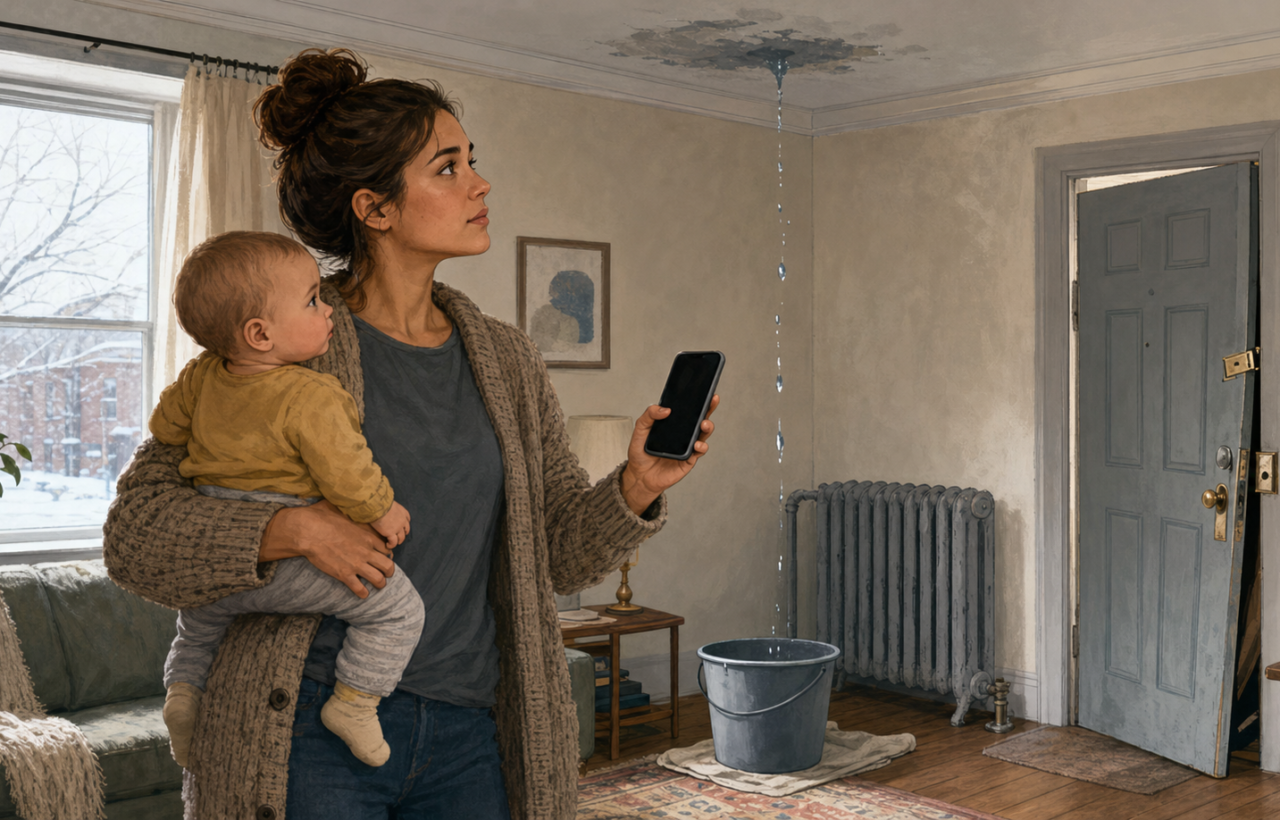
Your heat has stopped, a leak is spreading toward the baby’s room, or a broken lock is making the apartment feel unsafe. You have told the landlord, but the problem is still there. What you do next matters: you need to protect your family, create proof, and avoid a shortcut that could put your tenancy or money at risk.
This plan will help you organize those next steps. Landlord-tenant law is local, so confirm the rules for your province, territory, state, and city before withholding rent, paying for a repair yourself, leaving the unit, or ending a lease. This is general information, not advice about an individual legal case.
Protect your child before you argue about responsibility
Start by deciding what the condition requires right now. This is a safety decision, not a legal conclusion. A repair can be the landlord’s responsibility without being an emergency, and an emergency still needs immediate action even if nobody has settled who will ultimately pay.
- Immediate danger: Leave the affected area and contact the appropriate emergency service, utility, or building emergency line if there is fire, suspected gas, exposed live wiring, sewage entering the living space, or signs that part of the structure may fail. Do not wait for the landlord to answer first.
- Urgent loss of an essential service: Report a complete loss of heat, water, electricity, a secure exterior door, or another condition that prevents safe use of the home through every emergency repair channel your lease or building provides. Loss of heat during cold weather is a classic serious repair problem, not a minor inconvenience to leave indefinitely.
- Routine but necessary repair: Report conditions that are not immediately dangerous before they worsen. A slow leak, loose fixture, malfunctioning supplied appliance, or damaged surface can become more expensive and disruptive when notice is delayed.
Move your child, crib, play space, food, and essential supplies away from the affected area when you can do so safely. Do not ask a child to test a switch, investigate a smell, touch damaged material, or enter a wet area. If anyone develops symptoms after an exposure, seek appropriate medical care rather than trying to solve the health question through the repair dispute.
If you need temporary lodging, extra transportation, replacement food, or another emergency purchase, keep every receipt. That does not guarantee reimbursement. It does preserve the evidence you would need to request it from the landlord, an insurer, a tribunal, or a court.
Decide whether the problem belongs to the landlord
A landlord’s enforceable duties come from several places: local housing standards, landlord-tenant legislation, building and fire rules, the lease, and promises made when the unit was rented. Do not assume the lease is the final word. Minimum legal standards may apply even when a lease is silent or attempts to assign a duty to the tenant.
Use these questions to sort the issue before making a demand:
- What failed? Problems involving the building, an essential service, a common area, required safety equipment, or an item supplied with the rental are more likely to engage a landlord duty than a problem with something you own.
- What does the lease promise? Check the repair, appliance, maintenance, entry, emergency-contact, and notice clauses. Save a complete copy of the lease rather than photographing only one paragraph.
- What caused the damage? A landlord may still need to arrange a safe repair while disputing the cost. If the landlord claims that you, your child, a guest, or a pet caused the problem, ask for that position and its basis in writing. Do not make an immediate admission just to get the conversation moving.
- Is the issue merely cosmetic? Worn finishes and appearance-only complaints may receive different treatment from conditions affecting health, safety, security, sanitation, or use of the unit. But do not dismiss a condition as cosmetic simply because the visible mark is small; dampness, heat damage, or discoloration can be evidence of a larger defect.
- Which local rule applies? Use an official government, housing authority, tenancy board, or tribunal website to identify the responsible enforcement body and the required notice process. Search using the exact place where the rental is located, not where the landlord lives.
Your goal at this stage is not to prove an entire legal case. It is to identify the condition, the likely responsibility, and the correct local process well enough to send a precise repair request.
Send one repair notice that creates usable evidence
A phone call can alert the landlord quickly, but it is difficult to prove later. Follow every call or in-person conversation with a written message. Use the notice method required by the lease or local rules, and use a second traceable channel when appropriate, such as email or the building’s maintenance portal.
- Identify the rental: Include your name, full address, unit number, and a reliable way to reach you.
- Describe the defect: State what is not working, where it is, and when you first noticed it. Report what you directly observed rather than guessing at the technical cause.
- Explain the impact: Say which room, essential service, entrance, appliance, or normal activity cannot be used safely. Mention that a baby or young child lives in the unit when that fact changes the urgency, but do not disclose unnecessary medical or personal information.
- Attach evidence: Include clear photos or short videos, any relevant measurement you recorded, and previous request dates. Keep the original files because forwarded or uploaded copies may lose useful metadata.
- Ask for a concrete response: Request confirmation of receipt, the inspection or repair plan, the expected attendance window, and any safe interim measure the landlord will provide.
- Offer access: Give practical access windows and ask the landlord to confirm the appointment in writing. If local law specifies entry notice, emergencies, or access rights, follow those rules.
A useful subject line is: Urgent repair request – no heat – [your address and unit]. The message itself can be simple: identify when the failure began, describe the current condition, attach evidence, explain that a young child lives in the unit, provide access times, and ask when qualified repair personnel will attend.
Keep a repair log after sending the notice. Record the date and time of each message, call, visit, inspection, attempted entry, temporary repair, and recurrence. Save screenshots from a maintenance portal before a ticket disappears or changes status. Store copies somewhere you can access even if a phone is lost or damaged.
Keep the tone factual. Threats, insults, and a stream of duplicate messages make the timeline harder to read. One complete notice followed by clearly dated updates usually produces better evidence than many incomplete texts.
Escalate through the local process without creating a new problem
If the landlord does not respond, gives no workable repair plan, or repeatedly applies a temporary fix that fails, move up an escalation ladder. The right office and procedure vary by location and by the kind of hazard.
- Send a written follow-up: Refer to the original notice, describe what remains unresolved, and ask for the repair schedule. Attach the earlier message instead of rewriting the history from memory.
- Contact the relevant enforcement body: Depending on the condition and location, that may be municipal property standards, building inspection, housing enforcement, public health, fire prevention, or a utility emergency service. Ask whether the office inspects rental units, what evidence it needs, and whether it can issue an order.
- Use the tenancy tribunal, rental board, or court process: Look for the official application dealing with maintenance, vital services, housing standards, rent reduction, compensation, or termination. Read the eligibility rules before paying a filing fee or choosing a remedy.
- Get legal help when the stakes rise: Contact a tenant legal clinic, legal aid service, licensed local lawyer, or another qualified housing adviser if the home may be unsafe, the landlord threatens eviction, access becomes disputed, the damage is costly, or you are considering ending the tenancy.
Be especially careful with self-help remedies. Withholding rent, subtracting repair costs from rent, hiring a contractor and sending the bill, changing locks, abandoning the unit, or declaring the lease ended can expose you to arrears, an eviction application, liability for damage, or continuing rent. Some jurisdictions permit one or more of these steps only after specific notice, inspection, approval, or payment into an official account. Do not use them merely because they sound fair.
If you authorize work yourself during an emergency, the dispute may later turn on whether the work was necessary, whether the price was reasonable, and whether local law allowed you to act. When immediate safety does not require action, get jurisdiction-specific advice or written landlord authorization first.
Continue offering reasonable access for inspection and repair. If the proposed time does not work, respond promptly with alternatives. A landlord may argue that a tenant prevented the repair when messages about access are incomplete, so keep that part of the record as carefully as the original complaint.
If the landlord threatens, penalizes, or pressures you after a repair request, save the exact communication and get local advice. Retaliation protections and enforcement procedures differ, and a written sequence connecting the repair request to the later conduct can be important.
Ask for a remedy that matches the evidence
Getting the defect repaired and recovering money are related but separate questions. A tribunal or court may have power to order repairs, reduce rent for lost use, reimburse qualifying expenses, compensate for proven loss, or allow a tenancy to end. Availability depends on local law, and no remedy is automatic simply because the landlord was slow.
Build your request around a clear chain:
- The condition: Photos, videos, inspection findings, maintenance records, and a plain description of what failed.
- Notice: Proof showing when and how the landlord learned about it.
- Opportunity to repair: Your access offers, appointment records, and evidence of missed or incomplete work.
- Effect on the household: The rooms, services, or activities you could not safely use, with dates rather than broad statements.
- Financial loss: Receipts, invoices, damaged-property evidence, and any insurance response. Separate expenses caused by the defect from ordinary household spending.
- The requested outcome: State whether you want an inspection, a permanent repair, reimbursement, a legally authorized rent remedy, or permission to terminate. Use the official terminology and form for your jurisdiction.
Protect your child’s privacy while building that file. Photograph the condition without including your child’s face when possible. Redact unrelated medical, financial, and identifying information before sharing documents, but preserve an unredacted original in case an authorized decision-maker later requires it.
Key takeaways
- Deal with immediate danger first; the repair dispute can be documented after everyone is safe.
- Check the lease and the official rules for the rental’s location before deciding who must repair or pay.
- Follow every call with a complete written notice that identifies the defect, impact, evidence, requested response, and access options.
- Escalate through the correct inspector, housing authority, tribunal, or court when ordinary repair requests fail.
- Do not withhold rent, deduct costs, change locks, abandon the unit, or end the lease until you have confirmed that local law authorizes the exact step.
If the condition is not immediately dangerous, your best next move is simple: send one complete written notice today, save it with your evidence, and identify the official local office you would contact if the promised repair does not happen. That gives you a safer home-repair process and a record strong enough to support whatever lawful step comes next.