
You like the warmth of a Southern baby name, but choosing among Magnolia, Beau, Savannah, Wyatt, and more than 175 other possibilities can make the decision harder, not easier. The useful question is not which name sounds the most Southern. It is what kind of connection you want the name to carry.
Start with that connection, then test the name as something your child will actually use. It has to work when whispered to a newborn, called across a playground, spelled over the phone, printed on a form, and introduced by an adult.
Decide what “Southern” means to your family
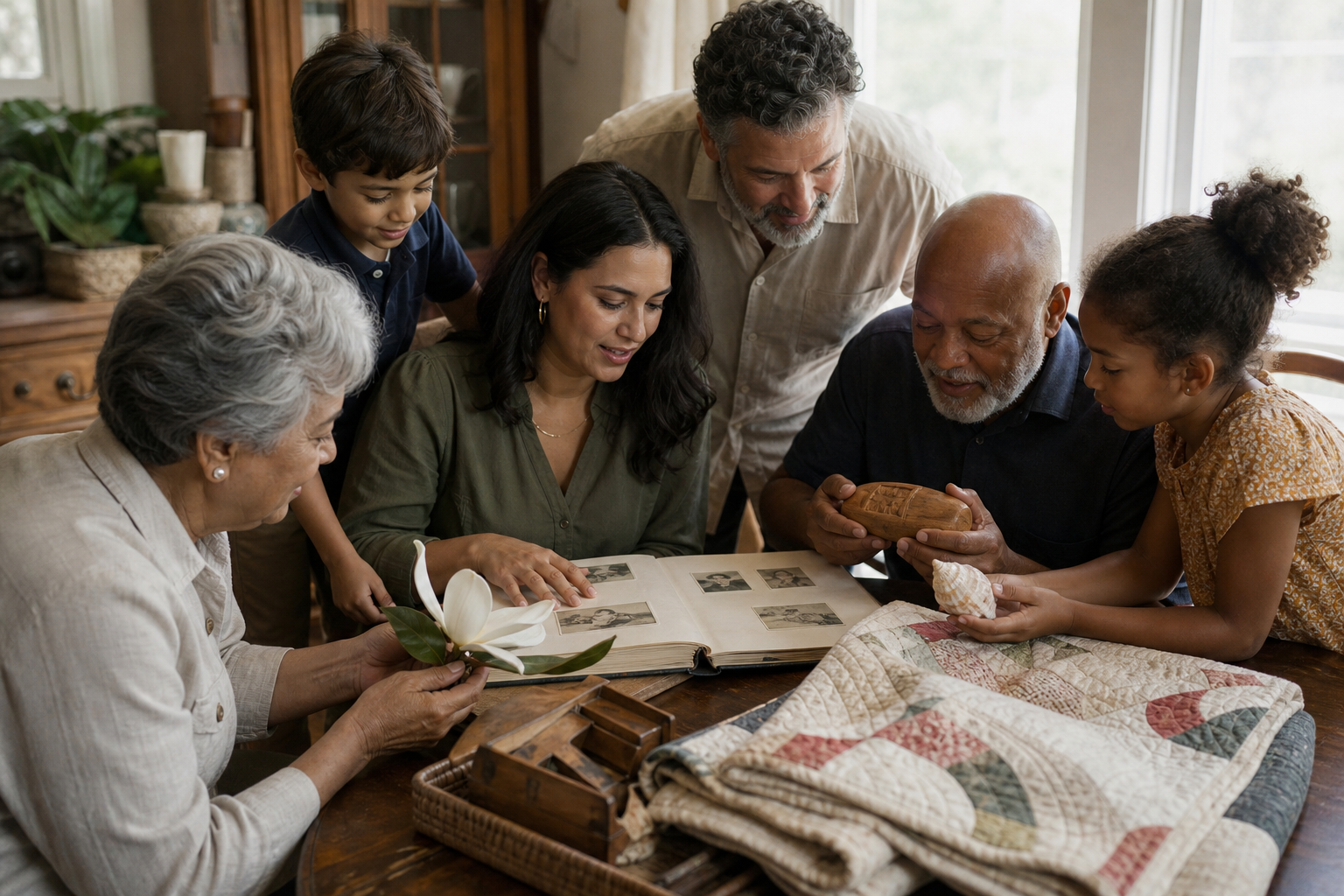
Southern is a style label, not one fixed origin or meaning. A name can feel Southern because it comes from a family surname, evokes a particular place, recalls a garden or landscape, sounds vintage, or has a strong country, Western, collegiate, or musical association.
Before collecting names, finish this sentence: “We want this name to feel connected to ____.” Your answer might be a grandparent, a hometown, the natural world, a family tradition, or simply a sound you both love. That answer is your filter.
- If family continuity matters, begin with surnames, middle names, nicknames, and overlooked names in your family tree.
- If place matters, choose a location that has a real connection to your family rather than one that merely sounds picturesque.
- If you want warmth without a literal regional reference, look at vintage, botanical, surname, and occupational names.
- If music, literature, a university, or Western imagery is the attraction, decide whether you want the association to be immediately obvious or quietly personal.
- If you only love the sound, say that plainly. You do not need to invent a heritage story to justify a name.
This step prevents a common mismatch: one parent is choosing for family meaning while the other is choosing for style. Both approaches are valid, but you will struggle to compare names until you agree on what the name is supposed to do.
Build your shortlist by style, not by gender alone

A large alphabetical collection encourages endless browsing. Style groups make the differences easier to see. Notice which group consistently draws you in, then keep only the names you would seriously consider using.
Place names with a built-in story
Southern place-name choices range from familiar state names to more distinctive city names:
- Georgia, Virginia, Carolina, Savannah
- Austin, Raleigh, Memphis, Montgomery
- Abilene, Alexandria, Atlanta, Macon, Tennessee
Georgia and Savannah have a softer, more conventional given-name rhythm. Memphis, Tennessee, and Montgomery make the geographic reference more prominent. Abilene, Macon, and Raleigh sit between those poles: recognizable as places, but less expected as first names.
Ask what you will say when someone asks, “Were they named after the place?” If the honest answer feels comfortable, the association is probably an asset. If you already feel the need to explain it away, move the name down your list.
Garden and landscape names
Nature names can suggest the South without naming a state or city. The available styles are quite different, even when they sit under the same botanical or landscape umbrella.
- Quiet and compact: Daisy, Fern, Lily, Sage, Wren
- Floral and expressive: Azalea, Camellia, Gardenia, Magnolia, Wisteria
- Gem-like or vintage: Opal, Pearl
- Landscape-led: Bayou, Delta, Lake, Ridge, River
- Playful or unexpected: Bee, Birdie, Bluebell, Cricket
The choice is not simply “nature name or no nature name.” Daisy and Fern are restrained; Magnolia and Wisteria fill more space; Bayou and Delta put the landscape association first. Match the intensity of the first name to your surname. A long, elaborate surname may pair more easily with Fern or Wren, while a short surname can give Magnolia or Camellia room to breathe.
Surnames and occupational names
For a tailored, less overtly romantic sound, consider surname and occupational options:
- Surname style: Bellamy, Brooks, Ellis, Emerson, Greer, Hayes, Hollis, Jackson, Knox, Nash, Quinn, Reed, Shelby, Sutton
- Occupational style: Carter, Cooper, Harper, Hunter, Mason, Parker, Piper, Sawyer, Taylor, Thatcher, Tucker, Walker, Wilder
If an appealing surname appears in your own family tree, it gives you an immediate way to narrow the field. Check the exact spelling before adapting it; a small spelling change may weaken the connection you wanted to preserve. If there is no family link, judge the name on sound and usability. You can simply like Brooks or Parker without presenting it as inherited.
Pay particular attention when the first name and surname are both surname-like. Sawyer Brooks, for example, has a different cadence from Sawyer Bell or Mabel Brooks. Read your actual combination aloud instead of judging the first name in isolation.
Vintage, country, and Western names
This group carries the widest range of associations, from quietly old-fashioned to unmistakably country:
- Gentle vintage: Adelaide, Alma, Belle, Ida, Mabel, Odette, Pearl, Vivian
- Bold vintage: Atticus, Beau, Rhett, Rufus, Sterling, Tallulah, Thaddeus
- Country and musical: Cash, Dolly, Hank, Jolene, June, Loretta, Patsy, Reba, Waylon
- Western: Annie, Bowie, Cassidy, Clementine, Colton, Jesse, Kit, Oakley, Shane, Stetson, Wyatt
The stronger the association, the more important it is to test what other people hear. Do not ask whether they “like” the name; that turns the decision into a popularity contest. Ask a trusted person, “What comes to mind first when you hear this?” If everyone gives the same answer, assume that association will often arrive before your private reason for choosing the name.
That does not automatically rule out Dolly, Jolene, Reba, Rhett, or Stetson. It tells you what comes bundled with the name, so you can decide deliberately rather than discovering the connection after you have committed.
Double names and collegiate names
A double name can hold two family connections or create a more traditional Southern rhythm. Options include Anna Beth, Ava Rose, Emmy Lou, Laura Beth, Mary Claire, Mary Louise, Sarah Beth, Sarah Jean, Everett James, James Wyatt, John David, Tucker Lee, and Walker James.
Decide whether both parts are meant to be spoken every day. If they are, introduce your child with both consistently and choose a written form you are willing to use on every record and form. If the second name is mainly ceremonial, a conventional first-and-middle arrangement may create less friction.
Auburn, Baylor, Clemson, Duke, Elon, Emory, Howard, Mercer, Morehouse, and Tulane offer another route for families with a meaningful school connection. These names have an institutional association built in. Use the same test as you would for a place name: be comfortable answering whether your child was named for it.
Choose between a formal name and the name you will call them
Some Southern choices sound intentionally informal: Bo, Bobby, Buddy, Butch, Callie, Frankie, Gus, Hattie, Huck, Millie, Minnie, Nellie, Rae, Ray, Scout, Tex, and Trip. The decision is whether that everyday name should also be the full legal name.
Use the nickname as the legal name if it is the only version you genuinely like and you can picture it in every setting. Choose a more formal legal name if you want your child to have options later. You can still call them Buddy, Hattie, Millie, or Gus from birth without requiring that nickname to do every job throughout life.
Do not choose a formal version you dislike merely to make the birth certificate look more serious. That often creates the opposite problem: the family never uses the legal name, while schools, clinics, travel documents, and employers do. The gap is manageable, but it should be intentional.
Double names need the same clarity. If Mary Claire is always Mary Claire, treat the full combination as the everyday name. If she will usually be Mary, then Claire may work more naturally as a middle name. Imagine completing a form and introducing your child to a new caregiver; the arrangement should be easy to explain in one sentence.
Run every finalist through a real-life name test

A name can look beautiful on a list and still feel awkward with your surname. Test the complete name before discussing spelling, announcements, or nursery decor.
- Write the full name exactly as it would appear on an official form. Check the initials, repeated sounds, and any accidental word they create.
- Say it in an ordinary introduction: “This is ____.” Then say it as you would when calling your child from another room. A combination that only works when spoken slowly may become frustrating in daily use.
- Spell the first name and surname aloud as though you were speaking by phone. If both require frequent correction, decide whether the distinctiveness is worth that recurring task.
- Pair the name with likely everyday forms. Consider what friends may shorten naturally, not only the nickname you prefer.
- Put the name beside any sibling names. They do not need to match, but check whether the combination accidentally creates a theme you feel obliged to continue.
- Search the exact full name and the first name by itself. You are looking for one overwhelming public association, an unexpected phrase, or a meaning that changes how the name feels to you.
- If the name comes from a language, community, or tradition outside your own, investigate that specific origin. Calling something “Southern” does not replace understanding where it came from or how it is used.
- Let the strongest finalists sit without collecting more options. If you keep adding names, you are postponing the decision instead of improving it.
When you ask other people for input, give each person a job. One person can listen for awkward sounds, another can check initials and spelling, and another can identify obvious associations. Broadly asking everyone to vote rewards the least controversial choice, which may not be the name that means the most to you.
Key takeaways
- Define the connection you want before you collect names: family, place, nature, vintage style, music, Western imagery, or simple sound.
- Compare names within style groups. Georgia and Memphis are both place names, but they create very different impressions.
- A strong association is not automatically a problem. It is something to choose knowingly.
- Decide separately what belongs on the legal record and what you expect to say every day.
- Test the complete name with the surname, initials, likely nicknames, spoken rhythm, spelling, and public associations.
- Once a small set passes those tests, stop browsing and choose the name whose connection you will still be glad to explain.
Your next move is simple: write the connection you want the name to carry, circle the style group that fits it, and keep only the finalists that work in real life. The right Southern name does not need to perform its Southernness for everyone else. It needs to sound natural in your family and leave your child room to make it their own.
References