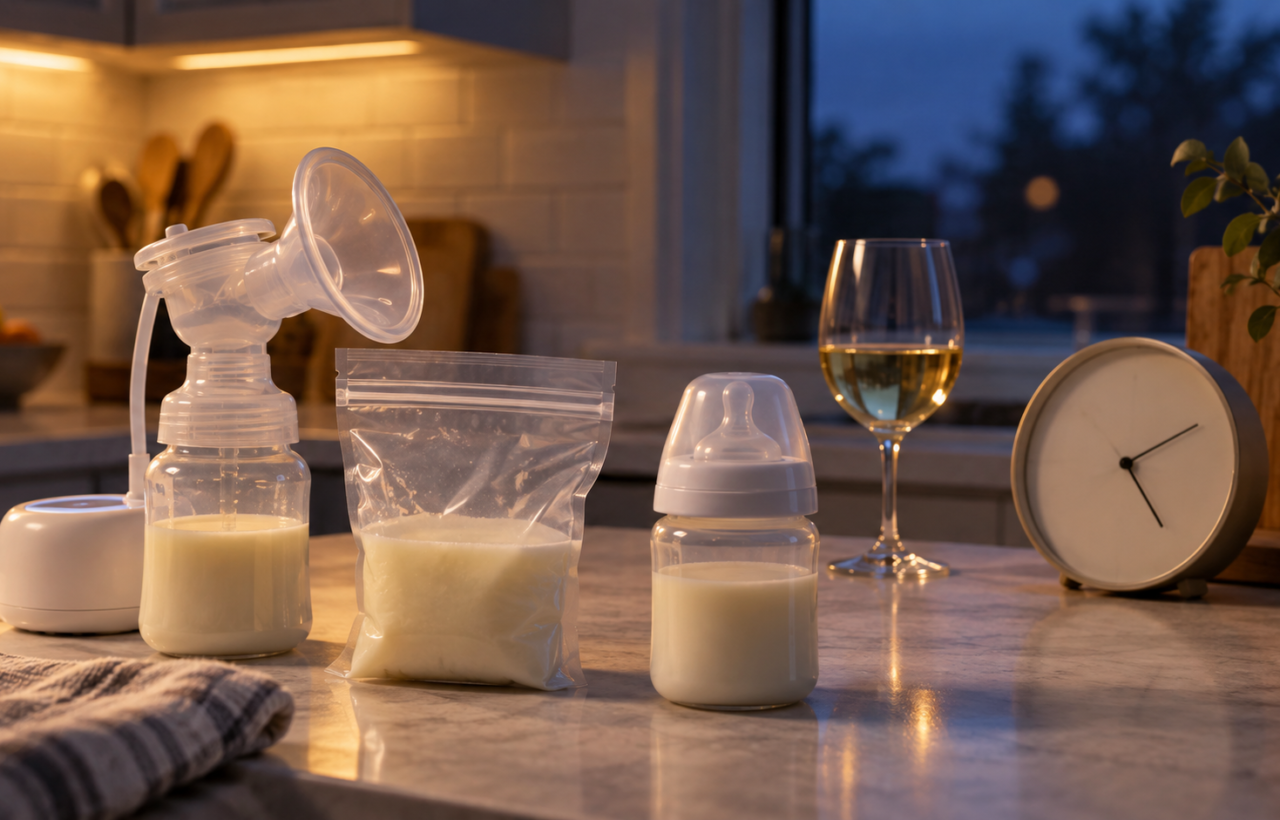
You’ve had a drink, your breasts are full, and the next feed is approaching. The important question isn’t whether you can rescue the milk by mixing it with an older bag. It’s whether enough time has passed for the alcohol level in your body, and therefore your milk, to fall.
If it hasn’t, use milk expressed before drinking or formula for that feed. You can pump for comfort or to maintain your usual schedule, but pumping and dilution don’t make alcohol leave your milk faster.
Key takeaways for your next feed
- Not drinking is the safest option, but up to one standard drink in a day is not known to harm a breastfeeding infant.
- After one standard drink, wait at least 2 hours before nursing or feeding milk expressed after the drink. More alcohol requires more time.
- Alcohol in breast milk rises and falls with the alcohol level in your bloodstream. Time lowers it; pumping does not.
- Mixing milk pumped after drinking with milk pumped before drinking is not an evidence-based safety method. There is no recommended dilution ratio.
- Milk safety is only part of the plan. If alcohol could impair you, arrange for a sober adult to care for the baby.
Why time matters more than pumping

The alcohol level in breast milk is essentially the same as the level in the breastfeeding parent’s bloodstream. As the blood alcohol level falls, the level in milk falls too. Pumping removes milk from the breast, but it doesn’t make the body process alcohol faster.
Alcohol levels in milk are usually highest about 30 to 60 minutes after a drink. Food can delay that peak. The amount consumed, how quickly you drank, whether you ate, your body weight, and your metabolism can all affect how long alcohol remains detectable.
That is why how you feel isn’t a precise milk test. A person with a higher alcohol tolerance may feel normal even when alcohol is still present. For a cautious plan, count standard drinks and use the clock instead of relying on sensation alone.
There are also two separate limits to keep straight. “Up to one drink per day is not known to be harmful” describes overall consumption. It doesn’t mean milk is alcohol-free immediately after that drink. Timing still matters.
A practical feeding plan around a standard drink

The size of the glass doesn’t tell you how many standard drinks it contains. The CDC defines one standard drink as any one of the following:
- 12 ounces of beer at 5% alcohol
- 8 ounces of malt liquor at 7% alcohol
- 5 ounces of wine at 12% alcohol
- 1.5 ounces of distilled spirits at 40% alcohol
A strong beer, large wine pour, or cocktail may contain more than one standard drink. Check the alcohol percentage and serving size rather than counting containers.
- Feed or pump just before you start drinking if that works with your baby’s schedule. This creates the longest natural gap before the next feed.
- Count the actual number of standard drinks. Don’t assume one glass always equals one drink.
- After one standard drink, wait at least 2 hours before breastfeeding. Public-health guidance uses a minimum of about 2 hours per drink, so consuming more than one requires a longer wait.
- If your baby needs to eat during that window, offer milk expressed before you drank or formula. Don’t postpone a needed feed solely to complete the waiting period.
- If you need to pump for comfort or to maintain your pumping schedule, record the time. Pumping can help your body and routine, but it doesn’t shorten the waiting period.
If you want to avoid any alcohol exposure, the clearest option is previously expressed milk or formula until the waiting period has passed. Milk pumped before you started drinking doesn’t acquire alcohol because you later had a drink.
Why pumping or diluting doesn’t reset the clock
“Pumping and dumping” is often misunderstood as a way to clear alcohol from the breasts. It isn’t. New milk continues to reflect the alcohol level in the bloodstream, so pumping repeatedly won’t make the next batch clear sooner. Only the body’s metabolism and the passage of time lower the level.
There may still be a practical reason to pump during the waiting period: you might be uncomfortable, need to protect your supply routine, or be away from your baby at your normal pumping time. CDC guidance says milk expressed within 2 hours per drink can be discarded. Discarding that milk manages what was expressed during the waiting window; it doesn’t accelerate alcohol clearance.
Dilution creates a different problem. Combining milk pumped after drinking with a larger amount of pre-drink milk may reduce the concentration, but you don’t know the starting alcohol level and there is no validated mixing ratio that establishes the result as safe. More volume is not the same as a reliable safety calculation.
If your goal is no alcohol exposure, keep the pre-drink milk separate and use it for the feed. Here, “dilution” means mixing two batches of breast milk; never add water to breast milk in an attempt to manage alcohol exposure.
When the simple plan isn’t enough
The 2-hour minimum is a practical benchmark for one standard drink, not a guarantee that fits every situation. If you had more than planned, don’t know the strength of the drink, or can’t confidently count the servings, wait longer and use pre-drink milk or formula. Don’t try to solve that uncertainty by diluting milk.
Get individualized advice from your baby’s pediatrician or a qualified lactation consultant if your baby’s age or health affects your feeding decisions, if alcohol use is frequent, or if you are unsure what to do with milk already expressed. If your baby may have had substantial alcohol exposure or seems unwell, contact a health professional promptly.
Also plan for caregiving, not just feeding. Alcohol can impair judgment and the ability to respond safely to an infant. If you may become impaired, put a sober adult in charge before you start drinking.
Before your next occasion, label one pre-drink feed, note when you begin and finish each standard drink, and decide who will handle the baby if you become impaired. That small amount of preparation removes the need for a late-night dilution calculation.
References
- Parents — Why There’s No Need to Dilute Pumped Milk After Drinking
- Centers for Disease Control and Prevention — Alcohol