

If you’re wondering whether your breast size will make breastfeeding harder, or you’re trying to tolerate a pump that pinches or leaves marks, separate those concerns. Breast size is not a milk-supply score. Pumping pain is a reason to check the setup.
A smaller chest does not mean you will make less milk: breast size by itself does not determine milk supply. At the same time, incorrect pump use can cause bruising and other breast or nipple discomfort. The practical goal is to judge feeding by how it is going and judge pump fit by what your tissue does under suction, not by your bra size.
Breast size cannot predict your milk supply

People with small breasts can breastfeed successfully. Larger breasts are not a guarantee of abundant milk, just as smaller breasts are not evidence of low supply. Visible size is therefore not a useful way to decide whether breastfeeding will work for you.
It helps to distinguish milk production from feeding mechanics. Supply refers to the milk your body makes. Milk transfer is the process of a baby or pump removing that milk. A concern about latch, milk transfer, pumping, or your baby’s intake can deserve attention, but breast size alone cannot identify the cause.
Size can affect logistics. You may find one nursing position, hand placement, or pump angle easier than another. That is a comfort and access issue, not proof of a supply problem. Bring your baby toward your breast rather than leaning your body toward the baby, and choose a position in which you can stay supported instead of holding tension in your shoulders or back.
If you are worried about feeding, do not use cup size as the deciding evidence. Ask a qualified lactation professional to observe a feed and assess what is actually happening. If there is concern about your baby’s intake or growth, involve your baby’s health care professional as well.
Fit the pump to your nipple movement, not your cup size
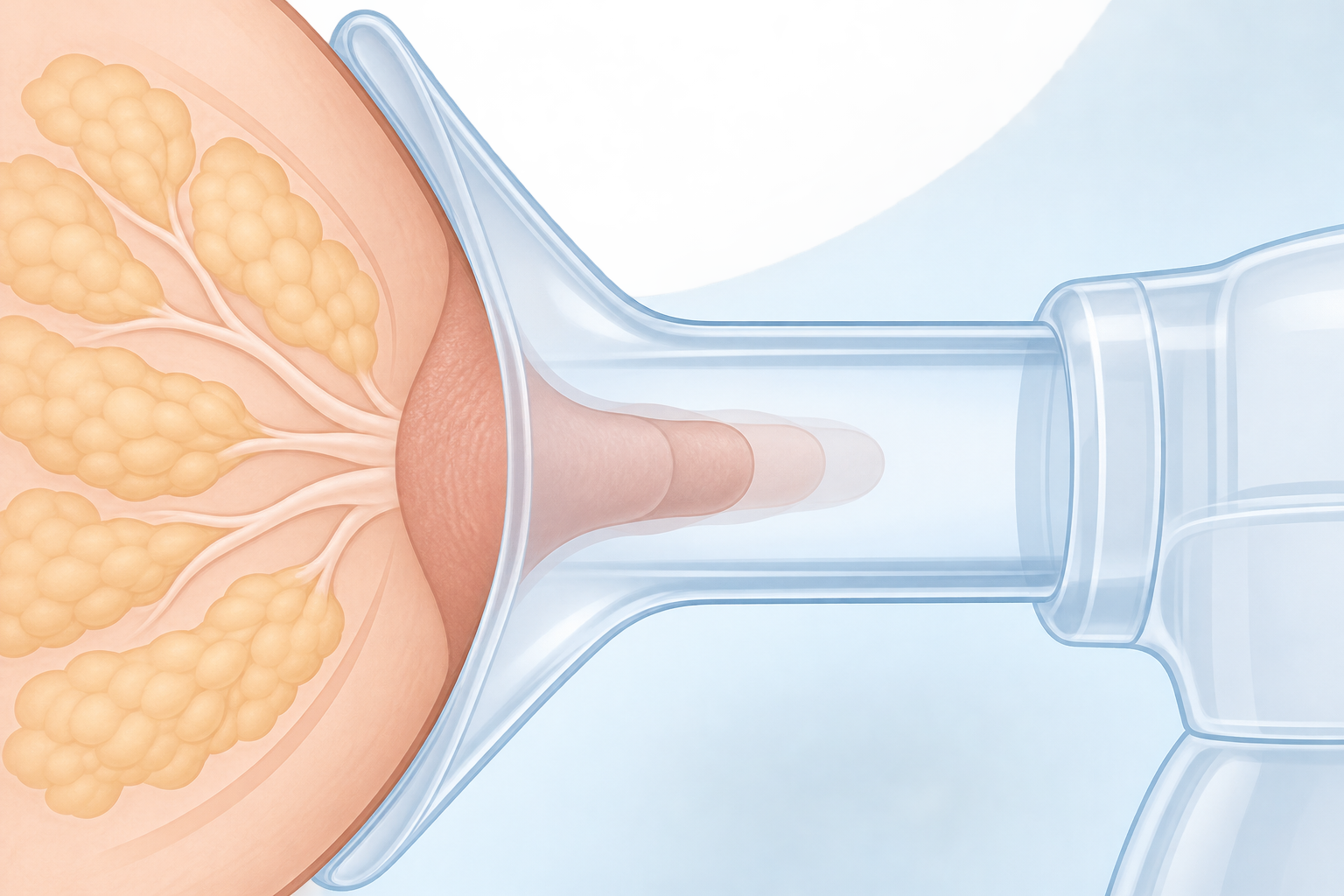
The part placed against your breast is usually called a flange or breast shield. Its opening needs to accommodate the nipple and nearby tissue comfortably while the pump is running. A small breast does not automatically require the smallest shield, and a large breast does not automatically require a larger one. Bra size is the wrong measurement for this decision.
Judge the fit during pumping, not only by how the shield looks before suction begins. Your nipple should remain centred in the tunnel without repeatedly scraping its sides or being compressed painfully. If tissue is being pulled in painfully, the nipple rubs throughout the cycle, or you feel pinching, stop and reassess instead of waiting for your body to adapt.
- Assemble the pump according to its instructions. A misplaced or worn part can change how the pump behaves, so check the manual rather than compensating immediately with stronger suction.
- Sit in a supported position and place the breast shield so the nipple is centred before turning the pump on. Avoid pressing the shield into your breast more forcefully than needed to maintain its seal.
- Begin with low suction. Increase it gradually only while the pulling sensation remains comfortable. A setting that hurts is too high for that session, regardless of the number shown on the pump.
- Watch several pumping cycles. Look for repeated rubbing, painful stretching, pinching, or a nipple that will not remain centred.
- If something hurts, turn the pump down or off and release the seal before removing the shield. Reposition it and try again at a lower setting rather than pulling the shield directly away under suction.
- Check each breast separately. A position or setting that feels comfortable on one side should not be assumed to be right for the other.
Check how you feel after the session, too. New bruising, broken skin, swelling, or pain that continues between pumping sessions is not simply a cosmetic issue. It means the current setup or technique needs attention.
Pumping comfort FAQ
What should pumping feel like?
You may feel rhythmic pulling or firm pressure. Pumping should not require you to tolerate sharp pain, persistent pinching, repeated scraping, numbness, or bruising. A sensation can be unfamiliar without being harmful, but visible injury or pain that continues after repositioning is a sign to stop troubleshooting by endurance.
Should I turn up the suction if little milk appears?
Do not use pain as evidence that the pump is working harder or better. If a higher setting hurts, lower it. Check that the pump is assembled correctly, recenter the shield, and make sure the seal is secure. If output remains unexpectedly low, a lactation professional can help assess the session without asking you to overpower pain.
What should I do if pumping hurts immediately?
Reduce or stop the suction, release the seal, and reposition the shield. Restart at a low setting and watch the nipple’s movement. If the same pain returns, do not keep repeating the session unchanged. Review the shield fit, pump assembly, and technique before trying to solve the problem with more suction or a longer session.
Can each breast need a different setup?
Assess each side on its own. Bodies are not perfectly symmetrical, and comfort on one side does not prove that the same position or setting is comfortable on the other. If only one nipple rubs or bruises, troubleshoot that side rather than assuming all parts of the setup are correct because the other side feels fine.
Bruising and persistent pain deserve attention

A bruise is tissue trauma, not a milestone you need to push through. Continuing with the same painful fit or suction can repeat the injury. If you depend on pumping for regular milk removal, seek help promptly so you can find a more comfortable setup without making an abrupt change to your feeding plan.
- Contact a qualified lactation professional if rubbing, pinching, or bruising returns; if you cannot find a comfortable shield position; or if you are unsure whether the shield fits while the pump is operating. If possible, have the pump and the parts you use available so the full setup can be assessed.
- Contact a health care professional promptly for broken or bleeding skin, significant swelling, worsening pain that continues when you are not pumping, spreading redness or warmth, fever, or feeling unwell. These symptoms need medical assessment rather than another equipment adjustment.
- Contact your baby’s health care professional as well as a lactation professional if the concern includes feeding, intake, or growth. Pump fit and your baby’s feeding needs are related parts of the plan, but they are not interchangeable assessments.
At your next pumping session, leave breast size out of the calculation. Centre the shield, begin with low suction, watch the nipple move, and respond to pain when it starts. If the discomfort returns after a careful reset, arrange hands-on help instead of asking injured tissue to tolerate one more session.
References
- Parents – What To Know About Breastfeeding With Small Breasts
- Parents – 6 Ways To Avoid Bruised Nipples From Pumping



