

Your baby sleeps beside your bed, your home has no spare room, and your relationship still needs a private life. The practical question isn’t whether loving parents should want sex. It is whether intimacy can happen without compromising your baby’s safety or a growing child’s boundaries.
With a newborn or young infant asleep in a separate, safe sleep space, same-room intimacy is not something you need to feel guilty about. The answer changes as your child becomes more alert, mobile, and verbal. The goal is to make that transition deliberately, before an unexpected wake-up makes it for you.
The short answer depends on who is sharing the room
A newborn or young infant does not understand sexual activity as sexual activity. That is why parents generally do not need to feel guilty about intimacy while a very young baby sleeps nearby. The essential condition is that the baby remains in a separate, safe sleep space throughout.
That condition is non-negotiable. Don’t bring a sleeping baby into the adult bed, place them beside you, or change a safe sleep arrangement to create more room. If your plan only works after moving the baby out of their usual safe setup, wait or choose another place.
Same-room intimacy is an option, not an obligation. Some parents cannot relax with a baby nearby. Others become so quiet and guarded that the experience feels more like monitoring than connection. Repeatedly suppressing normal expression can eventually affect how freely a couple relates sexually, so tension is useful information: if either partner feels watched, distracted, or uncomfortable, find privacy instead of trying to push through it.
A toddler is a different case. Once a child can wake, orient to the room, move toward you, use language, or understand that something unusual is happening, plan sexual activity somewhere the child cannot see or hear it. A deep sleeper is still capable of waking unexpectedly, and darkness is not the same thing as privacy.
Use development, not a birthday alone, as the cutoff

Around age one is a useful prompt to reassess your arrangement, but it is not a universal deadline. Children develop awareness, language, and mobility at different rates, so there is no birthday that switches understanding on overnight.
Use the earliest relevant developmental change as your signal to move intimacy out of the shared room. Don’t wait for every item on the list.
- Your child is crawling, walking, climbing, or otherwise able to move toward you after waking.
- They use words, gestures, or questions to make sense of what adults are doing.
- They wake and become alert quickly rather than remaining drowsy and disoriented.
- They follow movement or sound around the room and show growing awareness of other people’s actions.
- You find yourselves relying on darkness, distance, or the belief that your child is a particularly deep sleeper.
The last point matters because it is easy to turn a description of your child’s usual sleep into a guarantee. It isn’t one. If your plan would feel inappropriate with your child awake, and your child is old enough to wake and understand that something is happening, use another setting.
This developmental approach also avoids two unhelpful extremes. You do not need to treat a sleeping newborn as though they understand an adult sexual situation. You also should not treat a mobile, verbal toddler as though sleep makes them unaware. The boundary moves as the child does.
Build a privacy plan that fits your actual home
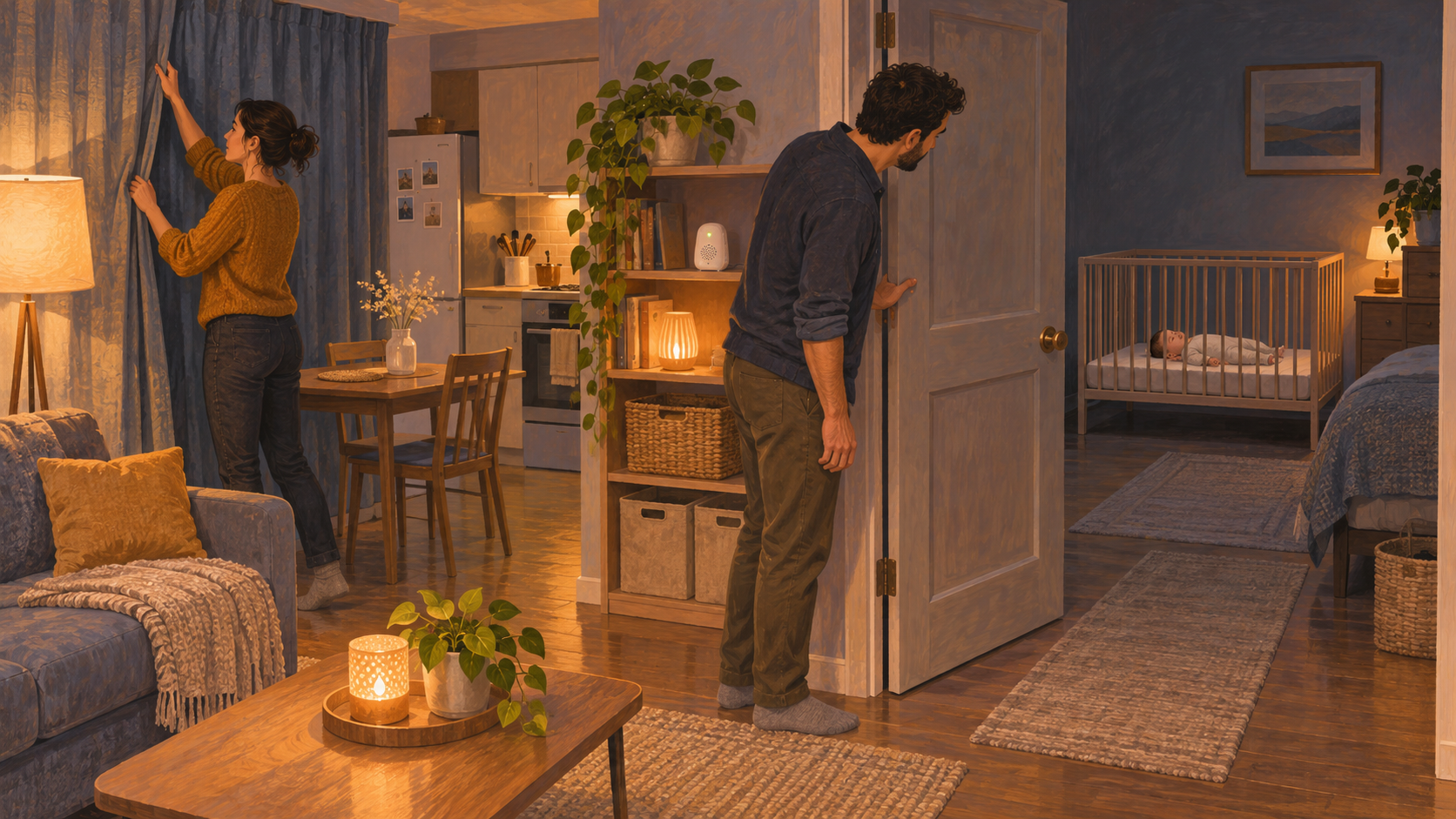
Advice to “use another room” is not very helpful when your home has only one room. The useful question is what kind of privacy your household can reliably create without weakening sleep safety, supervision, or anyone’s consent.
- Agree on the boundary first. Decide whether same-room intimacy is acceptable only while your child is a young infant in a separate sleep space, or whether either partner would prefer it never happen. The more cautious partner’s boundary wins.
- Name a primary private place. In a one-bedroom home, that may be another room while the baby stays safely asleep and you remain able to respond. Choose the location before you need it rather than improvising beside the sleeping space.
- Create a backup window. A trusted caregiver might take your child for an outing or host a visit. In a studio or a home shared with extended family, a genuine caregiving window may be more workable than trying to manufacture privacy with a curtain or a few feet of distance.
- Plan for interruption. Agree that either adult can call an immediate stop. Keep the route to your child clear and be prepared to return to caregiving without frustration or blame.
- Protect connection when sex does not work out. A baby waking is an interruption, not a partner’s rejection. Decide in advance whether you will reschedule, spend a few quiet minutes together, or simply sleep.
If older children can wander into the room, include them in the logistics even though the baby is the one room-sharing. A closed door does not create dependable privacy when another child may need you or enter without warning. A period when a trusted caregiver is responsible for the children may be the cleanest solution.
Parents in small homes often need flexibility, other rooms, trusted caregivers, and short private windows. Scheduling does not make intimacy less genuine. It keeps the opportunity from depending entirely on luck, perfect sleep, and two exhausted adults having the same spontaneous thought.
Intimacy also does not have to mean intercourse every time. Affection, private conversation, touch, and sexual connection can occupy different windows. Separating them reduces the pressure to make every rare moment of privacy carry the whole relationship.
No logistical plan overrides consent, comfort, or physical wellbeing. If the real obstacle is pain, fear, resentment, or a persistent mismatch in desire, changing rooms will not solve it. Pain or other physical symptoms warrant a conversation with a qualified health professional; relationship or sexual concerns may be better addressed with an appropriately qualified therapist.
If your child wakes up, stop first and explain second

An accidental interruption can feel enormous to an embarrassed adult. Your response matters more than producing a perfect explanation. The immediate task is to end the activity, restore an ordinary caregiving interaction, and show your child that they are safe.
- Stop immediately. Cover up or get dressed before continuing the conversation.
- Respond to the child. A preverbal baby usually needs soothing and a return to the normal sleep routine, not an explanation.
- Keep your voice calm. Panic, anger, or shouting can make an otherwise brief interruption feel frightening.
- Give a verbal child a short, truthful answer. You might say, “We were having private grown-up time. Everyone is safe.” If they ask whether someone was hurt, answer that question directly.
- Do not scold them for waking or entering. They did not violate a boundary they were never taught. Adjust the adults’ privacy plan for next time.
A brief accidental sighting is unlikely on its own to cause emotional harm when the adults stop, remain calm, reassure the child, and answer questions simply. That does not make repeated exposure acceptable. It means one awkward interruption does not require you to react as though a catastrophe has occurred.
Avoid an elaborate story that creates more questions than it answers. Young children generally need to know that they are safe, nobody is hurt, and some activities are private. If your child remains distressed, repeatedly returns to what they saw, or shows a change that concerns you, ask their pediatrician or a qualified child-development professional how to respond at their developmental level.
Key takeaways
- Same-room intimacy can be reasonable with a newborn or young infant who remains asleep in a separate, safe sleep space.
- Around age one is a reminder to reassess, not a universal cutoff. Mobility, language, alertness, and awareness are more useful signals.
- Once your child is mobile or verbal, use genuine privacy rather than relying on deep sleep, darkness, distance, or a room divider.
- Small-home solutions may include another room, a trusted caregiver, or a planned private window outside the child’s sleeping area.
- If your child wakes or sees something, stop, stay calm, reassure them, and give only the simple explanation their question requires.
- If either partner cannot relax with the child nearby, move elsewhere. Same-room intimacy is never an obligation.
Before the next bedtime, agree on three things: the developmental cue that will end same-room intimacy, one genuinely private location, and one backup window. That short conversation protects your child’s boundaries and gives your relationship a plan that does not depend on nobody waking up.
References



