

You may be looking for a name that sounds at home when one grandparent says it in Spanish and another relative, teacher, or caregiver says it in English. The goal does not have to be one perfectly identical pronunciation. It is a name that remains recognizable, comfortable, and connected to your family in both languages.
Use the shortlists below to find contenders, then test each one as carefully as you test the spelling. A beautiful name on a screen can feel very different once it is paired with your child’s surname, shortened by relatives, or spoken with two accents.
What makes a baby name work in Spanish and English?
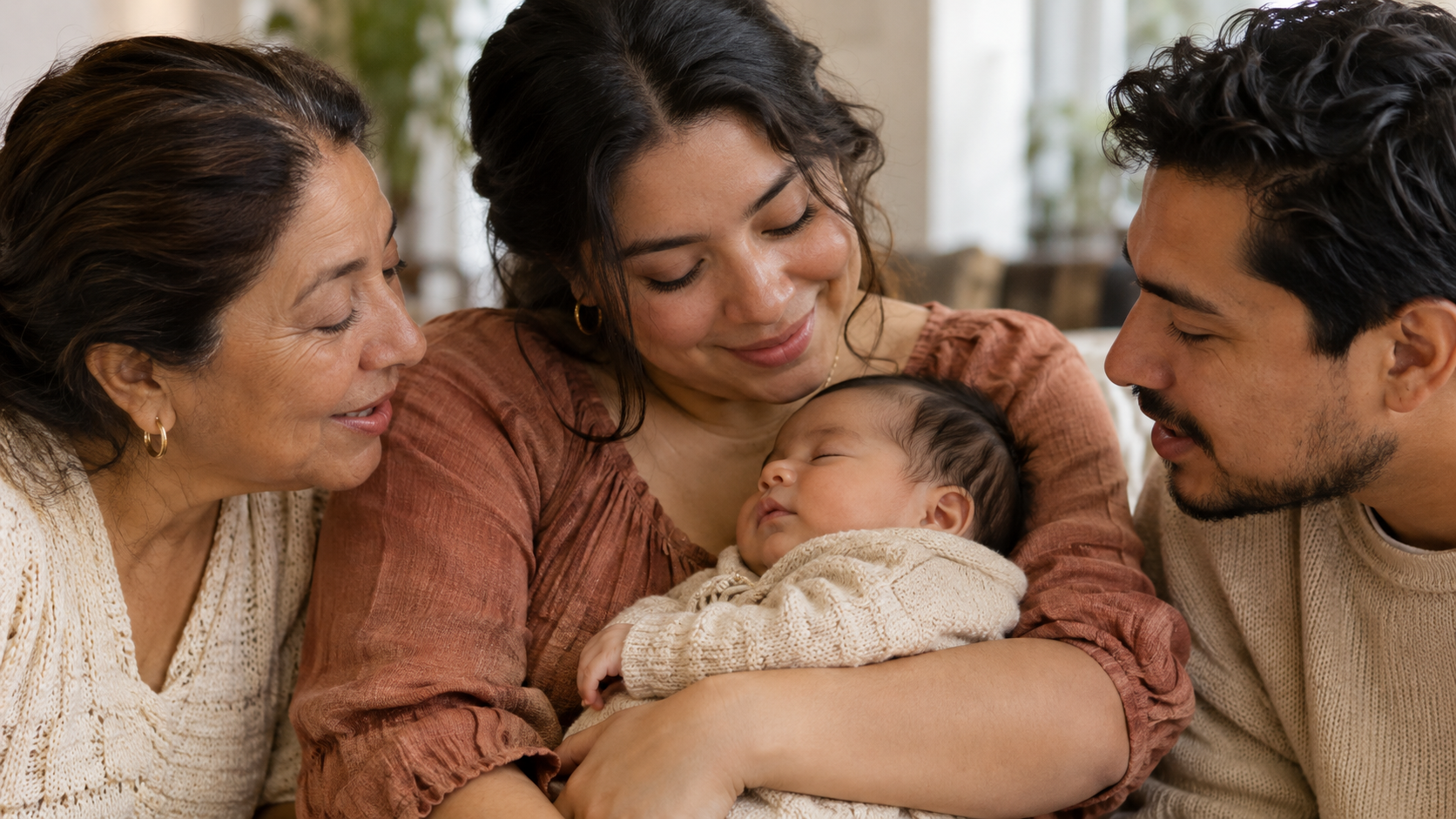
A bilingual name does not need to erase the differences between languages. Daniel, for example, can sound different in Spanish and English while still being immediately recognizable as the same name. That is often more realistic than searching for a pronunciation that never changes.
A strong candidate usually passes these practical checks:
- Recognition: A listener can connect the Spanish and English pronunciations without needing a long explanation.
- Comfort: The people closest to your child can say the name naturally. They should not have to imitate an unfamiliar accent to make it work.
- Spelling: You know whether the official version will include an accent mark, and you are comfortable correcting or accepting common variations.
- Full-name flow: The given name works with every surname your child will use, not only when it is said by itself.
- Nickname fit: You can live with the short forms that relatives and friends are likely to try.
- Family meaning: The name fits the particular heritage you want to honour. Hispanic identity covers many countries, regions, and family histories; familiarity in one community does not guarantee the same response in another.
Do not reject a name merely because the two languages place stress differently or shape a consonant differently. Ask a more useful question: do you genuinely like the name both ways? If one version makes you hesitate every time you hear it, that friction is worth noticing now.
Bilingual Hispanic girl names to put on your shortlist
These are starting points, not a ranking. Some are concise and easy to introduce; others give you a formal name plus an everyday nickname. If none feels right, widen your search with more Hispanic girl names suited to Spanish and English, then apply the same spoken test to every contender.
Short, clear options
- Alma
- Ana
- Clara
- Eva
- Julia
- Luna
- Mía or Mia
- Nora
- Sara
- Vera
Short names are not automatically pronunciation-proof. Clara and Vera, for instance, may pick up noticeably different vowel sounds in English. Say each version beside the surname before deciding that brevity makes it effortless.
Familiar full-length names
- Adriana
- Camila
- Carmen
- Elena
- Isabel
- Lucía or Lucia
- Natalia
- Sofía or Sofia
- Victoria
With a longer name, listen for the rhythm of the complete name rather than counting syllables. A longer given name can work beautifully with a short surname, while a compact name may balance a double or hyphenated surname. There is no universal formula; your child’s actual full name is the test.
Names with useful nickname choices
- Alejandra – Ale or Alex
- Catalina – Cata
- Daniela – Dani
- Gabriela – Gabi
- Isabella – Isa or Bella
- Mariana – Mari
- Valentina – Vale
A nickname is an option, not a guarantee. Your daughter may prefer the full name or choose another short form later. For now, identify the versions you would welcome and the ones you would find irritating. If you love Valentina but dislike Vale, decide whether you are willing to keep making that preference clear.
Bilingual Hispanic boy names to consider
Boy-name lists often mix biblical staples, long-standing family names, and more streamlined modern choices. The options below cover those different directions. You can also explore a wider selection of Hispanic boy names that work in Spanish and English before narrowing the field.
Short names that are easy to introduce
- Alex
- Bruno
- David
- Hugo
- Leo
- Luis
- Marco
- Nico
Think about whether a short name is the complete name or a nickname. If you prefer Nico, decide whether you want Nico on its own or Nicolás as the formal version. Neither choice is inherently better, but treating them as interchangeable can leave parents divided later.
Established names with bilingual familiarity
- Adrián or Adrian
- Daniel
- Gabriel
- Isaac
- Julián or Julian
- Lucas
- Mateo
- Nicolás or Nicolas
- Rafael
- Samuel
- Sebastián or Sebastian
- Tomás or Tomas
These names do not all sound identical across languages, and they do not need to. Pay attention to the version you hear at home, the version your English-speaking community is likely to use, and whether you enjoy both rather than merely tolerating one.
Longer names with flexible short forms
- Alejandro – Ale or Alex
- Antonio – Tony or Toño
- Emilio – Emi
- Francisco – Fran or Paco
- Santiago – Santi
- Valentino – Valen
Nickname traditions can be specific to a country, region, or generation. Ask your relatives what they would naturally call the baby instead of assuming everyone will choose the short form you prefer. This is especially useful when a name honours an older family member but you want your child to have a distinct everyday name.
Put every finalist through the same real-life test

Once you have a small shortlist, stop adding names for a while. Run every finalist through the same situations so that a new and exciting option does not get an easier test than the names you have been considering for weeks.
- Write the exact name. Include the accent mark, spacing, and every surname exactly as you currently intend to use them.
- Say the full name in both languages. Each parent should use a natural voice rather than trying to copy the other person’s accent.
- Use it in ordinary moments. Introduce the baby, call the name from another room, say it with affection, and say it firmly. A name needs to work outside a birth announcement.
- Try adult introductions too. Your baby will eventually use the name without you. Listen to how the complete name sounds when spoken by an adult introducing themselves.
- Hand the written name to trusted Spanish and English speakers. Ask them to read it before hearing your pronunciation. This shows you what the spelling communicates on its own.
- List the likely nicknames. Include affectionate family forms as well as obvious English and Spanish shortenings. Mark each one as welcome, acceptable, or a problem.
- Name the actual friction. If something feels off, decide whether the issue is pronunciation, spelling, surname flow, a nickname, or a personal association. A defined problem is easier to weigh than a vague hesitation.
Make an intentional choice about accent marks
In Spanish, a written accent can indicate which syllable receives stress. That makes Sofía and Sofia, Lucía and Lucia, Adrián and Adrian, and Nicolás and Nicolas deliberate spelling choices rather than decorative variations.
Choose one exact version for your shortlist. Then discuss how firmly you want to preserve it in everyday use. Some parents consistently correct the missing accent; others keep it in the official spelling but accept an unaccented form in casual messages. The important part is agreeing before forms, labels, gifts, and family group chats begin using different versions.
Ask relatives for information, not a vote
Family feedback is most helpful when it reveals how the name will actually live. Ask relatives how they would pronounce it, what nickname they would use, and whether it carries a strong family or regional association. You do not need to ask whether everyone approves. Turning the choice into a family election often produces more opinions without making your decision clearer.
If the reactions expose a real mismatch – an unwanted nickname everyone immediately uses, for example – decide whether you want to manage that correction repeatedly. If the only objection is that a relative has not heard the name before, ask whether it became comfortable after hearing it aloud. Unfamiliar is not the same as unusable.
Key takeaways
- A bilingual name can have two natural pronunciations and still work well.
- Test the complete name with the surname or surnames your child will actually use.
- Choose the accented or unaccented spelling intentionally; do not leave that decision until paperwork appears.
- Screen nicknames in both languages, including the forms your relatives naturally prefer.
- Use family feedback to uncover pronunciation and cultural context, not to outsource the final choice.
- Prefer a name you enjoy hearing in both languages over one that looks perfectly bilingual only in writing.
Take your strongest contenders off the page and use them aloud at home. Keep the name that feels natural in both languages, fits your child’s full identity, and still sounds right when the novelty wears off. Once one name consistently passes that test, you have a good reason to stop searching.
References
- BabyCenter – Looking for a bilingual name? These Hispanic boy names shine in both Spanish and English
- BabyCenter – These Hispanic girl names sound beautiful in both Spanish and English



