

In your newborn’s first weeks, routine questions can arrive all at once: Is this water safe for formula? Is that behaviour normal? What does a positive blood test mean? Why did the diaper fail again? You don’t need to treat every surprise as an emergency, but you do need a reliable way to separate a practical fix from a reason to call.
Use three filters: what is normal for your baby, what has changed, and whether your baby otherwise seems well. That approach makes feeding, development, medical follow-up, and diaper care easier to manage without asking one observation to prove too much.
Key takeaways
- When formula requires mixing, use the exact product directions and water you know is safe. Never change the water-to-formula ratio.
- Treat early milestones as a way to notice your baby’s emerging pattern, not as a pass-or-fail checklist for a particular day.
- A Coombs-positive result is not a diagnosis, but it can signal a risk of jaundice or anemia. Keep every requested follow-up even if your baby looks well.
- Recurring blowouts usually call for a diaper fit check. A sudden stool change plus poor feeding, unusual sleepiness, vomiting, blood, or an unwell baby calls for medical advice.
Prepare formula by product directions, not by habit
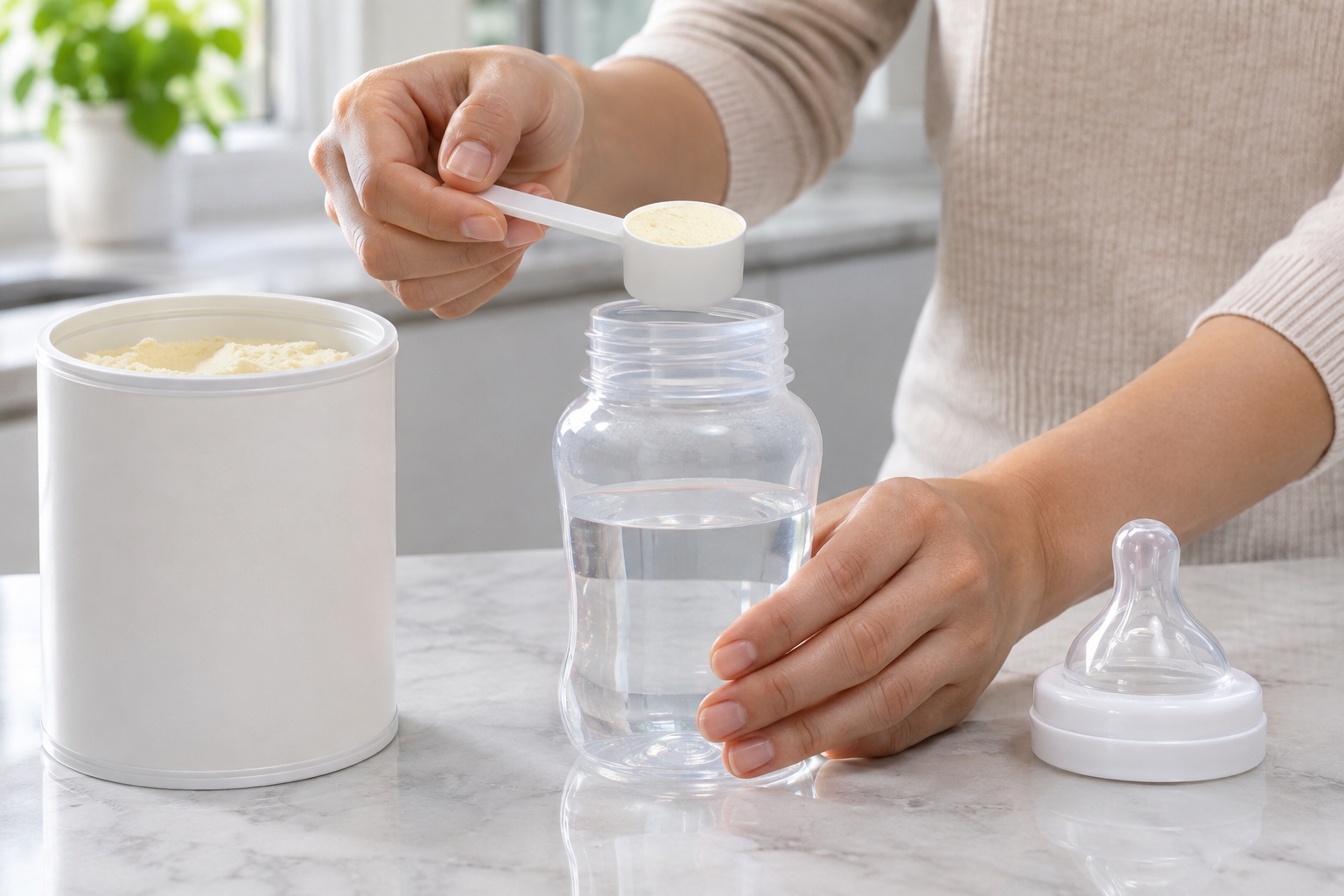
Formula safety begins with two separate checks: the container’s exact mixing directions and water that is safe for preparing baby formula. One does not compensate for the other. Safe water cannot make an incorrect ratio safe, and accurate measuring cannot make questionable water safe.
Identify the formula type before reaching for water
Ready-to-feed formula is used as supplied and should not have water added. Liquid concentrate and powdered formula require preparation according to their own labels. Directions are not interchangeable between products, so recheck the container after changing a brand, format, or package size.
- Wash your hands and prepare the bottle on a clean surface.
- Read the directions on the container you are using now.
- Use the amount of safe water and formula specified on that container, in the stated order.
- For powder, use the scoop supplied with that product rather than a scoop from another container.
- Do not add extra water to stretch a bottle or extra powder to make it more filling. Changing the ratio can be dangerous.
These rules apply whenever formula is part of your baby’s feeding, including when it is used alongside breast milk or expressed milk. They are preparation rules, not a judgment about how you feed your baby.
Resolve uncertain water safety before mixing
Do not assume that bottled water is automatically a better choice than tap water, or that clear water is necessarily safe. Safety depends on the water supply and local conditions. If you use a private well, have aging or damaged plumbing, are under a water advisory, or simply cannot confirm the supply’s safety, contact local public health or your baby’s clinician before preparing powdered or concentrated formula.
Boiling can address some germs, but it does not remove every possible chemical or mineral problem. Follow the instructions attached to a local advisory rather than improvising. If safe mixing water cannot be confirmed, ask whether ready-to-feed formula is an appropriate temporary option because it requires no added water.
Read early development as a pattern, not a performance

A two-week-old development check is most useful when it helps you establish a baseline. Newborn behaviour changes with sleep, hunger, comfort, and recovery from birth. One unusually sleepy or unsettled period tells you less than a clear change that continues across feeds and wakeful periods.
Notice your baby when calm and awake. Look at whether movements appear on both sides, whether your baby responds to your voice or touch, and whether they can become alert enough to feed. You are not trying to score those observations. You are learning what is usual so that a meaningful change is easier to recognize and describe.
If your baby was born early, ask the clinician whether development should be considered using corrected age. Do not silently compare a premature baby’s timeline with that of a baby born at term.
Bring a non-urgent question to a routine appointment when your baby is otherwise feeding and behaving normally. Contact the clinician promptly for a sudden loss of an ability you had been seeing, movement that is consistently one-sided, a major change in alertness, or difficulty waking your baby to feed. If you can safely record an unusual movement, a short video may help the clinician understand it, but recording should never delay urgent care.
A brief log can make these conversations clearer. Record the time, what changed, how feeding went, any wet or stool diaper, and whether the behaviour repeated. The log is evidence for a conversation, not a home diagnostic test.
Give a Coombs-positive result the follow-up it deserves

In a newborn, a positive Coombs result generally means antibodies are attached to red blood cells. Those cells may break down more quickly, which is why a Coombs-positive baby can develop jaundice or anemia. The result identifies a risk that needs interpretation; it does not tell you by itself how unwell a baby is or whether treatment will be needed.
The care team may consider your baby’s age, examination, bilirubin measurements, blood counts, and how those findings change over time. Some babies need observation and repeat testing, while others need treatment such as phototherapy for elevated bilirubin. Only the clinician caring for your baby can decide what the result means in your baby’s situation.
Before leaving the hospital or appointment, make sure you can answer these practical questions:
- Is repeat bilirubin or blood testing required?
- Exactly when and where should the follow-up happen?
- Which changes should prompt a call before that appointment?
- Whom should you contact after hours?
Do not postpone requested testing because your baby appears fine. Jaundice can be difficult to judge from skin colour alone and may be harder to see in some skin tones. Contact the clinician promptly if yellowing seems stronger, your baby looks unusually pale, feeds less effectively, becomes much harder to wake, or otherwise seems unwell.
Trouble breathing, blue or grey colouring, limpness, or unresponsiveness requires emergency help. Suspected fever in a newborn also needs prompt medical assessment; follow the urgent instructions provided by your baby’s care team.
Treat recurring blowouts as a fit problem to investigate
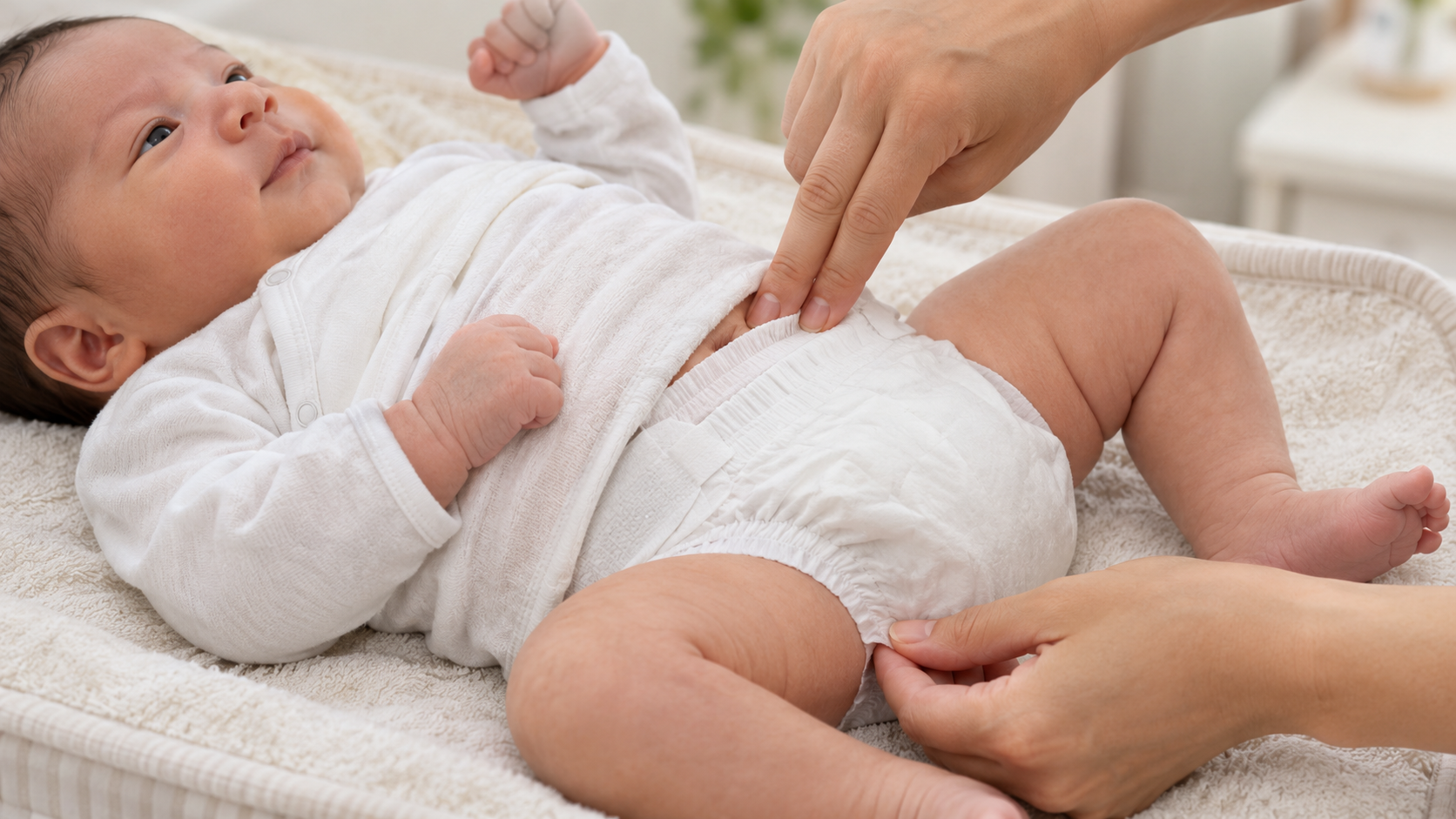
A single blowout can happen when stool volume, body position, and diaper capacity meet at the wrong moment. Repeated leaks, however, give you something to troubleshoot. The location of the mess often points toward the fit issue behind recurring diaper blowouts.
- Up the back: Check whether the back waistband sits high enough and whether the diaper seems too small or already very full.
- Around one leg: Re-centre the diaper, fasten the tabs evenly, and check for a gap around that thigh.
- Around both legs: Pull the leg ruffles outward and consider whether a different size or diaper shape would seal better.
- Only in a seat or carrier: Check the diaper before the trip. Pressure and position can redirect stool, but never alter a car-seat harness or add an unapproved liner to solve a diaper leak.
A larger diaper is not automatically the answer. If the current diaper leaves deep marks, sits low at the back, or cannot cover the bottom comfortably, sizing up may help. If there are obvious gaps at the legs or waist, the diaper may be too large or simply the wrong shape for your baby. Change one variable at a time so you can tell what worked.
Clean the baby first, then the room
- Place your baby on a stable, washable surface and keep one hand on them if the surface is raised.
- Use the clean portion of the diaper to contain as much stool as possible before removing it.
- If the bodysuit has overlapping shoulder panels, pull it down over the body instead of dragging stool over the baby’s head.
- Clean gently from front to back and check skin folds. Avoid scrubbing irritated skin.
- Pat the skin dry before putting on a fresh diaper.
- Contain the soiled clothes, clean the changing surface, and wash your hands.
Newborn stool is often soft, so texture alone does not establish diarrhea. Look for change from your baby’s baseline. Call the clinician if stools suddenly become much more watery or frequent and your baby feeds poorly, vomits repeatedly, is unusually sleepy, has blood in the stool, or otherwise appears unwell. A blowout is a laundry problem; a sick-looking newborn is not.
Before the next feed, confirm the formula directions and water supply you would use. Put any Coombs follow-up in your calendar rather than relying on memory. At the next diaper change, check the waistband, leg seal, and ruffles. Those small checks give you a clearer baseline – and a better reason to act when something truly changes.
References
- Parents – The Best Water To Use for Baby Formula
- Parents – What Does It Mean to Be a Coombs Positive Newborn?
- Parents – Explore Your 2-Week-Old Baby’s Development and Milestones
- Parents – How to Manage Diaper Blowouts: Causes, Prevention, and Cleanup Tips



