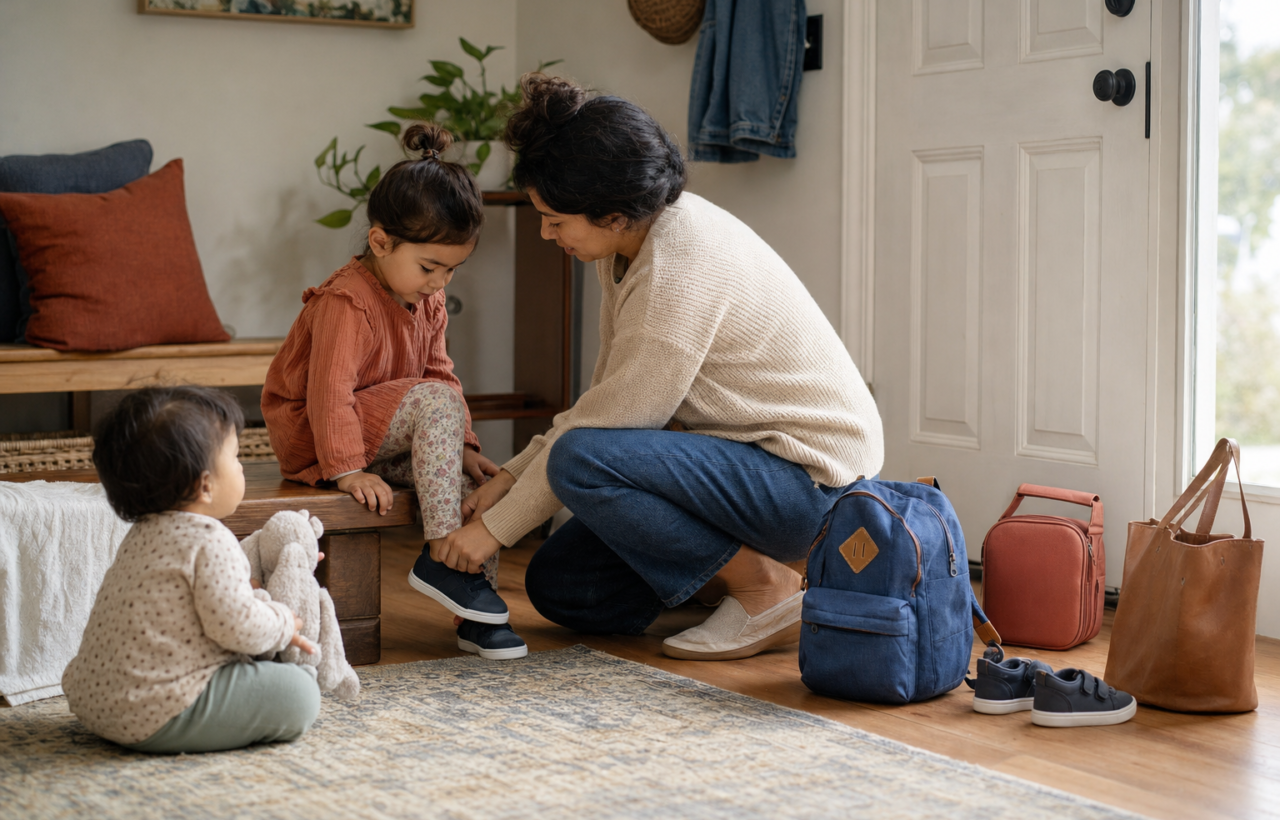
Departure time is getting close. Your toddler has changed their mind about getting dressed, the baby’s bag still needs checking, and a shoe that was by the door has disappeared. If this keeps ending in a rush, the answer is not to push everyone harder. It is to make fewer parts of the morning depend on a young child’s speed, memory, or mood.
With babies and children under three, a stress-free morning does not mean nobody cries or objects. It means the adult knows what comes next, the essentials are ready, and an ordinary delay does not become a household emergency. You can build that kind of morning without creating an elaborate schedule.
Design the morning backwards from departure
Start with the moment you actually need to cross the threshold. That is your departure time. Then work backwards through the tasks that must happen before it. Starting with a preferred wake-up time can hide the real problem: the last part of the routine may contain too many decisions and transitions.
- Write down the time when your family must leave, not the time when you would like to start leaving.
- List only the things that must happen first: essential care, getting dressed, eating, packing required items, putting on outerwear, and getting everyone safely out.
- Put those tasks in the order that creates the fewest handoffs. If breakfast regularly soils an outfit, for example, dressing afterwards may work better for your family.
- Set a separate ready-to-leave target before the true departure time. The gap between them is your buffer.
That buffer is protected space, not time for one more chore. If everyone is ready early, you can use it calmly. If a diaper needs changing, a toddler refuses the first pair of socks, or you have to retrieve something from the refrigerator, the delay has somewhere to go.
Choose the size of the buffer from your real mornings. Notice how much time the recurring delay consumes, then protect at least that part of the schedule. If you keep filling the gap with dishes, email, or tidying, it is no longer a buffer.
Move decisions out of the morning, not every household chore
Night-before preparation works when it removes morning decisions. It stops working when it becomes an exhausting second shift. Focus on items that have delayed your departure before.
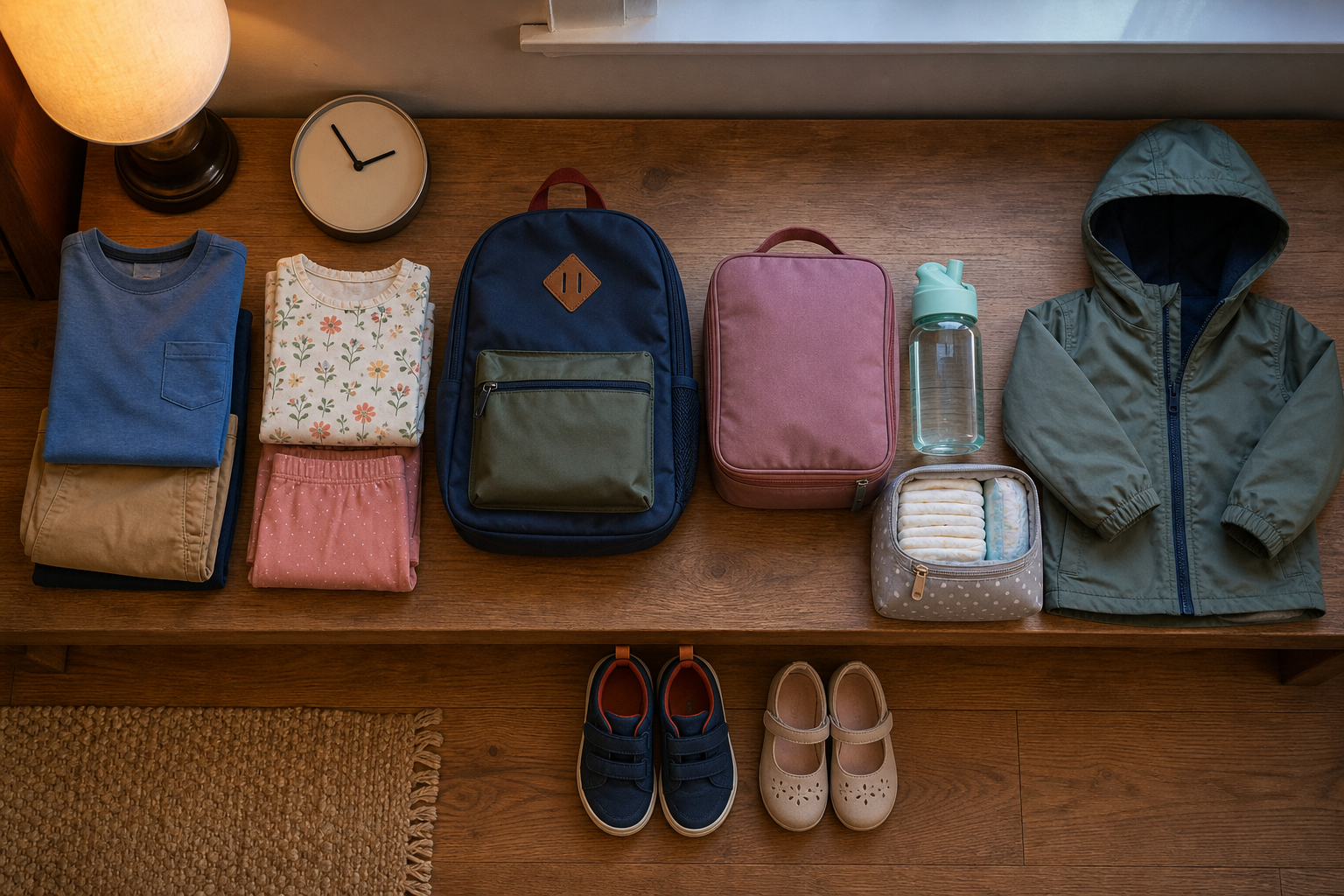
- Lay out a complete outfit, including socks, weather layers, and any item that is usually searched for separately.
- Pack the daycare, nursery, or school bag using the requirements of your child’s setting. Check supplies, spare clothes, forms, and any permitted comfort item.
- Prepare breakfast components that can be stored safely, and choose a default breakfast that does not require a fresh family negotiation.
- Ready the adult’s bag, keys, pass, footwear, and outerwear as carefully as the child’s things.
- Place unusual items, such as a form or special-event clothing, with the bag instead of trusting yourself to remember them during the rush.
Create a launch pad by the door for everything that will leave the house. A hook, shelf, or basket for each person is enough. It should hold tomorrow’s bags, footwear, outerwear, and departure essentials – not become general storage for whatever enters the home.
Some things cannot wait by the door. Do not stage a refrigerated bottle or food item there. Put a visible cue at the launch pad instead, such as a card that says to collect the bottle from the refrigerator. Keep medicines and other adult-controlled items stored as directed and out of a young child’s reach; the cue can point you to them without moving them somewhere unsafe.
Reset the launch pad at a repeatable point, such as when you return home or after the children are settled for the night. If the reset has no trigger, the system will be empty precisely when you need it.
Give your child a sequence they can follow
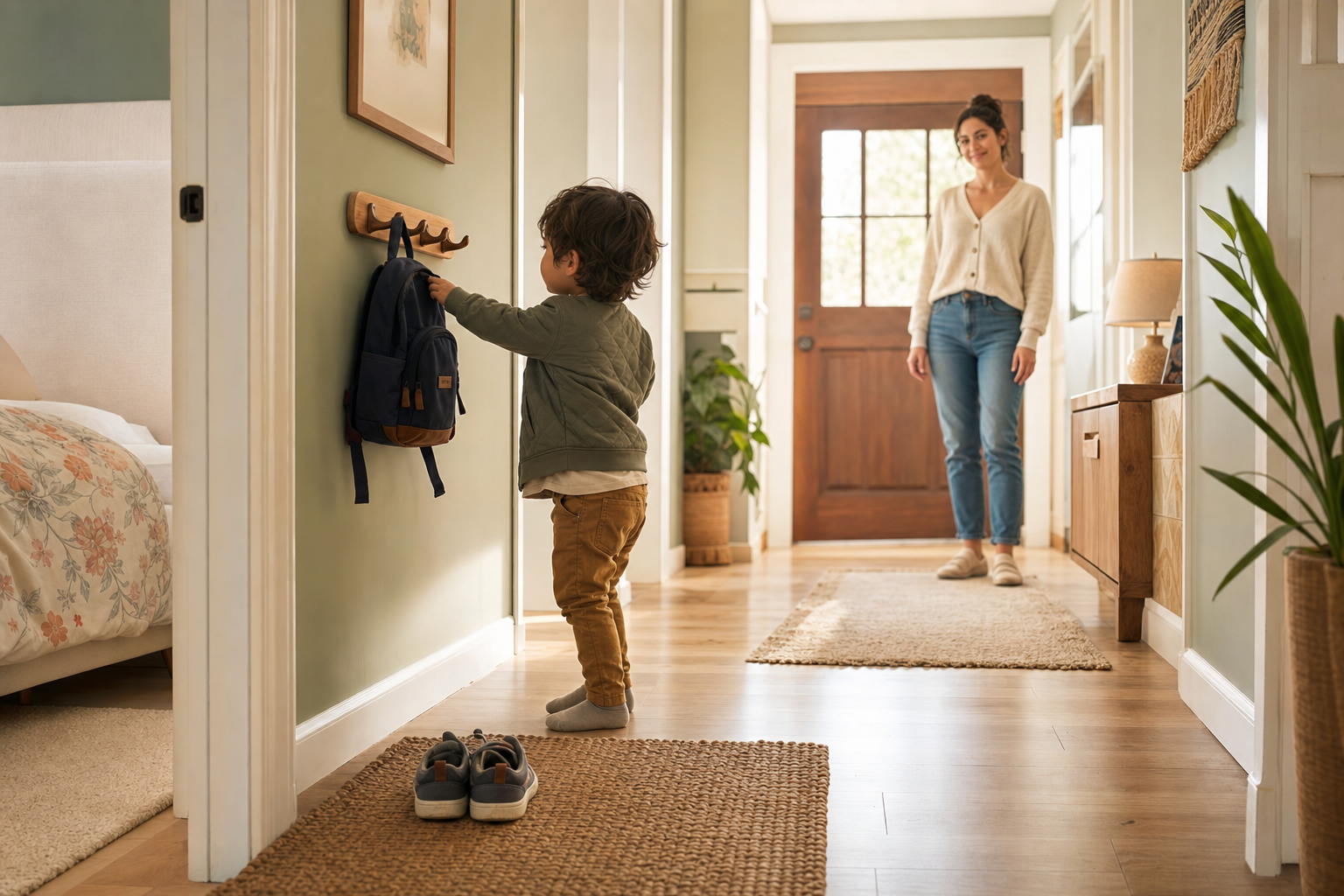
A baby cannot manage a schedule, and a toddler cannot be responsible for getting the household out on time. A young child can, however, begin to recognize a familiar order. Keep the sequence stable even when the exact pace changes.
- Wake up and reconnect.
- Handle the diaper or toilet routine.
- Get dressed.
- Eat breakfast.
- Complete washing and teeth care.
- Put on footwear and outerwear.
- Leave.
This is an example, not a rule. Change the order to fit your child’s care needs and your household. Once you find an order that works, use the same short words for it each morning. A child who can recognize familiar pictures may also benefit from a simple photo strip showing the sequence.
Give one direction at a time. A request to get dressed, find shoes, finish breakfast, and bring a bag asks a toddler to hold several unfinished tasks at once. Start with the next physical action, wait for it to finish, and then cue the next one.
Offer a choice only when either answer works. Two suitable shirts are a real choice. Asking whether your child wants to get dressed when leaving without clothes is not possible turns a required transition into a debate. On a tight morning, fewer open questions usually make the boundary clearer.
You can give a mobile toddler one safe, manageable job, such as choosing between two tops or placing a soft comfort item in the bag. Treat participation as practice, not as a dependency. The routine still needs to work when the child declines, gets distracted, or needs more help.
Build a fallback for hard mornings and repair the first failure
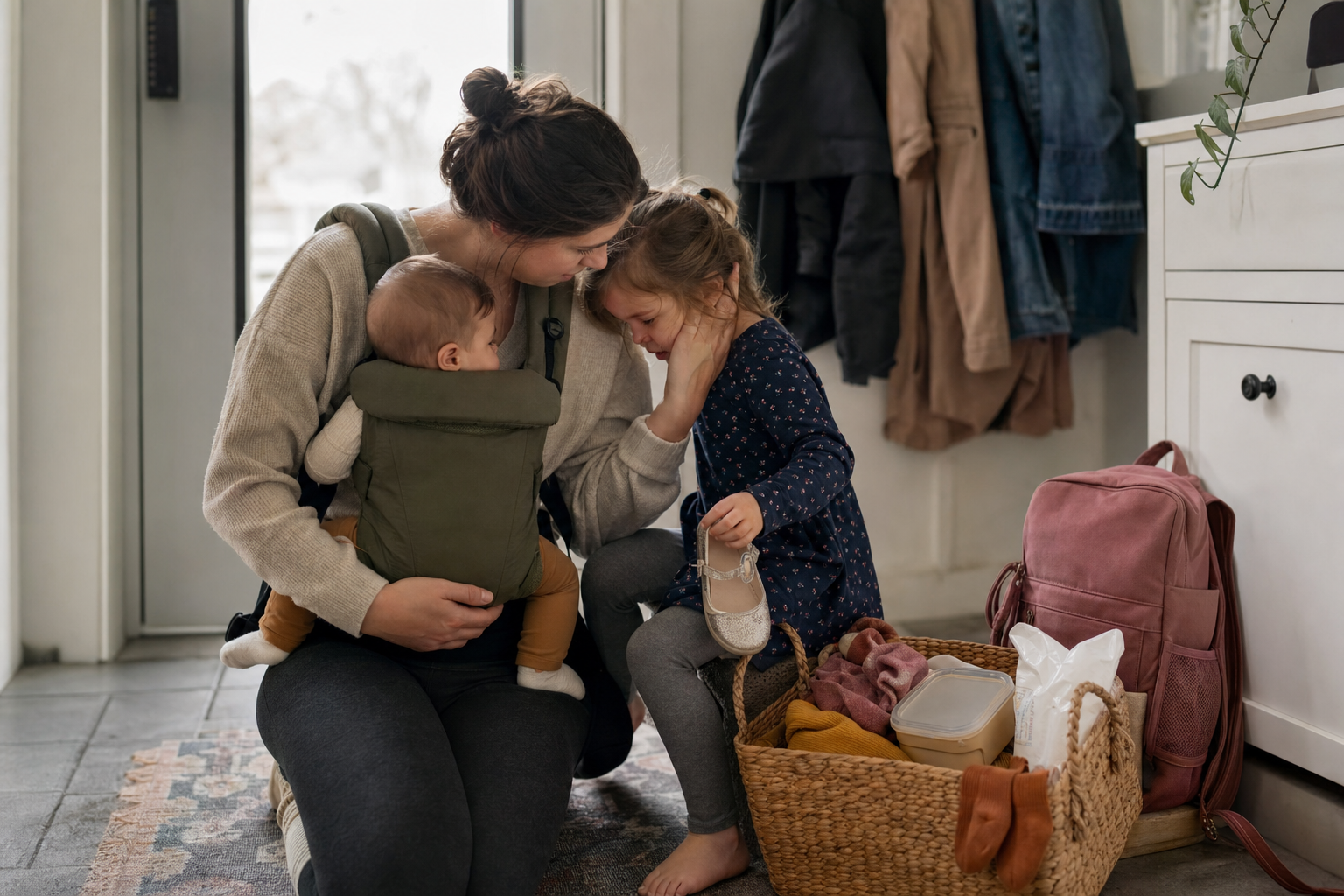
A useful routine needs a reduced version for disrupted nights, surprise messes, and mornings when a child needs more care. Decide what remains essential while everyone is calm. Keep required feeding and care, prescribed medicines used as directed, suitable clothing, necessary childcare items, and a safe departure. Defer cosmetic details, household tidying, and optional errands.
Choose defaults in advance. A default outfit avoids opening the whole wardrobe. A familiar breakfast avoids inventing a menu. A standard packing checklist replaces repeated mental checking. When you are behind, switch to those defaults and stop adding choices.
After drop-off, identify the first point where the routine broke. Fixing that first failure is more effective than blaming the final rush.
- If footwear or bags were missing, change where they are returned and how the launch pad is reset.
- If getting dressed became a long negotiation, move the choice to the previous evening or offer only the prepared options.
- If your child stalled between tasks, shorten the instruction to one action and make the sequence more visible.
- If your own belongings delayed the family, add an adult space to the launch pad and finish your non-child preparation earlier.
- If ordinary baby or toddler care erased the schedule, increase the buffer before departure and keep it free of optional tasks.
Change one recurring failure at a time. Rebuilding the entire morning after one difficult day creates more to remember and makes it harder to tell which change helped.
Key takeaways: reset the routine tonight
- Write down the real departure time and set an earlier ready-to-leave target.
- Prepare the outfit, required bag items, breakfast components, and adult essentials that most often cause delays.
- Give each person’s departure items a defined place near the exit, with visible cues for anything that must stay elsewhere.
- Choose one short morning sequence and give your child only the next instruction.
- Set default options and decide which nonessential tasks will be dropped on a hard morning.
- After the next real run, repair the first snag instead of trying to perfect everything at once.
Tomorrow’s goal is not a silent, perfectly cooperative household. It is to reach the door with the essentials handled and fewer decisions still open. Prepare the exit tonight, test it in a real morning, and adjust the first place where it catches.