
Your newborn finishes a feed, then starts grunting, drawing up their knees or arching their back. Before you change what they eat or reach for a product, work through the problem in order: release air still in the stomach, help lower gas move, then look at how air may be getting in during feeds.
Gas is common while a newborn’s digestion and feeding coordination are developing, and it usually improves substantially by three to four months. Common does not mean every cry is gas, though. The steps below will help you respond without turning every feed into a long search for a burp.
Use a short sequence instead of trying everything at once
Start with the technique most likely to match where the air is. Burping helps air that remains in the stomach. Leg movements, massage and supervised tummy-down positions are more useful when gas has moved into the intestines. Feeding adjustments reduce the amount of air your baby swallows next time.
Key takeaways
- Pause to burp during a feed, not only after it: when switching breasts or after every 2 to 3 ounces of a bottle.
- Try a burping position for two to three minutes. If nothing happens, change the angle once rather than continuing to pat indefinitely.
- If your baby is comfortable without producing a burp, keep them upright for 15 to 20 minutes and move on.
- Use bicycle legs, knee-to-tummy movements or a light abdominal massage when burping does not relieve the discomfort.
- Treat fever, vomiting, blood in the stool or poor weight gain as reasons to call your baby’s doctor, not as ordinary gas.
Burp in the middle of the feed and rotate positions
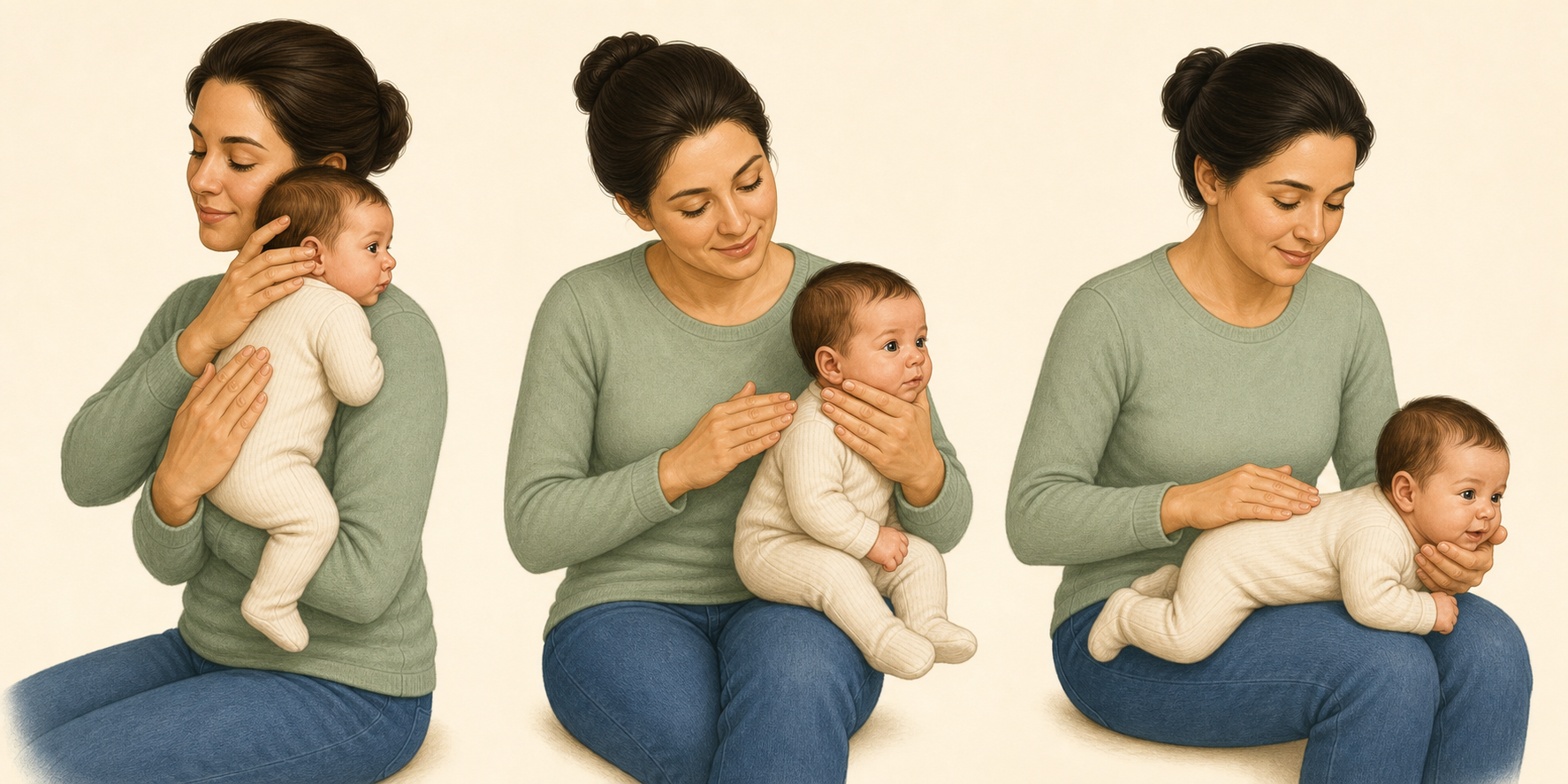
Air becomes harder to bring back up after it passes from the stomach into the intestines. That is why timing matters. For a bottle-fed baby, pause after every 2 to 3 ounces and again at the end if needed. If your newborn finishes a smaller bottle, burp at the end. When nursing, use the natural pause between breasts; if your baby takes only one side, try at the end.
Over your shoulder
- Hold your baby upright against your chest, with their chin resting above your shoulder and their body leaning slightly into you.
- Support their head, neck and bottom securely.
- Use your free hand to pat gently but deliberately, or rub upward along the back.
- If stillness is not working, walk slowly or add a gentle rocking motion while maintaining full support.
The vertical position lets gravity help, while light contact between your shoulder and the baby’s abdomen can provide enough pressure to shift the air. Keep a cloth nearby because a burp can bring up some milk too.
Seated upright on your lap
- Sit your baby on your lap facing slightly forward.
- Support the chest with one hand. Cradle the jaw by placing your thumb and fingers on either side of the chin; do not press the throat.
- Lean your baby forward slightly while keeping the head stable.
- Pat or slowly rub the back with your other hand.
This position lets you see your baby’s face and keeps the body relatively vertical. It can be a useful choice when the over-the-shoulder position tends to bring up a lot of milk.
Face-down across your lap
- Lay your baby face-down across your thighs.
- Support the head and neck, keeping the head level with or slightly higher than the chest.
- Make sure the nose and mouth remain completely unobstructed.
- Pat or rub the back while your lap provides gentle pressure against the abdomen.
This angle can release air when the upright positions do not. It requires careful head support, so use it only while you are fully awake, seated and able to watch your baby’s breathing.
Give each attempt about two to three minutes. If a burp does not come but your baby looks relaxed, that is not a failed feed. Hold them upright against you for 15 to 20 minutes while you remain awake and attentive. When it is time to sleep, place your baby on their back in their usual safe sleep space; never leave them propped upright or put them down to sleep face-down.
When air has moved lower, use gentle abdominal motion

Burping cannot always retrieve air once it has moved beyond the stomach. If your baby is still drawing up their legs or straining after a burping attempt, place them on a stable surface while they are awake and try one of these movements. Your touch should be light. A newborn’s abdomen should never be pressed hard.
- Bicycle legs: With your baby on their back, hold the lower legs gently and alternate them in a slow cycling motion for 30 to 60 seconds. The repeated compression and release can help move trapped gas along.
- Knees toward the tummy: Bring both knees together, press them gently toward the abdomen, hold for a few seconds, then release. Repeat several times without forcing the hips or knees.
- I-Love-You massage: Warm your hands and use two fingers with very light pressure. From your baby’s perspective, trace an I down the left side of the abdomen. Make an upside-down L across the upper abdomen and down the left side. Finish with an upside-down U by moving from the lower right, up the right side, across the top and down the left. This follows the general route of the large intestine.
- Football hold: Lay your baby tummy-down along your forearm, with the head near your elbow and the legs on either side of your hand. Support the body securely, keep the airway clear and walk or rock gently.
- Supervised tummy time: A brief, fully supervised tummy-time session places natural pressure on the abdomen and may help gas pass. Use this only when your baby is awake and alert. Tummy time is never a sleeping position.
These gas-relief movements are options, not a routine you must complete in full. Stop once your baby settles. If handling makes the crying sharper or your baby appears unwell, move from home techniques to medical advice.
Reduce the air entering at the next feed

If discomfort returns after most feeds, the most useful change may happen before the burping stage. Watch and listen while your baby eats. Clicking, repeated pulling away, gulping and milk flowing faster than your baby can comfortably manage are practical clues that extra air may be entering.
- When nursing: A shallow latch can allow more air in. Clicking or repeatedly losing the latch deserves a closer look, especially when it happens throughout a feed. A lactation consultant can assess the latch and help you manage a fast letdown rather than leaving you to troubleshoot by guesswork.
- When bottle-feeding: A nipple that flows too quickly can make a newborn gulp. Check that the flow is appropriate for a newborn and move up a flow level only when your baby is ready, not simply because of the age printed on a package.
- For paced bottle feeding: Hold the bottle more horizontally and allow your baby to control the rhythm instead of letting gravity produce a continuous fast stream.
- For either feeding method: Keep your baby’s head higher than the stomach, at roughly a 45-degree angle rather than feeding flat. Pause when you hear sustained gulping.
Crying can create a frustrating loop: discomfort triggers crying, crying brings in more swallowed air, and the added air creates more discomfort. When possible, settle your baby enough to restore a manageable feeding rhythm before continuing. You are looking for a feed that is coordinated and calm, not one that must be completed at a particular speed.
Be deliberate about drops, probiotics and medical help
What gas products can and cannot do
Infant gas drops commonly contain simethicone, which changes the surface tension of gas bubbles so they can combine and pass more easily. It is not absorbed into the body and is generally considered safe, but evidence for how much it helps is mixed. Some babies appear to respond; others do not. Ask your pediatrician before giving it, then track whether there is a clear change instead of assuming continued dosing must eventually work.
Probiotics are not an immediate gas remedy. Some evidence supports Lactobacillus reuteri for reducing crying over several weeks in breastfed babies with colic, but the evidence is stronger for breastfed babies than for formula-fed babies. That makes probiotics a pediatrician conversation for persistent symptoms, not the next step during one difficult feed.
Notice whether the pattern looks more like gas or colic
| Clue | More consistent with trapped gas | More consistent with colic |
|---|---|---|
| Timing | Often connected to feeds | Often peaks in the late afternoon or evening |
| Response | May improve after burping, passing gas or changing position | Comfort measures offer little or only temporary relief |
| Duration | Episodes tend to settle once the discomfort passes | Crying can continue for more than three hours |
| Typical pattern | Variable across the newborn period | Often begins around 2 to 3 weeks and peaks around 6 weeks |
The classic rule of threes for colic is crying for more than three hours a day, on more than three days a week, for more than three weeks, in an otherwise healthy baby. Colic is not something you need to confirm alone. Call your pediatrician when crying follows that pattern or when repeated discomfort continues despite improved feeding and burping. Reflux or milk protein sensitivity can sometimes resemble a simple trapped-air problem and needs professional assessment.
Call promptly when symptoms go beyond ordinary gas
Fever, vomiting, blood in the stool or poor weight gain should prompt a call to your baby’s doctor. A newborn with a fever needs prompt medical assessment; do not wait to see whether burping or bicycle legs changes it. Home gas techniques are for a baby who otherwise appears well, feeds adequately and settles between episodes. They are not a substitute for evaluation when your baby appears ill.
At the next feed, choose one useful change: add a mid-feed burp, slow a gulping bottle or correct the feeding angle. Note what happened and repeat the change consistently for the next few feeds. A clear pattern will tell you more than cycling through every remedy in one unsettled evening.
References
- Newton Hush – Newborn Gas Relief: How to Soothe a Gassy Baby
- Newton Hush – How to Burp a Newborn: Positions, Timing, and Tips