If an app says you ovulated yesterday, sex may still lead to pregnancy, but the useful window is closing quickly. If you are deciding whether to start trying this year or wait, age matters too, just not as a single “best age” that should override the rest of your life.
It helps to separate two clocks. The cycle clock tells you when sex is most likely to result in conception. The life-stage clock helps you weigh changing fertility against your health, relationships, emotional readiness, finances, and plans. Neither clock can guarantee an outcome, but both can help you make a clearer next decision.
For this cycle, aim before ovulation rather than after it
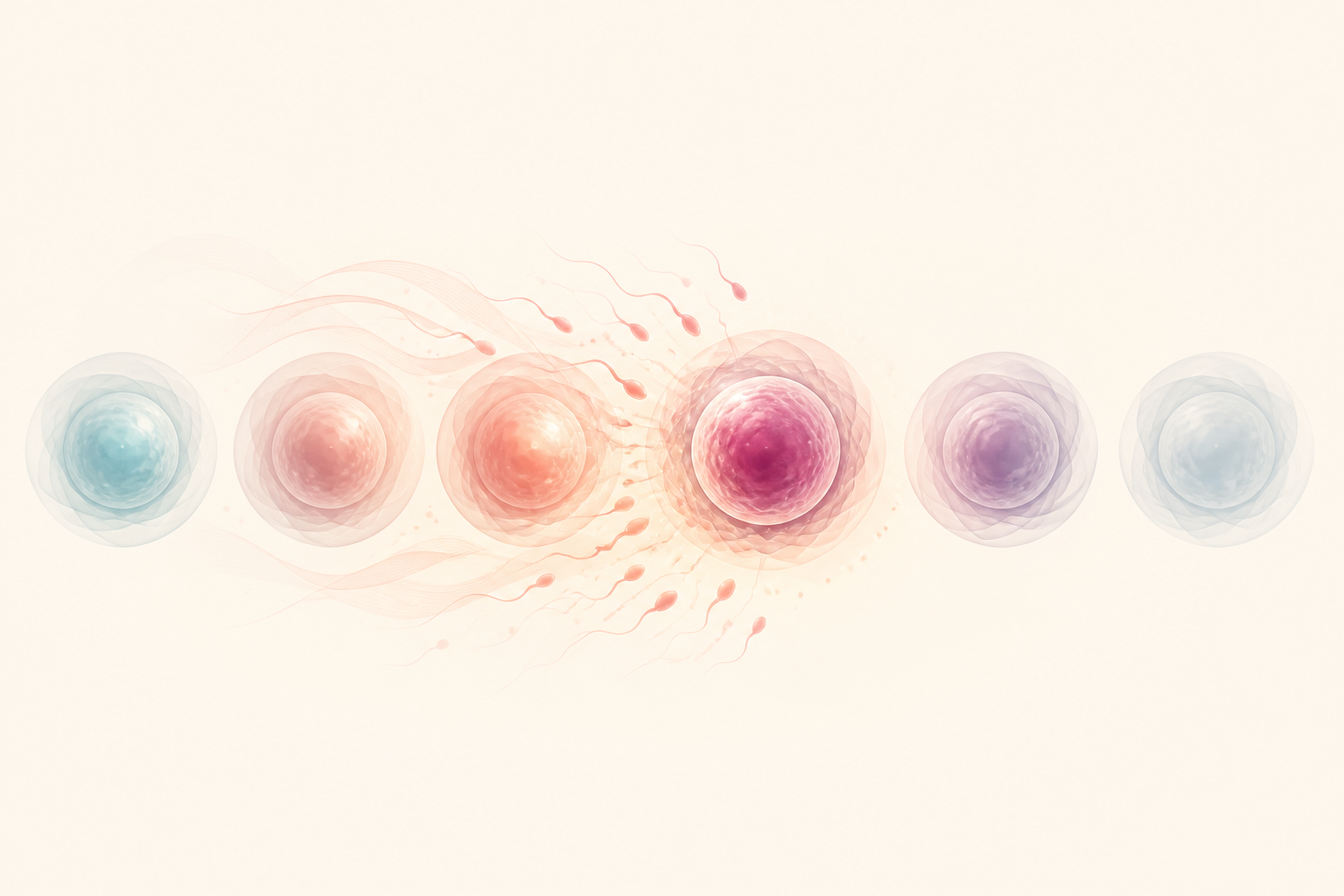
The fertile window is uneven. Sperm can survive in the reproductive tract for up to five days under suitable conditions, while a released egg generally remains available for fertilization for only about 12 to 24 hours. Your odds are therefore usually better when sperm are already present before the egg is released.
If you are trying to conceive through penis-in-vagina sex, a practical approach is to have sex every day or every other day during the four days before expected ovulation, on the expected ovulation day, and on the following day. That schedule creates coverage without requiring you to identify the exact hour of ovulation. If daily sex feels tiring, stressful, painful, or simply unrealistic, every other day still covers the days that matter most.
If ovulation has probably already happened, trying is not automatically pointless. Conception may still be possible during the first 12 to 24 hours after the egg is released, with a smaller possibility around 48 hours afterward. Once that short period passes, the next meaningful opportunity is usually the next cycle.
Older, often-cited estimates show how sharply the probability can change around ovulation:
| Timing of sex | Estimated chance of pregnancy |
|---|---|
| One day before ovulation | 21% to 35% |
| On ovulation day | 10% to 33% |
| One day after ovulation | 0% to 11% |
| Two days after ovulation | 0% to 9% |
These are population ranges, not a personal countdown clock. The day of ovulation is often estimated rather than directly observed, and timing is only one part of conception. Even among healthy couples in their 20s and early 30s, the chance of conception in a given cycle is about 25%. A period after one carefully timed cycle does not prove that you chose the wrong days or that something is wrong.
This timing advice is for people trying to conceive. If you are trying to avoid pregnancy, do not use an app or an estimated ovulation date as your only contraceptive plan. Cycle timing can shift. Use an appropriate contraceptive method, and if unprotected sex has already happened, contact a pharmacist or health care provider promptly to discuss your options.
Track a pattern instead of assuming ovulation happens on day 14

A calendar prediction is a starting point, not a measurement. Menstrual cycles from 21 to 35 days can fall within the normal range, and ovulation commonly occurs about 14 days before the next period begins. That is different from saying everyone ovulates on cycle day 14.
For example, someone with a longer cycle may ovulate later than day 14. Someone whose cycle length changes from month to month may find that an app’s predicted date moves or misses the fertile window. Calculators generally use the first day of your last period and an average cycle length, so they tend to be more useful when cycles are regular.
- Mark cycle day one. This is the first day of menstrual bleeding. Record several cycle lengths so you can see whether your pattern is consistent rather than relying on one month.
- Use the calendar to choose a broad window. Work backward from when your next period is expected instead of automatically circling day 14.
- Watch cervical mucus. Near the fertile period, it can become clear, slippery, and stretchy. Treat that change as a reason to begin or continue your every-day-or-every-other-day schedule.
- Consider an ovulation predictor test. It gives you another piece of information when a calendar alone feels too uncertain. Follow the test instructions rather than assuming every brand works the same way.
- Record basal body temperature if you want a longer-term pattern. Basal temperature can rise about 0.5 to 1 degree Fahrenheit after ovulation. Because the rise occurs afterward, it is more useful for recognizing a pattern across cycles than for providing advance notice in the current one.
You do not need to use every tracking method. Start with the least burdensome combination that answers your question. A calendar plus cervical-mucus observations may be enough for one person; another may prefer an ovulation test or wearable monitor. More data is useful only if it helps you act. If it turns sex into an exhausting daily performance review, simplify the system and return to broad coverage of the likely fertile days.
Use age as a planning signal, not a verdict

There is no universally correct age to start a family. Fertility changes with age, but biological probability is not the same as personal readiness. Your decision may also involve your health, desire to parent, relationship or support network, work, housing, child care, and financial stability.
In your 20s
Fertility is generally highest in the early 20s. Healthy couples ages 20 to 24 have about an 85% chance of conceiving within a year of unprotected sex. That is a cumulative chance across a year, not the probability from one encounter or a promise that conception will happen immediately.
Fertility in the late 20s tends to remain similar to fertility in the early 20s, and pregnancy-complication risk is generally at its lowest in this period compared with earlier or later ages. Those biological advantages still do not answer whether you have the stability, resources, support, or desire to become a parent now.
In your 30s
For people with ovaries, fertility typically begins to decline around age 32, with a more pronounced decline by about age 37. This is a slope, not a switch that flips on a birthday. Pregnancy after 35 is common, and many people have healthy pregnancies in their late 30s.
At the same time, it is reasonable to take the changing probabilities seriously. After 35, risks including hypertension, gestational diabetes, preeclampsia, and chromosomal abnormalities become more common. A preconception appointment is useful at any age and can be especially helpful in the mid- to late 30s. A clinician can discuss your own health and history rather than asking you to make decisions from age averages alone.
Around 40 and beyond
By age 40, a healthy person’s chance of becoming pregnant without intervention is about 5% to 10% per menstrual cycle. Risks of ectopic pregnancy, miscarriage, preeclampsia, gestational diabetes, placenta previa, low birth weight, and preterm labour are also higher. Those facts justify an individualized medical conversation; they do not mean a healthy pregnancy is impossible.
If age is central to your decision, replace the vague question “Am I too old?” with three answerable ones: Do I want to try now? Is there a health reason to get advice before trying? What practical condition would need to change before I felt ready? That separates a medical question for a clinician from the personal decisions only you and your family can make.
Key takeaways
- Your best coverage begins before ovulation because sperm usually survive longer than an egg.
- If you are trying to conceive, aim for sex every day or every other day during the four days before expected ovulation, on the expected day, and the day after.
- Sex shortly after ovulation can still result in pregnancy, but the probability drops quickly after the egg’s 12- to 24-hour lifespan.
- Do not assume cycle day 14 is universal. Use your cycle pattern and, if helpful, cervical mucus, an ovulation test, basal temperature, or a wearable monitor.
- Age changes average fertility and pregnancy risks, but it cannot decide whether you are personally ready or predict exactly what will happen in your next cycle.
- Timing improves the opportunity for conception; it does not make pregnancy inevitable.
For your next cycle, estimate ovulation, mark the four preceding days, and choose a daily or every-other-day schedule you can realistically sustain. If the larger question is whether age or health should change your timeline, book a preconception appointment instead of trying to solve an individual medical decision with a calendar alone.
References
- Parents – What Are Your Chances of Getting Pregnant After Ovulation?
- Parents – What Experts Say About the Best Age to Get Pregnant