
Your period is late, but the test looked negative until a faint line appeared much later. Or you felt unmistakably pregnant yesterday, and today the nausea and breast tenderness are gone. Perhaps an early scan did not show the heartbeat you expected. These moments feel decisive, but they often are not.
Your safest next step is not to interpret every symptom more intensely. It is to separate what can be checked now, what needs properly timed follow-up, and what should prompt urgent medical care.
Early symptoms are clues, not confirmation
Nausea, fatigue, breast tenderness, mild cramping, spotting, bloating, and a late period can happen in early pregnancy. They can also occur around a menstrual period or with other physical changes. A symptom checklist cannot confirm pregnancy, identify where a pregnancy is developing, or tell you whether it is progressing normally.
The same limit applies when symptoms fade. Early pregnancy symptoms can change from one day to the next. A morning without nausea is not proof that something is wrong, just as strong nausea is not proof that everything is fine. Try not to use symptom intensity as a daily test of the pregnancy.
Bleeding and pain deserve more attention, but their meaning still depends on the full situation. Note where the pain is, whether it is worsening, how much you are bleeding, and whether you feel faint or unwell. Those details are more useful to a clinician than a general statement that you are spotting or cramping.
A pregnancy test is only readable within its time window
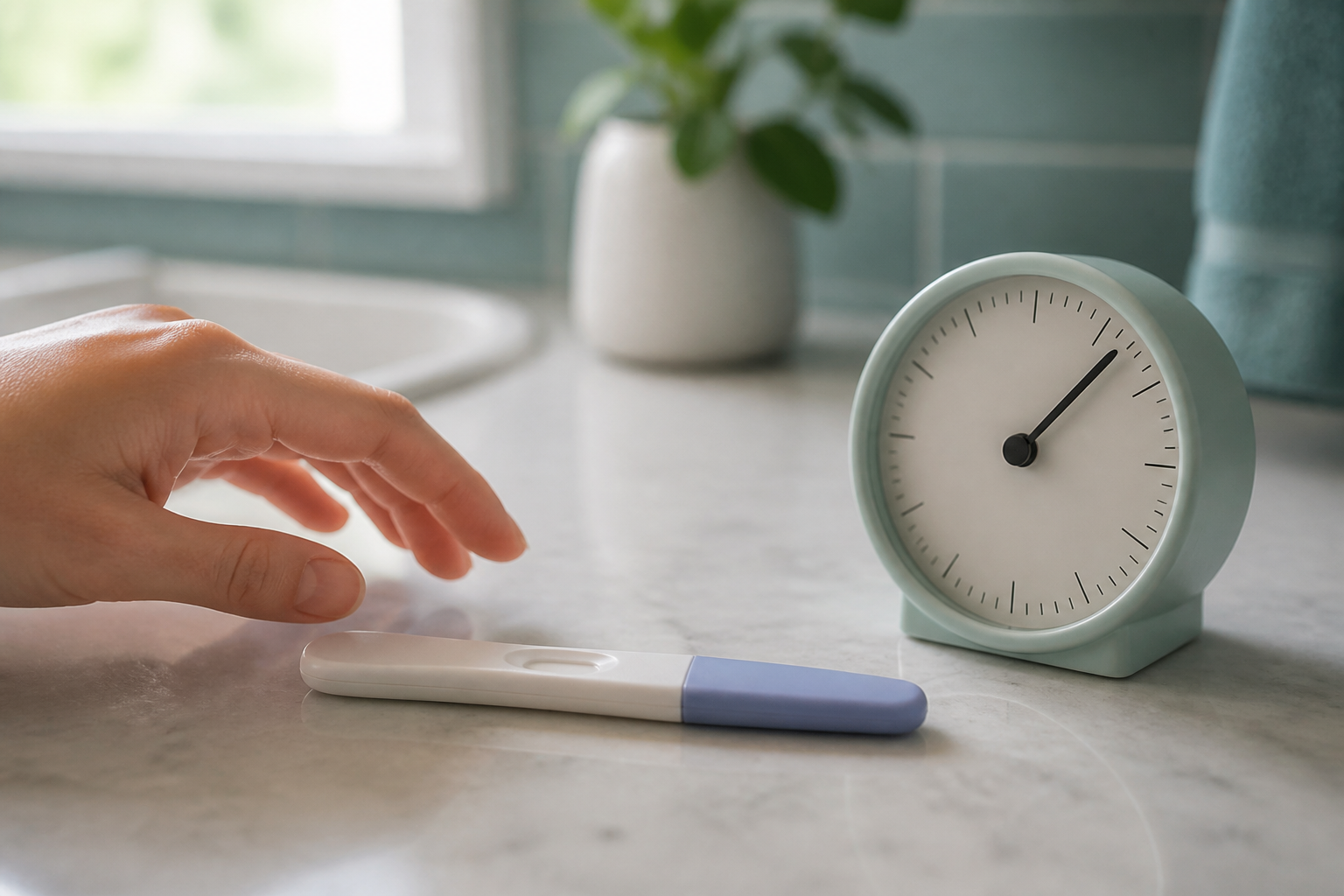
Follow the instructions for your exact test, including when to check the result and when to stop reading it. A second line that appears only after the permitted reading window may be a misleading false positive. Do not treat a line discovered later on a test left beside the sink or retrieved from the bin as confirmation of pregnancy.
If the result is unclear, use a new test rather than repeatedly inspecting the old one. Check the expiry date, follow the sampling instructions, set a timer, and read the result in the stated window. Make sure the expected control indicator appears; without it, the test has not shown that it worked correctly.
- Read the complete instructions before opening the test.
- Set a timer for the manufacturer’s reading window.
- Record only what is visible during that window.
- Discard the test afterward so you are not tempted to reinterpret drying lines.
- If the answer remains unclear, follow the package directions for retesting or contact a health-care professional.
A correctly timed positive home test supports that pregnancy hormone is present. It cannot establish the pregnancy’s location, exact stage, or viability. Comparing line darkness across different test brands, lighting conditions, photographs, or tests taken only hours apart does not reliably answer those questions. If follow-up is needed, let a clinician advise which test or examination should come next and when it should happen.
An early ultrasound is a snapshot, not always a verdict

Hearing that an ultrasound did not detect a fetal heartbeat can be frightening. It may be associated with miscarriage, but other factors can also explain that finding on an early scan. One very early image may not provide enough information for a final conclusion.
Pregnancy dating can be less certain than it looks on an app. The date of the last menstrual period is useful, but it does not directly measure when ovulation, fertilization, or implantation occurred. Cycle variation and uncertainty about dates can therefore affect what should be visible at a particular appointment. The type of scan and the measurements obtained also matter.
Your clinician may need to interpret the scan alongside your dates, symptoms, measurements, and other clinical information. They may recommend another ultrasound or other follow-up rather than making an immediate diagnosis. Ask for the plan in concrete terms: what was seen, what remains uncertain, what the next assessment is intended to clarify, and whom you should contact if symptoms change before then.
Do not use a sudden change in nausea, breast tenderness, or fatigue to settle what the scan could not. Symptoms cannot replace the planned follow-up. Likewise, do not assume that an uncertain early scan definitely means miscarriage unless the clinician responsible for your care has explained that the diagnostic criteria have been met.
Use a short action plan while the answer is unclear

Uncertainty becomes harder to manage when every new sensation starts a fresh round of searching. Put the facts in one place and use them to decide the next step.
- Write down the relevant dates. Include the first day of your last menstrual period if known, whether your cycles are usually regular, and the dates of any tests or scans.
- Record test results precisely. Note the test brand, whether the control indicator appeared, when you read the result, and whether a second line was visible inside or only after the instructed window.
- Describe symptoms, not conclusions. Record bleeding, pain location, whether pain is worsening, dizziness, faintness, fever, or feeling acutely unwell. Avoid turning those observations into a self-diagnosis.
- Contact the appropriate clinician. A positive test read within the correct window, unresolved conflicting results, pain, or bleeding are reasons to ask a primary-care, prenatal-care, or reproductive-health professional what follow-up is appropriate.
- Follow one plan. Use the retesting or scan schedule provided by the test instructions or your clinician. Repeating home tests every few hours and comparing line darkness is more likely to create noise than clarity.
If you might be pregnant, mention that possibility before starting a new medicine or treatment. Do not abruptly stop a prescribed medicine on your own; ask the prescriber or a pharmacist how to handle it while your pregnancy status is being clarified.
Do not wait on urgent warning signs
Seek urgent medical assessment for severe or worsening abdominal or pelvic pain, especially pain concentrated on one side; shoulder pain; fainting or marked dizziness; heavy bleeding; difficulty breathing; or feeling acutely unwell. These symptoms can require prompt evaluation even when a home test was negative, faint, or difficult to interpret. If you are fainting, severely unwell, or cannot travel safely, call local emergency services.
Bleeding, persistent pain, fever, or any symptom that concerns you also warrants prompt advice from a health-care professional. An online description cannot determine the cause or rule out a complication in your individual situation.
Key takeaways
- Symptoms alone cannot confirm pregnancy or show whether it is progressing normally.
- Read a home pregnancy test only within the manufacturer’s stated time window.
- Do not count a line that first appears later as a confirmed positive; use a fresh test or obtain professional advice.
- No heartbeat on a very early ultrasound can have more than one explanation and may require planned follow-up.
- Severe or one-sided pain, shoulder pain, fainting, marked dizziness, heavy bleeding, or feeling acutely unwell needs urgent assessment.
Before your next test or appointment, put the instructions, dates, results, symptoms, and clinician’s contact details together. A properly timed test and a defined follow-up plan will give you more useful information than another night spent examining an old test or measuring every change in how you feel.
References
- Parents — What No Fetal Heartbeat on an Early Ultrasound Means
- Parents — Why Did a Second Line Appear Later on My Pregnancy Test?