You hit your child. The next decision matters: stop the incident, make sure your child is safe, and take responsibility without asking them to make you feel better.
Repair cannot erase what happened. It can begin restoring safety, however, when your apology is clear and your behaviour changes. For a baby or toddler, that means fewer explanations, more calm repetition, and a concrete plan that prevents your anger from reaching your hands again.
Make the first few minutes about safety

Do not try to teach a lesson while you are still flooded with anger. Your first job is to end the physical contact and make the situation safe.
- Stop and move your hands away. Put down anything you are holding. If your child is somewhere unsafe, move them to a safe, supervised place as calmly as you can.
- Check your child. Look for signs that they may be hurt. If there could be an injury, or you are uncertain, contact an appropriate medical professional promptly. Use emergency services if your child is in immediate danger.
- Lower the intensity. Use a quiet voice and only the words needed for safety: “I am stepping back. You are safe. I am here.” A long explanation can wait.
- Get another adult involved if necessary. If you are afraid you might hit again, ask a trusted adult to take over. Distance can interrupt the danger, but a baby or toddler must still have safe supervision.
Do not insist that your child stop crying, look at you, hug you, or accept an apology. Crying, turning away, becoming quiet, or reaching for another caregiver may be the only ways a very young child can communicate what they need.
If you cannot keep your child safe in that moment, contact someone who can be physically present. If the risk is immediate and no safe adult is available, call your local emergency or crisis service.
Give an apology your young child can understand

Hitting is not a recommended form of discipline. Say that plainly. An apology loses its meaning when it is followed by a justification, a lecture, or a request for the child to reassure the parent.
A useful apology has five parts:
- Name the action: “I hit you.”
- Say it was wrong: “Hitting is not okay.”
- Take responsibility: “You did not make me do that.”
- Acknowledge the effect: “That hurt and scared you.” Use only what you can reasonably observe.
- Name your next action: “Next time I feel that angry, I will step away and get help.”
Put those pieces together in one short statement: “I hit you. That was wrong. You did not make me hit. I am sorry. I am going to keep my hands safe and ask for help when I am angry.”
An infant will not understand the full explanation, and a young toddler may grasp only a few words. Keep it simple anyway: “I hit. That was wrong. I am sorry. Gentle hands.” The words keep your response honest; your calm handling and repeated safe behaviour give them meaning.
Leave these phrases out:
- “I am sorry, but you would not listen.”
- “Look what you made me do.”
- “If you had behaved, I would not have hit you.”
- “I am the worst parent.”
- “Do you forgive me?”
The first three put responsibility on the child. The last two ask the child to manage your guilt. Process that guilt with another adult or a professional, not with the baby or toddler who was hit.
Keep the boundary without defending the hit
Your response crossed a boundary, but the original safety limit may still be necessary. Separate the two issues so your child does not hear either “hitting was justified” or “all limits have disappeared.”
- If your toddler threw a hard toy: “I should not have hit you. Throwing this toy is not safe, so I am putting it away.”
- If your toddler hit or bit: “I will not hit you. I also will not let you bite me. I am moving back and helping you stop.”
- If your child resisted leaving: “I should not have hit. We still need to leave, and I will help you into the stroller with safe hands.”
Use a consequence connected to what happened: remove the object being thrown, block access to a danger, move out of biting range, or help the child through the transition. Do not add extra punishments because you feel ashamed or because the first conflict has become a power struggle.
Then offer connection without demanding it. You might say, “Would you like me to sit here or over there?” or “Would you like a cuddle or some space?” With a baby, stay nearby, soften your voice, and return to familiar care such as feeding, changing, rocking, or the usual bedtime routine.
If your child reaches for another safe caregiver, let them. If they do not want to be touched, do not force affection to prove that the relationship is repaired. Stay available and continue meeting their needs. A gift or special treat may distract from the moment, but it does not replace responsibility and safer behaviour.
Build a plan for the next high-pressure moment
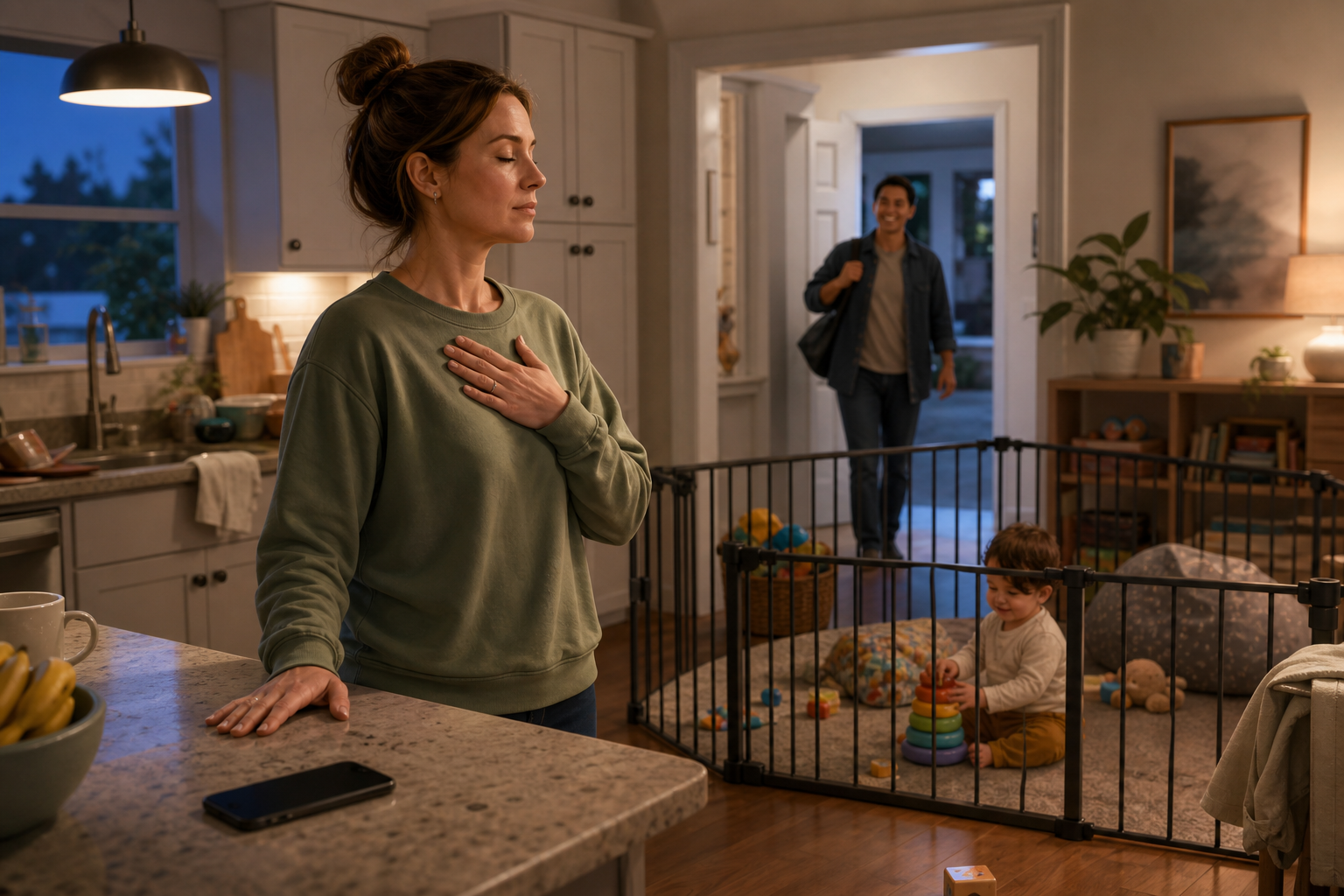
An apology describes what should change. A prevention plan specifies how it will change. Write yours while the incident is still clear enough to examine honestly.
Start with the minute before the hit:
- What was happening around you: prolonged crying, a rushed transition, repeated night waking, food being thrown, or something else?
- What did you notice in your body: clenched hands, heat, a racing heart, louder speech, or the urge to grab?
- What thought pushed you closer to acting: “This has to stop now,” “My child is doing this to me,” or “I have no way out”?
- At what earlier point could you have paused safely?
- Who can take over, answer a call, or come to you when you are nearing that point?
These conditions do not cause or excuse hitting. Identifying them helps you intervene earlier, before the urge becomes an action.
Turn the answers into an if-then plan. Make it specific enough to use when you are tired:
- “If I notice my hands clenching, then I will put them behind my back, lower my voice, and take three steps away while my child remains safely supervised.”
- “If the baby’s crying feels unbearable, then I will place the baby in a safe crib, step back briefly, and call my support person.”
- “If my toddler hits me, then I will move out of reach, block another hit if needed, and say, ‘I will not let you hit.’”
- “If I cannot handle the next part safely, then I will say, ‘I am too angry to do this safely. Please take over now.’”
Tell a trusted adult what happened and show them the plan. Choose the person before the next difficult moment, not during it. Save their number where you can reach it quickly and agree on the exact words that mean you need immediate help.
Seek outside support if hitting has happened more than once, you think it may happen again, your anger feels difficult to control, your child appears afraid of you, or there may have been an injury. A family doctor, pediatrician, or licensed mental-health professional with experience in parenting and early childhood can help assess what support is appropriate. A parenting program can help you practise non-physical ways to set limits, but it is not a substitute for urgent help when a child is unsafe.
Key takeaways
- End the physical contact, check your child, and bring in another adult if you cannot stay in control.
- Apologize briefly and directly: name the hit, say it was wrong, take responsibility, and explain what you will do differently.
- Do not blame your child, ask them to comfort you, demand forgiveness, or force physical affection.
- Keep necessary safety limits, but enforce them with a related, non-physical response.
- Identify your earliest warning sign and write an if-then plan for the next high-pressure moment.
- Get professional or emergency help when there is an injury, immediate danger, repeated hitting, or a real concern that you may hit again.
Your next step is concrete: give the clear apology, write down one exit line, and tell one trusted adult what happened. Do those three things before the next difficult moment. The repair begins with words, but your child will experience it through what your hands and choices do next.
References