

You have handled the teeth, pajamas, water, missing stuffed animal, and every other small negotiation. Then your child asks you to make up a story, and your mind produces absolutely nothing.
You do not need a clever plot. You need a small structure you can remember while tired, a way for your child to participate without taking over, and an ending that does not create another round of bedtime. Here is a system you can use tonight and reuse tomorrow.
Decide what counts as a successful bedtime story
A bedtime story has a different job from a daytime story. It does not have to surprise your child, teach a formal lesson, or build toward a spectacular finish. Its job is to give you a few minutes of calm connection while the day winds down.
At bedtime, being less interesting can work in your favour. A complicated mystery creates questions. A daring rescue invites sound effects. A gentle story about a bear putting blocks into a basket has fewer places to accelerate.
Calm does not have to mean lifeless. Give the story four simple ingredients:
- A familiar character: a sleepy rabbit, a toy truck, your child’s stuffed bear, or a family pet.
- An ordinary task: finding a sock, carrying a cup to the kitchen, closing the curtains, or putting toys away.
- A gentle obstacle: the basket is missing, the cup rolls under a chair, or the last toy belongs on a high shelf.
- A settled ending: the task is finished, everyone returns home, and the character gets comfortable.
Keep the stakes low from the first sentence. If a dragon appears, it can be looking for its blanket rather than threatening the village. If a spaceship appears, it can be returning library books rather than escaping an exploding planet. The character can still have a problem; the problem simply does not need to wake the room back up.
A successful story also does not have to make your child fall asleep before you finish. You are creating a predictable transition, not performing a sleep trick. End when the small problem is resolved, then use the same closing line each night: “That is where the story rests until tomorrow.”
Use an eight-line formula when your mind is blank
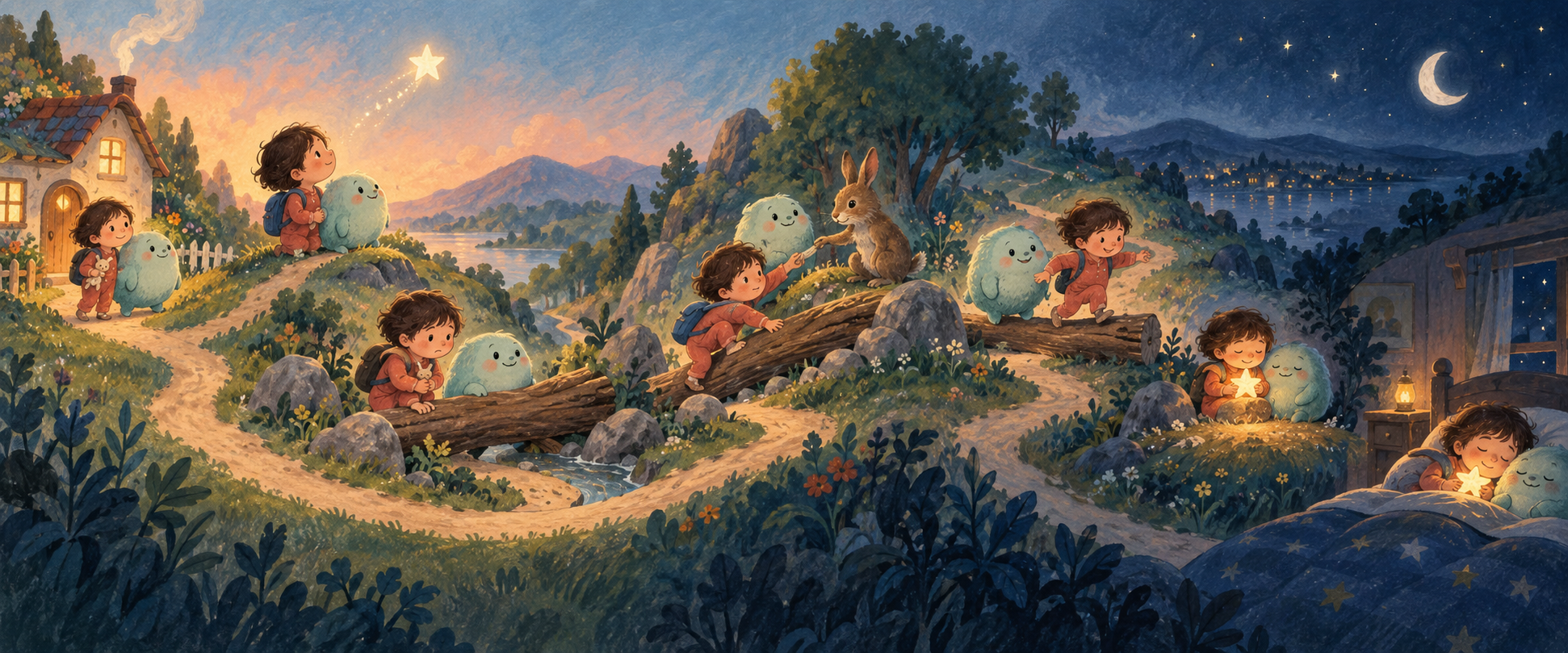
When improvising feels impossible, use the Ken Adams story spine. Each line tells you what kind of sentence comes next, so you never have to invent an entire plot at once:
- Once upon a time… Introduce the character.
- Every day… Describe the character’s normal routine.
- But one day… Add a small change or problem.
- Because of that… Show the first consequence.
- Because of that… Let the character try something.
- Because of that… Move the character toward a solution.
- Until finally… Resolve the problem.
- Ever since then… Establish the calm new routine.
The repeated “because” lines do most of the work. You only need to ask what happened as a result of the previous sentence. That creates a chain of cause and effect without requiring twists, extra characters, or a complicated ending.
A complete story you can tell tonight
- Once upon a time, a small rabbit named Pip kept a blue cup beside the bed.
- Every day, Pip took a drink and placed the cup carefully on a little stool.
- But one day, the cup rolled underneath a heavy dresser.
- Because of that, Pip asked a patient turtle for help.
- Because of that, the turtle brought a wooden spoon, but it was too short.
- Because of that, they tied a soft scarf to the spoon and gently pulled the cup closer.
- Until finally, Pip picked up the cup, folded the scarf, and put everything back in its place.
- Ever since then, Pip checked the stool before climbing into bed and listening to the quiet room.
Nothing enormous happened. That is the point. The story moved, resolved, and became quieter as it approached the end.
Give your child a manageable role
You do not have to supply every detail. Co-creating the story lets your child contribute ideas while the sentence starters preserve its direction. Match the invitation to how much participation feels manageable:
- If your child is not answering yet: narrate the story yourself. A look, point, sound, or object they are holding can become the character you use.
- If choices are easier than open questions: offer two options. Ask, “Rabbit or duck?” rather than, “Who should the story be about?”
- If your child wants to invent everything: invite an idea at “But one day” or “Until finally,” then narrate the connecting sentences yourself.
- If participation becomes negotiation: make the boundary part of the routine. Say, “You choose the character, and I will tell what happens.”
You can also do the whole spine alone. Co-creation is a shortcut when it helps, not another bedtime obligation.
Reuse characters instead of building a new world every night
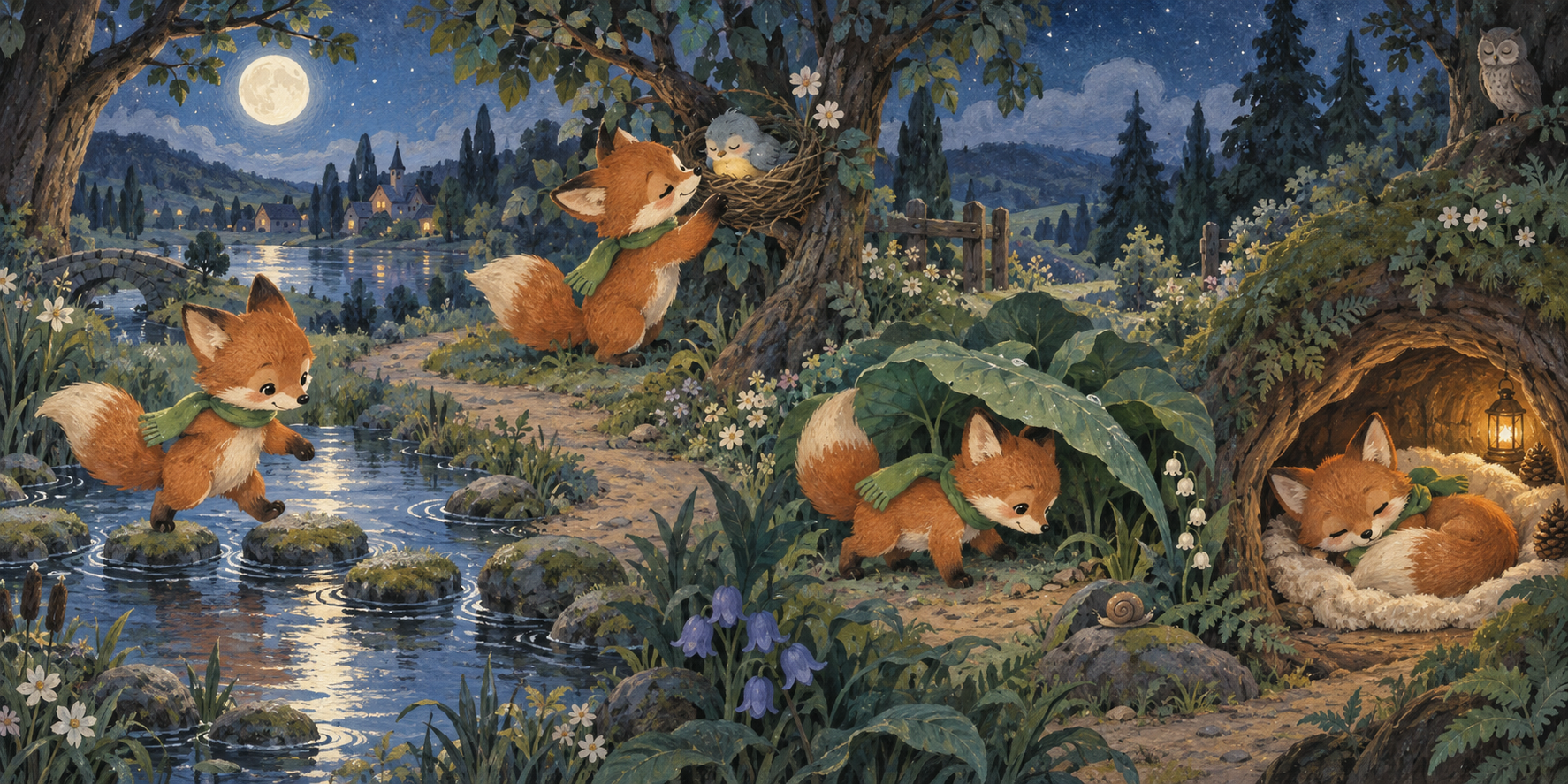
Originality is unnecessary at bedtime. Reusing yesterday’s character or plot turns a demanding creative task into a familiar routine. Your child may even request the same story again.
Build a tiny story world from three reusable parts: a character, a place, and an ordinary activity. For example:
- Milo Mouse lives behind the laundry basket and matches lost socks.
- Nora Narwhal lives in a quiet harbour and helps bubbles find their way home.
- A small city bus sleeps at the depot and returns things passengers have forgotten.
Once you have that world, change only what you can manage. The same character can face a new household problem. The same plot can happen to a different animal. You can also repeat everything exactly as you remember it. If the wording changes, that is not a mistake; it is simply tonight’s version.
Keep a few prompts in your phone if fatigue makes recall difficult:
- Someone cannot find a familiar object.
- Something needs to be carried home.
- Two characters quietly put a room back in order.
- A character helps a friend finish a bedtime task.
- The weather changes, so everyone finds a comfortable place indoors.
These are not full plots. They are starting points that fit inside the same eight-line structure. You can choose one without deciding what happens next until you begin speaking.
If your child asks for a sequel when you have no energy left, you do not need to create it immediately. End with, “We will find out what Pip does next tomorrow.” The unfinished possibility becomes tomorrow’s opening rather than tonight’s extra work.
Listen for real-life echoes without turning it into an interview
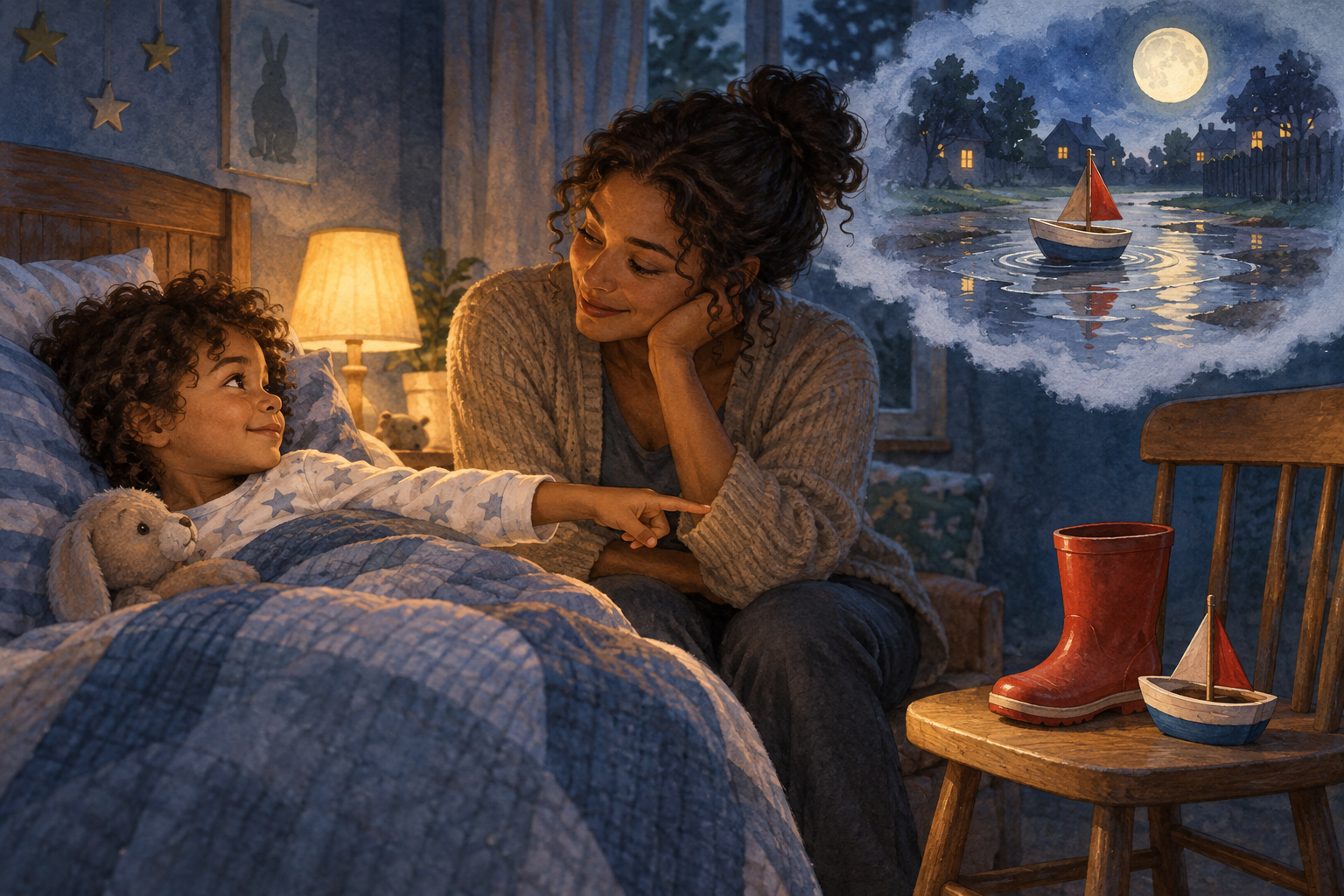
A made-up story can give a child an indirect way to bring up something that felt exciting, confusing, or difficult. Ideas and worries may surface more easily during relaxed storytelling than when a child is asked a broad question about the day.
That does not mean every nervous rabbit represents a hidden problem. Treat a fictional detail as an invitation, not proof. If your child says the rabbit does not want to enter a loud room, you can respond in stages:
- Reflect the story: “The room felt too loud for that rabbit.”
- Offer the character a choice: “Should the rabbit find a quiet corner or ask a grown-up for help?”
- Ask once, if it fits: “Did anything feel loud or uncomfortable for you today?”
- Accept the answer: If your child says no or returns to the plot, continue the story without pressing.
If a theme keeps returning, remember it and ask about it during the day, when neither of you is trying to finish bedtime. That keeps the evening story emotionally open without making your child responsible for having a serious conversation on demand.
You can also borrow a neutral detail from the day without forcing a lesson. A toy that was difficult to share can become two bears deciding where to park a wagon. A new room can become a place the rabbit explores slowly. Let the fictional characters encounter the situation; your child can decide how closely to approach it.
Key takeaways
- Make the story calm, familiar, and low-stakes; bedtime is not the moment to prove how entertaining you can be.
- Use the eight story-spine prompts whenever you cannot think of a plot.
- Offer a contained choice, such as the character or the problem, instead of asking your child to design the entire story.
- Reuse yesterday’s cast, setting, plot, and ending as often as you need.
- Notice themes from your child’s day, but do not interrogate the fiction or assume every detail carries a hidden meaning.
- End after the problem is resolved, using the same closing phrase to make the boundary predictable.
Tonight, choose a familiar animal and a missing household object. Start with “Once upon a time,” follow the prompts, and let the story become quieter as it goes. Tomorrow, bring back the same character. You have already done the hardest part: creating a place to begin.
References




