

NATPAT can look like an appealing answer when you want something simple to use around a baby or toddler without reaching for a spray. The practical draw is clear: parents are choosing patches that attach to clothing as a spray-free option.
That tells you why the format is popular. It doesn’t tell you whether a particular patch is suitable for your child’s age, whether it can deliver the result you want, or how safely it fits into your routine. Before you buy or apply one, separate those questions.
Start with the job you want the patch to do
Don’t begin with the choice between a patch and a spray. Begin with one sentence: “I want this product to…” If you can’t finish that sentence with a clear, observable goal, you won’t have a sound way to choose the product or judge the result.
There is an important difference between wanting a more convenient application format and wanting treatment for a health problem. A clothing patch may be easier for your family to carry and apply. That convenience does not make it medicine, and it should never delay appropriate care when a child is unwell.
“Spray-free” also describes a format, not a complete safety or effectiveness verdict. A patch avoids misting a product, but it still contains materials or ingredients that require directions, age guidance and safe storage. Likewise, a spray isn’t automatically harmful simply because a patch is available. Compare the exact products rather than treating the formats as shorthand for “safe” and “unsafe.”
Parent recommendations can help you spot products that are portable or easy to incorporate into family life. They cannot establish that a patch works for every child or every purpose. Use word of mouth to discover the option, then use the package information to decide whether it belongs in your home.
Run this label check before the patch reaches your child

Read the physical package for the exact NATPAT product you have, not just a photo, social caption or retailer headline. Similar-looking wellness products can have different intended uses and directions. Check these points before opening it:
- Intended purpose: The package should say what the patch is meant to do in plain enough language that you can compare it with your goal. Don’t fill in a vague promise with an outcome the label never makes.
- Age guidance: Look for a stated age range, not just words such as “family” or “kids.” For a child from birth to 36 months, an unclear or missing age statement is a reason to pause and ask a pharmacist or pediatric clinician.
- Ingredients and materials: Read the complete list, especially if your child has allergies, eczema, asthma or known fragrance sensitivities. If the list is incomplete or unavailable, you do not have enough information to assess exposure.
- Placement: Confirm whether the directions specify clothing, skin or another location. If the patch is labelled for clothing, don’t move it onto your child’s skin in the hope of making it work better.
- Use instructions: Find the stated wear period, number of patches per use, replacement directions and whether the item is single-use. More patches or longer wear should not be treated as a stronger version of the directions.
- Warnings and storage: Check what contact to avoid, how to dispose of a used patch and where the package must be kept. Store both unused and used patches where a baby or toddler cannot reach them.
Marketing words such as “natural,” “gentle” or “family-friendly,” if they appear, cannot replace those details. Natural substances can still irritate, trigger an allergy or be inappropriate for a particular age. The useful question is not whether an ingredient sounds familiar. It is whether the full product is labelled for your child’s age and the exact way you plan to use it.
If you want professional input, take clear photos of the front, ingredient panel, directions and warnings. That gives a pharmacist or clinician something specific to assess instead of asking them to judge the NATPAT name alone.
Use a clothing patch as something that could come loose
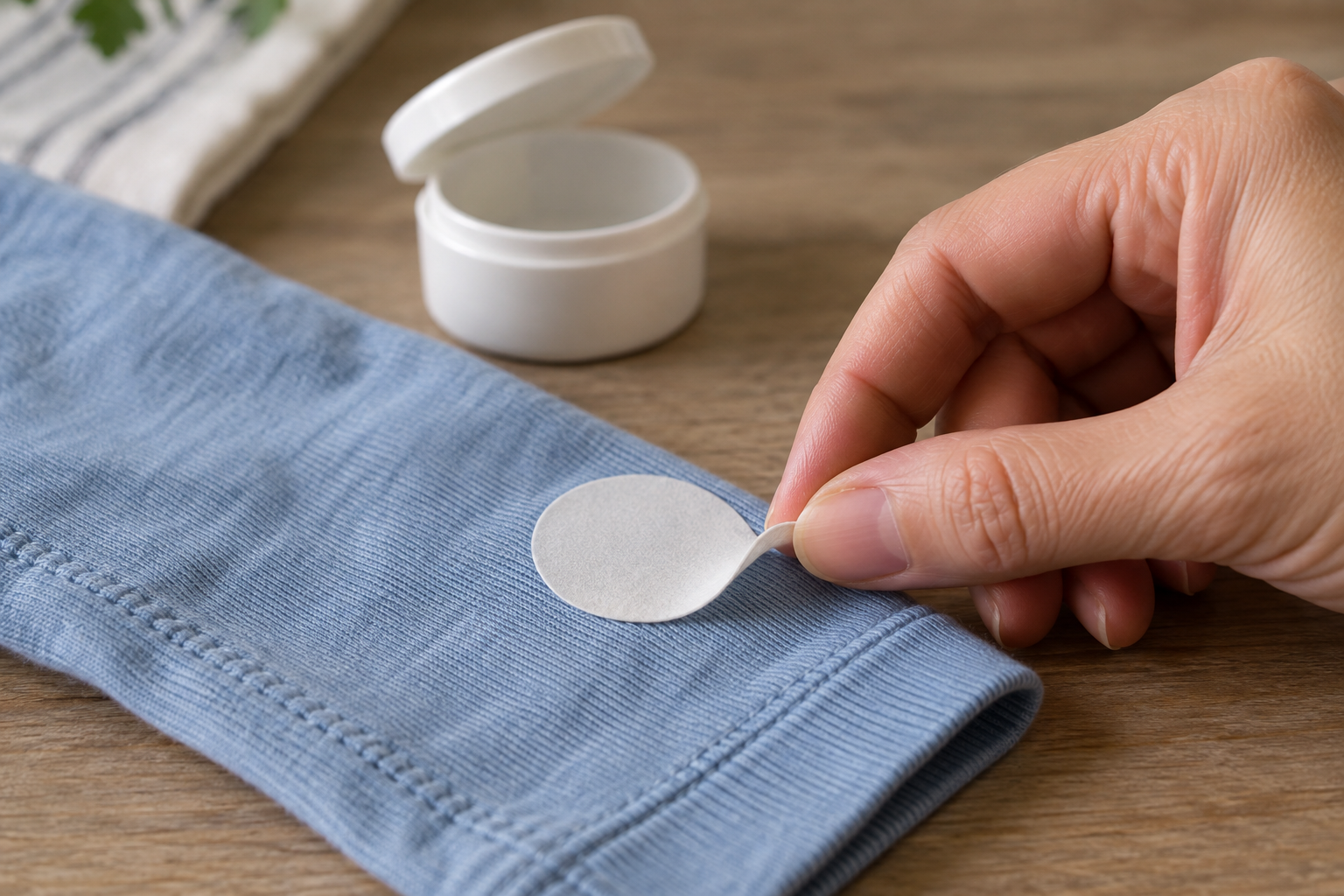
A patch that begins on clothing can still peel away. With a baby or toddler, placement should account for curious fingers, mouthing and the friction created by layers, stroller straps and car-seat harnesses.
- Have an adult apply the patch exactly where the package directs. Put it on a clean, flat part of the garment unless the directions say otherwise.
- Choose a location your child cannot easily see, grab or bring to the mouth. Keep it away from the face and hands, and don’t attach it to a loose accessory that the child can remove.
- Press it down as directed and check that the edges are secure. Do not cut, puncture, heat or modify the patch.
- Recheck it when circumstances change: after adding or removing a layer, fastening a harness, moving from stroller to floor play, or changing a diaper. Those transitions can rub the patch or bring it within reach.
- Unless the label clearly permits sleep use for your child’s age, remove the patch before a nap or bedtime. A sleep space isn’t the place to improvise with an adhesive item.
- At the end of use, account for the entire patch and dispose of it according to the label. Don’t leave a used one on clothing, in an open diaper bag or beside the changing area.
Introduce only one new topical, scented or wearable wellness product at a time. If your child reacts, this makes the likely trigger easier to identify. If redness or irritation appears, remove the patch, change the garment and stop using the product while you seek appropriate advice. Trouble breathing, swelling around the face or lips, or a child who is unusually difficult to wake requires urgent medical help.
Judge the result without moving the goalposts

Before the first use, choose an outcome tied directly to the labelled purpose. Then note the setting, how the patch was used and what happened during the label-directed period. A short record prevents a memorable good or bad outing from becoming the entire verdict.
Be careful about proxy signals. A noticeable scent only proves that you can smell something. A patch staying attached proves adhesion. Neither observation, by itself, proves that the product delivered its intended wellness result.
If the expected result isn’t apparent after correct, label-directed use, don’t add extra patches, extend the wear time or combine products to force a better outcome. Stop and reconsider the fit between the product and your original goal. If that goal involves symptoms, sleep difficulties, breathing, skin changes or another health concern, discuss the concern itself with a qualified professional rather than asking a wellness patch to carry the decision.
Value should be assessed just as concretely. Divide the package price by the number of label-directed uses, then account for patches that detach or cannot be used. Compare that cost with alternatives that are appropriate for the same age and purpose. Convenience may be worth paying for, but it should be a conscious reason rather than a substitute for evidence of benefit.
Key takeaways
- NATPAT’s clothing-patch format may appeal when you want a portable, spray-free option, but format alone does not establish safety or effectiveness.
- Check the exact product’s intended purpose, age range, ingredients, placement instructions, wear directions and warnings before using it around a child from birth to 36 months.
- If the label says clothing, keep the patch off skin and place it where your child cannot grab or mouth it.
- Recheck adhesion at routine transitions, remove the patch before sleep unless age-specific directions clearly allow it, and account for it after use.
- Judge only the outcome the label promises. Do not increase the number of patches or wear time when the expected benefit is unclear.
- A wellness patch is not a substitute for medical assessment or treatment when a baby or toddler is unwell.
If the package clearly covers your child’s age, intended use and placement, begin with one ordinary, label-directed use and watch both the result and your child’s response. If any of those basics are missing, leave the patch unopened until a pharmacist or pediatric clinician can help you evaluate it.
References




