
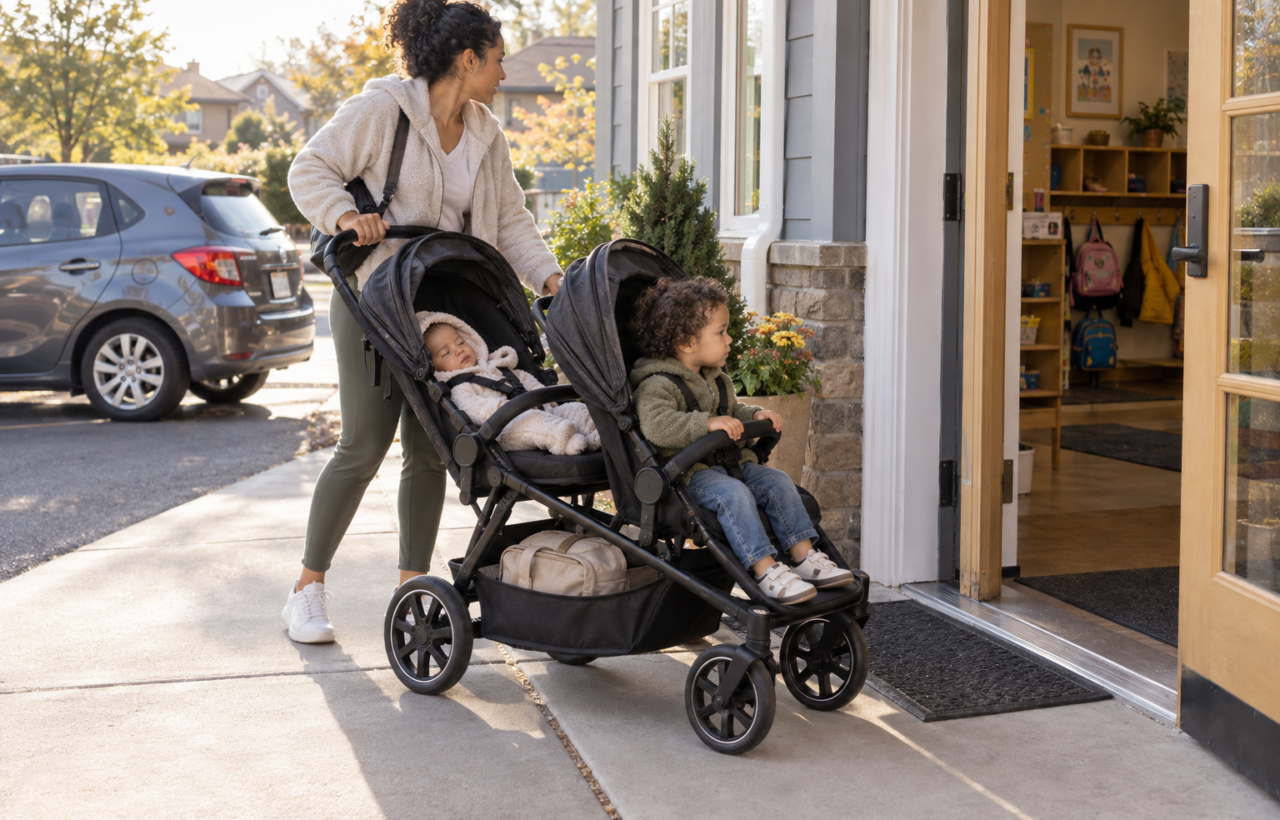
You are not just choosing two seats on wheels. You are choosing what happens at the daycare door when one child wants to be carried, the other is asleep, and the stroller still has to clear the entrance, hold the bag, and fit into your car.
The questions worth testing are practical: Can you fold it without wrestling, get it through your usual doors, steer it with both children aboard, and keep them comfortable? The best double stroller for you is the one that handles your hardest recurring moment, not the one with the longest feature list.
Define the stroller’s job before looking at models
Start with the passengers. Twins, a newborn and a toddler, and two mobile toddlers need different seating arrangements. A configuration that works beautifully for two older children may not provide two manufacturer-approved newborn positions. A stroller that accepts an infant car seat may give the older child less room or block access to the storage basket.
Write a short decision brief before you browse. It should answer these questions:
- Who will ride now, and who is likely to ride a year from now?
- Does either child need a newborn-approved position, infant car seat connection, deep recline, or independent nap space?
- Where will you use the stroller most: sidewalks, shops, transit, school runs, parks, or uneven paths?
- What is the narrowest doorway, elevator entrance, hallway turn, or gate on your regular route?
- Will you fold it several times a day, occasionally, or almost never?
- Does it need to fit in a car? If so, what usable space remains after car seats, groceries, and other gear are in place?
- Will one adult regularly handle the stroller alone?
Now identify three must-pass tasks. They might be clearing your front door, carrying both children without rearranging seats, and fitting into the trunk without removing wheels. These are requirements, not preferences. A stroller that fails one should not win because its canopy, fabric, or cup holder is appealing.
Take your own measurements. Measure the clear opening with the door positioned as it is during normal use, not just the door frame. For a car, measure the trunk opening as well as the usable floor space. A folded stroller can fit within the cargo area’s volume but still be impossible to pass through the opening.
Choose a layout by its tradeoffs, not its label
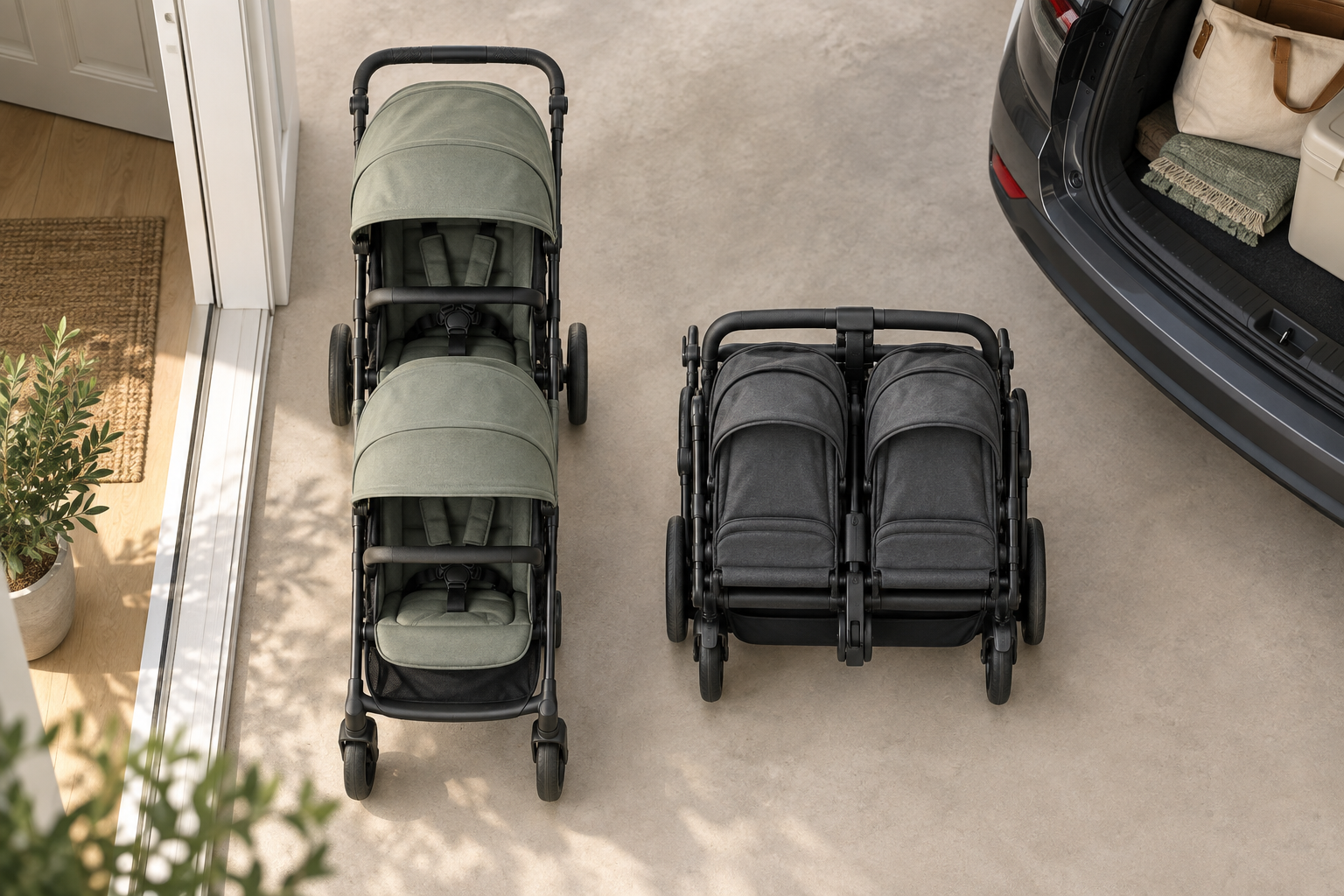
Every double-stroller layout moves the inconvenience somewhere. Your job is to put it where it will bother you least.
- Side-by-side: The children sit next to each other. This can make access to both seats straightforward, but the stroller’s total width deserves careful testing at doors, shop aisles, elevators, and gates. Measure the actual model at its widest fixed point rather than assuming every side-by-side stroller has the same footprint.
- Tandem: One seat sits in front of or behind the other. The profile may suit narrow passages, but length, turning space, seat access, basket access, and the view from each position can change with the configuration. Test the exact seat arrangement you intend to use.
- Convertible single-to-double: This starts as a single stroller and accepts another seat or riding position. It can suit a growing family, but do not judge it in single mode. Install the second seat, add any adapters, and check what happens to legroom, recline, storage, steering, and folding.
- All-terrain or jogging design: Larger wheels and a sporty appearance do not establish that a stroller is approved for jogging. If running is part of your plan, verify the permitted configuration in the manual and follow its child-stage requirements. Do not jog with a child until the manufacturer says that both the child and setup are eligible.
Seat order matters in tandem and convertible models. Check whether both children can recline as needed, whether one seat blocks the other, and whether you can reach each buckle without removing a sibling. If you expect to use an infant car seat, confirm compatibility for its exact make and model. Matching brand names alone do not prove that a particular seat, adapter, stroller version, and position are an approved combination.
Run the same real-life test on every finalist
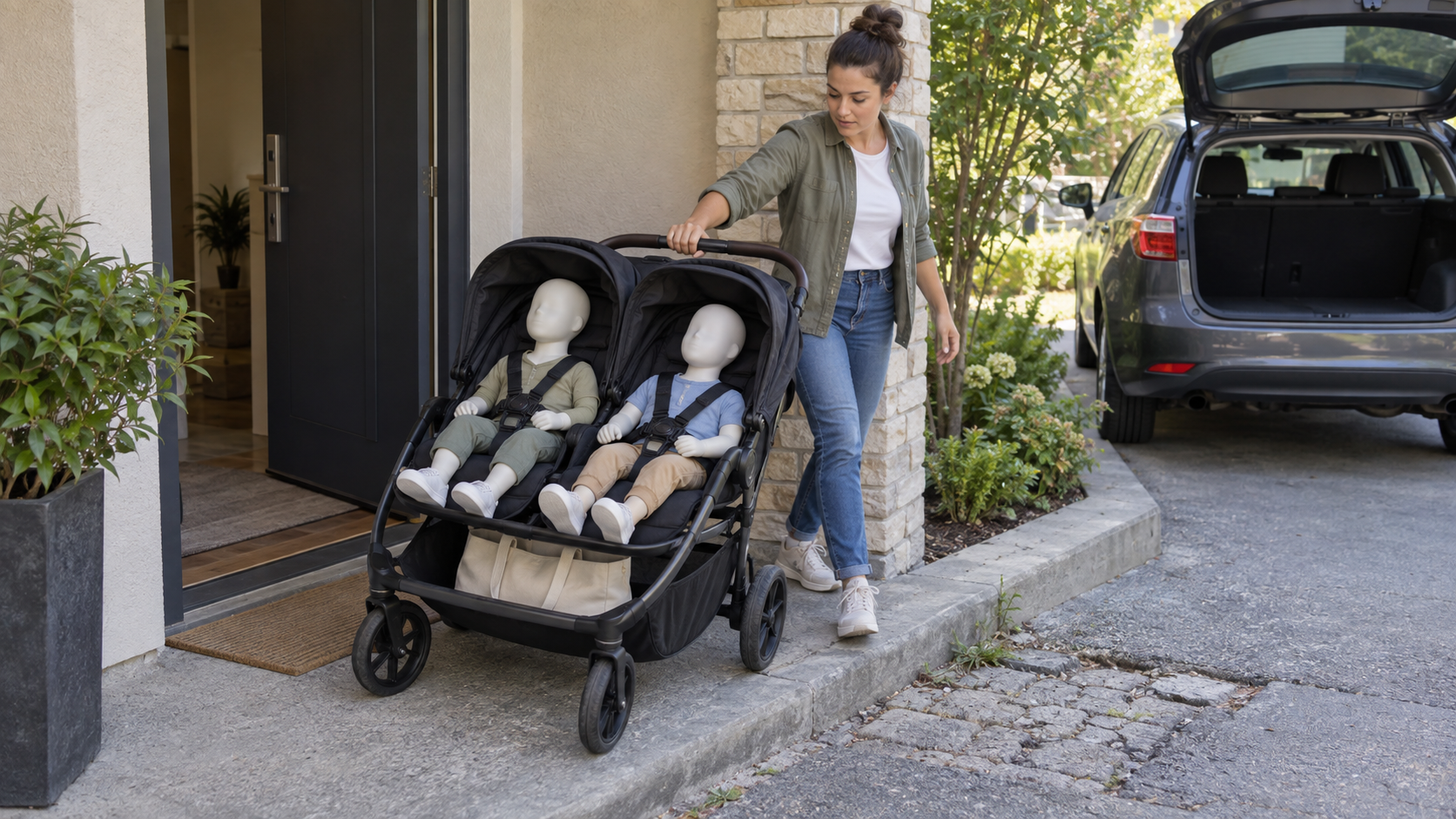
A quick push around an empty showroom rewards smooth floors and an unloaded frame. It does not reproduce a narrow turn, a full basket, two passengers, or a rushed fold. Use the same test sequence for every candidate so a charming first impression does not replace a fair comparison.
- Build your intended configuration. Install both seats, approved adapters, canopies, and any other item required for daily use. Adjust the handle to the height of the adult who will push most often.
- Load it realistically. If children can participate, secure them correctly and follow the retailer’s rules. Otherwise, use only retailer-approved test weights. Put your usual bag in the basket rather than hanging it from the handle unless the manual expressly permits that use.
- Buckle both positions. Time is less important than friction. Notice whether straps twist, whether you can reach the release, and whether one child must wait unsecured while you attend to the other.
- Push, turn, stop, and reverse. Try a straight line, a tight turn, a U-turn, and a small permitted threshold. Look for pulling, wheel interference, excessive force at the handle, or a frame that becomes hard to manoeuvre when both positions are occupied.
- Check the brake on level ground. Engage it, confirm that it has locked, and apply gentle pressure at the handle. You should be able to operate it in the footwear you commonly use without accidentally releasing it.
- Use the storage with both seats occupied. Put the bag in and take it out. A large basket is not useful if the rear seat, footrest, or support bars block the opening in your normal configuration.
- Fold and unfold it twice. The first attempt tests whether the mechanism is understandable. The second shows whether you can repeat it. Check whether the seats must be removed, whether the folded frame locks, whether it stands securely if advertised to do so, and where your hands need to go. Never fold a stroller with a child in it.
- Lift it as you actually will. Use the intended carry point and simulate the move into your trunk or storage area where the retailer permits. A manageable showroom fold may still be awkward when you must reach over a trunk lip or keep one hand available for a child.
- Recheck both children. Look at headroom, leg position, canopy coverage, seat support, sibling reach, and sight lines. If naps matter, test each approved recline while the other seat remains installed.
At home, mark the stroller’s published width and folded footprint on the floor with removable tape. Compare those dimensions with your measured doorway, hall turn, elevator, storage spot, and trunk opening. This will not replace a physical fit test, but it can eliminate an obviously unsuitable model before you buy it.
Use a scorecard without averaging away a dealbreaker
After confirming that a stroller is approved for your children’s stages and intended configuration, score each finalist from 0 to 2: 0 means the task fails, 1 means it is possible but awkward, and 2 means it is easy to repeat. Score what you actually tested, not what you expect to get used to.
| Test area | Question to answer | Your score |
|---|---|---|
| Route fit | Does it clear every must-pass opening and turn? | 0, 1, or 2 |
| Passenger setup | Can both children use approved, practical positions at the same time? | 0, 1, or 2 |
| Steering | Can the usual caregiver control it when realistically loaded? | 0, 1, or 2 |
| Folding | Can you fold, lock, and reopen it without confusion or excessive effort? | 0, 1, or 2 |
| Transport and storage | Does the folded stroller fit where it must go, with the necessary seats and gear? | 0, 1, or 2 |
| Daily access | Can you reach both harnesses and the basket in your normal configuration? | 0, 1, or 2 |
| Child comfort | Do both positions provide suitable space, support, shade, and permitted recline? | 0, 1, or 2 |
A candidate can score up to 14, but the total is secondary. Any 0 on one of your three must-pass tasks eliminates it. A high overall score cannot compensate for a stroller that will not clear your doorway or safely support the required seating setup.
If two candidates remain close, count the steps in your most frequent transition. How many releases, seat removals, adapter changes, and loose pieces stand between arriving at the car and driving away? Repeated steps matter more than occasional extras. Also check where removed parts will go; an adapter that must be taken off for every fold needs a reliable storage place.
Confirm safety, ownership effort, and the final decision
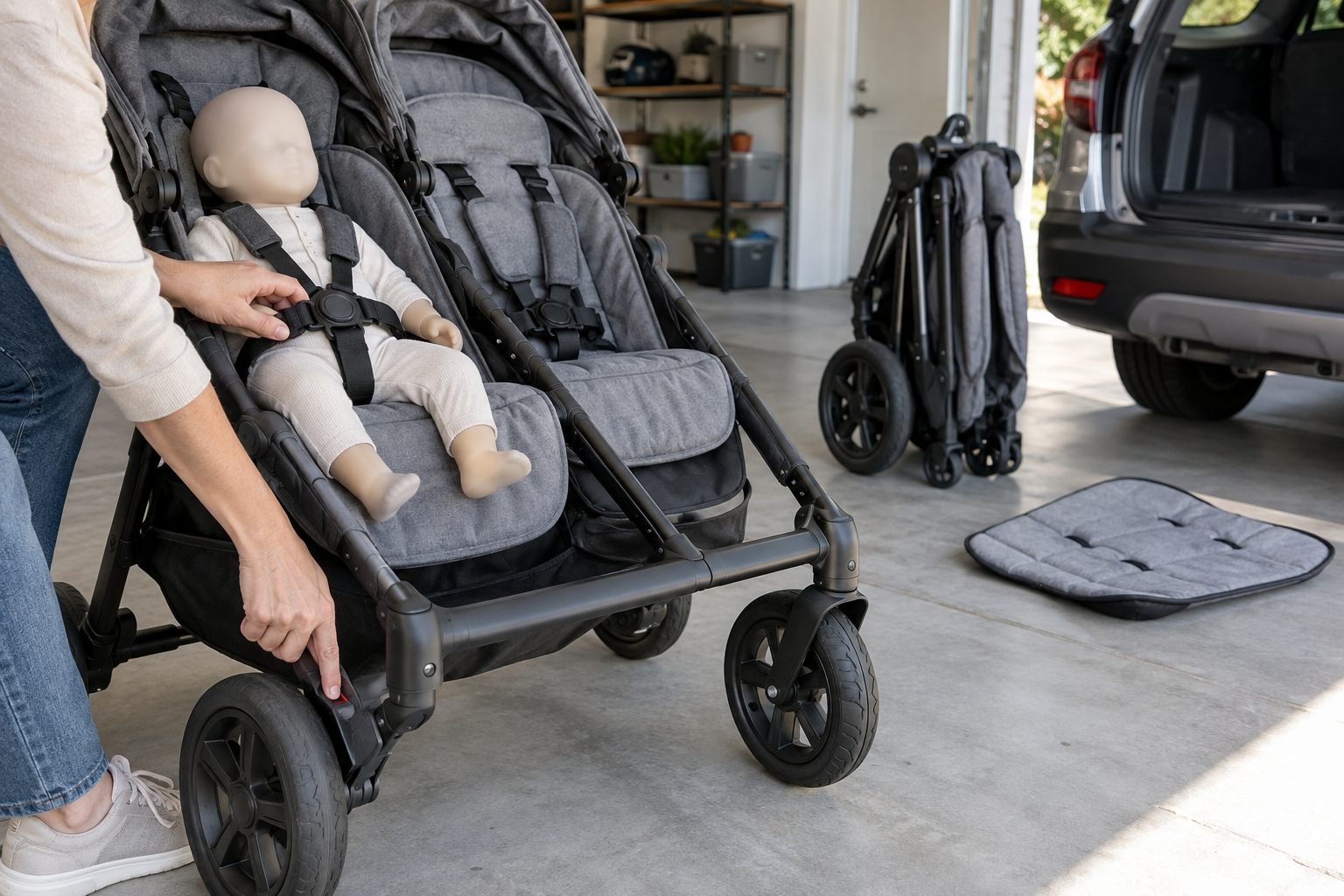
Read the manual for the exact model and version before buying. Confirm the permitted seating combinations, limits for each position, newborn-use requirements, infant car seat and adapter compatibility, folding procedure, and any restrictions on jogging or accessories. If the retailer’s display conflicts with the manual, follow the manual and ask the manufacturer for clarification.
Inspect the parts that will receive daily wear: harnesses, buckles, brakes, seat locks, folding latches, wheels, tires, handle covering, and basket openings. Try removing the fabrics only if the instructions permit it, then decide whether the cleaning process is realistic for your household. Check whether common replacement parts are available and whether required adapters or rain covers are included or sold separately.
Before paying, read the return conditions. Find out whether an assembled stroller can be returned after an indoor fit check, who pays return shipping, and which packaging must be retained. Keep the box until you have tested the stroller inside your home and vehicle without marking or using it outdoors.
A second-hand stroller needs additional scrutiny. Confirm its exact model identity, check your country’s official product recall database, obtain the correct manual, and inspect for cracks, bent sections, missing fasteners, damaged restraints, unreliable brakes, or modifications. Missing labels can make model and recall verification difficult. Do not use a stroller whose identity, approved configuration, or structural condition cannot be established.
Key takeaways
- Choose for your children’s actual stages and your hardest recurring route, not for a generic family profile.
- Measure clear openings, turns, trunk access, and storage space before shopping.
- Test every stroller in the exact two-child configuration you plan to use.
- Give fit, fold, steering, access, and comfort separate scores, but treat safety and must-pass tasks as absolute gates.
- Verify every seating, car seat, accessory, and jogging configuration in the exact model’s manual.
Take the measurements first, write down your three must-pass tasks, and bring that list to every test. If no finalist passes all three, change stroller category or transport plan instead of accepting a failure you will face every day. The right choice is the one that makes your most difficult routine reliably uneventful.
References




