
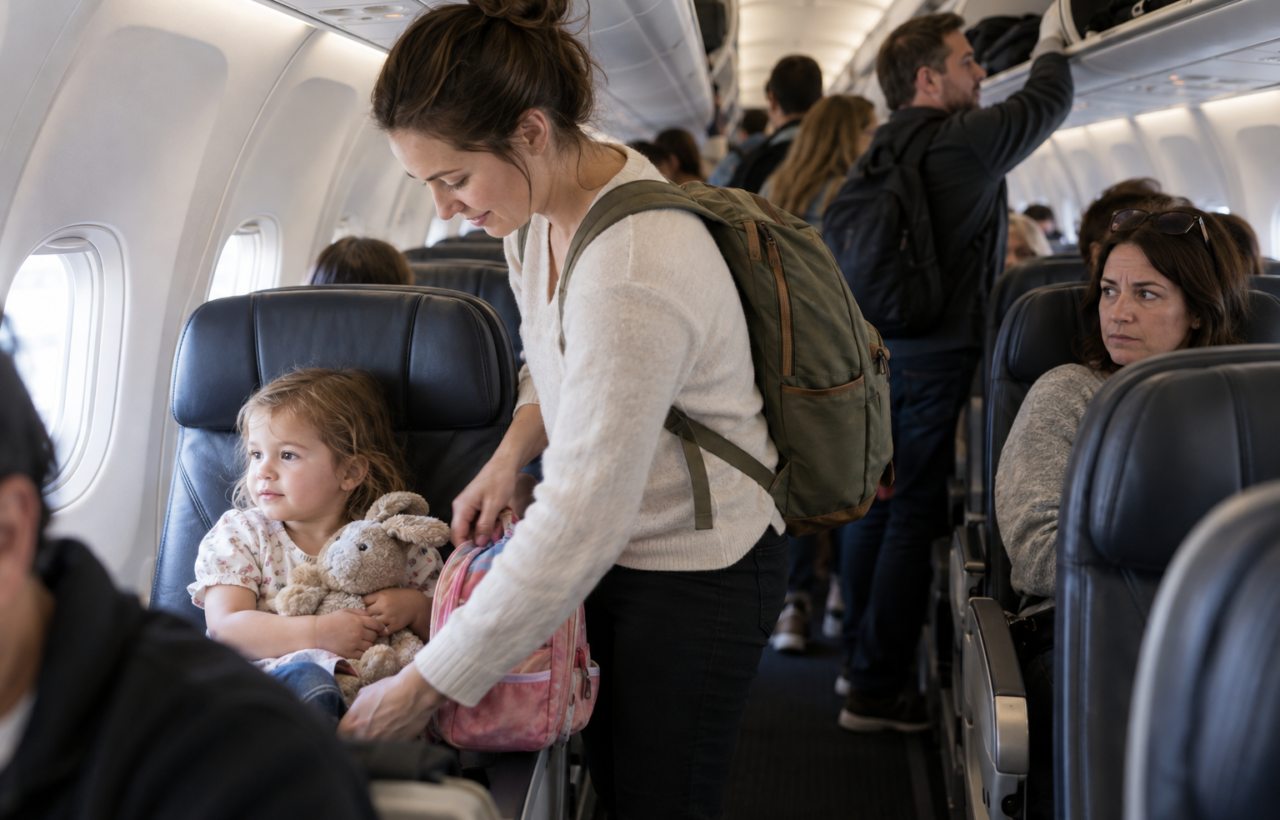
A stranger looks toward your toddler and sighs. Someone makes a comment before you have even settled into your seats. Now you are managing luggage, a small child, and the feeling that everyone is grading your parenting.
The useful question is not whether every traveler approves of you. It is whether there is a concrete problem to address. Once you separate an actual disruption from someone else’s prediction about your child, you can respond without apologizing for your family’s presence or ignoring behaviour that genuinely affects others.
You do not have to apologize for bringing a toddler
Judgment does not always follow bad behaviour. In one parent’s account, his toddler was judged before their flight had even taken off. When disapproval arrives before a child has done anything, it is a prediction, not a response to harm.
That distinction matters. You cannot prevent another passenger from assuming that a toddler will be loud, restless, or inconvenient. Trying to win that person over can pull your attention away from the child who actually needs you.
At the same time, sharing public space creates ordinary responsibilities. Stop your child from kicking a seat, grabbing another person’s belongings, hitting, or blocking a walkway. Follow the safety instructions given by transport staff. Correct what you can control without treating your child’s age, voice, or need for help as an offence.
A workable standard is simple: you owe other travelers reasonable care and a response to preventable interference. You do not owe them a silent or invisible toddler.
First decide whether there is a problem to solve
Feeling watched can make every glance seem like a complaint. Before reacting, sort the moment into the right category:
- There is a concrete impact. Your toddler is kicking a seat, throwing an object, reaching into someone else’s space, or repeatedly touching another traveler. Interrupt the behaviour and change the setup.
- Your toddler is having an ordinary hard moment. They are crying, resisting a transition, or struggling to settle while you are already helping them. Stay with the child instead of starting an apology tour.
- You noticed a look, sigh, or whisper. You do not know what it means, and no response is required. Return to the next practical task.
- Someone addressed you disrespectfully. The immediate issue is now the adult’s conduct, not proof that you are a good parent. Use a short boundary and disengage.
Describe the event to yourself with plain nouns and verbs. “She cried while we boarded, and I held her” is an observation. “Everyone thinks I should not travel with her” is a conclusion you cannot verify. That small correction helps you decide what to do instead of reacting to what you fear other people think.
Respond to disruption in the right order
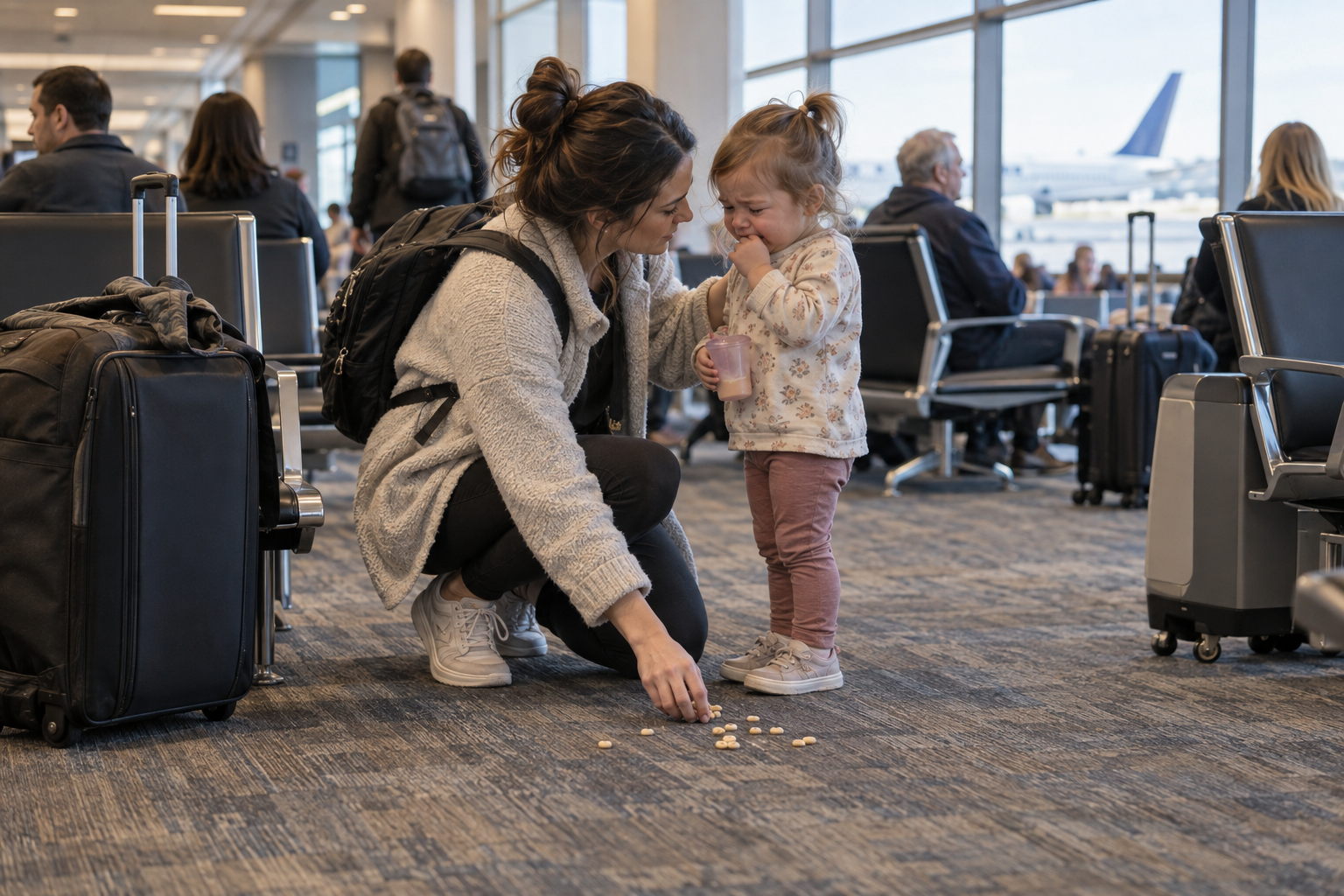
When your toddler’s behaviour is affecting someone else, speed and clarity are more useful than a long explanation. Use this order:
- Stop or contain the behaviour. Move your toddler’s feet away from the seat, retrieve the thrown item, close the tray, or reposition your child. If transport staff give an instruction, follow it first.
- Give your toddler one clear direction. Try “Feet stay here,” “That belongs to her,” or “Sit beside me.” A short instruction is easier to act on than a public lecture.
- Repair the specific impact. Say, “I’m sorry she kicked your seat. I’ve moved her legs away.” The repair names what happened and what changed.
- Return your attention to your child. You do not need to keep explaining your parenting once the practical problem has been handled.
Crying calls for a different response. It may be difficult for nearby travelers to hear, but an apology cannot switch it off. Comfort your child, reduce demands where possible, and work through the next transition. You can acknowledge another person’s frustration without promising an outcome you cannot guarantee.
Keep a few sentences ready so you do not have to invent them under pressure:
- “I hear you. We’re helping him settle.”
- “You’re right. She was kicking your seat, and I’ve stopped it.”
- “We’re doing what we can, but I can’t promise that he won’t cry.”
- “We’ve got it, thanks.”
The best response is usually the shortest truthful one. A detailed defence invites a debate when your attention belongs elsewhere.
Set a boundary when a comment becomes personal
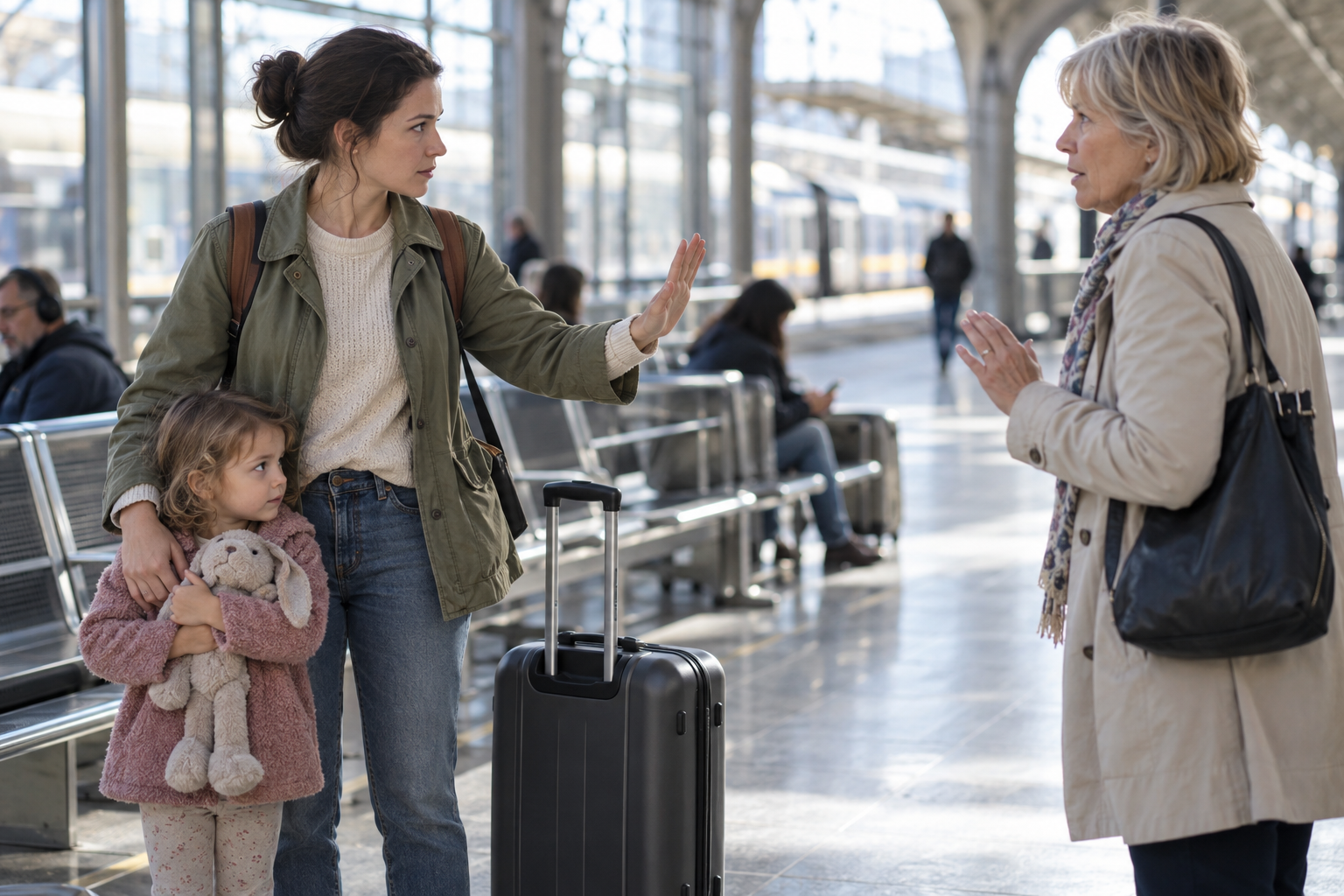
A traveler may be allowed to dislike noise or ask you to stop a specific behaviour. That does not give them permission to insult you, shame your child, or speak about your family as though you are not there.
Start with the least energy needed and become firmer only if the behaviour continues:
- Close the exchange: “We’re handling it.”
- Redirect the person: “Please speak to me, not to my child.”
- Set the limit: “You can ask about the seat, but you cannot insult us.”
- End the conversation: “I’m not discussing this further.”
- Ask staff for help: “This person keeps confronting us. Could you help us find a workable way forward?”
Do not force your toddler to perform an apology while they are still overwhelmed just to reassure an audience. Do not threaten a punishment you do not intend to use. And do not turn discipline into a public demonstration designed to prove that you are in control. Correct the behaviour your child can change, then help them recover.
If someone threatens you, touches you or your child, blocks your movement, or continues directing abuse at your family, move toward transport staff or other travelers and ask for assistance. You do not need to remain in a confrontation to make your boundary legitimate.
Make a plan for the moment you start feeling watched

The hardest part of judgment is often the attention split. You start monitoring strangers’ faces while your toddler becomes more tired of waiting. A small plan keeps your focus on what is actionable.
- Choose your sentence before the trip. “We’re handling it” works for unsolicited commentary. “Please speak to me, not my child” covers a crossed boundary.
- Put frequently used items within reach. If a comfort item, snack, wipe, or change of clothes is buried under everything else, a manageable moment can become a frantic search.
- Divide roles when another adult is traveling with you. One person can help the toddler while the other handles bags, documents, staff questions, or the surrounding space. Switch deliberately instead of both trying to do everything.
- Use one familiar reset. A known song, simple game, comfort object, or quiet cuddle gives you somewhere to begin. The goal is not guaranteed silence; it is a familiar next step.
- Stop scanning the audience. Look at your child, the immediate environment, and any staff member giving instructions. Strangers’ expressions do not tell you what action is required.
- Review logistics after the trip, not your worth as a parent. Ask what created friction: an inaccessible bag, an awkward handoff, a long transition, or unclear roles. Change that part of the plan next time.
This preparation is not an admission that toddlers are a problem. It protects your limited attention so you can respond to the situation in front of you rather than to an imagined jury.
Key takeaways
- A sigh or stare is not the same as a concrete request. Do not solve a problem that has not occurred.
- Address preventable interference promptly, but do not apologize for your toddler’s mere presence.
- When behaviour affects someone, stop it, give a short direction, repair the specific impact, and move on.
- Use brief boundary phrases with rude adults. Long explanations usually consume attention without changing the exchange.
- Your job is to travel safely and care for your child, not to secure approval from every person sharing the journey.
Before your next trip, choose one boundary sentence and place the items you are most likely to need where you can reach them. If judgment shows up, you will already know what deserves your attention and what does not.
References




