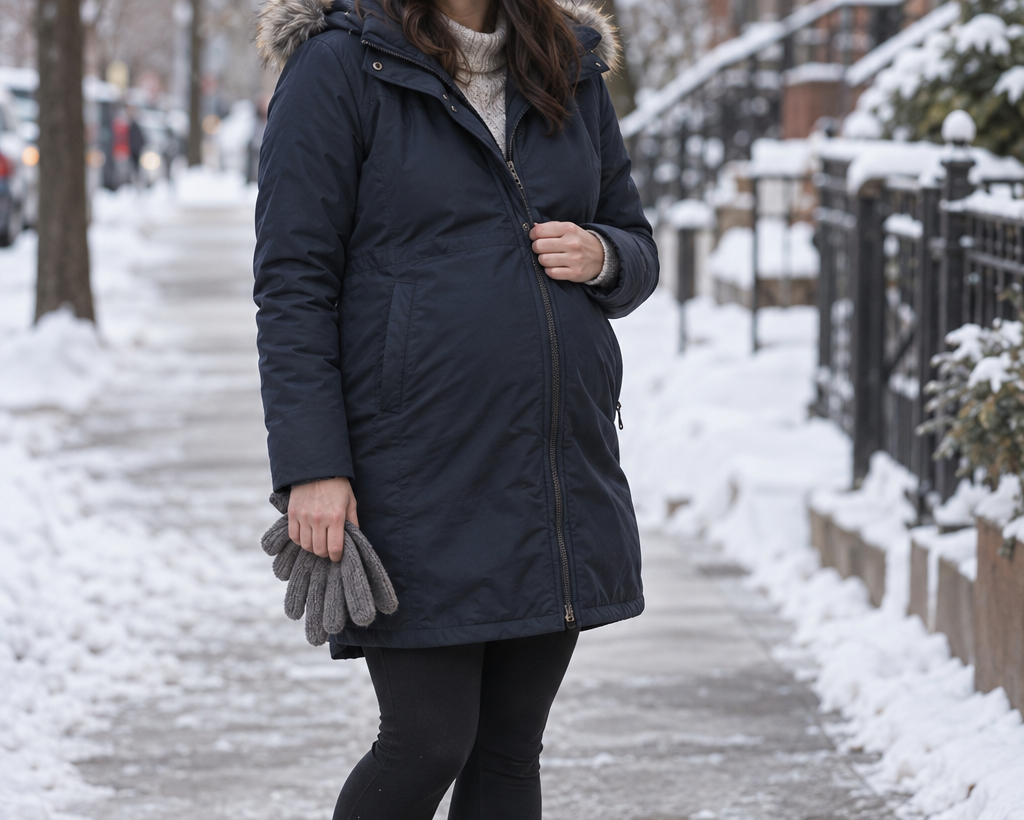
Your everyday coat has stopped meeting at the zipper, but buying another one for a body that will keep changing can feel like an expensive guess. A larger conventional coat may create room at your middle while leaving you with dropped shoulders, long sleeves, and excess fabric everywhere else.
The better approach is to buy for a specific stretch of weather and a specific routine. A useful maternity coat should cover pregnancy and postpartum, preserve your freedom of movement, and stay comfortably closed during the outings you actually make.
Start with the coldest outing you regularly make
Do not begin with colour, length, or even size. Begin with the hardest ordinary job the coat must handle. Waiting outside for public transit, taking a long stroller walk, and moving between a car and a building place very different demands on outerwear.
Write a one-sentence brief before you shop. It might be: This coat must close over a heavy sweater through late pregnancy and remain useful for daily stroller walks after birth. That sentence gives you a standard against which to judge every attractive but unsuitable option.
- Map the weather to your timeline. Consider the cold weeks remaining before your due date as well as the weather you are likely to encounter during the first postpartum months.
- Name your usual exposure. A coat for extended outdoor walks needs more dependable coverage than one used mainly for short trips from the car.
- Choose your thickest realistic layer. The coat must fit over that layer without compressing your shoulders or pulling across the front.
- Decide how you expect to travel. Stroller walks, driving, public transit, and babywearing each make different features useful.
- Be honest about frequency. If the coat will become your daily outer layer, easy closures and practical pockets matter more than they would for occasional wear.
If your current coat still closes comfortably over your normal layers, you may not need to replace it yet. If you need coverage for only a short, mild part of the season, a compatible extender, a borrowed coat, or a second-hand maternity coat may solve the problem more economically. For sustained cold or wind, however, full front coverage is a functional requirement rather than a styling preference.
Choose the expansion system by its second life
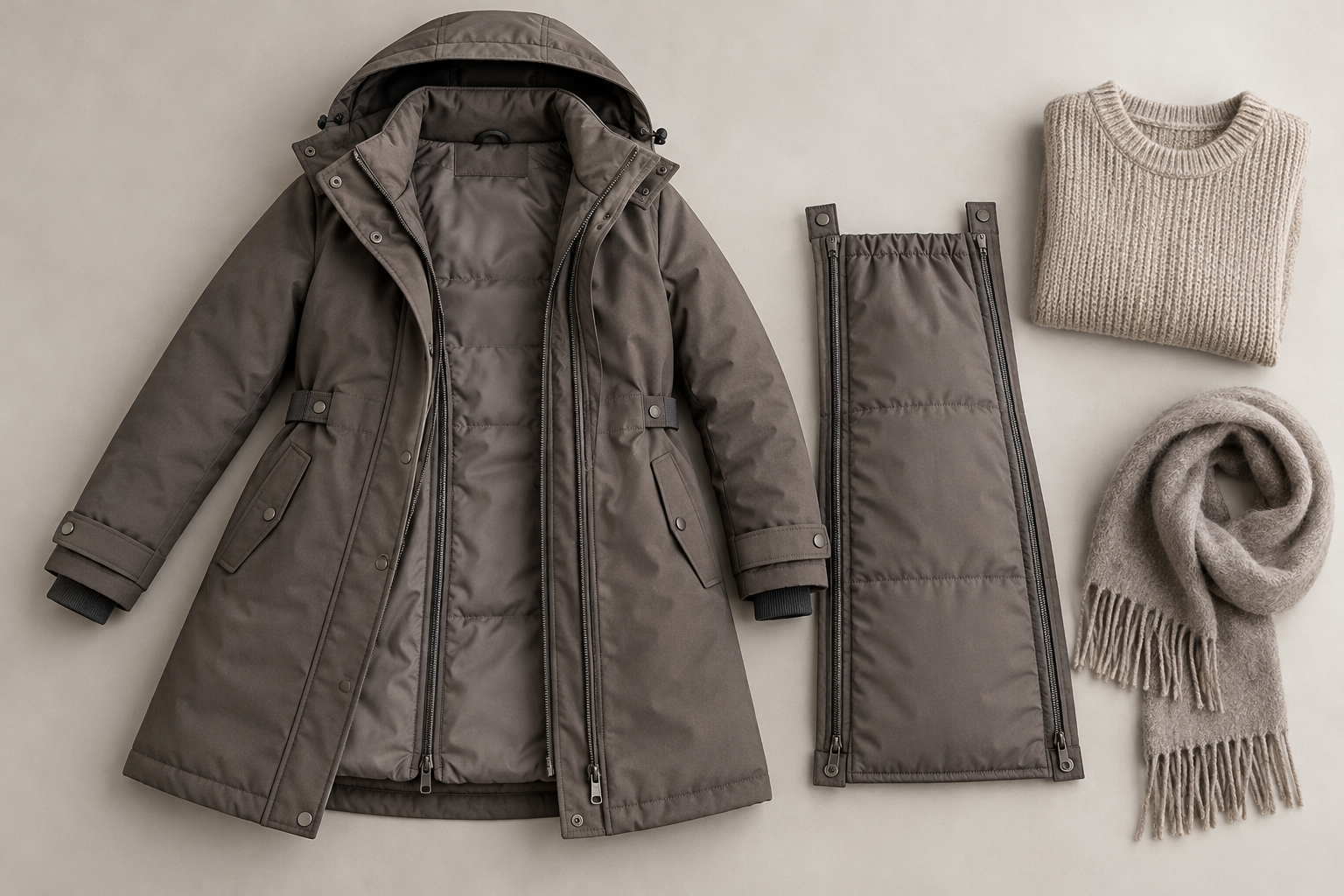
The most important design decision is how the coat creates and later removes extra space. Each system behaves differently during late pregnancy and after birth.
- A removable front panel adds room where pregnancy changes the fit most. Removing it can return the coat to a more conventional shape. Check that the panel is insulated to a similar degree as the coat, closes without gaps, and has an adjustable neckline. If a separate babywearing panel is offered, confirm exactly which panel is included.
- Side zips or expandable gussets preserve the original front closure while adding space around the torso. Open and close every adjustment before buying; hardware that feels awkward in a fitting room is unlikely to become pleasant when you are wearing gloves.
- Drawcords and adjustable waists can help the coat follow several body shapes. Make sure the adjustment changes the fit where you need it rather than merely gathering fabric above or below your abdomen.
- Wrap and tie-front coats offer flexible sizing and can remain wearable later. Their usefulness depends on how securely the overlapping front stays closed in wind and whether you are willing to retie it during the day.
- An oversized conventional coat may be enough for a short period, especially if you already own it. The trade-off is that extra room is distributed across the shoulders, sleeves, and back instead of being concentrated at the front.
A maternity feature is valuable only if you will use its conversion. If you expect to remove the panel and wear the coat for future winters, examine how the coat looks and moves without it. If postpartum babywearing is central to the purchase, confirm that the exact model supports that use; a pregnancy expansion panel should not be assumed to double as a babywearing panel.
Look closely at the ordinary coat details too. The front insert should not become a thin, cold strip between two insulated sides. The hood should turn with your head, cuffs should meet your gloves, and the hem should suit both your climate and your stride. A two-way zipper can make sitting and walking easier, but only if it operates smoothly in every configuration.
Fit-test the coat over real winter clothing
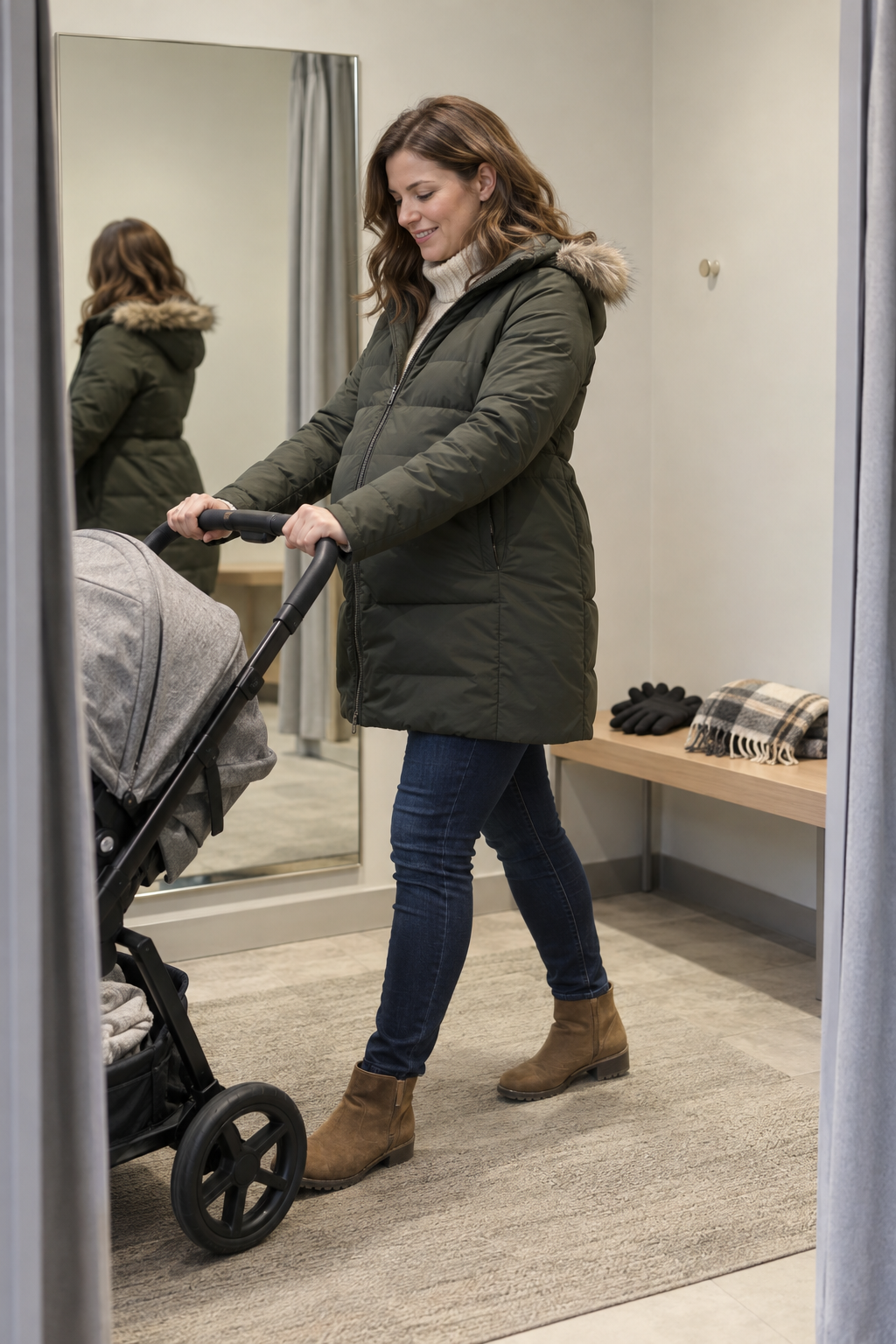
A coat that fits over a light fitting-room outfit may fail as soon as you add a sweater. Bring or wear your bulkiest regular layer, then test the coat as outerwear rather than posing in front of the mirror.
- Fasten the coat completely. Start at the bottom and close every zip, snap, or toggle. You should not need to pull the two sides together or hold your breath to start the zipper.
- Inspect the front. Horizontal pulling, a zipper that bows outward, or gaps around an insert show that the coat does not have usable room in its current setup.
- Check the shoulders. Reach forward as though pushing a stroller, lift both arms, and cross them over your chest. Expansion at the abdomen cannot compensate for restrictive shoulders.
- Sit down. Recreate the position you use in a car or on public transit. Notice pressure at the lower abdomen, hips, neck, and hem.
- Walk and take a long step. A warm coat is not practical if its cut limits your stride. Test any lower zip or vent intended to create more movement.
- Use the pockets and hood. Make sure you can reach the pockets one-handed and that the hood does not block your side vision.
- Try every promised configuration. Add and remove panels, open gussets, tighten drawcords, and inspect the coat from the front and side after each change.
When shopping online, compare the listed measurements with a coat that already fits your shoulders and arms. Check whether the chart gives body measurements or finished garment measurements; they are not interchangeable. Follow the brand’s sizing directions, read the return conditions before removing tags, and do the same movement test immediately after delivery.
Do not automatically move up several sizes to create belly room. That may solve the front closure while introducing loose shoulders, overlong sleeves, and a hood that sits incorrectly. A size change can be appropriate, but it should follow the brand’s chart and a full fit test rather than replace them.
Plan separately for postpartum wear and babywearing

Postpartum use is not one job. You might wear the coat by yourself, push a stroller, or place it over a baby secured in a carrier. Decide which of those situations matters before paying for extra panels or conversion features.
For ordinary postpartum wear, adjustability is more dependable than trying to predict exactly how the coat should fit by a particular date. A removable panel, side gussets, or a drawcord lets you change the shape when you are ready. Also look for a front closure you can operate without a struggle, pockets that hold essentials, and care instructions that suit the amount of use the coat will receive.
For stroller walks, test your pushing position during the fitting. Your arms will be forward for longer than they are during a quick mirror check, so tightness across the shoulders can become uncomfortable. Pocket access also matters because you may need a phone, keys, or tissues without stopping to open a bag.
Babywearing requires a sharper distinction. A babywearing-compatible coat is outerwear, not a carrier. Your baby must remain secured in a properly fitted carrier, and the coat or panel must not obstruct the baby’s face or airway. Use only a configuration the coat is explicitly designed to support, keep the baby’s face visible, and follow the instructions for both the carrier and the coat. Do not zip a baby inside an ordinary oversized coat or improvise with a pregnancy panel that is not approved for babywearing.
Check what the product name actually promises. Terms such as maternity, convertible, postpartum, and babywearing-compatible do not necessarily describe the same construction. Look at the included parts, permitted carrying positions, panel orientation, and fastening instructions instead of inferring capability from a roomy product photo.
Key takeaways
- Buy for your most demanding regular outing, not for the brief trip from the fitting room to the mirror.
- Choose an expansion system based on how you expect to use the coat after pregnancy.
- Fit-test over your thickest realistic layer, then sit, reach, walk, and use the pockets.
- Check warmth and wind coverage at the panel, zipper, neck, cuffs, and hem.
- Treat pregnancy expansion and babywearing compatibility as separate features unless the manufacturer explicitly confirms both.
- Consider borrowing, buying second-hand, or using a compatible extender when your need is brief and the weather is mild.
Before you buy, write down the coat’s one essential job and take your real winter layer to the fitting. If a candidate cannot close smoothly, let you reach forward, and handle that job in its intended configuration, leave it behind. The right coat is the one you can put on without renegotiating the fit every time you go outside.
References