

You are standing in the baby-food aisle with a Stage 1 jar in one hand and a pouch marked for a supported sitter in the other. Another package says 6+ months. They look as though they belong to one orderly system, but they may not.
The short answer is that a stage number is a brand’s shorthand for a general progression in texture and eating skills. Baby-food stages are not standardized across brands, and the age on the front is a rough guide rather than permission to start or a deadline to move on. Your baby’s readiness and current eating skills should make the final decision.
Key takeaways
- Stage numbers usually describe a progression from pureed food to strained food, then to more texture, small chunks, and table food.
- The common age ranges are Stage 1 at 4 to 6 months, Stage 2 at 7 to 8 months, Stage 3 at 9 to 12 months, and Stage 4 after 12 months. These are guidelines, not fixed milestones.
- A number may mean something slightly different from one brand to another. Read the texture description and developmental wording, not just the numeral.
- A package marked 4+ months does not override signs of readiness for solid food. The CDC’s age anchor for introducing solids is 6 months.
- If your baby cannot handle or remains uninterested in progressing to another texture, ask your child’s health care provider for individualized guidance.
What Stages 1 through 4 usually mean
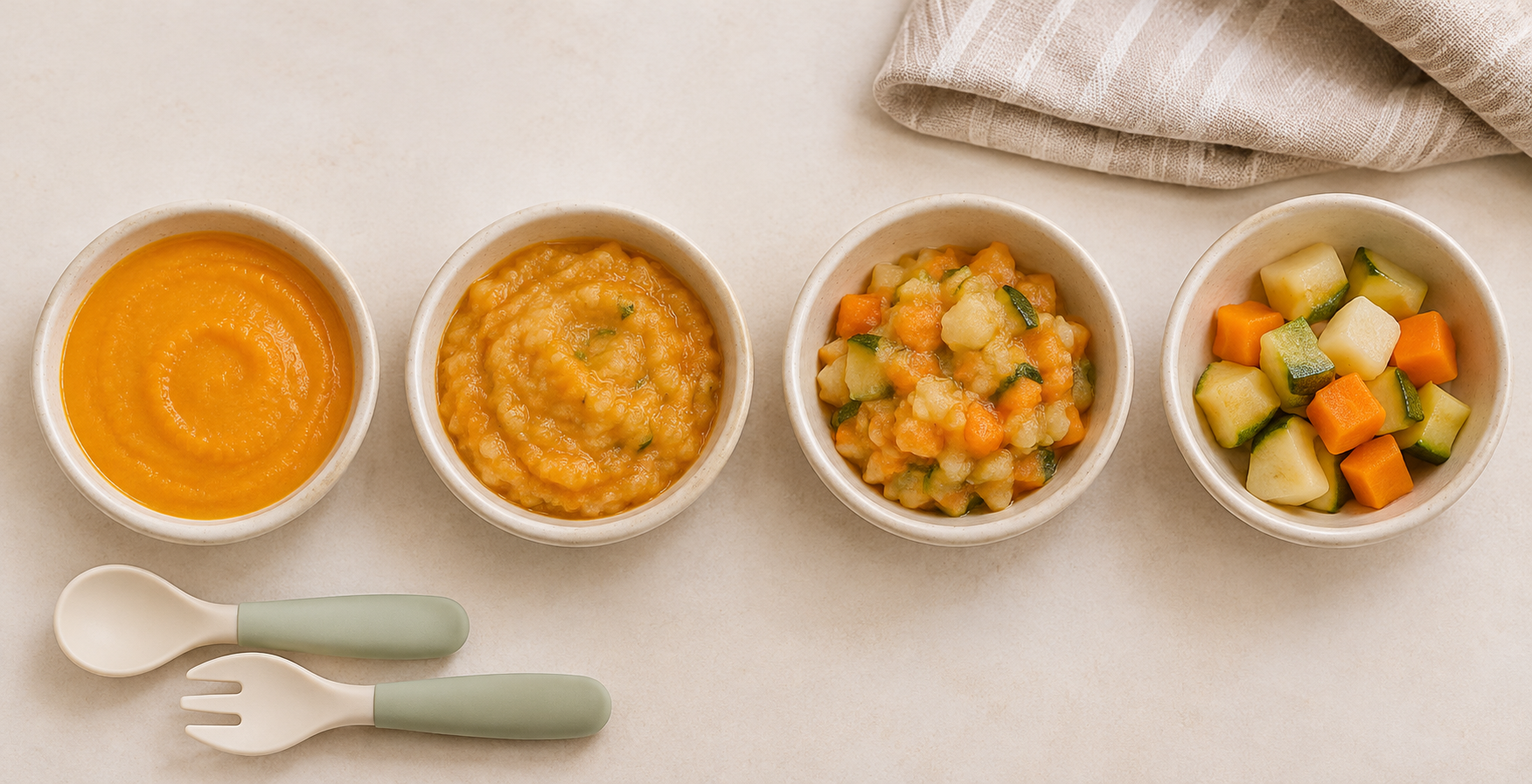
Most major brands organize their products around four broadly similar stages. Some packages say Stage 1, 2, or 3. Others use wording such as first foods, supported sitter, sitter, crawler, or toddler. Those terms can help you interpret a package, but they are still brand language rather than a universal developmental scale.
| Common stage | Typical age range on labels | What the food is usually like | What changes at this stage |
|---|---|---|---|
| Stage 1 | 4 to 6 months | Pureed, often single-ingredient food such as a pureed fruit or vegetable; infant cereal may also appear in this group | The baby is beginning solid foods and learning the process of eating from a spoon |
| Stage 2 | 7 to 8 months | Strained foods, including both single ingredients and combinations | The range of ingredients can expand while the texture progresses beyond an initial puree |
| Stage 3 | 9 to 12 months | More texture and small chunks | The food provides practice with chewing and managing a less uniform texture |
| Stage 4 | Often marketed for after 12 months | Meals with lumps or chunks, table food, or commercially prepared toddler food | The child moves toward the kinds of meals the family eats |
Stage 4 is the least tidy part of this framework. Commercial products may present it as an after-12-month stage, while the move to table foods with lumps or chunks can occur anywhere from 8 to 12 months. That overlap is another reason not to treat the number as a gate that opens on a particular birthday.
Ingredient count does not define every stage, either. Stage 1 is commonly associated with single-ingredient foods, but Stage 2 can include either one ingredient or a combination. If you are deciding between two products, the way the food has been prepared may tell you more about the intended step than the number of ingredients does.
Check readiness before following the age on the package
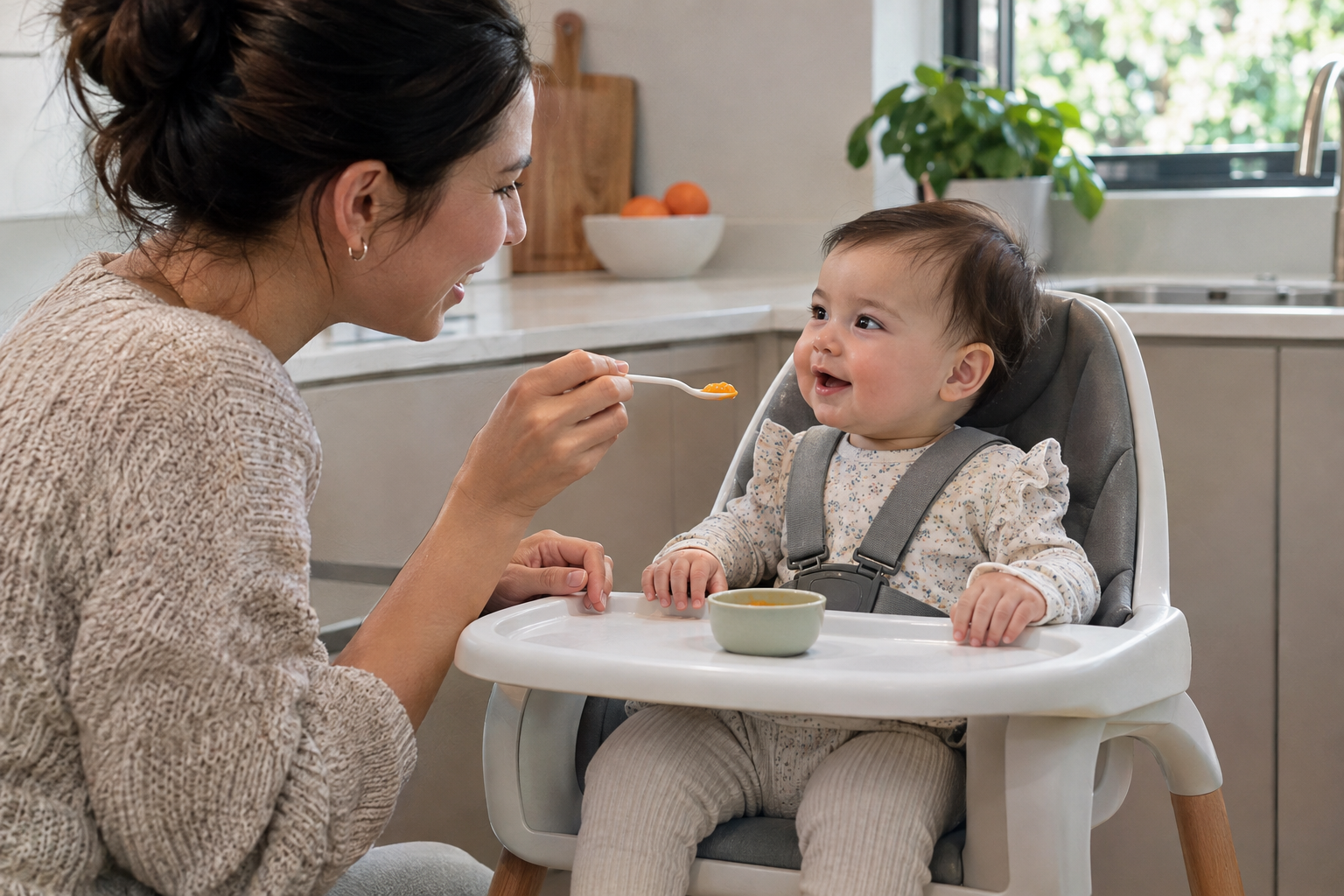
The biggest potential misreading happens at the beginning. A Stage 1 package may say 4+ months, but readiness for solid food involves more than reaching an age printed on a label. The CDC indicates that solids should be introduced at 6 months and identifies several signs to look for:
- Your baby can sit up.
- Your baby has good control of their head and neck.
- Your baby opens their mouth when food is offered.
- Your baby swallows food instead of pushing it back out.
- Your baby brings objects to their mouth.
- Your baby tries to grasp small objects.
- Your baby can move food from the front of the tongue toward the back.
Use those signs as a readiness check before you let a 4+ label settle the question. If your baby has reached the package age but cannot yet sit with control, manage food in the mouth, or swallow it, do not use the label as a reason to rush. Your child’s health care provider can help you decide when to begin.
The same principle applies after the first foods. A birthday tells you how old your baby is; it does not show you how comfortably they manage a particular texture. The age range can narrow your choices in the aisle, but observed ability should break the tie.
Choose a product by texture, skill, and then age
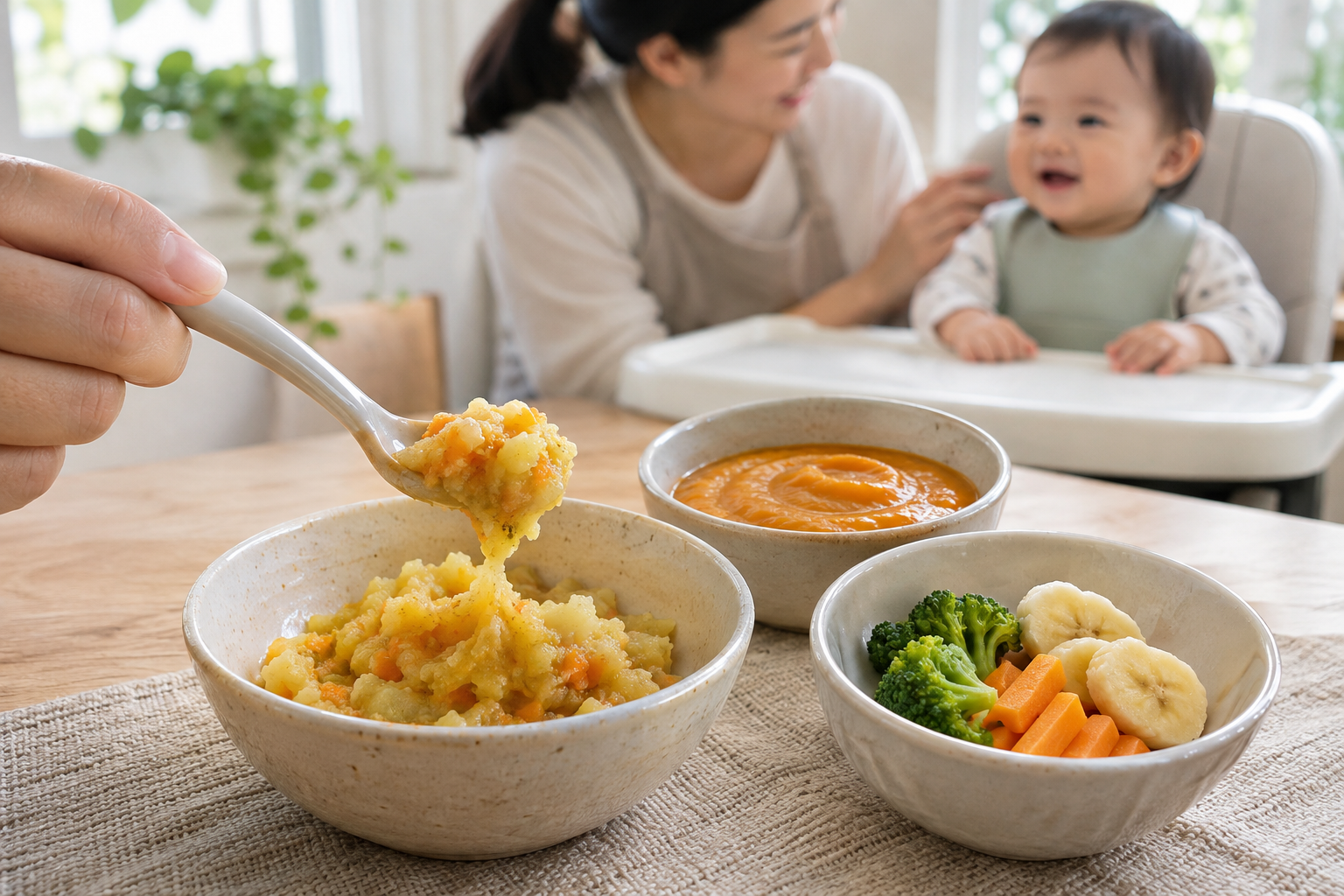
When packages use different systems, make the decision in the same order every time:
- Start with the skill your baby already has. Identify whether they are currently managing purees, strained foods, small chunks, or lumpier table food.
- Translate the package wording. First foods or supported sitter usually points toward an introductory puree. Sitter or second foods generally indicates the next step. Crawler or third foods generally signals more texture and small chunks. Toddler wording usually sits at the later end of the progression.
- Read past the numeral. Look for a description such as pureed, strained, textured, small chunks, lumps, or table food. This is especially important when you switch brands because the same number is not guaranteed to describe an identical product.
- Use age as a cross-check. If the age range and the texture both fit your baby’s current abilities, the product is a reasonable match. If the package age fits but the texture does not, do not rush the texture to satisfy the label.
- Apply the same progression outside the jar. Homemade baby food and baby-led approaches do not come with stage numbers. You can still use the underlying sequence – puree, strained food, more texture and small chunks, then lumpier or chunkier table food – to understand where a commercial product fits alongside the foods you already serve.
You do not have to buy every numbered product for your baby to progress. The four-stage system organizes commercial food; it is not a standardized feeding curriculum. The useful part is the gradual change in texture, not completing a brand’s full product sequence.
There is also no need to move up simply because the calendar reaches the next range. Some babies are ready for Stage 2 before 7 to 8 months, while others may not be ready until 9 to 10 months. Treat the next stage as an option to consider when your baby’s skills are developing, not as an assignment that becomes overdue.
Know when the label can no longer answer the question
A slower move between stages is not automatically evidence that something is wrong. The published age ranges are broad guidelines, and children progress in their own time. But a package cannot assess why a baby is unable or unwilling to move beyond a particular texture.
If your child appears stuck at one stage, cannot handle the next texture, or remains uninterested in progressing, talk with your child’s health care provider. There is no single label age that can resolve that individual question, so do not wait for a specific birthday or force a change based on the front of a jar.
At your next shop, make the decision in this order: readiness, current texture skills, the food’s preparation, and finally the age or stage printed on the package. If the label and your baby’s abilities point in different directions, follow the abilities and ask for professional guidance when you are unsure.
References



