
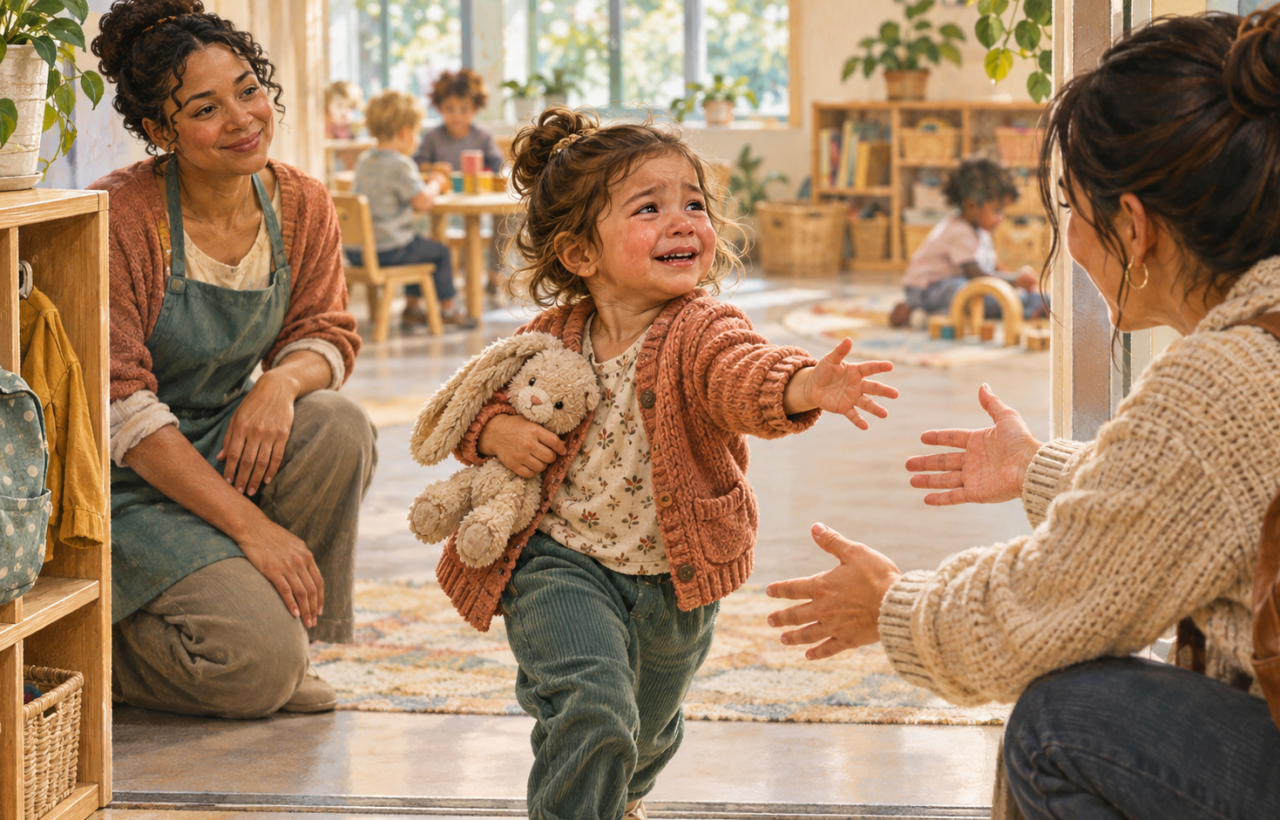
Your baby cries through every childcare handoff, or your toddler follows you from room to room and panics when you reach for your coat. You may be wondering whether this is ordinary separation anxiety or a sign of anxious attachment. The volume of the protest won’t answer that question. What matters is the pattern before you leave, while you are apart, and after you return.
Anxious attachment is not a diagnosis, a personality flaw, or proof that your bond is damaged. It describes a relationship pattern in which a child seems unsure that a caregiver will remain available, so the child puts extra energy into monitoring, holding onto, or repeatedly seeking that caregiver. Your goal is not to eliminate every tear. It is to help your child experience a dependable sequence: you prepare them, you leave honestly, another trusted adult provides care, and you return.
Key takeaways
- One difficult goodbye does not establish an attachment pattern. Look at what happens across ordinary days and different situations.
- Notice three stages: whether your child can explore before a separation, whether another familiar adult can help during it, and whether your child reconnects and returns to play afterward.
- Use a short, truthful goodbye routine. Sneaking away or repeatedly returning can make the sequence harder to understand.
- Build confidence outside separation moments by staying available while giving your child manageable chances to try, explore, and recover from frustration.
- Ask for professional support when distress repeatedly disrupts sleep, eating, play, childcare, or normal family life.
Clinginess alone is not anxious attachment

Babies and toddlers depend on adults for safety, comfort, and regulation. Crying, reaching, following, or objecting when a preferred caregiver leaves can be part of normal early development. A child can protest a departure strongly and still have a secure relationship with you.
Look for a combination of behaviours rather than treating one behaviour as proof. Separation anxiety and low self-confidence can occur alongside anxious attachment, but neither one identifies the pattern by itself. A hard first week in childcare, a disrupted routine, illness, fatigue, or an unfamiliar caregiver can temporarily make almost any young child more watchful and clingy.
Compare your child with their own usual behaviour, not with another baby at drop-off. Temperament affects how visibly children react. One toddler may cry loudly and then begin playing soon after you leave. Another may stay silent while remaining frozen, watchful, and unable to engage. The recovery tells you as much as the initial reaction.
When you are trying to understand the pattern, ask:
- Before separation: Can your child become interested in a toy, person, or activity while you remain nearby, or do they spend most of that time checking where you are?
- At the goodbye: Is the reaction tied to a new or difficult situation, or does it happen repeatedly during familiar, predictable separations?
- While you are away: Can a familiar adult provide any comfort and help your child engage, even if settling is gradual?
- At reunion: Does closeness help your child recover, or do they continue to appear uncertain, upset, or preoccupied with preventing another departure?
- Across the day: Is the concern limited to goodbye, or is it also reducing your child’s willingness to play, explore, sleep, eat, or accept care?
If the difficulty appears only with one person or in one setting, examine that setting before deciding the issue is attachment. An abrupt handoff, an unpredictable schedule, an overwhelming room, or a relationship that is still new may explain the reaction. Do not create unnecessary separations to test your child. Observe the transitions that already belong in family life.
Watch the whole separation-and-reunion pattern

Young children cannot explain attachment uncertainty in adult language. You see it through repeated behaviour. In a baby, that may mean tracking your movement closely, interrupting play whenever you move away, or remaining difficult to settle after you return. A toddler may ask the same question about your return, abandon an activity to keep you in sight, or resist a familiar caregiver even after many predictable handoffs.
Signs become more meaningful when several appear together and continue beyond a temporary disruption:
- Your child seems preoccupied with your availability and has difficulty becoming absorbed in age-appropriate play while you are nearby.
- Ordinary cues of departure, such as putting on a coat or collecting a bag, trigger distress before a goodbye has begun.
- Reassurance helps only briefly, and your child immediately needs another confirmation that you are staying or returning.
- Your child seeks closeness at reunion but remains upset, guarded, or unable to move back toward play and exploration.
- Your toddler avoids manageable tasks unless you repeatedly confirm that you will remain close or complete the task for them.
- The pattern appears during multiple familiar routines rather than only in a new, tiring, or frightening situation.
Low confidence in a child under three rarely sounds like a clear statement about self-esteem. It is more likely to look like refusing to try, stopping whenever you shift your attention, or checking your face before every small action. That behaviour still needs context. A cautious child who warms up slowly is not automatically anxiously attached.
Use descriptive notes instead of writing down a conclusion such as “anxious attachment.” Record the trigger, who was present, what your child did, whether another caregiver could help, what happened at reunion, and whether your child resumed eating, playing, or resting. This keeps the loudest moment from becoming the whole story and gives a clinician useful information if you later seek support.
Make departures honest, brief, and predictable
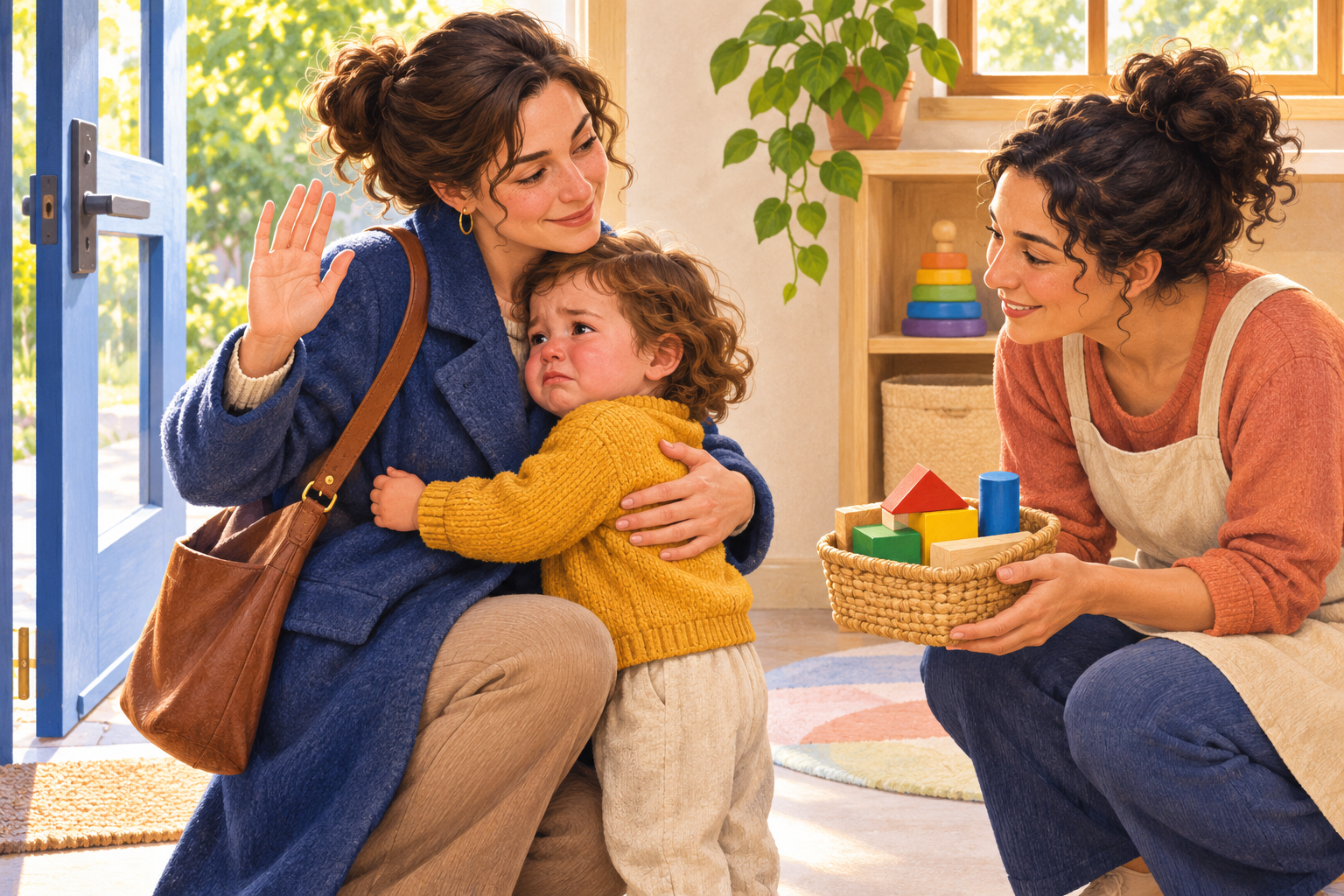
What to do during a goodbye
A distressed toddler cannot make much use of a long explanation. Keep the message short enough to remain the same even when the moment is emotional.
- Name the feeling without arguing with it. Try, “You want me to stay. Goodbyes are hard.” Avoid insisting that your child is fine when their body is telling you otherwise.
- State the plan in concrete language. Name the adult who will stay and an event connected with your return: “Nana stays with you. I come back after snack.” For a young toddler, a familiar event is easier to grasp than a clock time.
- Use one small ritual. A hug, one phrase, and a wave at the door are enough. Repeating the same sequence helps your child recognize what happens next.
- Leave when you say you will. Do not sneak away. If you return several times in response to crying, your child may focus on escalating the protest because the ending keeps changing.
- Let the other caregiver take over. Share any useful comfort object or settling routine in advance, then give that adult room to build a relationship with your child.
- Reconnect warmly when you return. Confirm the completed sequence: “I came back after snack, just like I said.” Offer closeness, then let your child decide when to move toward play.
Crying does not mean the routine failed. The useful experience is not “I never felt upset.” It is “I felt upset, someone cared for me, and my parent returned.” If the separation is optional and your child is overwhelmed, make the next attempt smaller and more manageable. If the separation is necessary, such as childcare or a medical appointment, keep the plan truthful and coordinate support with the adult who will remain.
What to practise between goodbyes
Security develops through ordinary interactions, not through one perfect departure. You do not have to respond instantly or prevent every frustration. Your child needs a relationship in which bids for connection are noticed often enough, limits are understandable, and reconnection is possible after a difficult moment.
- Follow through on small statements. If you say you are going to the kitchen and will return after putting down a cup, come back and name that you returned. Keep your child safely supervised throughout.
- Make room for exploration. Sit nearby while your child investigates a toy or attempts a manageable task. Stay available without directing every move.
- Pause before taking over. If your toddler struggles with a block, spoon, or simple piece of clothing, give them a moment to try. Offer the smallest amount of help that allows the attempt to continue.
- Use confidence-building language. “You are working on it, and I am close” supports effort without promising that nothing will feel difficult.
- Coordinate the adults. Ask regular caregivers to use the same basic goodbye message and return cue. They do not need identical styles, but contradictory promises make the sequence harder to predict.
- Repair mistakes plainly. If you left without saying goodbye or a plan changed, acknowledge it: “I left before I told you. That was confusing. Next time I will say goodbye.” Repair is more useful than trying to appear perfect.
Do not withdraw affection, shame clinginess, or force a long separation to make your child “tough.” Those responses add uncertainty to a moment already organized around uncertainty. Comfort and confidence are not opposites. A child can receive comfort while also being given space to practise coping with a manageable challenge.
Get help when anxiety starts shrinking your child’s world

There is no home checklist that can diagnose your child’s attachment pattern. A professional assessment becomes worthwhile when the difficulty is persistent, appears in several familiar situations, or interferes with development and daily functioning rather than remaining a hard but contained goodbye.
Talk with your child’s pediatrician or family doctor if:
- distress repeatedly disrupts sleep, eating, play, childcare, or necessary family routines;
- your child rarely settles with any familiar caregiver or remains highly distressed after you return;
- fear is spreading to more situations or becoming more limiting instead of easing as routines become familiar;
- there has been a marked behavioural change after a frightening event, loss, or major disruption;
- the family is avoiding nearly every separation, or the situation is overwhelming the adults who provide care.
A doctor can consider the child’s broader health and development and, when appropriate, refer you to an infant or early-childhood mental health professional. Bring your observations rather than trying to prove a label. Note the triggers, your child’s exact behaviour, what helps, how reunions unfold, and which parts of daily life are affected. Input from a regular childcare provider can add a view of what happens after you leave.
For your next necessary goodbye, choose one honest sentence and one brief ritual, share both with the caregiver, and observe the full sequence rather than only the tears at the door. If your child can accept support, reconnect, and gradually return to exploration, keep building on that experience. If uncertainty continues to dominate daily life, make the clinical appointment. The point is not to attach a permanent label to your child; it is to give them the support they need while relationships and coping patterns are still developing.
References



