
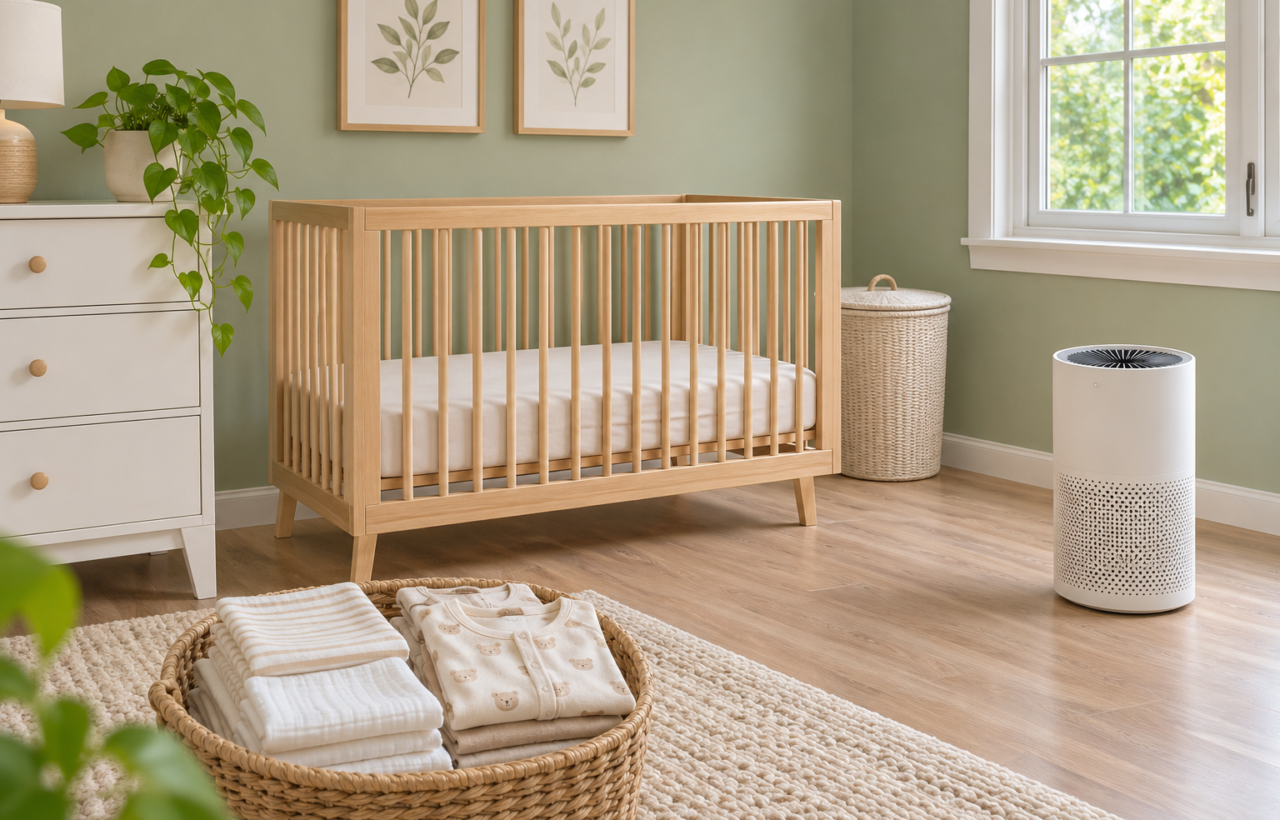
You want the nursery to feel fresh, but adding a purifier, a strongly scented detergent, and several specialty laundry products can create more questions than answers. The useful goal is simpler: control what enters the room, remove what has settled, and wash fabrics effectively without adding products your family does not need.
In this context, “baby-safe” is not a promise printed on a package. It is a system: suitable equipment, correct product use, secure storage, attention to your baby’s response, and a routine you can repeat when you are tired.
Fix the source before asking a product to manage it
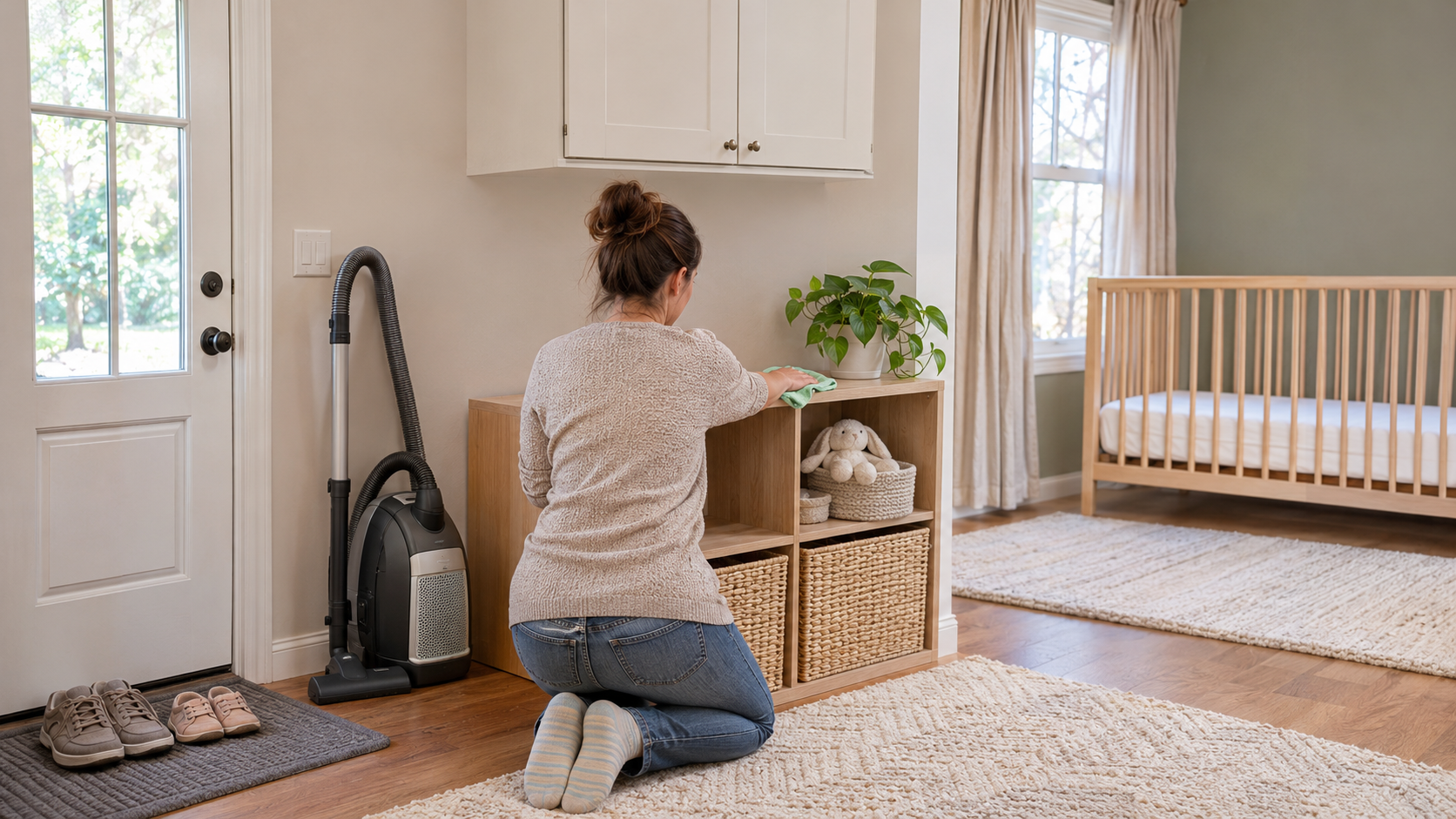
Start by identifying the problem you are actually trying to solve. Dust on the dresser, a stale room, an overflowing diaper pail, a scented crib sheet, and irritation after laundry day do not have the same solution.
Walk through the nursery when the issue is most noticeable. Check for a pattern rather than relying on a general sense that the air is “bad.”
- If the room smells unpleasant: check the diaper pail, hamper, damp cloths, recently cleaned surfaces, and anything stored under or beside the crib. Remove the source instead of covering it with another fragrance.
- If dust returns quickly: look at floors, rugs, curtains, shelves, soft toys, vents, and the space behind furniture. An air purifier does not remove dust that has already settled.
- If the room feels stuffy: consider airflow and whether furniture or curtains block a vent. Open a window only when the outdoor air and weather make that a sensible choice.
- If the problem appears after laundry: smell the clean bedding and clothing separately. A detergent, scent booster, fabric softener, dryer sheet, or stain treatment may be contributing to what you notice.
Make the direct correction first. Empty the pail, remove damp textiles, clean settled dust, and deal with spills or stains. Keep cleaning products closed and out of your child’s reach. A purifier can then support that routine instead of being expected to compensate for it.
Choose an air purifier you can use correctly every day
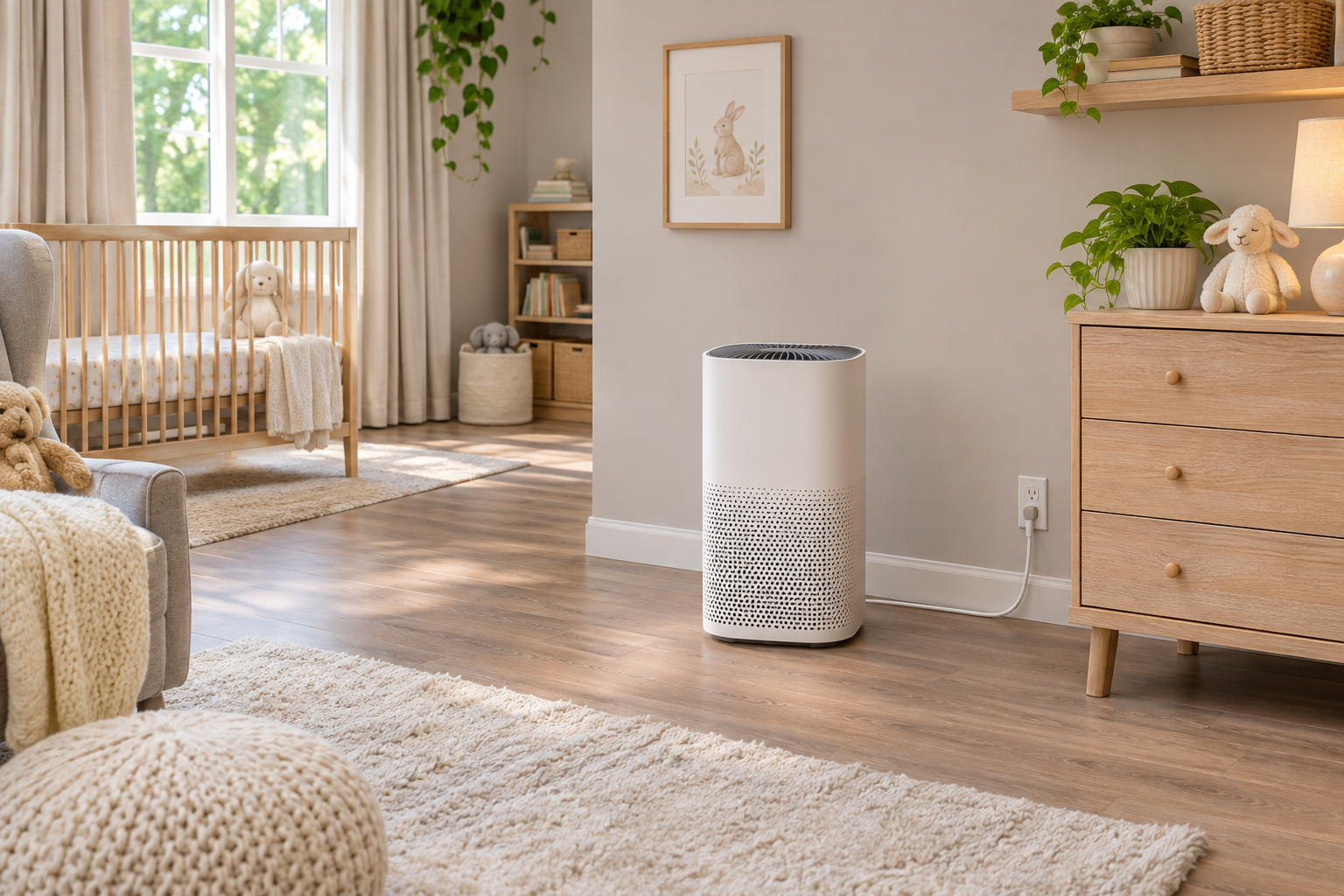
A nursery purifier may help manage dust, allergens, odours, and other material in the air, but only while air can move through the unit and its filter. The best fit is not automatically the machine with the longest feature list. It is the one suited to the room, placed safely, and maintained on schedule.
Use this shortlist before buying
- Room fit: compare the manufacturer’s stated room coverage with the actual nursery. Check the conditions behind the claim, including the fan setting, rather than treating the largest number on the box as the whole answer.
- Filtration: decide whether your main concern is airborne particles, odour, or both. Particle filtration and odour control are different jobs, so read what the installed filter is designed to address.
- Usable sound level: listen to the machine at the setting you expect to run. A quiet mode is not useful if you turn the purifier off because its light or sound interrupts sleep; a very low setting may also move less air.
- Replacement filters: check how filters are obtained, what maintenance the manual requires, and whether the ongoing cost fits your household. A machine you cannot maintain is a poor nursery choice.
- Simple controls: a timer, child lock, or dimmable display may be practical, but extra controls do not replace correct sizing, filtration, and maintenance.
Place it for airflow and child safety
- Read the manual’s placement and clearance instructions before choosing a permanent spot.
- Keep the intake and outlet clear of curtains, furniture, blankets, and piles of clothing.
- Put the unit on a stable surface approved by the manufacturer. Do not balance it on a narrow dresser or a surface your child may pull against.
- Secure the cord outside the crib area and out of reach. Reassess the setup as your baby begins to roll, crawl, stand, and explore.
- Keep liquids away from the unit. If you also use a humidifier, follow both manuals and do not allow moisture to collect on or inside the purifier.
- Choose a sustainable operating setting and use the purifier as directed. Do not wait for a strong smell before switching it on if routine operation is your plan.
Check the filter instead of guessing from the room’s smell. Confirm that it is installed in the correct direction, that any protective packaging was removed, and that the replacement indicator has not been ignored. Do not wash or vacuum a filter unless its instructions specifically permit it.
Build a laundry routine around cleaning, not baby branding
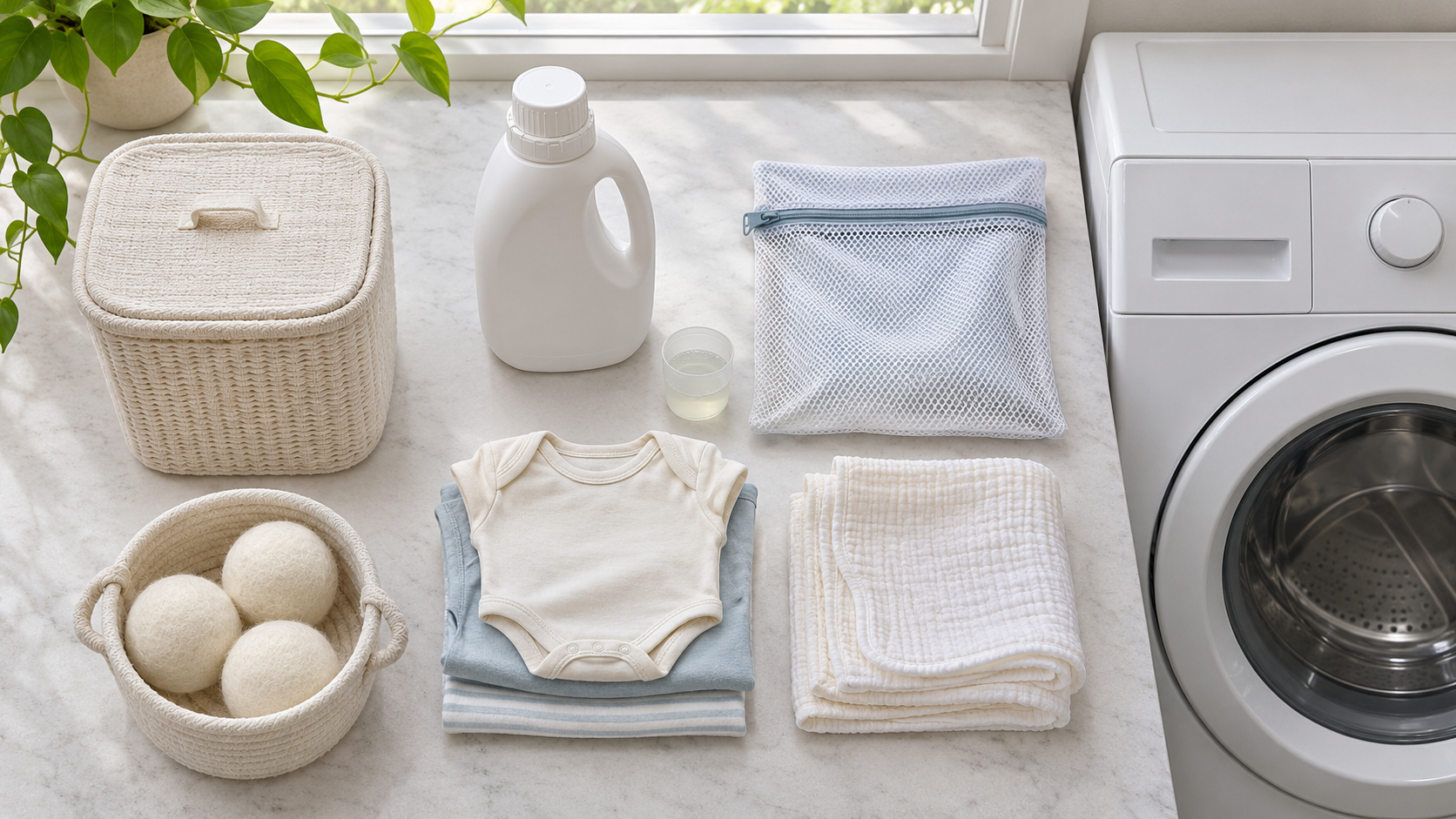
Baby clothing still needs a detergent that can handle ordinary messes. Useful evaluations include familiar stains such as pasta sauce, grass, and mud, because a gentle-looking label is not helpful if poor cleaning leads you to repeat the wash or add several treatments.
The word “baby” on the bottle does not tell you the correct dose, whether the fragrance suits your household, or how your child’s skin will respond. Choose by function.
Decide what your detergent needs to do
- Remove your usual stains: think about milk, food, diaper leaks, outdoor dirt, and anything else that regularly reaches your child’s clothes.
- Work with your washer: confirm that the detergent is intended for your machine and the cycles you use.
- Fit your fragrance preference: if your goal is to eliminate added laundry fragrance, choose a product labelled for that purpose and avoid adding scented boosters, softeners, or dryer sheets elsewhere in the cycle.
- Respect known sensitivities: if your child has a clinician-confirmed allergy or skin condition, follow the clinician’s product guidance rather than relying on broad front-label terms.
- Be easy to measure: a product with clear dosing instructions makes consistency easier. Free-pouring creates another variable when you are trying to understand residue, scent, or skin changes.
Use the smallest workable routine
- Read the garment label. Sleepwear, waterproof items, delicate fabrics, and stain-treated garments may have different care requirements. Do not assume every baby item belongs in the same cycle.
- Sort for a reason. Separate by colour, fabric care, or heavy soiling when necessary. A separate baby load should solve a practical problem, not exist only because the bottle says “baby.”
- Treat the stain directly. Remove loose material and use a treatment suitable for the garment. This targets the mess without automatically increasing detergent for the entire load.
- Measure the detergent. Follow the product directions for your washer, load, and soil level. More detergent is not a substitute for correct loading or stain treatment.
- Leave room for washing and rinsing. Do not pack the drum so tightly that clothing cannot move as the machine is designed to wash it.
- Dry items fully and as directed. Deal with damp laundry promptly rather than leaving it in the washer or nursery hamper.
An extra rinse can be a targeted troubleshooting step when you suspect product remains in the fabric, but first check the dose and whether the machine was overloaded. Otherwise, the extra cycle may use more water without correcting the reason the problem occurred.
You also do not need to introduce detergent, stain remover, softener, scent booster, and dryer sheets at the same time. Start with detergent and add something only when it solves a defined problem. Fewer products make it easier to identify what changed if clothing develops a strong scent or your baby’s skin reacts.
Troubleshoot one variable instead of replacing everything
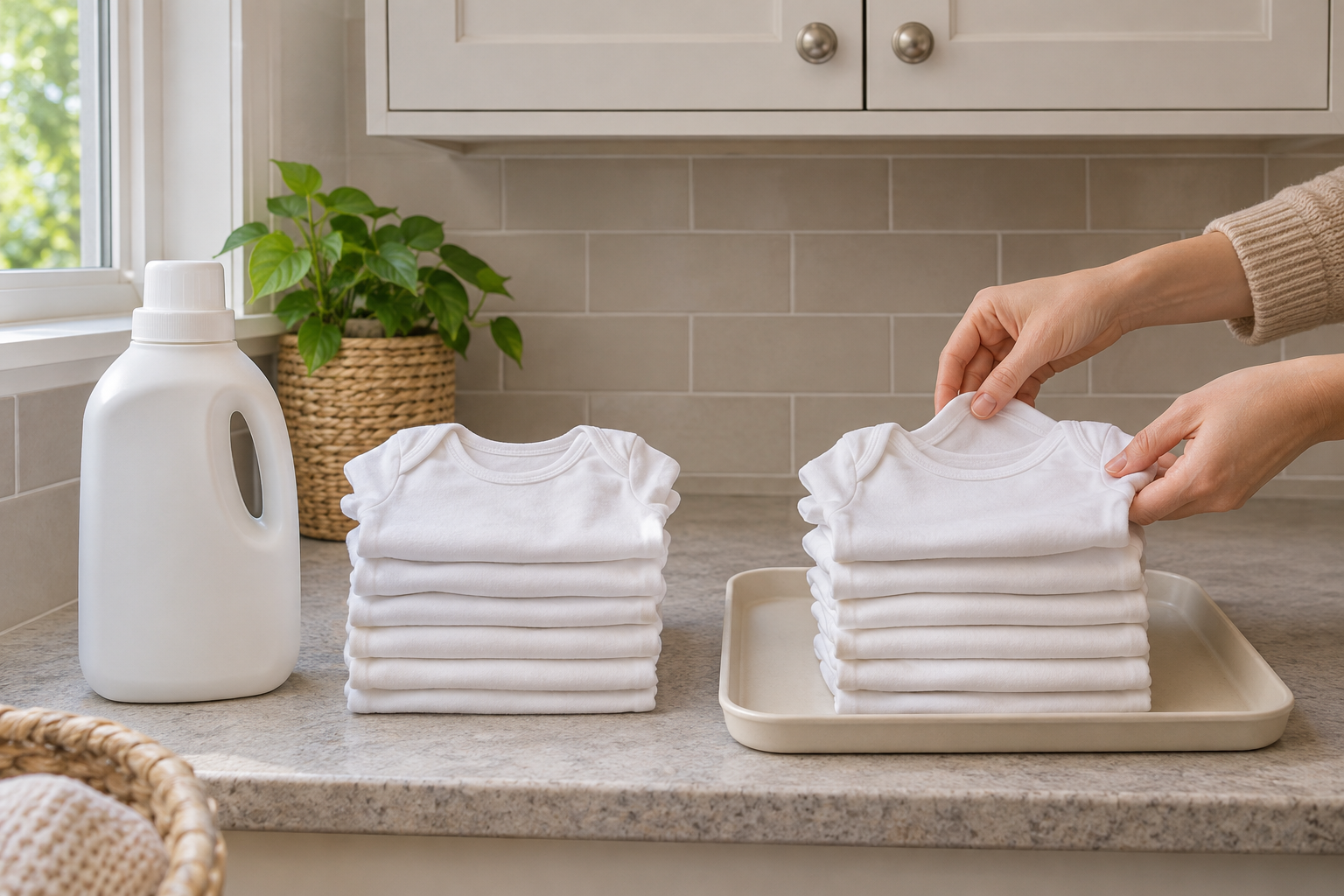
When something goes wrong, changing the purifier, detergent, wash cycle, bedding, and cleaning spray at once destroys the information you need. Record the date, the change you made, and what happened next. Then adjust one variable at a time unless there is an immediate safety concern.
| What you notice | What to check | What to do next |
|---|---|---|
| Dust returns soon after cleaning | Blocked airflow, filter installation or condition, and dusty surfaces or textiles | Clean the room, clear the intake and outlet, and inspect the filter according to the manual |
| An odour persists | Diaper pail, damp fabric, hamper, spill, cleaning product, or scented laundry | Remove or clean the source; do not add fragrance to disguise it |
| Clean clothing smells strongly of detergent | Dose, load size, and optional scented products used in the wash or dryer | Verify the measured dose, simplify the routine, and rewash or rinse as the garment label permits |
| Skin changes follow a laundry switch | The newest detergent, stain treatment, softener, dryer product, or changed dose | Stop the new optional product, return to a previously tolerated routine, and seek medical guidance if the reaction continues |
| The purifier seems ineffective | Room fit, fan setting, blocked vents, filter packaging, installation, and replacement status | Compare the setup with the manual before buying another unit |
A rash does not prove that detergent caused it. If your baby’s skin is persistently red, painful, blistered, oozing, or worsening, contact a pediatric healthcare professional rather than continuing product experiments. Trouble breathing, facial swelling, or a rapidly developing severe reaction needs urgent medical help.
Store detergent and every other laundry product closed, in its original container, and completely inaccessible to children. A high shelf is useful only if climbing, spills, and the changing reach of a mobile toddler have also been considered.
Key takeaways
- Remove odour, dampness, and settled dust at the source before expecting a purifier to manage the room.
- Choose a purifier by room fit, filtration, usable sound level, safe placement, and maintainable filters.
- Keep airflow paths open, secure the cord, and revisit the setup as your baby becomes mobile.
- Choose detergent by cleaning performance, washer compatibility, fragrance preference, and your child’s actual response – not the word “baby” alone.
- Measure detergent, follow garment labels, and add optional laundry products only when they solve a specific problem.
- When a problem appears, change one variable at a time so you can identify the cause.
Start with one pass through the nursery and one review of your next laundry load. Fix the obvious source, check the instructions for what you already own, and simplify before you shop. That gives you a safer, clearer baseline for every decision that follows.
References
- Parents – The 10 Best Air Purifiers for Babies We Tested With Our Little Ones
- Parents – The 9 Best Laundry Detergents for Babies, Tested by Parents



