
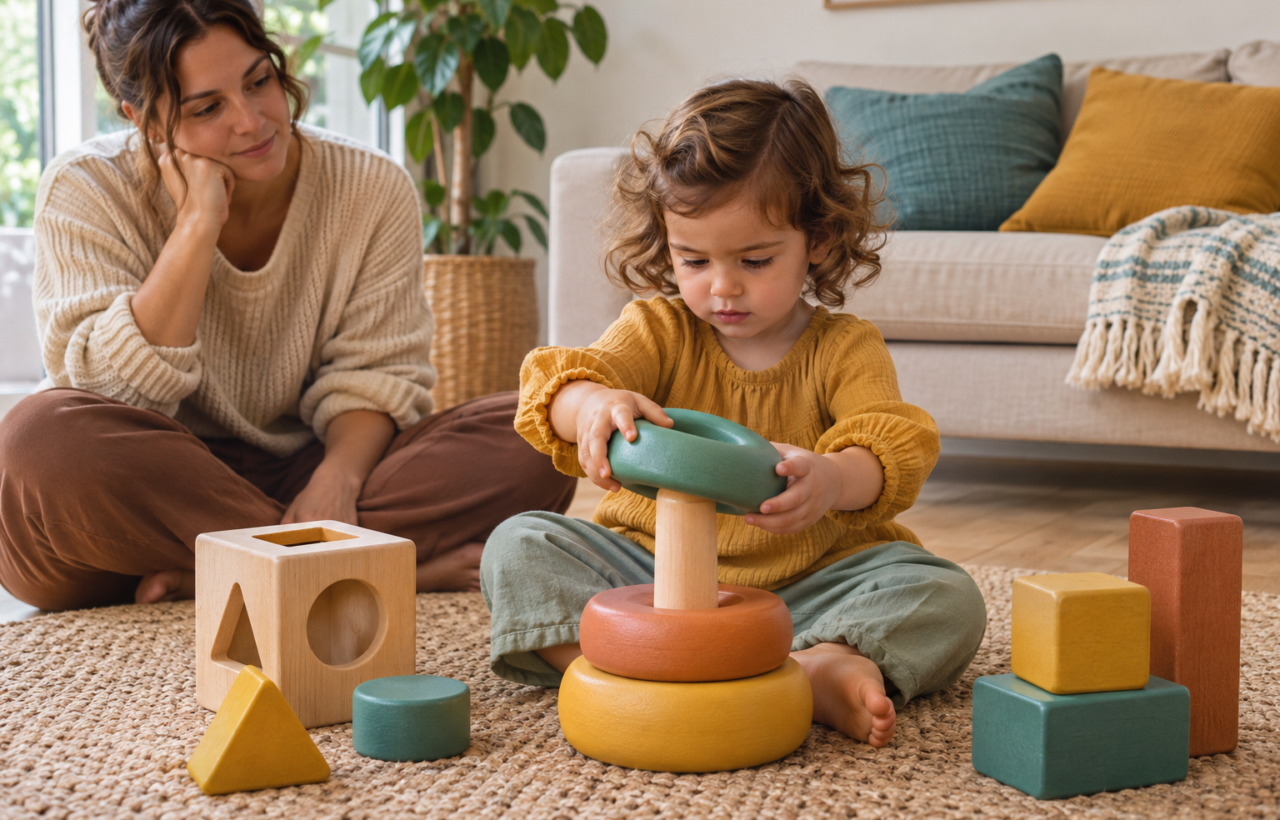
You are looking at a shelf full of toys that promise learning, development, or hours of engagement. The difficult part is not finding a toy with those words on the box. It is deciding which toy your toddler will actually use, what kind of play it will invite, and whether it will still be interesting after the first afternoon.
The most useful question is not, “Is this educational?” Ask, “What will my child do with it?” A good developmental toy gives your toddler an action to practise, a manageable problem to solve, and enough freedom to try a different approach next time.
Start with the action, not the developmental claim
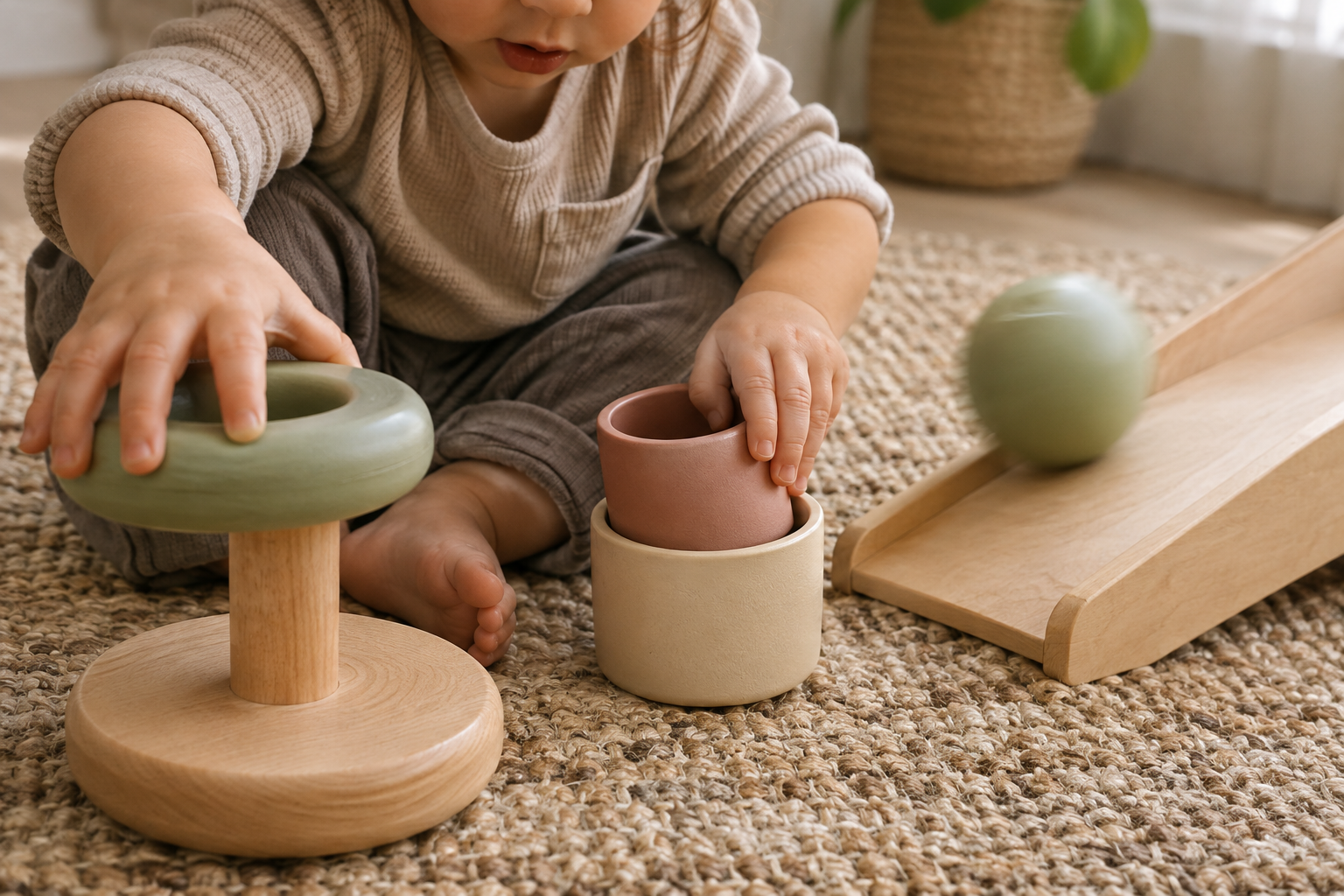
Turn the toy over in your hands and describe the child’s role with a verb. Will your toddler stack, fit, sort, carry, connect, push, ride, climb, or pretend? If the clearest verb is watch, the toy may offer less active play than its packaging implies.
This does not mean every toy must teach several skills at once. It means the play value should come from what your child does, not from how many sounds, lights, buttons, or printed learning claims the toy contains. A simple toy can offer a rich play loop when your toddler can make a choice, see what happened, and try again.
- Building: Your toddler can stack, balance, knock down, connect, separate, and rebuild. Look for pieces that can become more than one finished object.
- Puzzles and fitting toys: Your toddler can compare shapes, turn pieces, notice errors, and change strategies. The pieces should be easy to grip and clearly different from one another when your child is beginning.
- Pretend play: Your toddler can copy familiar routines, give objects new meanings, and create short sequences such as feeding, washing, driving, or putting a toy to bed.
- Ride-on and climbing play: Your toddler can plan movements, shift weight, stop, start, get on, and get off. The equipment must suit your child’s current abilities and the space where it will be used.
A toy does not need a single correct outcome to be worthwhile. In fact, toys that can be combined, rearranged, or used in pretend scenarios often remain useful as your child’s play becomes more complex. The same blocks might be stacked today, loaded into a truck later, and turned into pretend food another day.
Match the challenge to the child in front of you
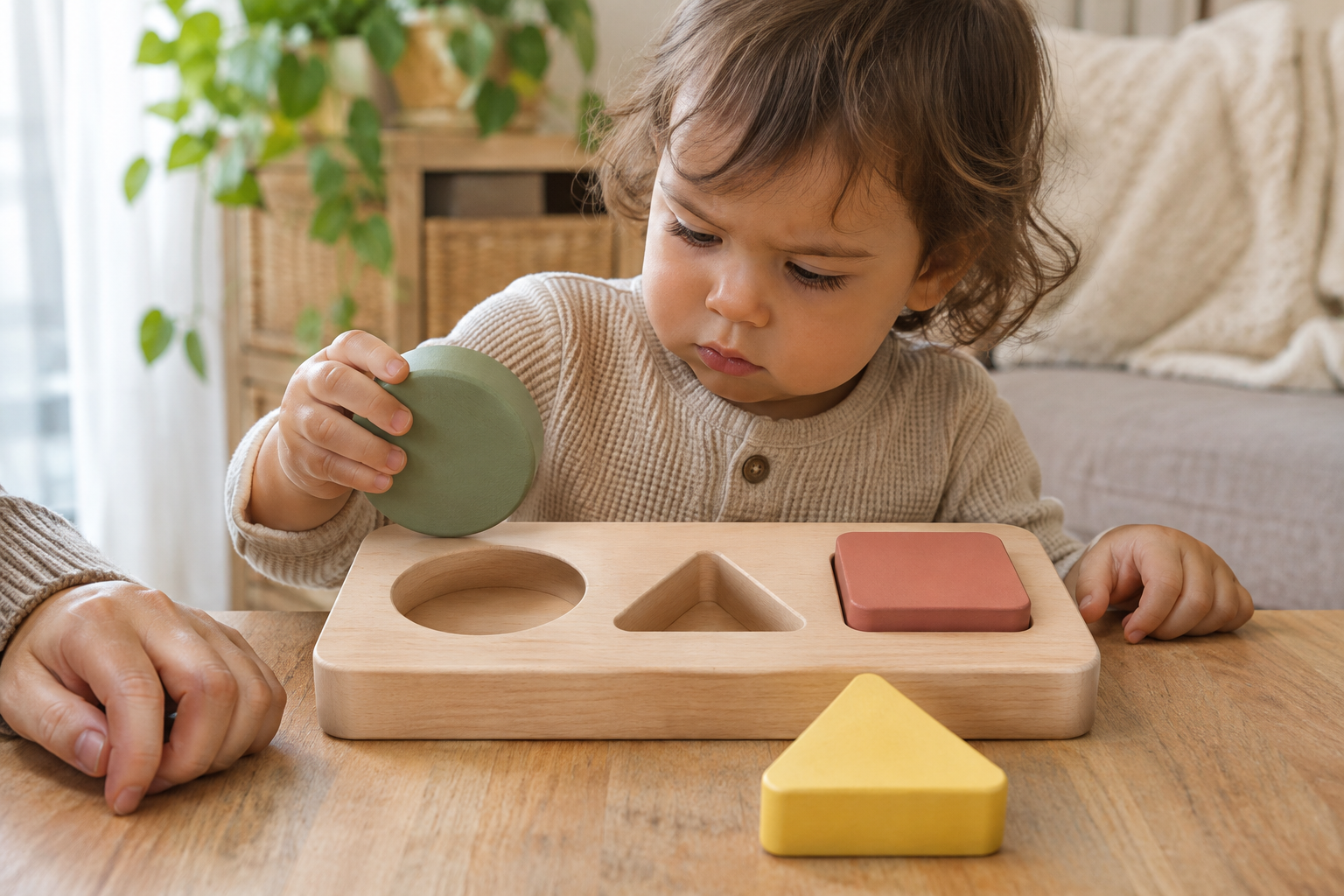
Toy recommendations are often organized by age, but toddlers do not develop every ability at the same pace. A child may be adventurous on a climbing toy and cautious with a puzzle, or absorbed by pretend play and uninterested in building. Choose within the manufacturer’s age guidance, then use your child’s actual play to judge the level of challenge.
The useful middle ground is a toy your toddler can begin without an adult taking over, but cannot completely master on the first attempt. Some effort is productive. Total dependence on an adult is usually a sign that the toy is too difficult right now, poorly designed for your child, or simply not interesting to them.
Signs the fit is about right
- Your toddler understands at least one thing they can do with the toy.
- They can complete part of the action independently, even if the whole task is still difficult.
- A failed attempt gives them usable information: the block falls, the puzzle piece does not fit, or the ride-on stops at an obstacle.
- There is another variation to discover after the first success.
- You can help with a prompt, a demonstration, or a steadying hand without becoming the person doing all the play.
Signs to simplify or put it away for later
- Your toddler cannot find a starting point after you demonstrate.
- The play repeatedly ends with you assembling, operating, or resetting everything.
- The toy requires hand control, balance, or strength your child does not yet have.
- Your toddler is consistently overwhelmed by the number of pieces or steps.
- The only successful result comes from following an exact adult sequence.
Putting a toy away is not admitting that you chose badly. It may become a better fit later. Remove loose pieces before storage, keep related parts together, and try it again when you notice your child doing a similar action elsewhere.
Do not use difficulty as a shortcut to faster development. Buying beyond the marked age range can introduce pieces, movements, or play expectations that are not appropriate for your child. Treat the label as a safety boundary and a starting point; treat your observations as the guide to interest and challenge within that boundary.
Build a small mix of different play opportunities
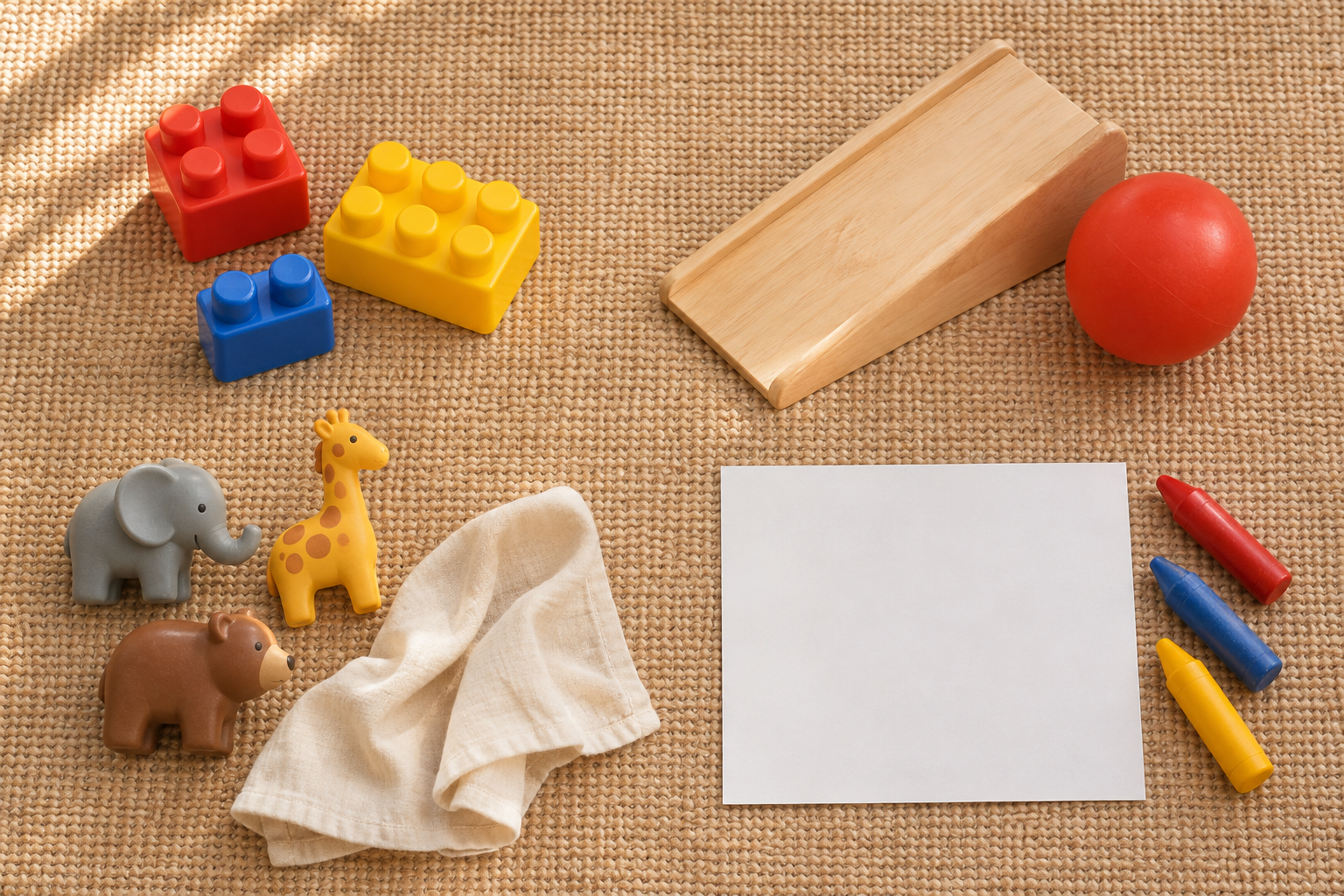
You do not need a separate product for every skill. A practical toy collection gives your child different kinds of work to do. Building toys, puzzles, pretend-play materials, ride-ons, and climbing equipment cover distinct forms of play, and one well-chosen toy may belong to several of those groups.
Use these categories as a gap check, not as a shopping quota:
- Something to construct: Blocks, connecting pieces, nesting objects, or stackers that can be arranged in more than one way.
- Something to solve: A simple puzzle, shape-fitting toy, or cause-and-effect activity that makes the result of an attempt clear.
- Something for pretend play: Familiar objects such as toy food, vehicles, figures, dolls, or household props that let your toddler act out routines.
- Something for whole-body movement: A stable ride-on, push toy, ball, or properly installed climbing structure suited to your child’s abilities and your available space.
Before adding a category, look around your home. Cardboard boxes can become buildings or vehicles. Cups can be nested and stacked. A wooden spoon can be a kitchen tool, a drumstick, or part of a pretend meal. Everyday objects are not automatically safe toys, so supervise their use and remove anything breakable, sharp, loose, or small enough to be swallowed.
Movement toys need a separate reality check. Confirm that you have the recommended surface, enough clear space around the toy, and a way to store it without creating a hazard. Follow the manufacturer’s assembly, placement, and supervision instructions. A climbing toy that does not fit safely in your home is not a better developmental purchase than a ball or another movement activity you can manage properly.
Inspect toys regularly, especially second-hand items and toys used for climbing or riding. Stop using anything with cracks, sharp edges, loose fasteners, exposed components, missing safety parts, or a battery compartment that no longer closes securely. If your child still explores objects with their mouth, be especially conservative about detachable pieces.
Key takeaways
- Choose a toy by the action it invites: stacking, fitting, building, pretending, pushing, riding, or climbing.
- Look for a challenge your toddler can begin independently and explore in more than one way.
- Stay within the manufacturer’s age and safety guidance, even when your child appears advanced in one area.
- A balanced toy shelf offers construction, problem-solving, pretend play, and whole-body movement without requiring a large collection.
- Buy for your actual child and home, including your available floor space, storage, noise tolerance, cleanup capacity, and need for supervision.
- When play becomes repetitive or frustrating, change the setup before assuming you need another toy.
Buy less by observing one play problem at a time
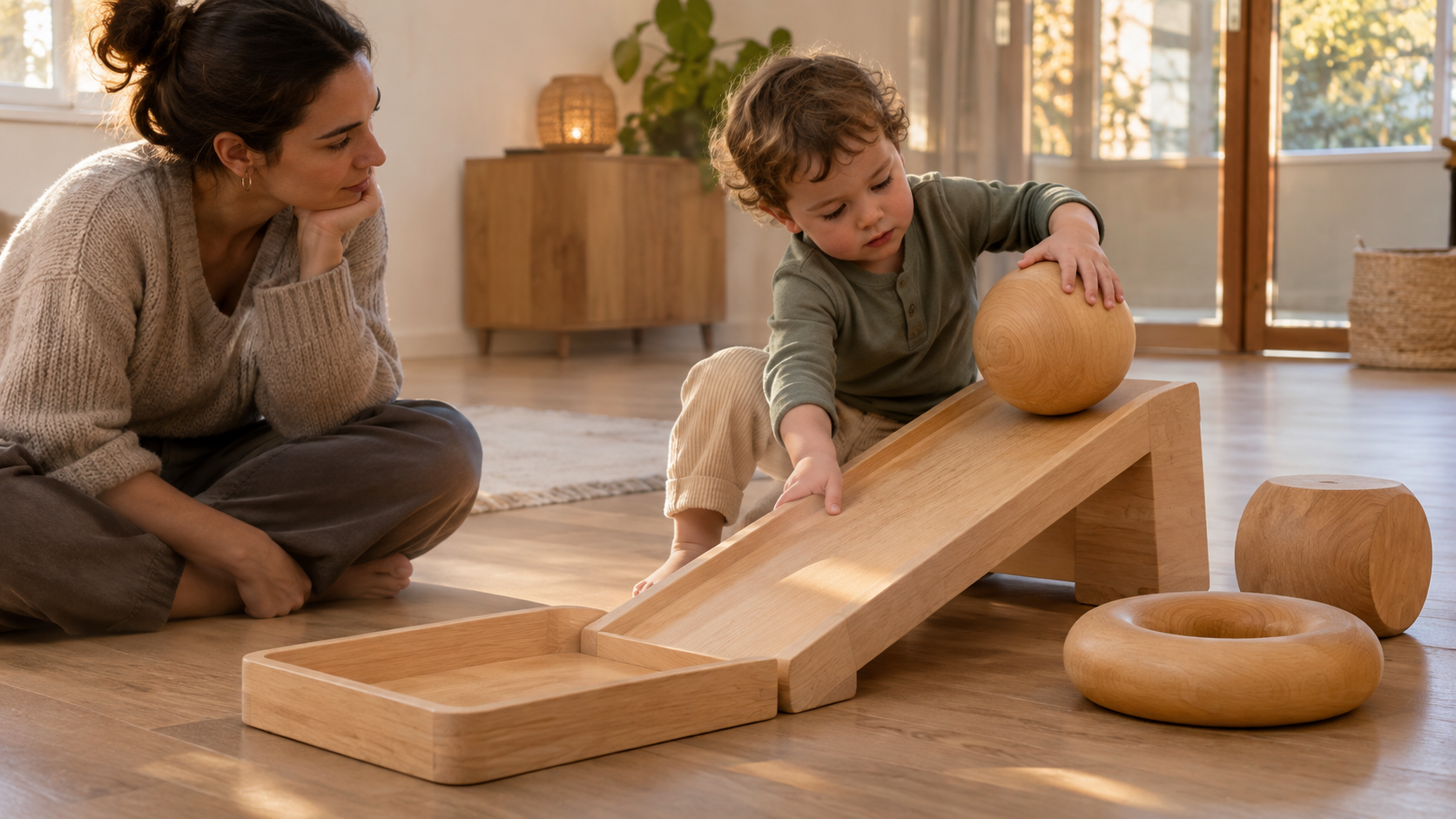
The easiest way to overbuy is to shop for a broad goal such as creativity, intelligence, or fine-motor development. Those labels do not tell you what is missing from your toddler’s play. Start with an observation you can see.
- Watch what your child repeats. Notice whether they are currently filling containers, stacking objects, transporting toys, copying household routines, fitting pieces together, or seeking opportunities to move.
- Identify the next variation. A child who fills and empties containers may enjoy nesting objects or blocks with a bucket. A child who copies cooking may use simple pretend food and utensils. A child who stacks may be ready for pieces that connect or require balancing.
- Check what you already own. Present familiar pieces in a new container, combine two compatible toy sets, or move pretend-play materials to a different setting.
- Choose the simplest safe option that adds that variation. Extra electronic features are not an advantage unless they support the action you want your child to perform.
- Make room before the new toy arrives. Store or pass along toys your child has outgrown, broken toys that should not be used, and near-duplicates that do not add a different play possibility.
When a toy is ignored, change only one part of the setup. Put it on a clear surface instead of in a crowded bin. Offer fewer pieces. Begin a short pretend scenario and let your toddler take over. Pair it with a familiar favourite. If there is still no interest, put it away rather than repeatedly directing your child back to it.
Rotation works best as a response to what you see, not as a rigid schedule. If your toddler is dumping crowded bins without settling into play, reduce what is available. If they are deeply engaged in a continuing building or pretend-play idea, leave those materials accessible. The goal is not a perfectly arranged shelf; it is making the next play decision easy enough for your child to begin.
For your next purchase, watch one ordinary play session before opening a shopping page. Write down the action your toddler returns to, the point where the play stops, and the variation they cannot yet create with what they have. That gives you a concrete buying brief and a much better filter than the word “developmental” on a box.
References



