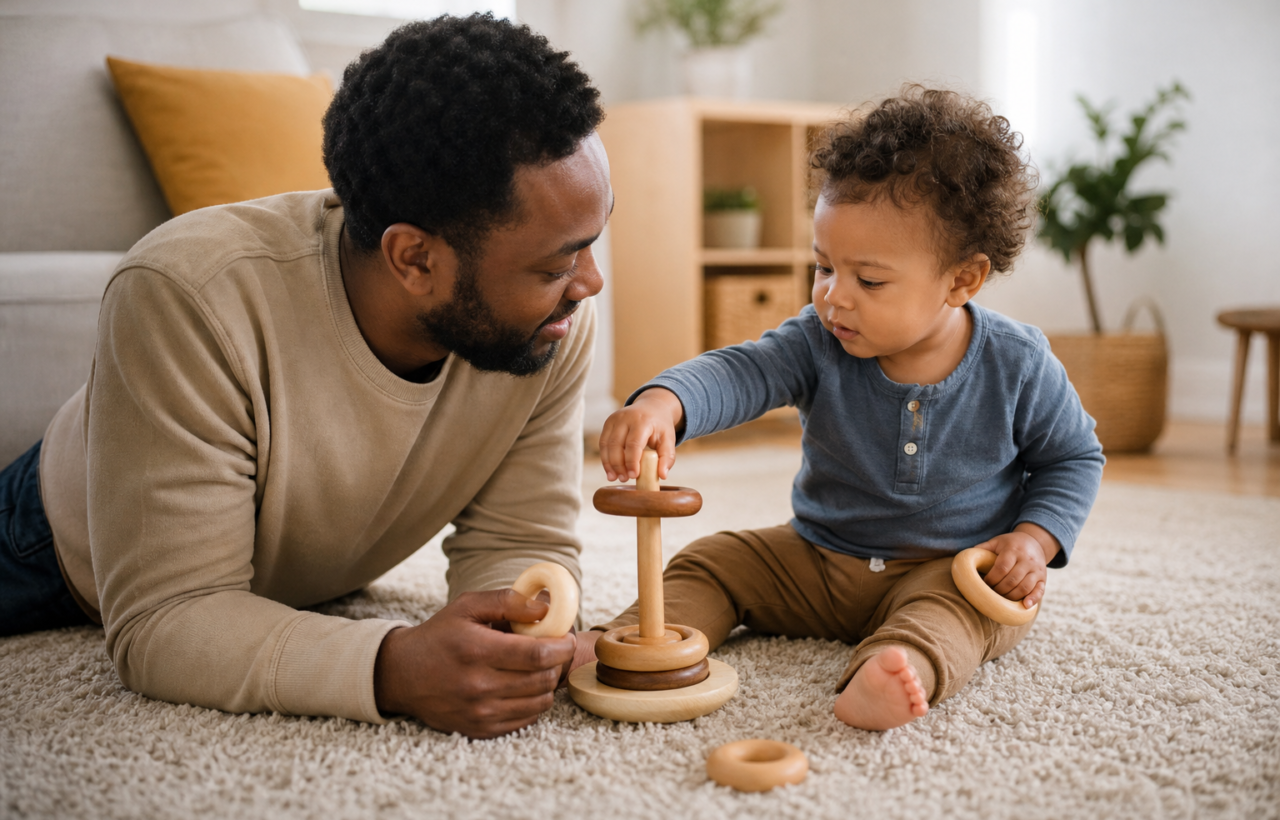
Your baby doesn’t need you to turn every waking minute into an activity. If you’re wondering whether you’re doing enough, use a simpler test: did you notice what caught your child’s attention, respond to it, and leave room for a response?
That small back-and-forth exchange is the heart of developmental play. Simple moments such as snuggling, playing, and sharing face-to-face attention are ways to deepen your bond while supporting healthy development. You don’t need a perfect script or a shelf of special toys. You need an activity your child can join, your attention, and enough flexibility to follow where the interaction goes.
Key takeaways
- Start with what your child is already looking at, touching, repeating, or trying to do.
- Offer one simple action, wait for a response, and treat that response as your child’s turn.
- Repeat before adding difficulty. Familiarity gives your child a chance to anticipate and participate.
- Use age ranges as menus, not deadlines. Choose activities that fit what your child can safely do today.
- Build play into care routines so connection doesn’t depend on finding a separate block of time.
- Stop or reduce the stimulation when your child turns away, becomes tense, fusses, or stops engaging.
Make the interaction the point of the activity
An activity can keep a child occupied without creating much connection. The difference is your response. When you notice a look, sound, gesture, or action and answer it, play becomes a shared exchange rather than something you present for your child to consume.
Use this simple loop with almost any activity:
- Get close enough to notice your child’s face, hands, sounds, and body movements.
- Offer one clear action: smile, tap a cup, roll a ball, hide your face, or place a block in a container.
- Pause. Give your child room to look, move, vocalize, reach, copy, or decline.
- Respond to what actually happened. Copy the sound, return the ball, name the movement, or acknowledge that your child wants something different.
- Repeat the exchange. Once it feels familiar, change one element rather than replacing the whole game.
That last step matters. Adults often introduce a second toy, a new instruction, and several questions as soon as a child succeeds once. The child then has to process an entirely new activity instead of practising the one that just made sense. Repeat first. When you add a variation, make it small: roll the same ball a different direction, pour into a taller cup, or hide the same toy in a new place.
Try not to turn play into a quiz. A stream of questions such as asking for a colour, sound, or object can make you the examiner and your child the performer. Add useful language by describing what is happening: the cup is empty, the ball rolled away, the bear is hiding. Then pause again. Your child can participate with a look or movement long before answering with words.
Let your child end the exchange, too. Looking away isn’t a personal rejection. It may mean the activity is too intense, your child needs a break, or something else has taken their attention. Lower your voice, remove an extra toy, or wait quietly. If engagement doesn’t return, move on without trying to win it back.
Choose developmental play that fits your child’s current stage

The age bands below are starting points, not a milestone checklist. Children enter activities in different ways. One may participate by watching, another by grabbing, and another by using a word or pretending. Start at the level where your child can take a turn without being physically positioned or repeatedly corrected.
From birth to about 6 months: faces, voices, and simple patterns
At this stage, keep the play calm and uncluttered. Your face, voice, and gentle touch provide plenty to notice. Choose a time when your baby is awake and settled rather than trying to continue through hunger, fatigue, or distress.
- Try a face conversation. Smile, raise your eyebrows, or make one soft sound. Wait to see whether your baby changes expression, moves, or vocalizes. Copy what you notice.
- Turn dressing into a body game. Gently touch and name a hand, foot, or tummy as you dress your baby. Pause after each touch instead of rushing through a list of body parts.
- Move one safe toy slowly within your baby’s comfortable view. Stop when their attention leaves it. If their gaze returns, move it again and describe the direction.
- Lie beside your awake baby during supervised floor time. Comment on the movement or object that has their attention instead of constantly redirecting their gaze toward you.
- Use a short sound pattern, then leave a gap. A coo, facial movement, kick, or quiet look can all be treated as an answer.
The goal isn’t to produce a particular response. It is to establish a rhythm in which your baby experiences you noticing and answering them.
About 6 to 12 months: visible results and repeated surprises
For a baby who can reach, grasp, and sit with whatever support they currently need, offer actions with an obvious result. Keep every object large enough not to be a choking hazard, and stay close enough to prevent an unsafe reach or fall.
- Play peekaboo with your hands. Use the same rhythm several times, then wait with your face covered. Your baby’s look, movement, or sound can cue you to return.
- Place a few large, safe objects beside an open container. Put one in, take one out, and then let your baby explore the action without correcting how they do it.
- Roll a soft ball a short distance. When your baby touches, stops, or pushes it, respond as though they have taken their turn and roll it back.
- Tap two safe objects together, then offer them. If your baby mouths, drops, or passes one instead of tapping, follow that action and name it.
- Hide part of a familiar toy under a cloth while leaving some of it visible. Let your baby uncover it; avoid taking over the moment as soon as they hesitate.
Repetition is useful here. If your baby wants peekaboo again, the game hasn’t become unproductive. Anticipating a familiar moment and finding a way to keep it going are forms of participation.
About 12 to 24 months: moving, filling, copying, and choosing
Young toddlers often learn through whole-body action and repeated experiments. Instead of requiring them to sit through an adult-designed task, give their movement a safe purpose.
- Set out a container and several large objects for filling, carrying, and dumping. Use words such as in, out, full, empty, more, and all gone while your toddler acts.
- Invite your toddler to copy one everyday action, such as wiping a low surface with a dry cloth or placing a safe item in a basket. Take turns copying each other rather than insisting on the correct method.
- Offer a choice between two acceptable objects. Name what your toddler selects and begin with it. Reaching or looking can count as choosing.
- Build a small stack, knock it down, and pause. If your toddler changes the game by carrying or lining up the pieces, join that version.
- Use a doll or stuffed animal for a simple pretend action, such as giving a hug or laying it down. Follow your toddler’s idea if the toy becomes something else.
A toddler who repeats dropping, dumping, or transporting isn’t necessarily refusing the activity. They may be showing you the action they want to investigate. Move the action to a safe setting and join it before attempting to expand it.
About 24 to 36 months: pretend stories, problems, and turn-taking
As your child brings more language, memory, and imagination into play, you can add a simple problem or story. Keep the plot open enough for your child to change it.
- Start a pretend scene with familiar objects: a stuffed animal needs a bed, a toy vehicle needs a place to park, or a block becomes food. Ask what should happen next only after your child has time to act.
- Build toward a shared goal. Make a short road, create a home for a toy, or move objects from one container to another. Give your child a real part of the task rather than handing over pieces after you have designed everything.
- Practise turn-taking with an action that naturally comes back, such as rolling a ball, adding blocks to one structure, or making marks on separate areas of the same large sheet of paper.
- Describe a sequence your child creates: the animal climbed, fell, and went to sleep. This connects words to their idea without taking control of the story.
- Offer a manageable play problem: the toy doesn’t fit in this container, or the road has a gap. Wait before suggesting a solution, and notice the attempt rather than focusing only on success.
If your child assigns an unexpected role to an object, you don’t need to correct the pretend logic. A block can be a phone, snack, pet, or boat. Joining the meaning your child created tells them their ideas can shape the interaction.
Use water play for movement, cause and effect, and conversation

Water changes whenever a child pats, squeezes, scoops, or pours it, so the feedback is immediate. Along with being enjoyable, water play can support physical and cognitive development. It also gives you an easy shared focus: you can watch what your child tries, name the result, and take a turn without scripting an elaborate lesson.
Water requires active supervision. Stay within arm’s reach and keep your attention on your child for the entire activity. Don’t step away to answer the door, retrieve a towel, or check a phone. Use only a shallow amount, keep the setup away from electrical items, and empty every container immediately afterward. Water play is not a reason to relax normal bath or water-safety precautions.
A simple setup is enough: shallow water, a towel, two unbreakable containers, and a large sponge or bath-safe scoop. Avoid glass, sharp edges, and small loose pieces. Then match the action to what your child can safely do:
- For a younger baby, support them securely and let them touch or pat the water with a hand. Copy the rhythm and describe splash, still, warm, or wet.
- For a baby who can grasp safely, demonstrate filling and emptying one large cup. If they only bang, mouth, or drop it, stay with that exploration while keeping the object and position safe.
- For a young toddler, provide two containers and let them scoop, transfer, squeeze, and pour. Place the containers close together so the challenge is manageable.
- For an older toddler, compare what happens with a wide and narrow container, squeeze water from a large sponge, or use the cups in pretend cooking. Ask for a prediction only after your child understands the action.
Keep your language tied to what your child can observe: full and empty, fast and slow, over and under, more and less. If every pour misses, move the target closer instead of guiding your child’s hands through the motion. That preserves their chance to adjust the attempt themselves.
Build play into the day and adjust when it stalls
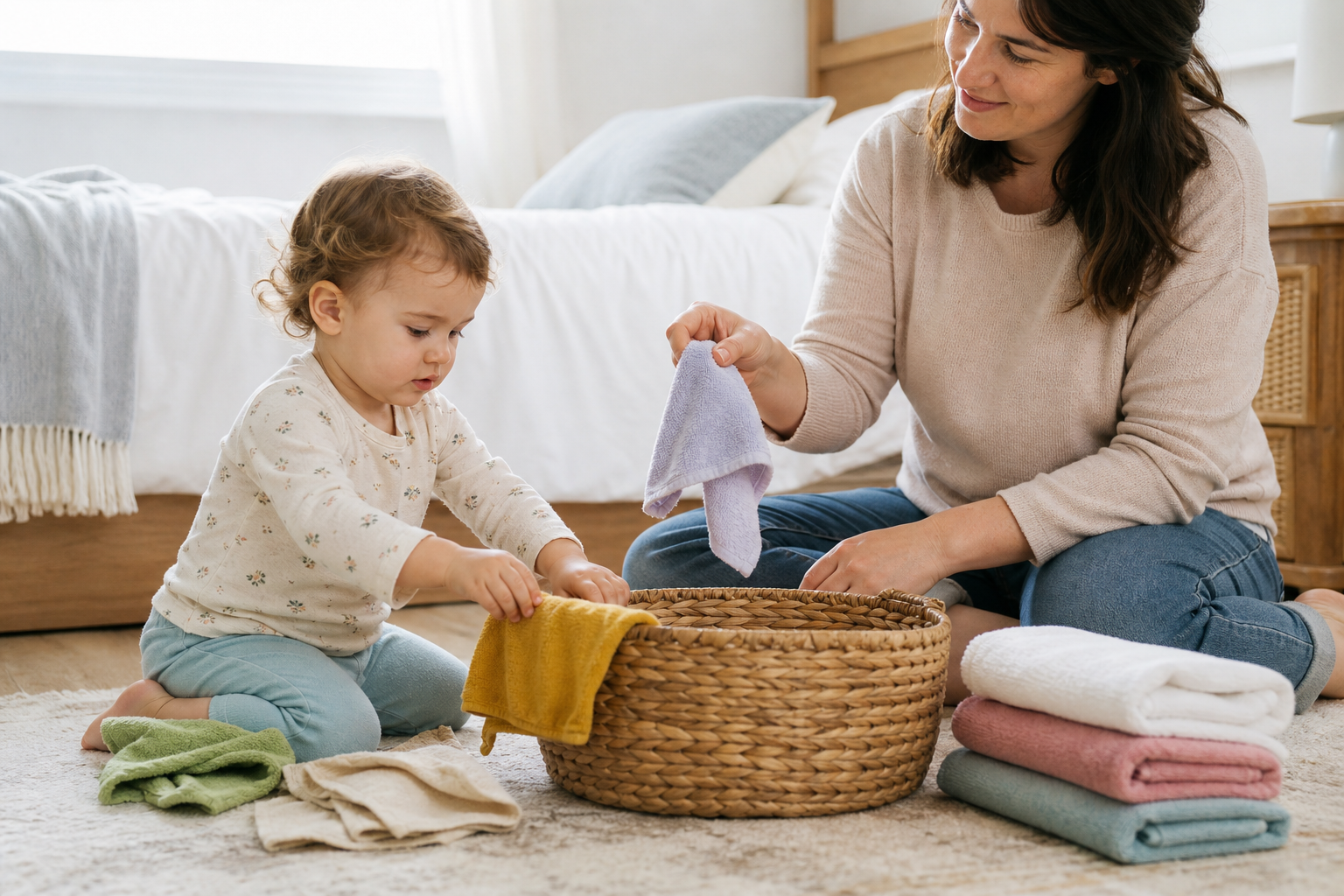
Play is easier to repeat when it attaches to something already happening. Choose one dependable moment and add a tiny interaction rather than waiting for a long, ideal stretch of free time.
- During a diaper change, try a face-and-sound exchange before fastening the clean diaper.
- While getting dressed, name and gently touch body parts or let an older toddler choose between two suitable items.
- During supervised floor time, follow the toy, movement, or sound your child has already selected.
- At cleanup, take turns placing large objects in a basket. If your toddler dumps them out again, allow one safe repeat before restarting together.
- During a bath, use one cup for a short fill-and-pour exchange while maintaining full water supervision.
- On a walk, stop at something your child notices. Name it and wait rather than filling the whole walk with commentary.
You don’t need to use all of these. Pick the routine that creates the least friction for you. Repeat it until the back-and-forth becomes familiar, then add one small variation.
What to change when the activity isn’t working
- If your child looks away or becomes fussy, lower the intensity. Stop talking, remove an extra object, or end the activity. More stimulation isn’t always the answer.
- If your child ignores your planned use for a toy, observe the use they chose. Join it if it is safe, then introduce one related variation.
- If your child repeats the same action, describe it and take a turn instead of rushing to make the task harder.
- If frustration rises immediately, reduce the physical demand. Bring the container closer, use a larger target, or offer an object that is easier to hold.
- If you find yourself giving constant directions, pause the instructions and copy one thing your child does. This can restore the feeling of shared play.
- If you’re depleted, choose a quieter exchange you can sustain. Looking at a board book together, copying sounds, or rolling one ball can still create connection.
Developmental play isn’t an assessment, and these age bands can’t tell you whether your child’s development is typical. If you’re concerned about how your child moves, communicates, responds, plays, or relates to you, write down the specific behaviours and situations you’ve noticed and discuss them with your child’s doctor or another qualified health-care professional. A clear description is more useful than saying only that something feels off. Play can help you notice patterns, but it doesn’t diagnose a developmental issue or replace professional care.
Choose the smallest exchange you’ll genuinely repeat: a face game during a diaper change, a ball rolled across the floor, or a cup poured during the bath. The next time you play, give one fewer direction and leave one more pause. What your child does with that space will show you where the interaction can go next.
References
- Parents — 7 Water Play Activities That Help Kids Learn While Having Fun
- Parents — Age-by-Age Guide to Deepening Your Bond with Baby