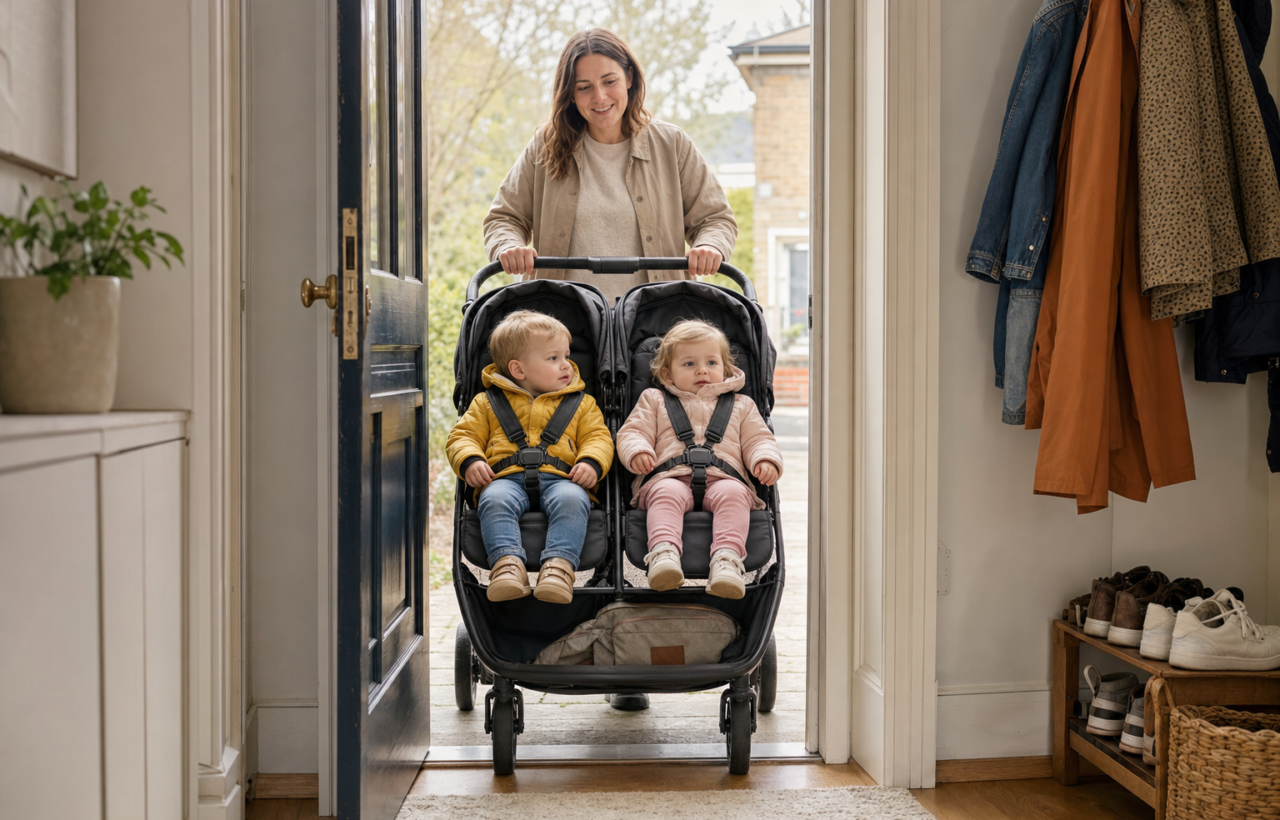
When you are shopping for twins, higher-order multiples, or a baby and toddler, the hard question is not which pushchair has the longest feature list. It is whether you can get both children out of the house without fighting the doors, fold, seating arrangement, and storage space every day.
There is no shortage of twin and multiple pushchairs, also called double or multi-seat strollers. The right one is the model that fits your children’s stages, your complete daily route, and the person who actually has to steer, fold, lift, and store it.
Start with two children, not one pushchair
“Double” describes the number of children a pushchair can carry, not a single type of family. Newborn twins may need two newborn-approved positions at the same time. A baby and an older toddler may need one deeply reclined position and one supportive upright seat. Three or more young children require an approved place for each child, not a collection of improvised attachments.
Write a short brief before looking at models. It should answer these questions:
- Who will ride? Record each child’s stage when you will start using the pushchair. Note whether each child needs a newborn-approved carrycot, seat, or compatible infant car seat.
- Where will you use it? Separate smooth indoor errands from uneven paths, long walks, public transport, and frequent car trips. The route you use most deserves more weight than an occasional outing.
- Who will operate it? Include every regular caregiver. A fold that feels straightforward to one adult may be awkward for another because of reach, grip, or lifting height.
- Where do naps happen? If either child regularly sleeps while you are out, confirm that the relevant seat can recline as needed without preventing the other seat from being used.
- What travels with you? Account for a changing bag, feeding supplies, coats, rain covers, and anything you normally put in the basket. Check access as well as stated capacity.
- How might the arrangement change? Consider whether you need a fixed twin setup or a system that can change as an older sibling walks more and a younger child moves into a different seat.
Turn those answers into two columns: non-negotiable and preferred. “Two positions approved for newborns” can be a non-negotiable; a particular fabric colour is a preference. This prevents an attractive demonstration model from distracting you from a configuration your children actually need.
Do not treat “car-seat compatible” as interchangeable with “suitable from birth.” Compatibility depends on the exact pushchair, car seat, adapter, and approved seating position. Check the manufacturer’s instructions for the complete combination, including whether two infant car seats or two carrycots can be fitted simultaneously.
Choose the layout by accepting the right compromise
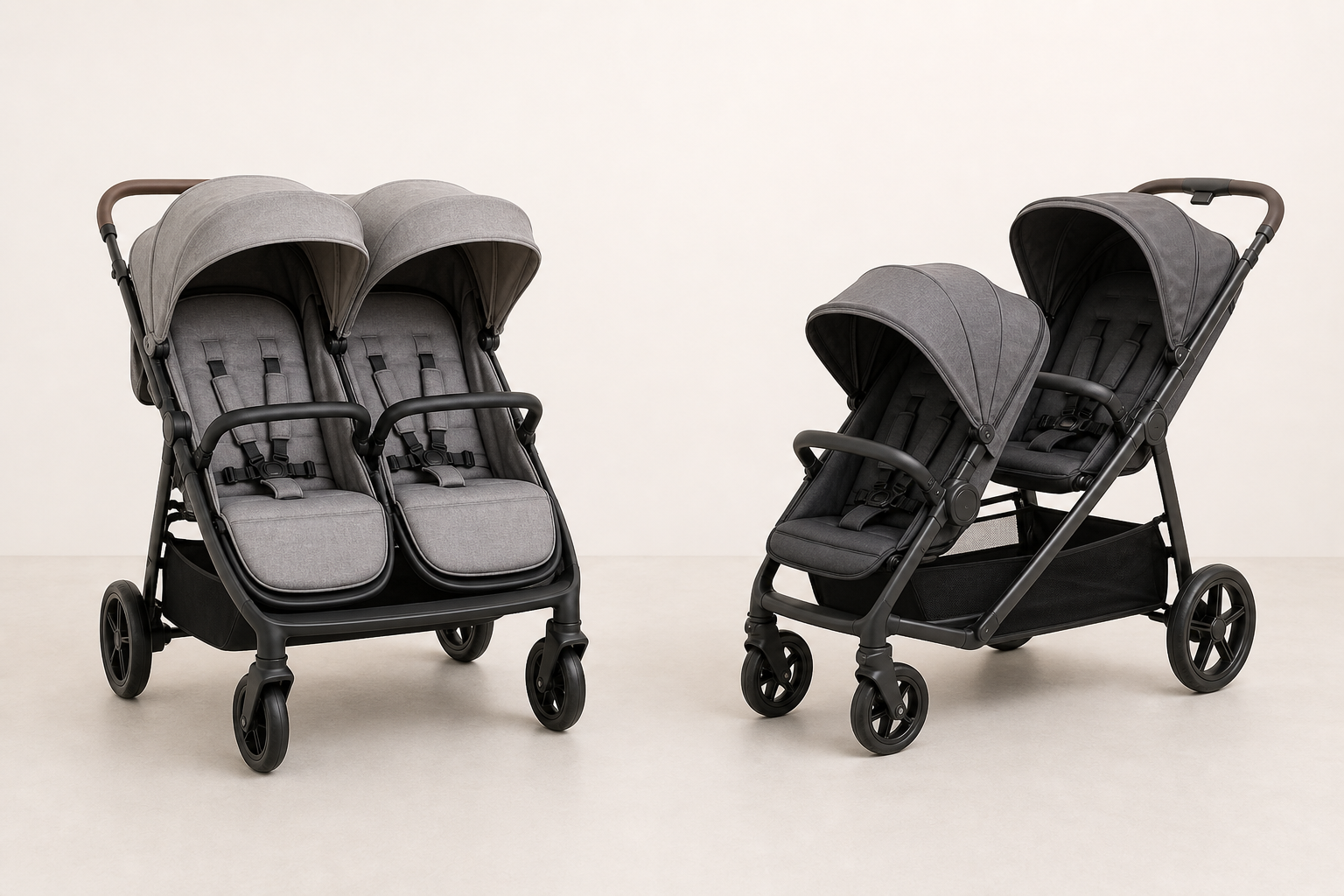
Every multi-seat layout solves one space problem by creating another. A side-by-side design uses width. A tandem design uses length and can make the two seating positions feel different. A convertible model adds flexibility but may handle differently once its second seat and accessories are installed. Compare them in the configuration you will use, not as an empty frame.
| Layout | When it may fit well | What to inspect closely |
|---|---|---|
| Side-by-side | Your regular route has generous doorway, gate, lift, and pavement width, and you want easy access to both children. | The widest physical point, doorway clearance, independent reclines, basket access, and folded shape. |
| Tandem or in-line | Passage width is a major constraint and a longer frame works in your home and usual destinations. | Turning space, curb handling, the lower or rear child’s view and access, legroom, and whether reclining one seat interferes with the other. |
| Convertible single-to-double | You have children of different ages or want the pushchair to change between single and double use. | Every approved configuration, the features and limits of the second seat, and whether the required newborn arrangement is genuinely possible. |
| Dedicated multi-seat system | You need approved seating for three or more young children. | The approved position for every child, total assembled size, individual seat limits, fold procedure, transport, and storage. |
For twins, look for equal suitability rather than visual symmetry. Two seats can look alike while differing in recline, canopy coverage, leg space, or permitted use. Check each seat separately, then check what changes when both are occupied.
For children of different ages, think about the boarding sequence. Can the toddler climb into the approved seat without pulling on the frame? Can you secure the baby while keeping the other child safely beside you? Can you reach both harnesses without removing bags or accessories? The easier sequence is often more valuable than a feature you use only occasionally.
Wheel and frame behaviour also matters. If your regular route includes rough ground, slopes, tight shop aisles, or frequent curbs, a showroom glide on a polished floor tells you very little. Ask to steer the fully configured pushchair over the most realistic permitted test surface and through repeated tight turns.
Measure the entire journey, including the fold
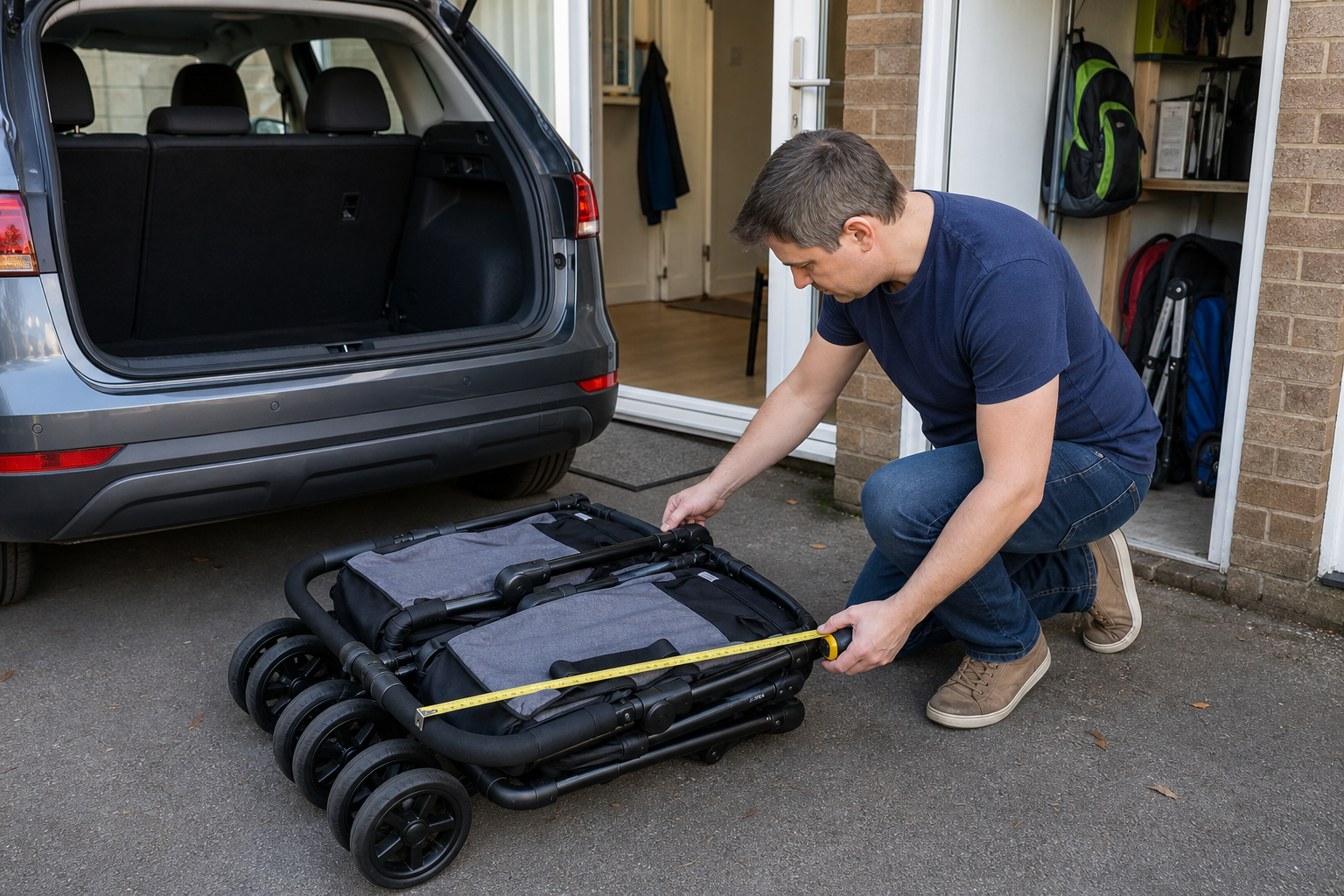
A pushchair does not merely need to fit through your front door. It needs to move from its storage place, around the turn in the hall, through the building exit, into the places you visit, and back into storage. One narrow point can make the whole route unworkable.
- Trace the route from storage to street. Include cupboard openings, hall turns, steps, thresholds, gates, communal doors, ramps, and lifts.
- Measure usable openings. Measure the space left when a door is open in its normal position, not just the frame. Account for handles, door closers, skirting boards, and anything that narrows a turn.
- Check turning space. A pushchair can be narrower than a doorway and still fail to make the approach. Mark the proposed footprint on the floor with removable tape to catch obvious problems, while remembering that a rectangle cannot reproduce wheel movement.
- Measure your vehicle’s cargo opening and interior. The folded pushchair has to pass through the opening, not merely fit within the theoretical boot volume. Check the opening height and width, floor depth, wheel arches, and the space left for the bags you must carry.
- Measure the storage position. Decide whether the pushchair will stand folded, lie flat, or remain assembled. Confirm that it will not block an exit or require you to detach and scatter several wet or muddy parts around the home.
- Check recurring destinations. Think about childcare entrances, medical appointments, relatives’ homes, local shops, and the public transport you actually use. A daily obstacle matters more than an exceptional one.
Compare those measurements with the pushchair’s widest assembled configuration and its true folded configuration. Find out whether published folded dimensions assume that seats, wheels, adapters, bassinets, or other parts have been removed. A compact-looking fold is less helpful if every car trip requires several pieces to be detached, stored, and rebuilt while you supervise two children.
Leave practical room for hands, wheel alignment, and imperfect approaches. A specification that matches an opening exactly is not evidence that the pushchair will pass through it comfortably. If a doorway is critical, test the actual model there before committing whenever a retailer’s trial or return terms permit it.
Test the complete setup before you commit
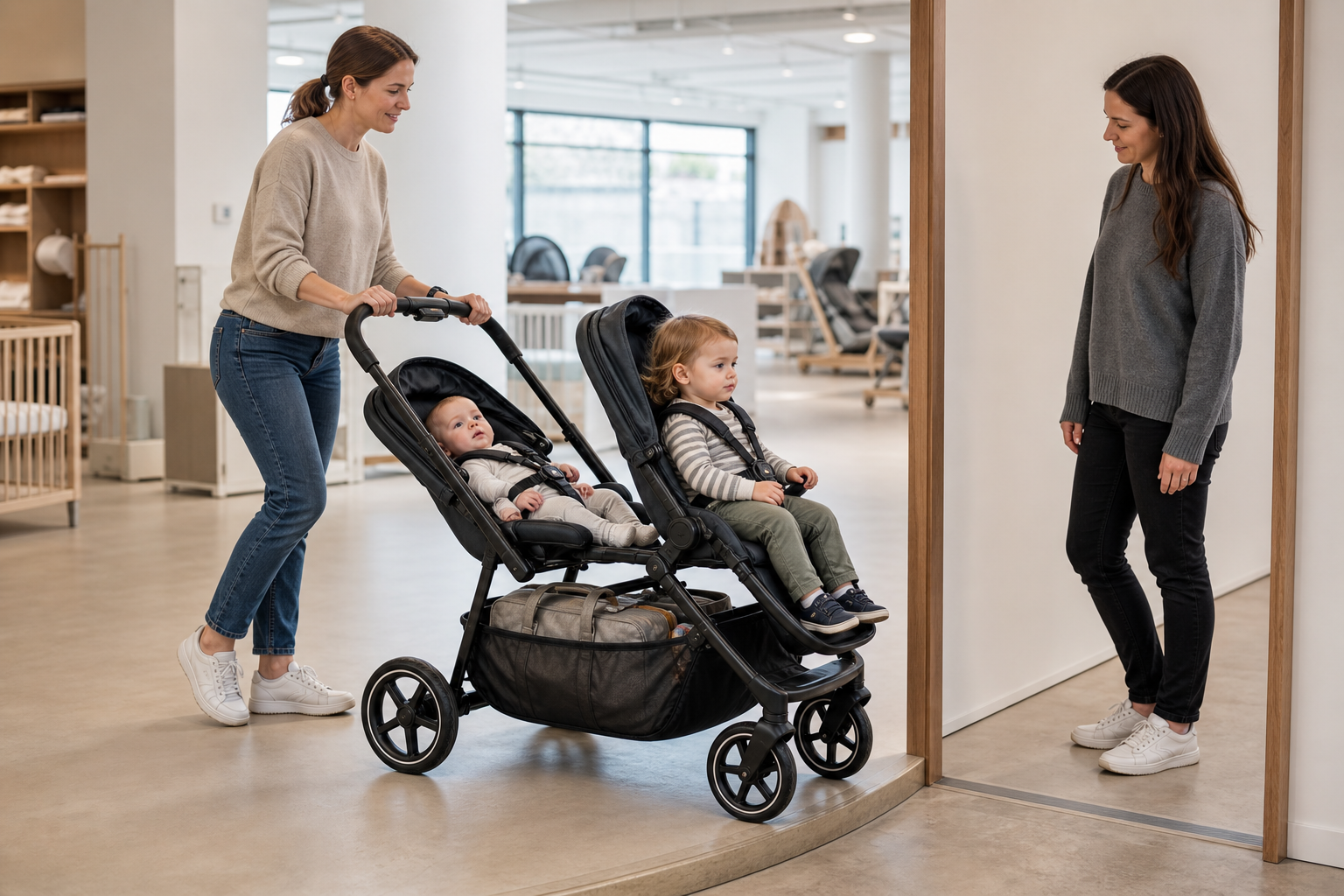
A useful test reproduces an ordinary outing. Install the exact seats, bassinets, adapters, and accessories you expect to use. Then ask each regular caregiver to complete the following sequence without taking over for one another:
- Apply the parking brake and identify the approved order for placing both children into their seats.
- Adjust and fasten both harnesses, including any changes needed for different clothing.
- Reach both children, recline each applicable seat, and raise or lower each canopy while the other seat remains occupied.
- Access the basket with both seats in their normal positions. Check whether a changing bag can be inserted and removed without disturbing a child.
- Release the brake, start, stop, reverse, turn tightly, and approach a permitted low threshold with the pushchair fully configured.
- Park, apply the brake, and follow the approved unloading sequence.
- Fold the pushchair from beginning to end. Count the pieces that must be removed and notice where each piece has to be placed during the fold.
- Lift the folded pushchair to the height required by your vehicle or home storage. If possible, test it with your actual vehicle rather than judging the lift beside a display stand.
- Reassemble it and confirm that the frame and seat locks are clearly engaged.
Repeat the fold rather than accepting one smooth demonstration. You need to know where the release controls are, whether the frame stays closed when lifted, whether it can stand in your storage space, and whether folding requires clean ground for detached parts. Rain covers, footmuffs, cup holders, and organisers may also alter access or prevent the normal fold, so include essential accessories in the final check.
Read the manual for the exact model and version before use. Observe the limits and approved configurations for each seat, carrycot, car seat, adapter, basket, and ride-on board. Use each child’s harness as instructed, apply the parking brake whenever the pushchair is stationary or children are being loaded, and do not hang heavy bags from the handle unless the manufacturer explicitly allows that load. Extra weight in the wrong place can make a pushchair unstable.
If you are buying used, establish the exact model and version before paying. Find the identification label, obtain the correct manual, and check current recall information through the relevant authority where you live. Inspect the frame joints, folding locks, wheels, brake, harnesses, fabric attachment points, adapters, and included seats. Walk away if you cannot identify the product, a structural part is damaged, a lock does not engage reliably, or an essential approved component is missing.
Budget for the working system, not the bare chassis. Your total may include additional seats, bassinets, approved adapters, rain protection, and other essentials. Also inspect the chores that repeat: removing washable fabrics, reaching crumbs around both seats, checking tyres or wheels, and storing damp accessories. Small maintenance frustrations become important when they happen after nearly every outing.
Key takeaways
- Define the approved seating position each child needs before comparing pushchair features.
- Choose between side-by-side, tandem, convertible, and dedicated multi-seat layouts according to your narrowest route and daily handling needs.
- Measure doors, turns, lifts, vehicle openings, boot space, and home storage; assembled width alone is not enough.
- Test the exact two-child configuration, including reclines, basket access, folding, lifting, and reassembly.
- Verify every seat, car seat, carrycot, adapter, and accessory in the manufacturer’s instructions for the exact model.
- For a used pushchair, confirm its identity and recall status, then reject damaged or unreliable structural and safety components.
Before opening another product page, write your two-child brief and measure the complete route from storage to street. Take that sheet and a tape measure when you shop. A pushchair that passes those checks has a much better chance of making ordinary days easier, which is the feature you will notice most.