
When your baby starts vomiting after a meal, it is tempting to replay every spoonful and search for the culprit. The safer first question is simpler: Can your child take in fluid, are they still urinating, and do they seem alert between episodes?
Food contaminated with viruses or bacteria can cause vomiting, diarrhea, stomach pain, nausea, and fever. Those symptoms can also come from a stomach virus or another illness, so you do not need to prove that food poisoning is the cause before deciding what to do. Protect hydration, watch for danger signs, and involve a medical professional early when a baby is unwell.
Key takeaways for the next few hours
- Watch the child, not just the number of vomiting or diarrhea episodes. Alertness, drinking, urination, breathing, skin colour, and pain give you more useful information.
- Get emergency help for breathing trouble, a seizure, collapse, extreme weakness, a child who is very difficult to wake, green vomit, or a rigid or swollen abdomen.
- Call your child’s doctor promptly if fluids will not stay down, wet diapers or urination decrease clearly, there is blood in vomit or stool, pain is severe, or symptoms are worsening.
- Continue breast milk or correctly prepared formula in smaller, more frequent feeds. A pediatric oral rehydration solution may help replace both fluid and salts.
- Do not dilute formula or give anti-diarrheal, anti-nausea, or antibiotic medicines unless a clinician specifically tells you to do so.
Read your child, not the menu
Food poisoning does not have one unmistakable symptom. A baby may vomit, develop stools that are suddenly much more frequent or watery than usual, feed poorly, seem unusually irritable, or have less energy. A toddler may also communicate nausea, cramping, headache, or chills. Fever can occur, but its absence does not rule out a foodborne illness.
Normal spit-up is different from repeated vomiting. Spit-up is generally a small, easy flow of milk after a feed; vomiting brings up more stomach contents and may be forceful. If you are unsure which you are seeing, repeated or forceful episodes deserve a call to your child’s clinician.
Do not assume the last food your child ate is responsible. Different germs cause symptoms on different schedules, and a stomach infection caught from another person can look much the same. If several people who shared a food become sick, a common exposure becomes more plausible, but it still does not identify the exact cause.
Keep the food package, receipt, restaurant details, or a photo of the label if you have them. Write down what your child ate, when symptoms began, whether anyone else is ill, the most recent wet diaper or urination, and any temperature you measured. That record is more useful to a clinician than trying to remember everything during a stressful call.
Know when waiting is not the safe option

Get emergency help now
Call emergency services or go to an emergency department if your child has any of these signs:
- Difficulty breathing, blue or grey colouring, collapse, a seizure, or being very difficult to wake.
- Sudden swelling of the lips, tongue, or face, or widespread hives with vomiting or breathing changes. That pattern may be a severe allergic reaction rather than food poisoning.
- Green vomit, a swollen or rigid abdomen, or severe and worsening abdominal pain.
- Extreme weakness or floppiness, an inability to swallow, or being too weak to drink.
- Signs of severe dehydration, such as little or no urine together with a very dry mouth, no tears, sunken eyes or soft spot, or marked drowsiness.
Do not try to drive fluids into a child who is struggling to breathe, cannot swallow safely, is having a seizure, or is barely responsive. Place them safely as directed by emergency services and follow the dispatcher’s instructions.
Call a clinician promptly
Babies and toddlers can lose fluid through vomiting and diarrhea and may not be able to replace it by drinking. Contact your child’s doctor, pediatric clinic, or local health advice line promptly when:
- Your baby has repeated vomiting or diarrhea, particularly if they are very young, were born prematurely, or have an ongoing medical condition.
- Your child cannot keep breast milk, formula, or oral rehydration solution down.
- Wet diapers or trips to the toilet have clearly decreased from your child’s normal pattern.
- You notice a dry or sticky mouth, no tears when crying, sunken eyes, a sunken soft spot, unusual sleepiness, marked irritability, or weakness.
- There is blood in vomit or stool, repeated forceful vomiting, persistent fever, or significant abdominal pain.
- The symptoms are getting worse instead of easing, or your child looks substantially more unwell than the symptoms alone would suggest.
A fever in a very young baby requires prompt medical assessment. Use the age-specific instructions your child’s clinician or local health service gives you rather than applying a temperature rule meant for an older toddler.
When home observation may be reasonable
Home monitoring may be reasonable when your child remains responsive, accepts fluids, continues to urinate, has no blood or severe pain, breathes normally, and seems reasonably like themselves between episodes. Keep reassessing. A child who looked comfortable earlier can still need medical help if drinking or urination drops off.
Replace fluids without making the stomach work harder
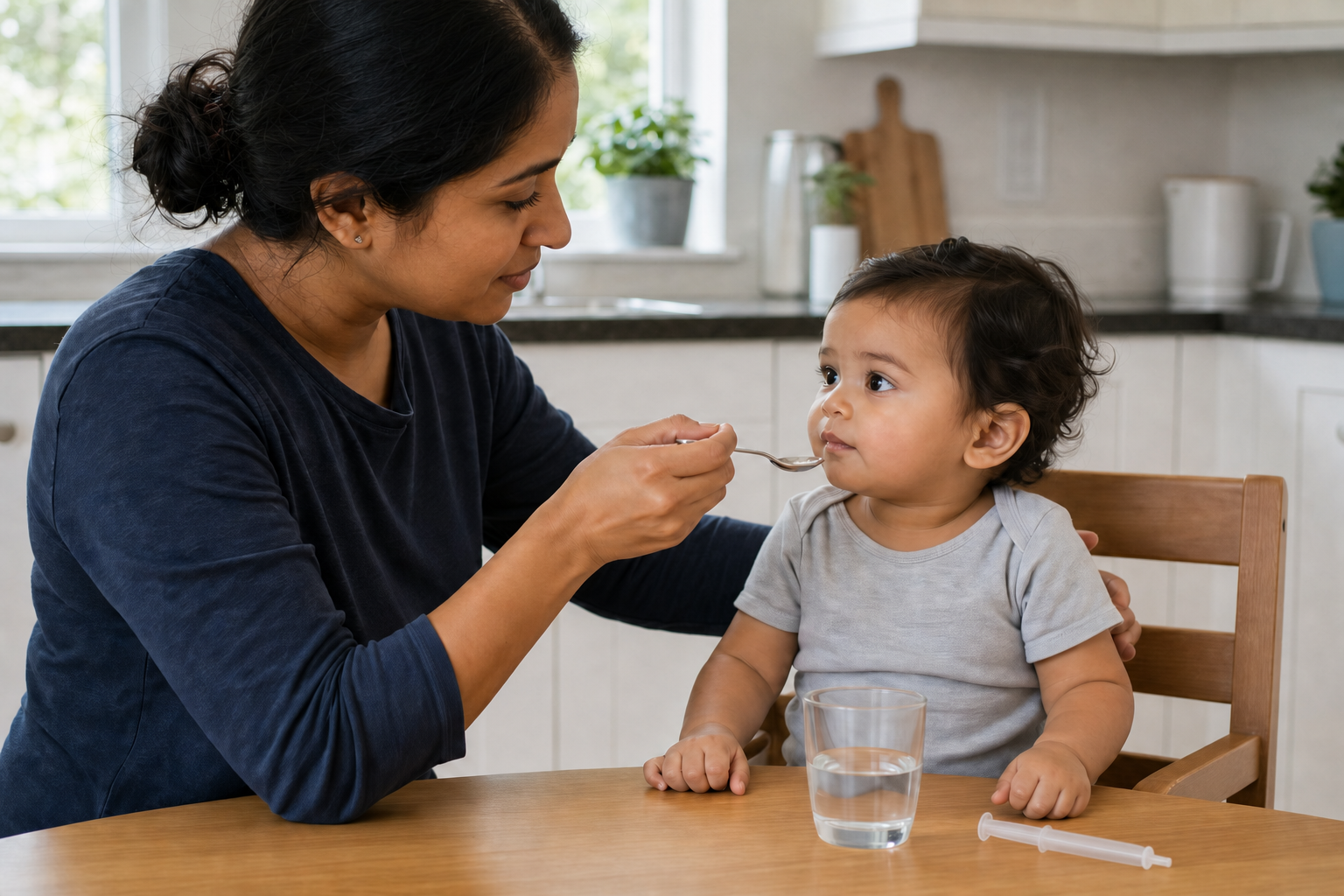
During the first part of the illness, fluid matters more than finishing a meal. Vomiting and diarrhea remove water and electrolytes, while nausea makes a full bottle, cup, or meal difficult to tolerate.
- Continue breastfeeding. Offer the breast as your baby wants it. Shorter, more frequent feeds may be easier to manage than a long feed.
- Keep formula at its usual strength. Prepare it exactly as directed. Diluting formula changes its nutritional and electrolyte balance and is not a safe way to add water.
- Ask about pediatric oral rehydration solution. A clinician or pharmacist can help you choose an age-appropriate commercial product. Mix or serve it exactly as the label directs; adding extra water or powder changes the balance it is designed to provide.
- Offer small amounts frequently. Use your child’s usual cup or bottle, or an age-appropriate spoon or oral syringe if that is easier. If every attempt triggers more vomiting, stop trying to manage the illness alone and call for medical advice.
- Track the response. Note feeds or sips, vomiting and diarrhea episodes, wet diapers or urination, temperature, and changes in alertness. Urination that continues to fall is a reason to call even if your child has taken some fluid.
Juice, soda, and sports drinks are not substitutes for a pediatric oral rehydration solution. Their sugar and electrolyte balance is not designed for a vomiting baby or toddler, and very sweet drinks can aggravate diarrhea. Plain water should not replace breast milk or formula for an infant.
Do not give over-the-counter anti-diarrheal or anti-nausea medicine unless your child’s clinician recommends a specific product and dose. Do not use leftover antibiotics. Some medicines are unsafe for young children, and antibiotics only help certain bacterial infections; in other situations they add risk without treating the cause.
When vomiting eases and your child shows interest in food, offer familiar, age-appropriate foods in small portions. There is no need to force a meal or make food the test of recovery. Continued drinking, improving energy, and regular urination matter more.
Reduce the chance of another case

You cannot prevent every stomach illness, but the same habits that lower food-poisoning risk also reduce spread through the household:
- Wash hands with soap and water before preparing food or feeding a child, and after using the toilet, changing a diaper, or cleaning vomit or diarrhea.
- Keep raw meat, poultry, seafood, and eggs away from ready-to-eat food. Use separate utensils and cutting surfaces, then wash them thoroughly.
- Cook food fully and refrigerate perishable food promptly. If you do not know how long a food has been unrefrigerated, do not serve it to a baby or toddler.
- Wash produce, use pasteurized foods, and avoid serving raw or undercooked animal foods to young children.
- Discard food from leaking, swollen, badly damaged, or recalled packaging. Do not taste a suspicious food to decide whether it is safe; dangerous contamination does not always change the smell or appearance.
- Never give honey to a baby younger than 12 months. Honey can contain spores associated with infant botulism, a rare but serious illness.
- Follow formula preparation and storage directions exactly, clean feeding equipment carefully, and discard a prepared feed when the product instructions say it is no longer safe.
If symptoms have already started, set out the fluids you may need, record the last wet diaper or urination, and save the suspected food details. Then make the call if your child’s drinking, alertness, pain, or urine output moves in the wrong direction.
References
- BabyCenter – Food poisoning in babies and toddlers: Symptoms, treatment, and when to call the doctor