You want to spend more of the summer outside, but the stroller basket is already full and every promising product seems to create another thing to carry. The useful question is not, “What outdoor gear should we buy?” It is, “What keeps this family from getting outside, moving and staying out comfortably?”
There is a wide mix of outdoor products intended to get children outside and active. Your best setup will be much smaller than the whole market. It should remove the friction that repeatedly ends your outings and give your child something simple to do with their body.
Start with the part of the outing that keeps failing
Before buying anything, think about your recent attempts to get outside. Find the moment when the plan became harder than it needed to be. That moment tells you which product category, if any, deserves space in your home.
- Leaving takes too long: Create a grab-and-go outdoor kit rather than adding another activity toy. Keep the reusable essentials together so you are not rebuilding the bag for every park visit.
- Your baby has nowhere suitable to play: Look for a portable ground mat that is easy to carry, simple to wipe or wash, and large enough for the way your baby currently moves.
- Your toddler gets restless in the stroller: Pack an object that invites an immediate action, such as rolling, pushing, pulling, scooping, pouring or drawing.
- You leave as soon as everyone gets messy: A washable bag for damp items, a practical towel and spare clothing may extend an outing more effectively than another toy.
- You avoid places without shelter: Consider a shade product that is appropriate for the location, stable when correctly installed and realistic for one adult to set up while supervising a child.
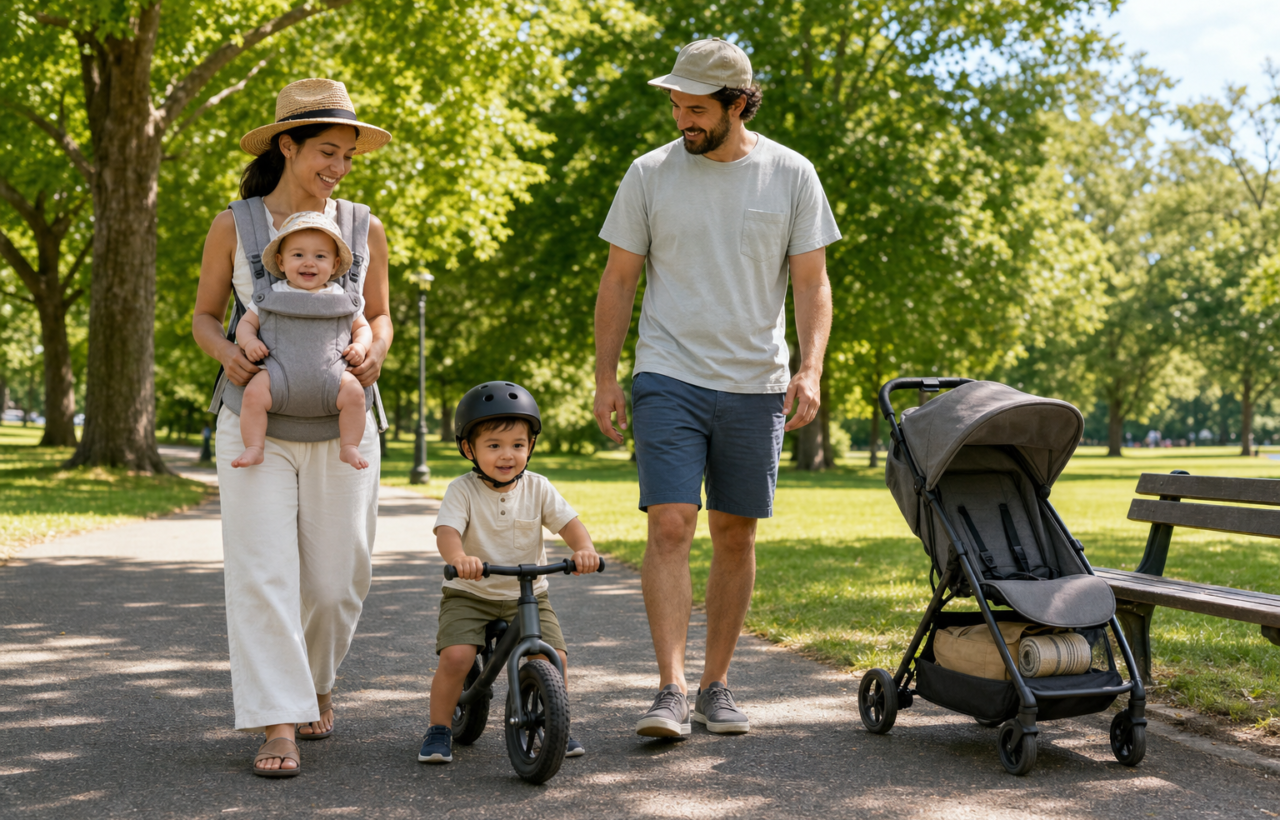
- The walk itself is the obstacle: Review your carrier, stroller or wagon needs before buying play equipment. Transport that suits your child, route and cargo may unlock more active time than gear waiting at the destination.
Buy for the outing you actually repeat. A large play structure may suit a backyard routine but be useless to a family that walks to a neighbourhood park. A compact ball or bucket may look ordinary, yet earn its place because it can be used immediately and in several ways.
Match the product to how your child moves now
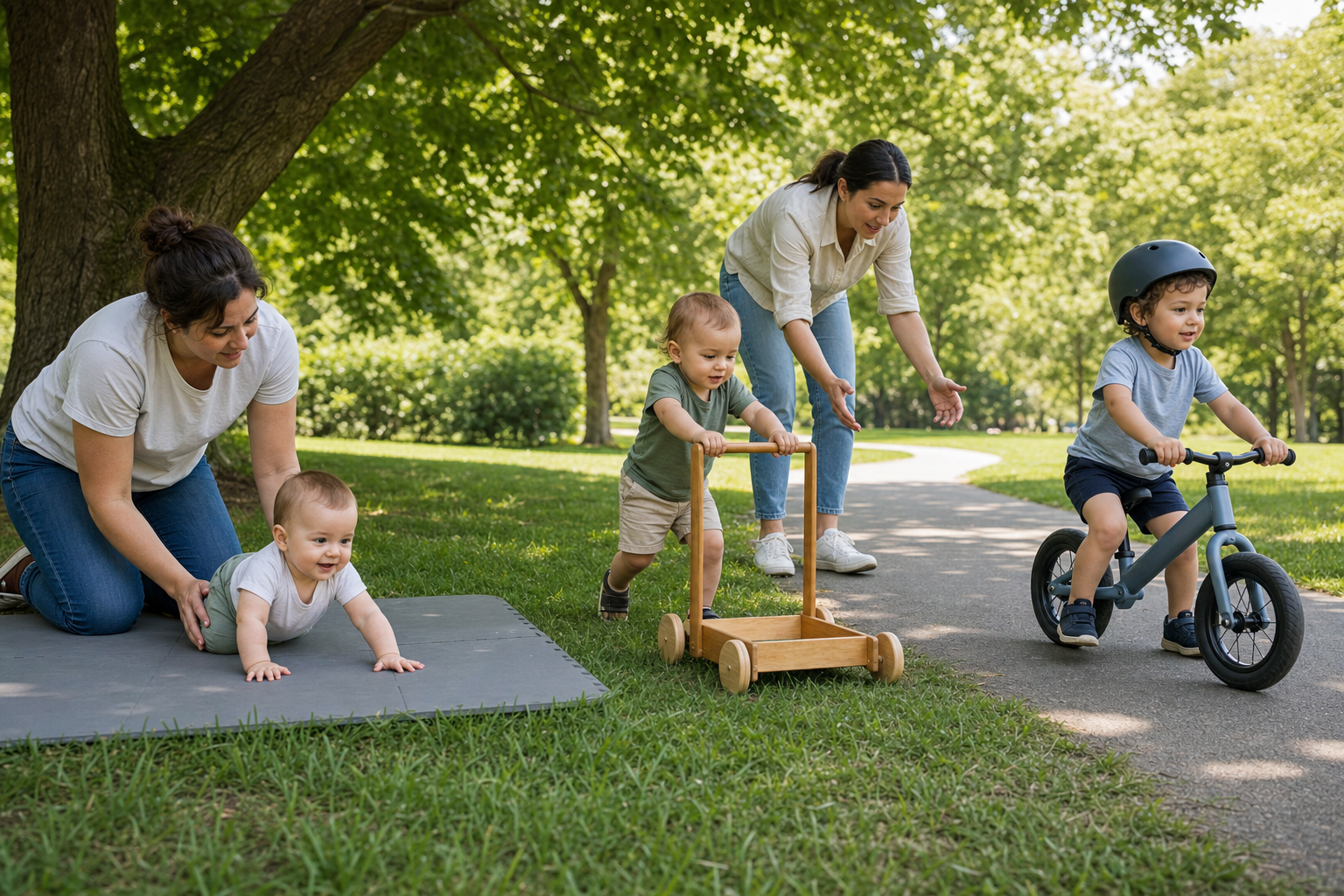
Children within the birth-to-preschool window do not use outdoor space in the same way. Shop by current movement stage, not by the activity you hope your child will grow into. Always check the manufacturer’s age, size and developmental guidance, because similar-looking products can have different limits.
For a baby who is not independently mobile
The main job is to create a usable place at ground level. A portable mat, an age-appropriate object to reach for and a correctly installed shade product can form a simple base camp. Favour items that let your baby use their current skills rather than holding them in a position they cannot reach independently.
Check the details that affect real use: whether the mat bunches under movement, whether its surface can be cleaned after grass or sand, and whether every toy is intended for your baby’s stage. A beautiful setup that takes too long to assemble will stay at home.
For a crawler, cruiser or new walker
This stage benefits from products with an obvious action and little explanation. A lightweight ball, stacking cups, a bucket, a watering can or an appropriately designed push-and-pull toy can turn a patch of grass, path or sandbox into active play.
Look closely at where the product is meant to be used. Wheels, bases and handles behave differently across smooth pavement, grass and uneven ground. Follow the product instructions instead of assuming that a toy designed for one surface is suitable for another.
For a confident walker and runner
Choose gear that gives your toddler a goal without dictating a single game. Balls, washable outdoor chalk, simple targets, ride-on products and child-sized digging or gardening tools can support many actions. The useful distinction is whether your child operates the product or waits for an adult to operate it.
Ride-on and balance products require an especially careful fit. Use them only in the intended setting, follow the manufacturer’s protective-equipment instructions and stop using anything your child has outgrown. A product being physically possible to sit on does not mean it still fits safely.
Pack a small outdoor system instead of a mobile playroom
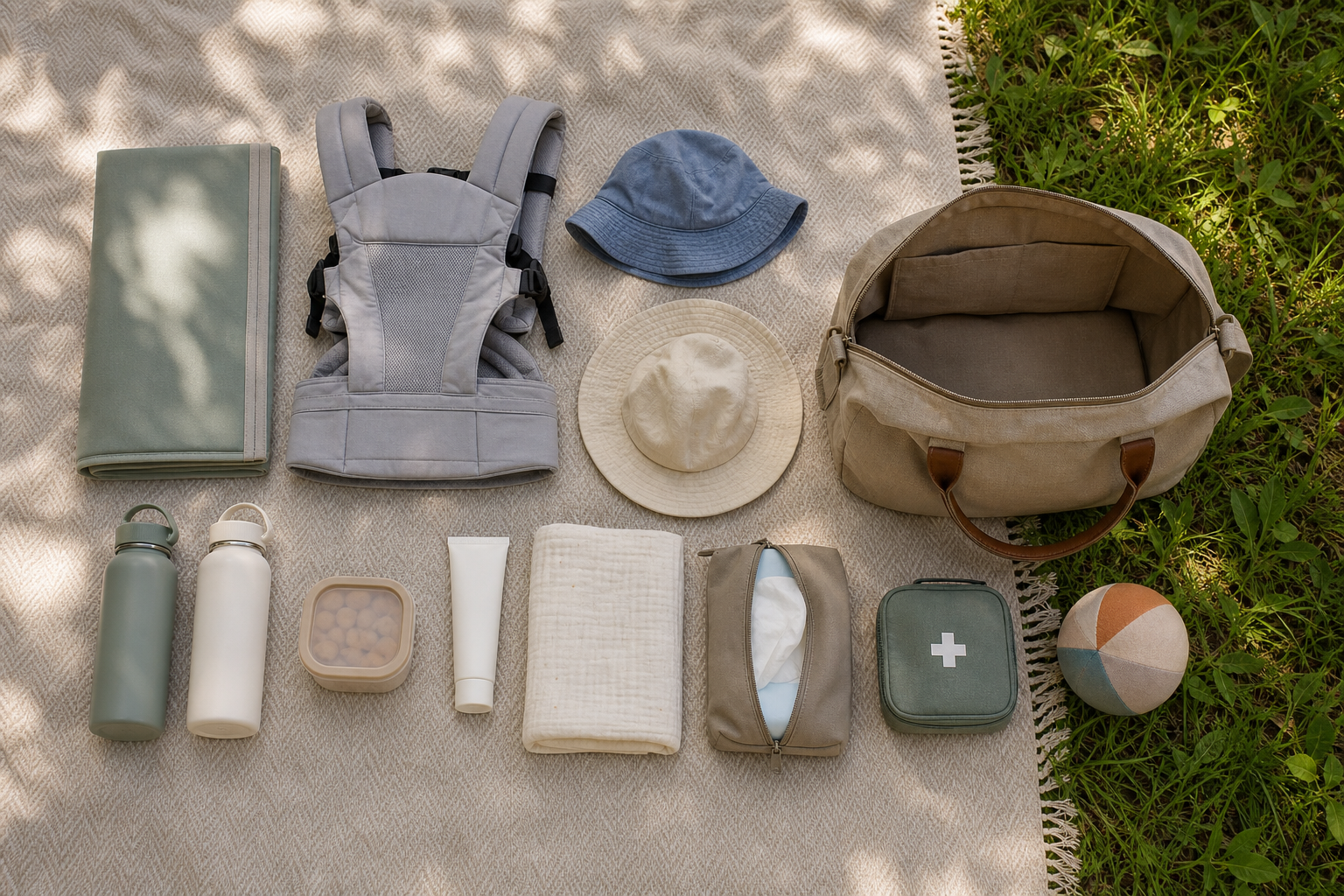
A useful summer kit has distinct jobs. Separating those jobs helps you remove extras without accidentally leaving behind something that makes the outing workable.
- The base-camp module: Your portable mat or seating surface, suitable shade equipment and the everyday child-care essentials you already take outside.
- The movement module: A compact item chosen for what your child can do with it: roll, chase, carry, draw, pour, dig, push or pull.
- The mess module: A towel, spare clothing and a washable or wipe-clean place for damp and dirty items.
- The destination module: Only what the specific plan requires, such as sand tools, water-play containers or appropriate riding equipment.
Keep the reusable modules in the same place at home and in the same parts of your bag or vehicle. Familiar packing matters because the benefit of outdoor gear disappears when you cannot find it while also managing a baby or toddler.
Try setting up the kit under realistic conditions before taking it farther from home. Can you carry it with the other essentials? Can you open, anchor and close it without letting go of the supervision your child needs? Can you identify where every loose part will go? If the answer is no, simplify the kit or reserve that product for outings with another adult.
Open-ended products are particularly efficient when storage is limited. A bucket can be carried, filled, emptied and used in pretend play. A ball can be rolled, chased, kicked or used as a target. The more safe actions an item supports, the less likely you are to need a separate toy for every destination.
Run every purchase through the same practical tests
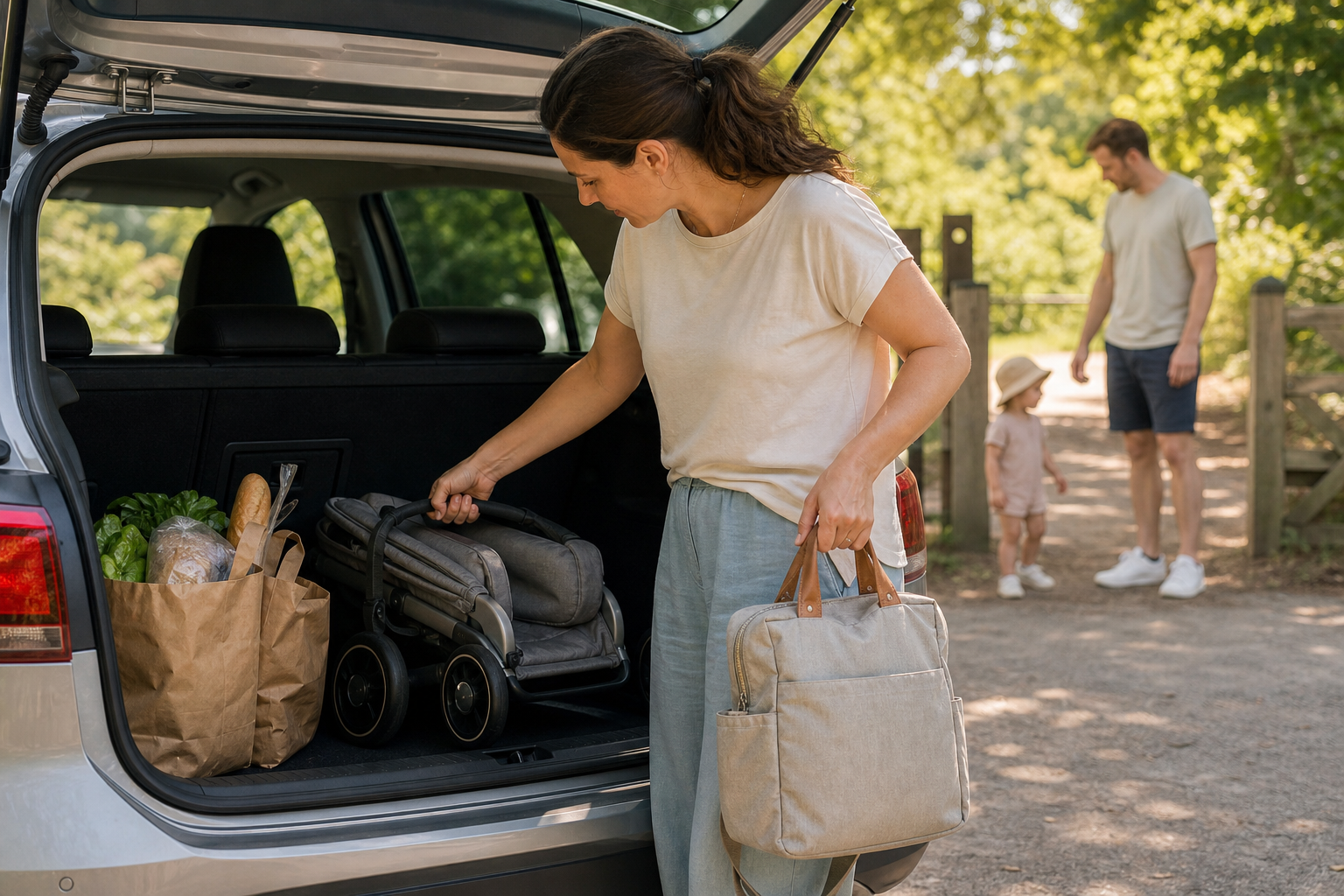
Product pages are good at showing the enjoyable moment and less good at showing the carrying, setup, cleanup and storage around it. Evaluate the entire outing, not only the photograph of the product in use.
- Name the friction: What recurring problem will this item solve? If you cannot describe the problem, wait before buying.
- Name the action: What will your child actually do with it at their current stage? “Outdoor fun” is too vague; “scoop and pour independently” is useful.
- Test adult workload: Consider who carries it, who sets it up and whether that person can still supervise every child present.
- Check the full fit: Read the age, size, weight, surface, protective-equipment and supervision requirements supplied with the product.
- Check transport compatibility: Do not assume that an accessory is safe to attach to every stroller, carrier, wagon or bicycle. Use only combinations permitted by the relevant manufacturers.
- Plan the cleanup: Decide where mud, sand, food residue and water will go before the product comes back into your bag, vehicle or home.
- Find its storage place: If it has no realistic home between outings, it will add daily clutter even when it is useful outside.
- Inspect the failure points: Look for loose fasteners, damaged straps, cracked parts, sharp edges, missing pieces or deterioration before use, particularly with hand-me-down and second-hand equipment.
Skip products that duplicate what your regular destination already provides, require more setup than your typical outing allows or depend on a future developmental stage. Also be cautious with sets full of small, easily lost components. More pieces often mean more adult management, not more active play.
Safety requirements are part of the buying decision, not an issue to solve after checkout. Water play requires constant, close adult supervision, including when the container or play area appears shallow. Never treat an outdoor toy, flotation product, stroller or carrier as an improvised sleep space. Follow the instructions for each product and use a sleep space intended for that purpose.
Before the season begins, check equipment that has been stored for a long period. Confirm that brakes, locks, straps, anchors and closures work as intended. Replace or stop using damaged equipment rather than improvising a repair that changes how a safety feature operates.
Key takeaways
- Start with the recurring reason your family delays, shortens or avoids an outdoor outing.
- Choose for your child’s current movement stage and the manufacturer’s stated limits.
- Prefer products that invite clear actions such as rolling, carrying, scooping, pouring, drawing, pushing or chasing.
- Count carrying, setup, supervision, cleanup and storage as part of a product’s real cost.
- Build a compact kit from base-camp, movement, mess and destination-specific modules.
- Use water, wheeled and transport products only with the supervision, setting and protective equipment their instructions require.
For your next outing, start with what you already own. Pack a comfortable base, choose a compact object that matches how your child moves today and leave the rest behind. If the same obstacle keeps cutting the outing short, you will know exactly what the next purchase needs to fix.