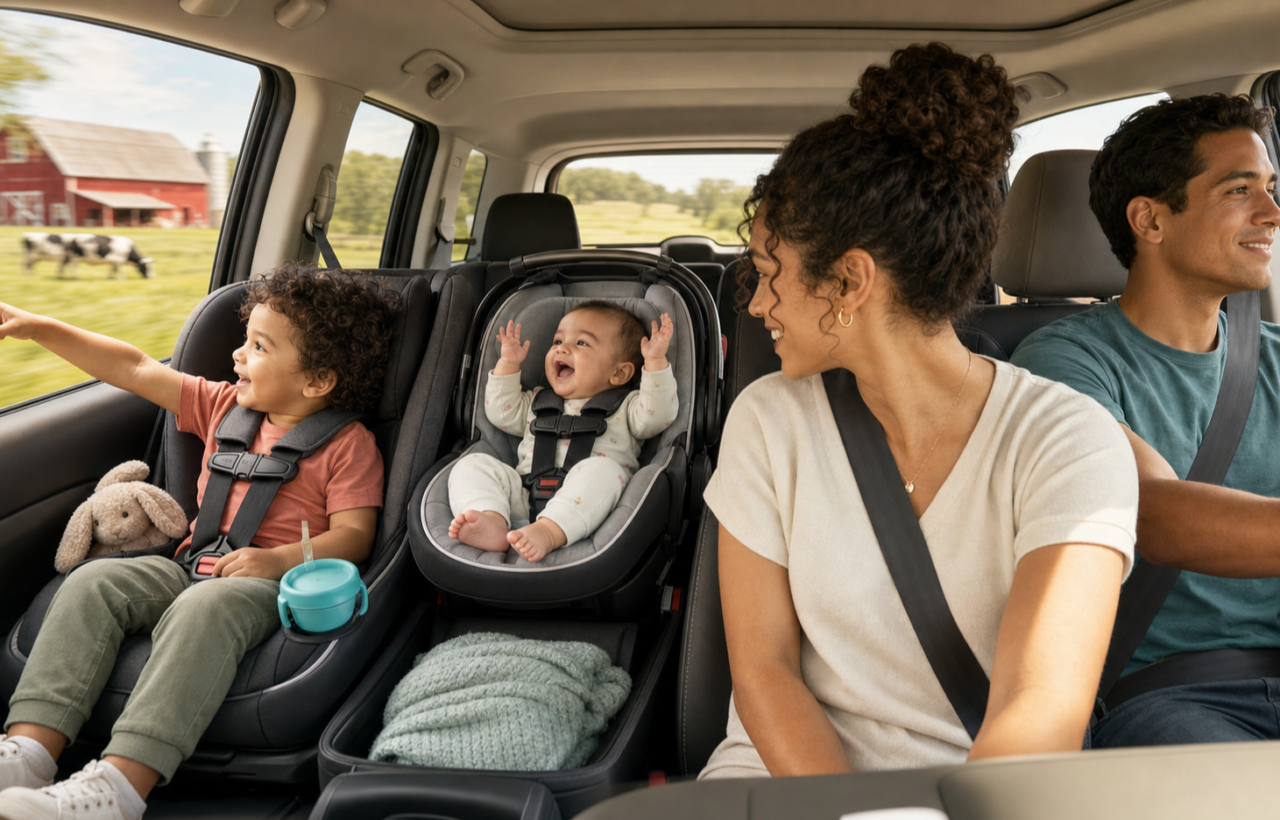
You have packed the snacks, chosen the music, and checked the route. Then the car starts moving and your baby fusses, your toddler rejects every suggestion, or the same question begins looping from the back seat. You need something that works without cards, pieces, reading, or complicated rules.
For children from birth to age three, a conversation game does not require a clever answer. A look, point, sound, copied word, or unexpected bit of toddler logic can be a complete turn. The trick is to choose a game that matches how your child communicates right now.
Match the game to the way your child answers
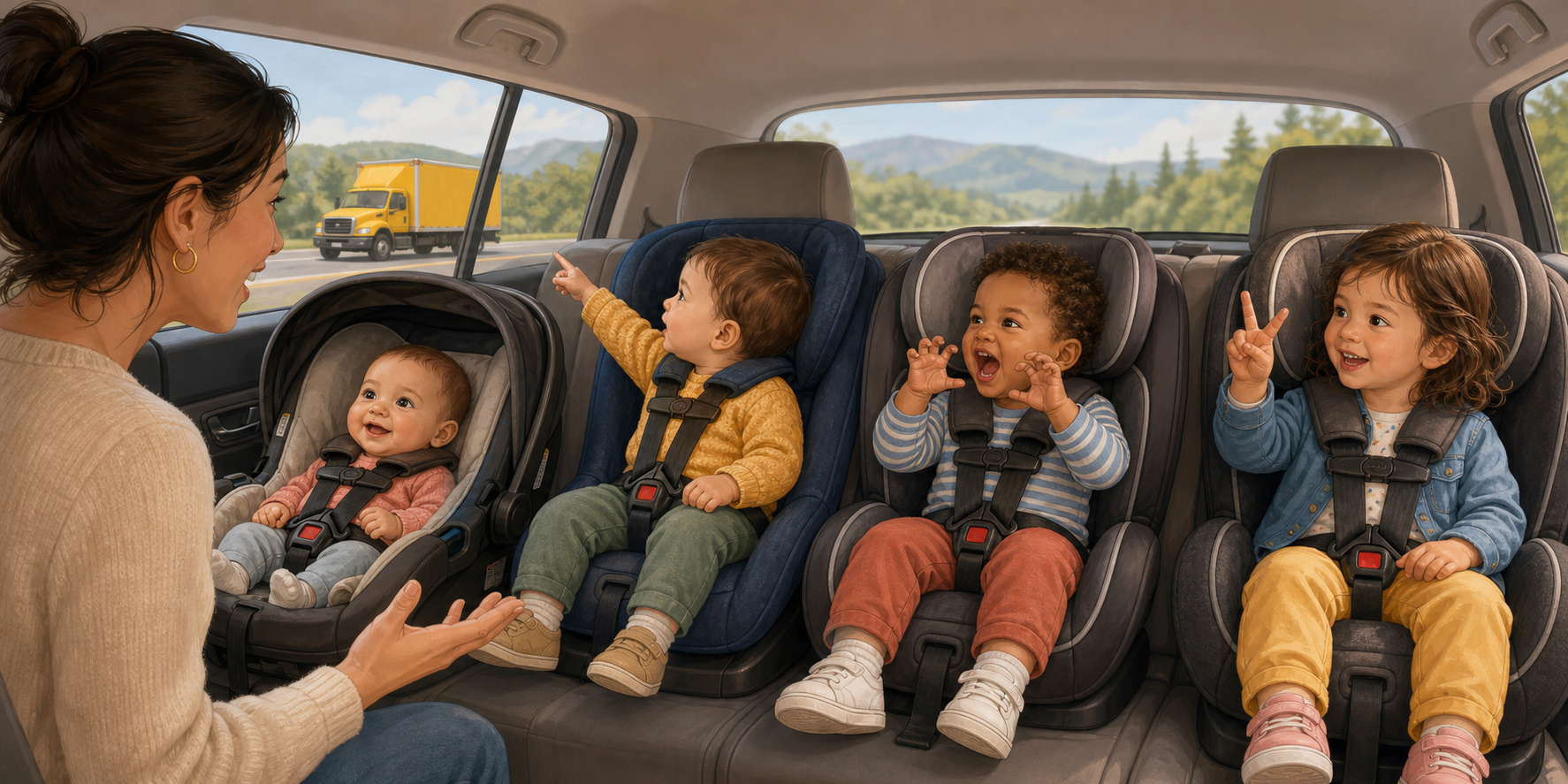
Age labels are less useful here than observable skills. A well-rested toddler may invent a story on the way out and answer only with grunts on the way home. Start with the easiest response your child can give in that moment.
- Looking and listening: Narrate what is happening, copy sounds, and pause as though you expect a turn. A glance, smile, kick, or babble counts as participation.
- Pointing and gesturing: Offer two clear choices. Your child can answer by pointing, nodding, shaking their head, or reaching.
- Using single words: Ask questions with an easy one-word answer, such as animal, song, colour, or sound.
- Combining words: Add a simple follow-up: What happens next? What should we call it? Where is it going?
These are entry points, not milestones your child must meet before a trip. If a question gets silence, make it smaller. Turn Where should the dragon go on vacation? into Beach or moon? If that is still too much, answer it yourself and invite your child to make the dragon’s sound.
Let a passenger lead games that involve watching your child’s face or searching the scenery. The driver can join with their voice, but their attention and eyes stay on the road.
Eight no-prop conversation games that grow with your child
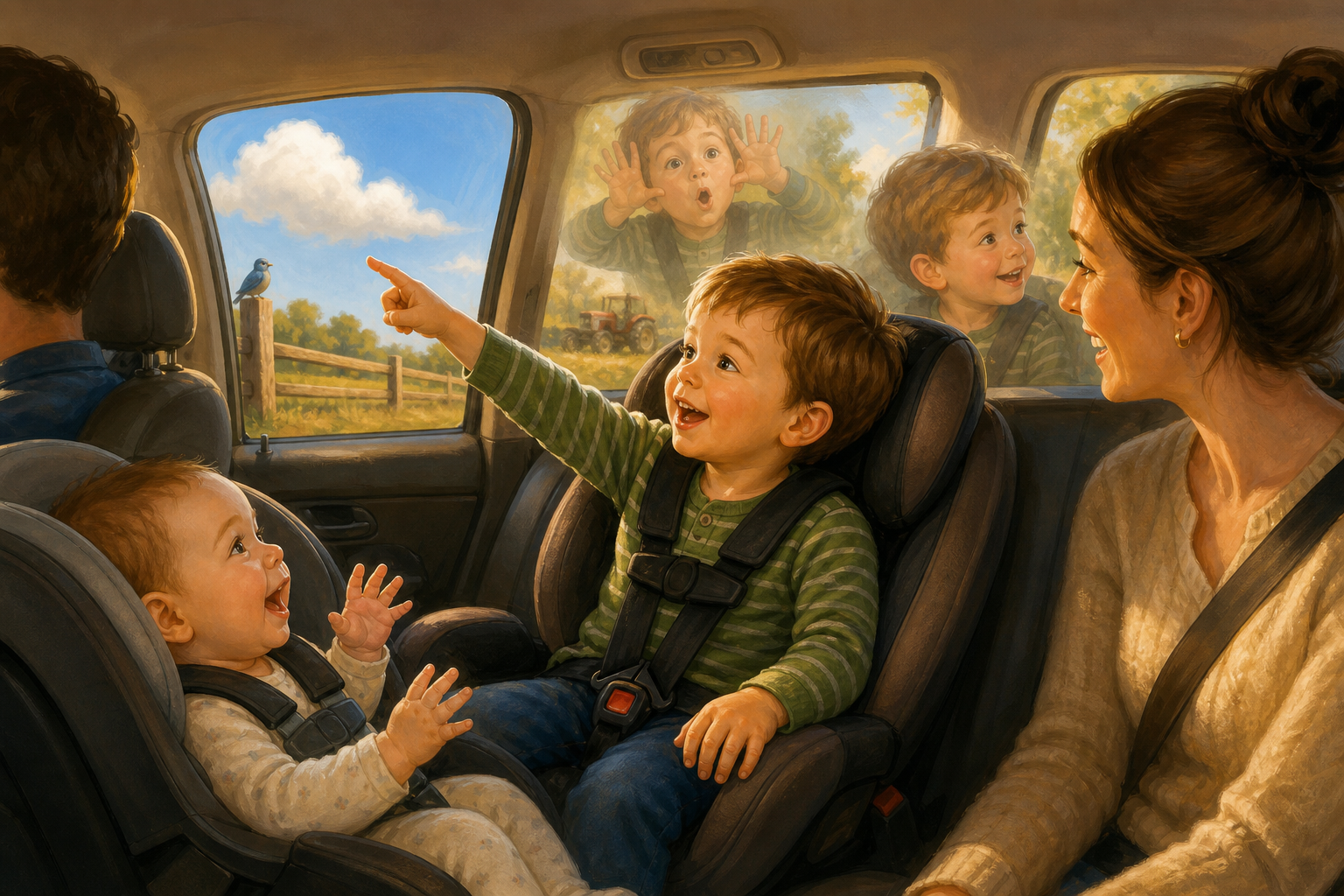
You do not need to explain all eight games before leaving. Pick two or three formats and repeat them. Familiar rules make it easier for a young child to join, especially when the drive has already stretched their patience.
1. Sound echo
Make one short sound, pause, and listen. If your baby or toddler responds, copy their sound back exactly. Let the exchange continue until they look away or stop answering.
- Start with easy sounds such as ba-ba, beep-beep, or mmm.
- If your child makes a completely different sound, follow their lead.
- For an older toddler, name the imaginary thing making the sound: a tiny truck, a sleepy duck, or a dinosaur eating lunch.
This is particularly useful for a pre-verbal child because there is no correct word to retrieve. The game is simply: you make a sound, they get a turn, and you notice what they did.
2. The window narrator
A passenger chooses one easy category and names examples visible from the car: truck, tree, light, bridge, or cloud. There is no need to turn it into a test.
- For a baby, point and label: Big truck. Red light. Tall tree.
- For a child who points, ask Where is the truck?
- For a child using words, ask What sound does that truck make?
- For a more verbal toddler, add an imaginary job: Where is that truck going?
Choose things that appear often enough to keep the game moving. If the view becomes repetitive, switch the rule from finding objects to describing them: big or small, moving or still, near or far.
3. Animal sound vote
Offer two animals and let your child choose which one everyone should imitate. Cow or duck? Lion or mouse? The winner gets a family sound effect.
A child can vote with a word, gesture, sound, or facial expression. Once two choices become easy, add a silly decision: Is the duck loud or quiet? Is the lion happy or sleepy? A toddler who invents a third option has not broken the game. They have improved it.
4. This or that
Give two contrasting choices and let everyone answer. The options can be real, imaginary, or deliberately ridiculous.
- Sun or moon?
- Pancakes or waffles?
- Cat or dog?
- Beach or mountains?
- Would a dragon rather eat a banana or a shoe?
- Would you rather be tiny like an ant or tall like a tree?
Keep the first round concrete. If your child answers readily, follow with Why? or What would happen? If they do not, give your own answer in one sentence and move to the next pair. Avoid offering real choices you cannot honour, such as which unavailable snack they want or whether they would like to leave the car.
5. Finish the familiar phrase
Begin something your child already knows and leave the final word or sound open.
- The cow says…
- Ready, set…
- Twinkle, twinkle, little…
- We are going to…
- Grandma has a…
Use phrases from your own routines, songs, and family life. Pause briefly, then complete the phrase yourself if your child does not. This keeps the exchange playful instead of turning it into a memory test.
6. Build a mixed-up animal
Combine two animals, then decide what the new creature is called, how it moves, and what sound it makes. A cat and duck might become a cattuck that meows while swimming. A bear and bee might become a beear that makes honey in a cave.
Give an early talker one decision at a time: Cat or dog for the head? Fish or bird for the tail? Older toddlers can name the creature or decide what it eats. There is no correct outcome, so unusual answers create more material instead of ending the round.
7. Pass-the-story
Start with one plain sentence: A little bus was driving to the park. The next person adds a word, sound, or short sentence. Keep accepting contributions until the story reaches a natural ending or your child loses interest.
- If your child says dog, continue with The bus stopped for a dog.
- If they bark, put the barking dog into the story.
- If they do not answer, offer a branch: Did the bus find a dog or a dinosaur?
- If they repeat your last word, treat the repetition as their turn and continue.
The goal is a shared story, not a coherent plot. Keep your additions short enough that your child can still remember where their turn begins.
8. Family favourites
Choose one familiar category and let everyone name a favourite: song, snack, animal, book, sound, place, or thing to do together. A younger child can select between two options. A more verbal toddler can explain or demonstrate the answer.
Turn the answer into the next activity when practical. If your child chooses a song, sing it. If they choose an animal, make its sound. If they choose a book that is packed away, ask who lives in it or what happens first. That follow-through makes the conversation feel connected to something they care about.
Use a prompt rhythm that does not feel like a quiz
A long stream of questions can make even a verbal toddler stop participating. Use the same short rhythm for almost any game:
- Offer one prompt. Keep the sentence short and ask only one thing.
- Leave room for a turn. Do not immediately repeat the question in three different ways.
- Model an answer if needed. Say, I choose the moon because it glows.
- Accept the child’s response. A point, approximation, sound, or surprising answer is enough.
- Extend once. If your child says truck, you might reply, Yes, a big blue truck.
- Notice when the round is over. Change games, play music, or allow quiet when your child stops responding.
The extension step matters, but it should not become a correction. If your child calls a bus a truck, you can respond with the useful word without demanding a repeat: That bus does look like a big truck. The conversation keeps its momentum, and your child still hears the label.
What to do when a game falls flat
- No answer: Answer your own question, make it sillier, or switch to a sound game.
- Automatic no to everything: Stop asking for agreement. Narrate for a while or let your child give deliberately wrong answers.
- One answer repeated: Use it. If every animal is a cow, build a world with a flying cow, a swimming cow, and a cow driving the car.
- Siblings talk over the toddler: Give the toddler the first vote, then invite everyone else.
- The child wants the same prompt again: Repeat it. Novelty is not required for a game to be enjoyable.
- Interest disappears: End the game without trying to rescue it. Quiet is a valid road-trip activity.
Adapt classic road-trip questions for a very young child
Many familiar road-trip formats – including this-or-that, would-you-rather, favourites, imaginative questions, and who-would-win matchups – assume that a child can compare ideas and explain a choice. You can keep the format while shrinking the language and response required.
| Prompt shape | Toddler-sized version | Easy way to answer |
|---|---|---|
| Would you rather | Would you rather hop like a bunny or stomp like an elephant? | Name, point, make a sound, or do the movement later |
| Who would win | Who gets to the tree first: the turtle or the bunny? | Choose one animal |
| Favourite | Which song should we sing: the duck song or the star song? | Say a word, hum, or make the associated sound |
| Imagination | If a cat drove our car, where would it go? | Offer any place or choose between two |
| Family memory | What was funny at breakfast? | Name a person, food, action, or sound |
| Rapid choice | Big or little? Fast or slow? Loud or quiet? | Say or demonstrate one option |
Abstract prompts can still work when you supply the first example. Instead of asking What would your perfect day be? and waiting, say, My perfect day has pancakes and a walk. Would your day have the playground or the library? You have turned an open field into a doorway.
Keep personal questions light in a confined space
A car can feel private, but your child cannot step away from the conversation. Do not use a game to press for an answer about fears, sadness, favourite relatives, or which parent they are most like. If your toddler brings up something difficult, listen and respond to the feeling instead of racing to the next prompt.
Family questions work better when they invite connection without demanding a judgement: What should we do together when we arrive? Who makes a funny animal sound? What song does our family know? What made you laugh? Silence, I don’t know, and a change of subject are all acceptable answers.
Key takeaways
- Choose games by how your child communicates today, not by the answer you think they should give at their age.
- For babies, treat looks, movement, and babble as conversational turns.
- For early talkers, use two choices, familiar sounds, and prompts with one-word answers.
- For more verbal toddlers, add one imaginative follow-up rather than asking several questions at once.
- Model an answer when your child is quiet; do not repeat the question until it feels like a test.
- Let a passenger lead anything that requires watching the child or scanning the scenery.
- Stop when participation fades. Music, an audiobook, rest, and silence do not mean the game failed.
Before your next drive, choose one game built around sounds and one built around choices. Start with the easier one, follow whatever answer your child gives, and keep the second in reserve. You are not trying to fill every kilometre with talk. You are giving your child a simple way to join the family conversation whenever they are ready.