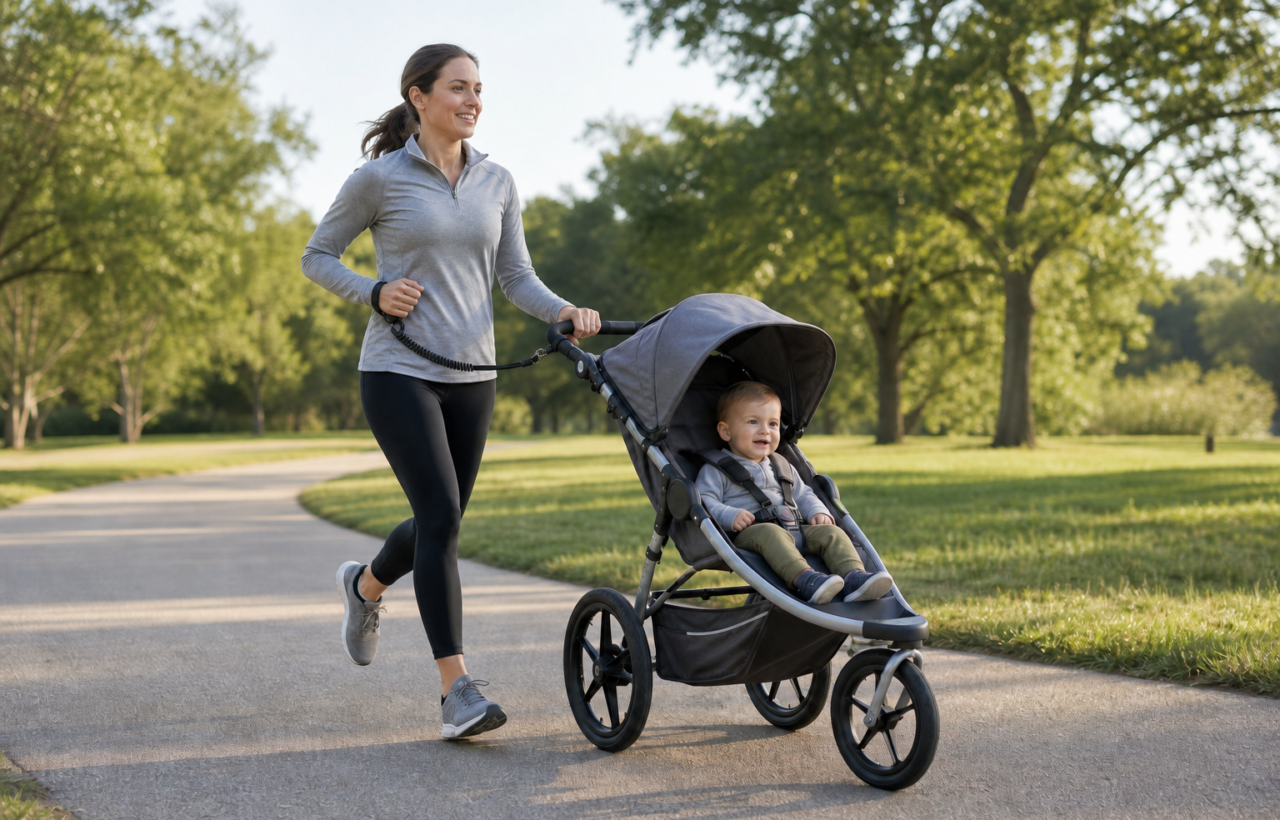
A jogging stroller can make running with your child practical, but only if it suits your child’s stage, your usual route, and the way your family actually gets out the door. A model that feels smooth on an open path may be frustrating in a small trunk, on public transit, or around tight shop aisles.
The first decision is not which stroller to buy. It is whether both the stroller and your child are ready for running. Once those two questions are settled, you can judge the features that will matter on your routes instead of paying for an impressive specification list you rarely use.
Key takeaways
- Confirm two things separately: that the manufacturer permits jogging with the exact stroller configuration, and that your child’s clinician considers your child ready.
- A compatible infant car seat does not automatically make a stroller-and-car-seat combination safe for running.
- Choose the wheel, tire, brake, suspension, and handlebar setup for your normal route, not an imagined ideal route.
- Test straight-line tracking, turning, braking, folding, lifting, and harness adjustment before buying whenever possible.
- For a used stroller, verify the model identity, safety notices, wheel condition, frame, harness, brakes, and folding locks.
- Before every run, secure the harness, set the front wheel as directed, check the tires and wheel attachments, and keep bags off the handlebar.
Get two separate green lights before you run
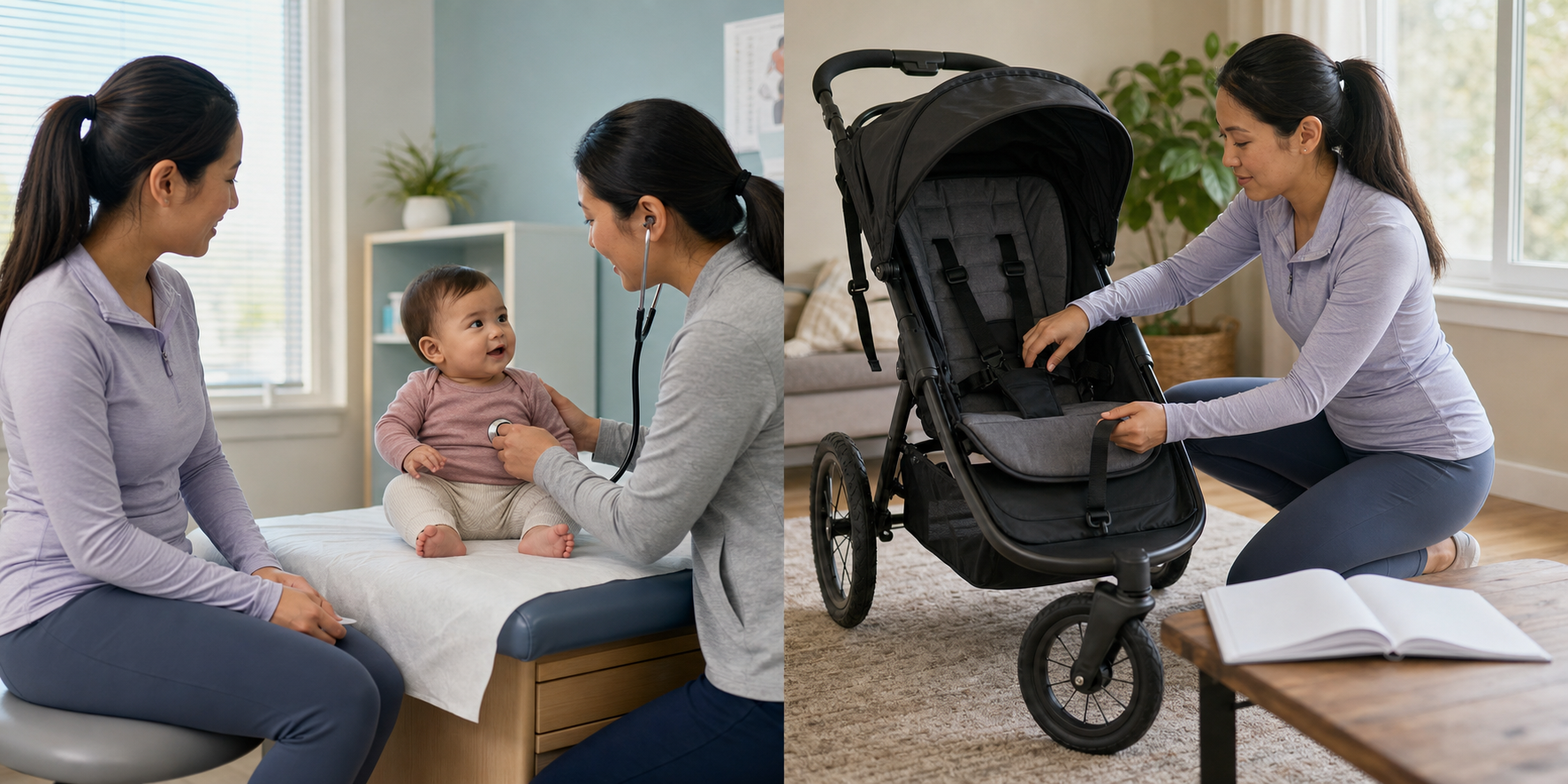
A stroller can fit a baby without being approved for jogging with that baby. Minimum requirements for sitting in the stroller, riding in an attached car seat, and riding while an adult runs may be different. Read the manual for your exact model and configuration; do not infer jogging approval from a three-wheel shape, a large canopy, or the word “sport” in a product name.
Look for instructions that specifically address jogging. Check the permitted seat position, front-wheel setting, required accessories, child requirements, and any restrictions that apply when a car seat, bassinet, or second seat is attached. If the manual does not clearly approve your intended configuration for running, use it for walking until the manufacturer confirms otherwise.
Your child’s readiness is a separate health question. Running creates repeated motion and jolts that do not occur during an ordinary walk. Ask your child’s pediatric clinician before beginning, especially if your child was born early or has a condition affecting the head, neck, breathing, muscles, joints, or development. A general age recommendation cannot account for those differences, and the stroller’s permitted minimum is not a medical assessment.
Car-seat compatibility is especially easy to misread. An adapter may let you move a young baby from the car to the stroller without waking them, but mechanical compatibility is not permission to run with that setup. The stroller manual, car-seat instructions, and your child’s clinician all need to support what you plan to do.
Match the stroller to the route you will really use
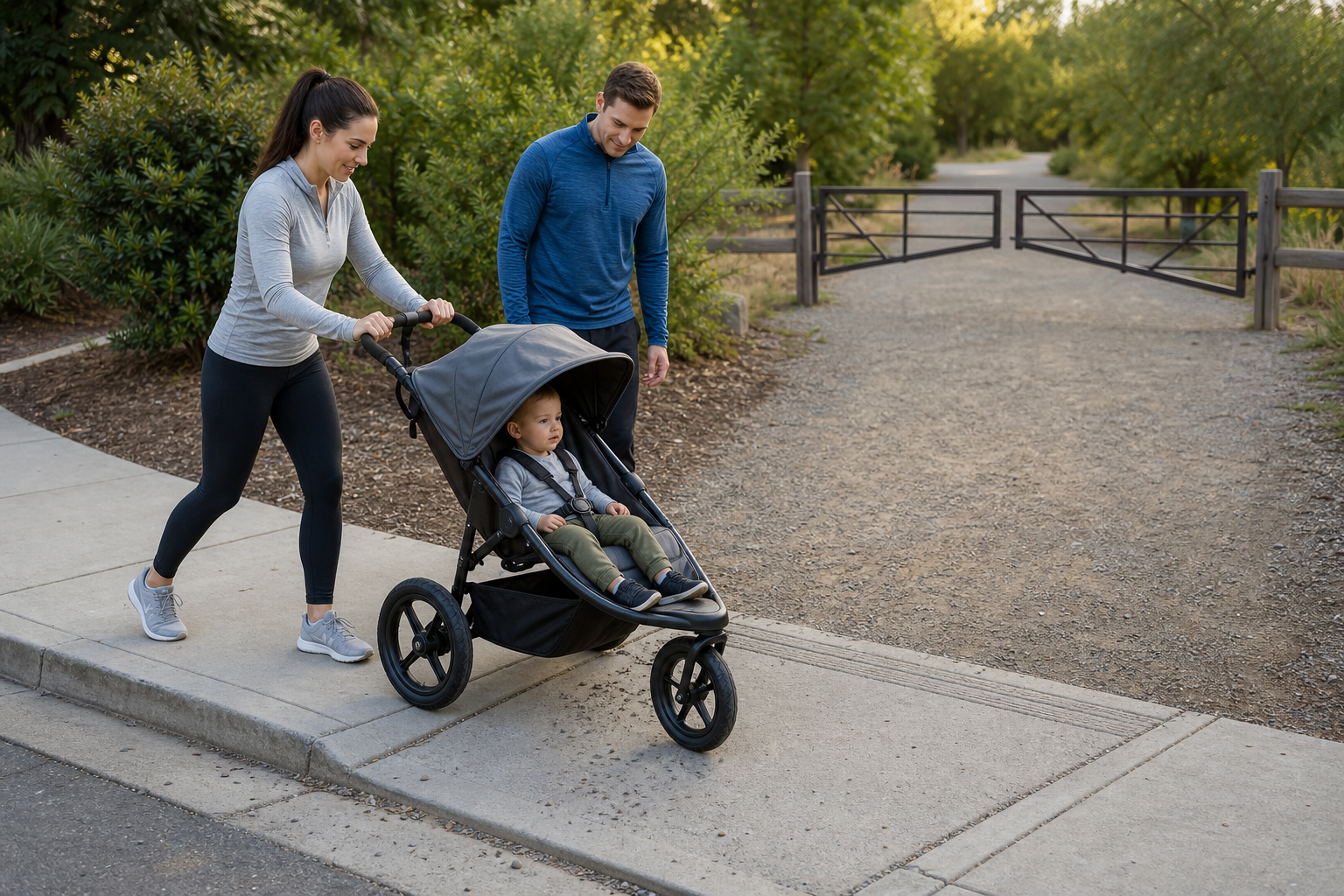
Jogging strollers are designed for different kinds of runners. The useful distinction is not “serious runner” versus “casual runner.” It is the combination of surface, hills, turns, storage, and pace that your stroller will face most often.
Trace one normal outing before you shop. Note where you meet cracked pavement, gravel, curbs, steep descents, narrow doors, tight turns, stairs, elevators, or traffic crossings. Then include the part that happens before the run: carrying the stroller downstairs, loading it into a vehicle, unfolding it while supervising your child, and storing it at home.
Front wheel and straight-line tracking
A front wheel that locks or is fixed for running helps the stroller track forward instead of changing direction when it meets a bump. A swivelling setting makes walking and tight manoeuvres easier. If you want one stroller for both running and errands, check how quickly you can change modes and whether the controls are obvious enough to verify at a glance.
Locking the wheel does not guarantee straight tracking. Small alignment differences can make a stroller pull to one side, forcing you to correct it throughout a run. Look for a tracking adjustment, then test the stroller on a level surface. It should travel straight with a light, controlled grip rather than demanding constant pressure from one arm.
Tires, suspension, and maintenance
Larger air-filled tires generally handle uneven surfaces more smoothly, but they also bring routine pressure checks and the possibility of a puncture. If you choose them, find out whether replacement tubes or tires are readily available and whether the wheels are simple to remove and reinstall correctly. Low-maintenance tires may be more convenient, but you should still judge how they feel on the surfaces you use.
Suspension can reduce how much rough ground reaches the seat. It cannot make an unapproved configuration safe or change whether a child is developmentally ready. Treat suspension as a comfort and handling feature after the two green lights are in place.
Brakes, handlebar, and control
If your route includes meaningful descents, test whether the stroller has a hand-operated brake that lets you control speed without fighting the handlebar. Learn the difference between any speed-control brake and the parking brake; their jobs and operation can differ. Apply the parking brake whenever the stroller is stopped and you are not maintaining full control of the handle.
Set the handlebar so your shoulders can remain relaxed and your wrists reasonably neutral. If two adults will run with the stroller, both need to test it. A fixed bar that suits one person may force the other into an awkward stride or hunched posture. An adjustable bar is valuable only if its range works for the people who will use it.
A wrist tether provides backup if your hand slips, particularly on a slope, but it does not replace active control or braking. Check that it fits comfortably and that you can use it without wrapping it around moving controls.
Test the whole family workflow, not just the push
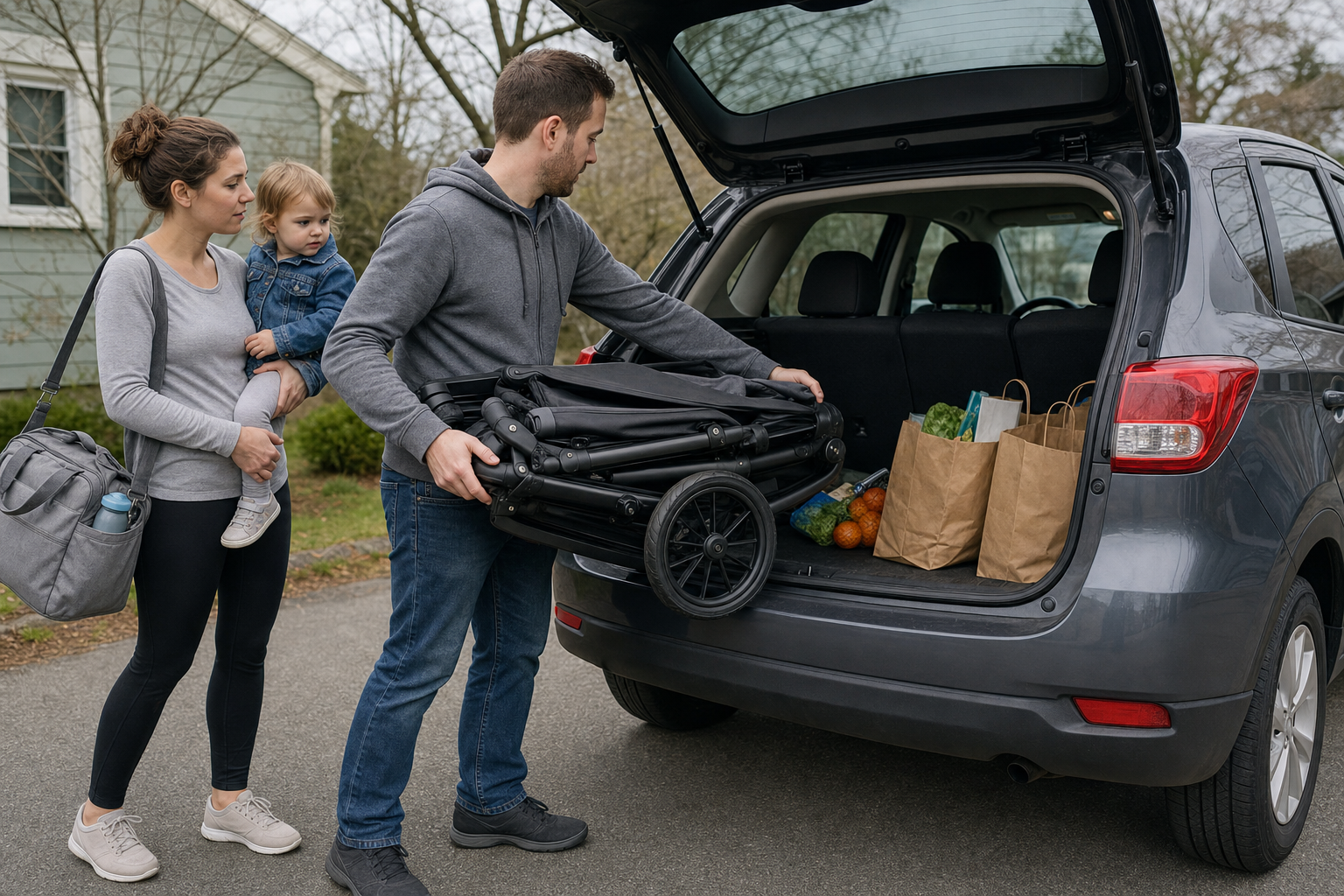
A smooth showroom floor reveals very little about a stroller’s fit in daily life. If a store permits a proper demonstration, work through the actions below. Start at walking pace and follow staff instructions about where and how the stroller may be tested.
- Adjust the handlebar and stand naturally behind it. Check that your feet do not strike the rear axle and that you are not shortening your stride to avoid the stroller.
- Set the front wheel to the manufacturer’s running position. Push on a level line and notice whether the stroller drifts left or right.
- Practise broad turns, controlled stops, and any approved braking system. Check whether the controls remain easy to reach without changing your grip dramatically.
- Adjust the harness, recline, canopy, and ventilation. You should be able to secure your child without twisted straps or guesswork.
- Fold and unfold the stroller more than once. Confirm that the frame visibly and audibly locks into its usable position.
- Lift the folded stroller as you would at home. Test it in your trunk, storage area, elevator, or doorway rather than relying only on listed dimensions.
- Open the storage basket and load the items you routinely carry. Check the manual’s load limits and make sure nothing can interfere with the wheels, brakes, or folding mechanism.
- Read the jogging and maintenance pages of the manual before committing. Confirm that every configuration you expect to use is actually permitted.
When buying online, check the return conditions before assembly or outdoor use. Also check whether routine replacement parts are available. A stroller that depends on a hard-to-find tire, tube, brake component, or adapter can be difficult to keep safely usable.
A used stroller needs a more careful inspection because wear and history are unknown. Find the model and serial information, then check current manufacturer notices and official recall records for that exact model. Inspect the frame for cracks, bending, heavy corrosion, or repairs. Confirm that the harness, tether, wheel-retention parts, brakes, and folding locks are present and working. Spin each wheel and watch for side-to-side wobble. If a safety-critical part is missing, damaged, improvised, or no longer supported, walk away rather than trying to make the stroller serviceable with an unofficial substitute.
Build a repeatable pre-run routine
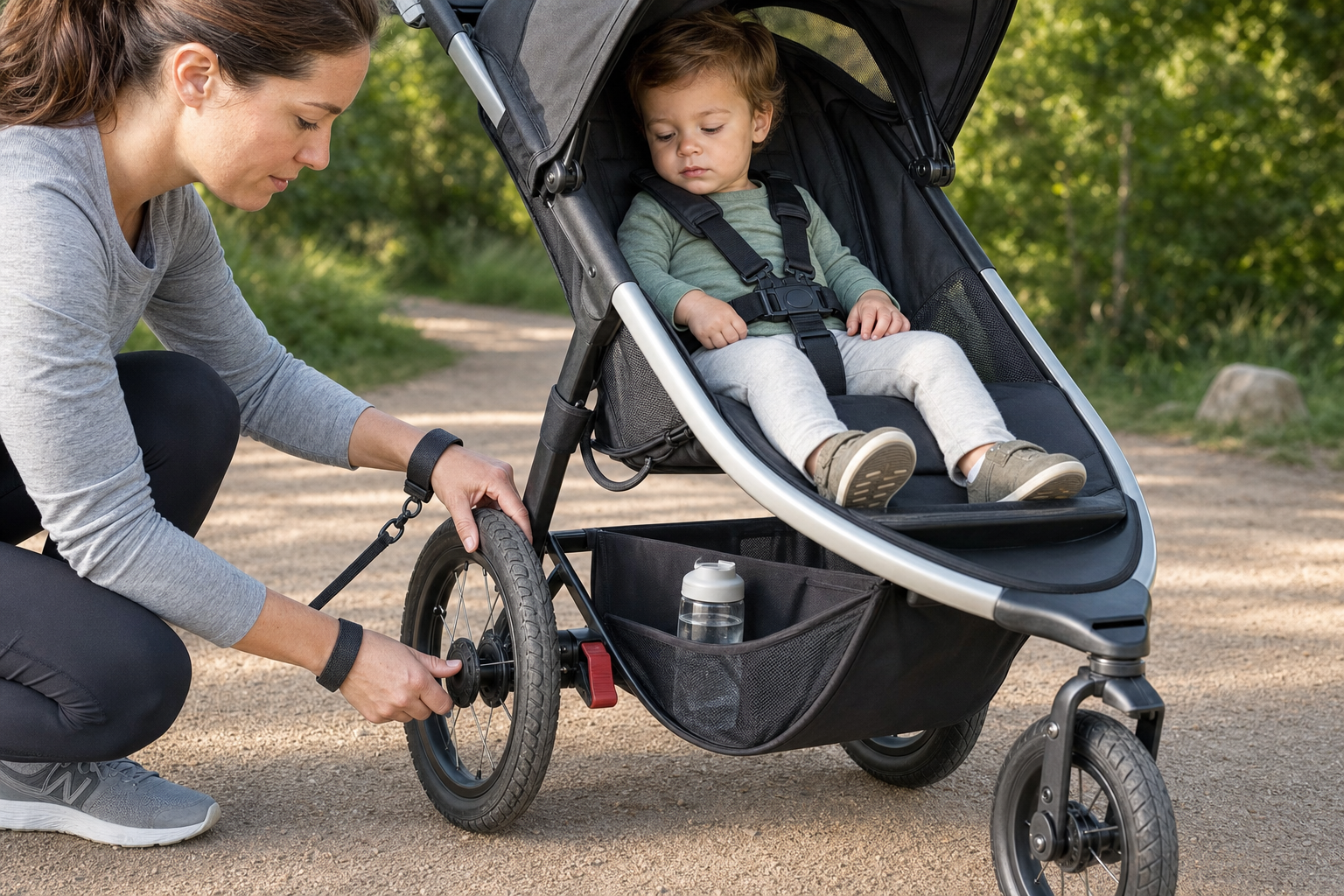
Your first outing should be a controlled check, not a test of distance or pace. Begin by walking with the stroller in its approved running configuration. Notice how it tracks, turns, and stops with your child and normal supplies aboard. Choose a familiar route with room to slow down or turn back if the stroller, weather, surface, or your child is not cooperating.
Use the same short inspection before every run:
- Secure the child harness according to the manual and check that the straps are not twisted.
- Confirm that the seat and any accessories are in a configuration approved for jogging.
- Set and verify the front wheel in the required running position.
- Check tire condition and pressure where applicable, and confirm that removable wheels are fully attached.
- Test the brakes before moving onto a slope or into traffic.
- Place supplies within the basket’s permitted load and keep bags, purses, and shopping off the handlebar, where they can affect stability.
- Put on the wrist tether if the model provides one and the instructions require or recommend it.
- Check that clothing, blankets, and toys cannot reach the wheels and do not block your child’s breathing or the stroller’s ventilation.
- Make sure you can hear traffic, other path users, and your child.
Scan the route as conditions change. Wet leaves, loose gravel, ice, broken pavement, steep slopes, crowded paths, and blind crossings can alter handling quickly. Slow to a walk or choose another route when the surface no longer gives you reliable control. Use two hands where braking, uneven ground, or traffic demands it, even if the stroller feels stable on an open straightaway.
Check your child during the outing rather than assuming silence means comfort. Look at body position, harness fit, temperature, sun exposure, ventilation, and whether anything has shifted into the seat. Stop if your child appears unwell, has trouble breathing, cannot maintain a safe position, or needs attention. A stroller run is exercise for you, but it remains a ride your child must tolerate safely.
Decide whether a jogging stroller earns its space
A jogging stroller makes the clearest sense when running will be a regular part of family life, your preferred routes suit it, and you have room to store and transport it. The trade-off is often less about running performance than daily friction: a larger fold, more weight to lift, wider wheels, or extra tire maintenance can make an otherwise capable stroller stay at home.
If your exercise is mainly brisk walking, do not assume you need running-specific equipment. Your existing stroller may already meet that need if it is used within its instructions. If you do plan to run, do not take an ordinary stroller jogging unless its manufacturer explicitly approves it for that use.
Some families will want one stroller that moves between errands and running. Others will prefer a compact everyday stroller plus a dedicated running model. Make that choice from the hardest recurring part of your routine. Limited storage, frequent transit, stairs, or a small vehicle can outweigh features that look appealing in isolation. Regular use on open paths or uneven surfaces can justify a more specialised setup.
Before spending, write down your actual route, where the folded stroller must fit, who will push it, and the exact seating configuration you need. Take that list to a test drive and reject any model that fails a safety requirement or creates a daily obstacle you already know you will resent. The right stroller is the one your child is cleared to use, you can control confidently, and your family can get out the door with consistently.
References