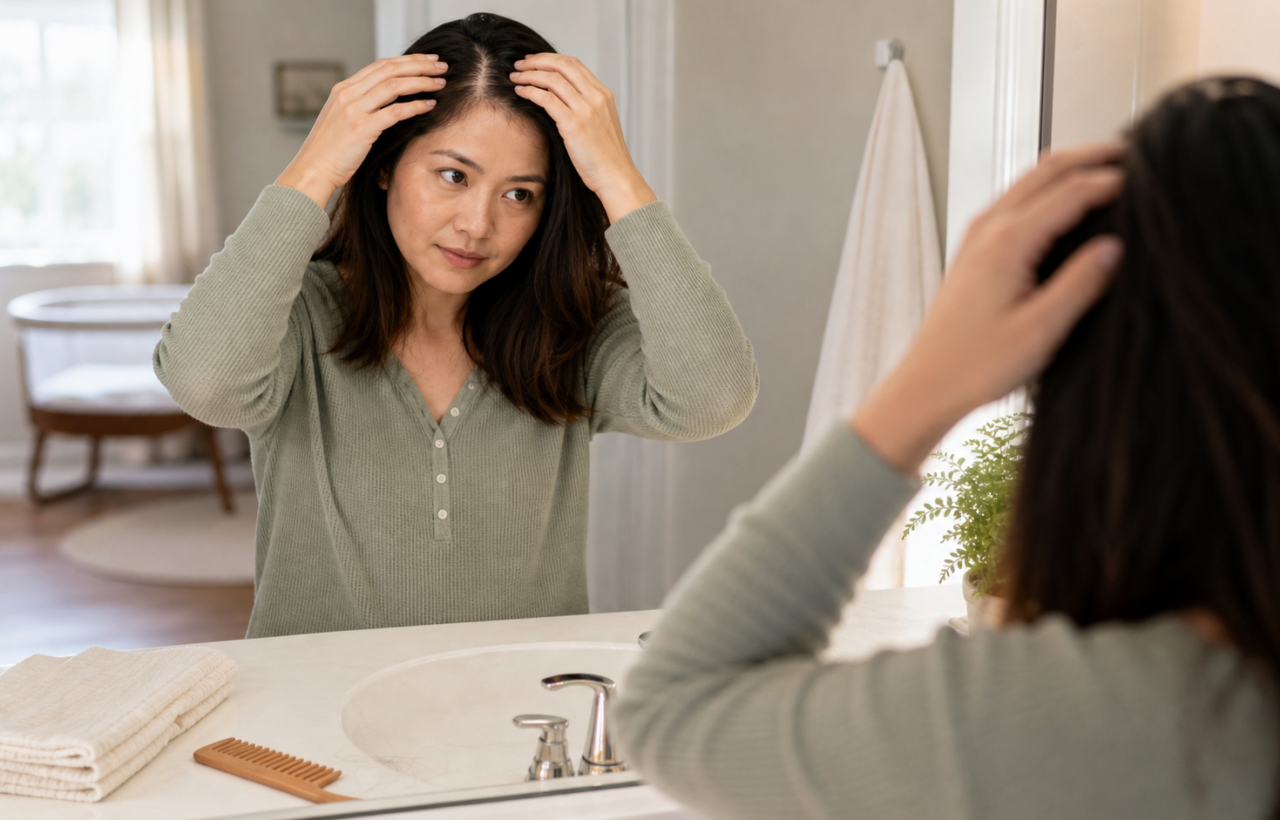
If hair is collecting in the shower while your scalp also feels itchy or flaky, it is tempting to treat everything as one problem. Usually, that leads to a shelf full of products and no clear sense of what is helping.
Start by separating the symptoms. Postpartum shedding comes from a change in the hair-growth cycle. Flaking and itching involve the scalp itself. They can happen together, but they do not always need the same response.
First, work out what has actually changed
Pregnancy-related estrogen changes can keep more hairs from falling out at their usual time. After childbirth, those hormone levels shift again and many hairs enter a resting phase called telogen. The resulting shedding is known as telogen effluvium. Noticeable postpartum hair loss is reported by up to 92% of people, so seeing more hair than usual does not automatically mean that your scalp or follicles are unhealthy.
The timing offers an important clue. Hormone-linked shedding commonly becomes noticeable during the first three to four months after delivery. Pre-pregnancy volume often starts returning within three to six months, with short new hairs appearing around the hairline as growth resumes. Those small hairs may be regrowth, so do not automatically treat every flyaway as breakage.
Scalp symptoms need their own inventory. Before buying anything, notice which description fits best:
- More shedding, but no scalp discomfort: focus on gentle handling and products that create the appearance of volume.
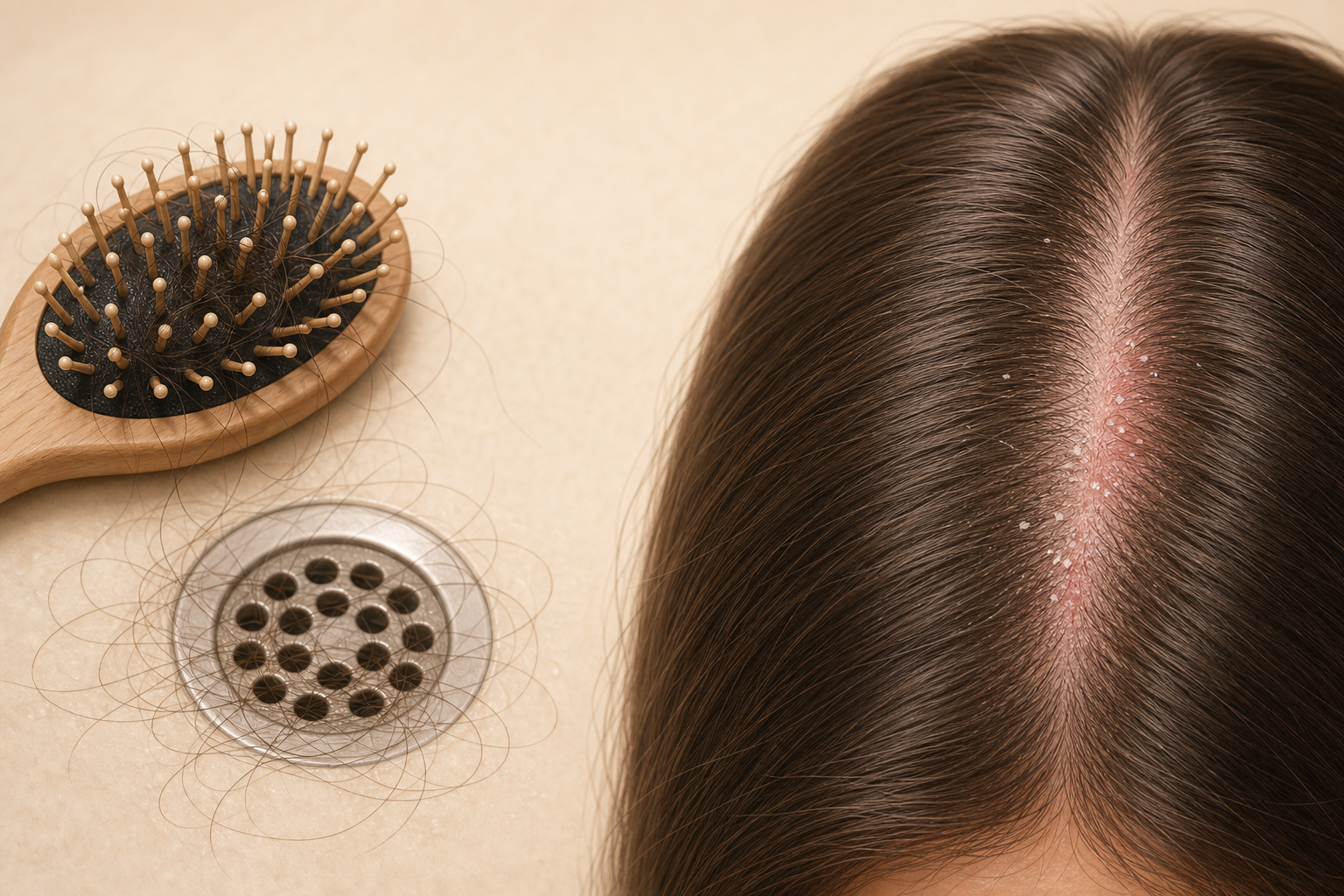
- Flakes with oiliness or itching: dandruff may be part of the problem, so an anti-dandruff approach is more relevant than adding a heavy conditioner.
- Itching without obvious flakes: do not assume it is dandruff. Hormonal changes, dehydration, physical stress and emotional stress can aggravate postpartum itch, but they do not prove its cause.
- Symptoms that are persistent, intense or affecting sleep: move from product experimentation to a health-care evaluation.
A simple weekly note can make the pattern easier to explain. Record where you are in the postpartum timeline, whether shedding appears diffuse or concentrated in one area, whether flakes are present, and which products touched your scalp. A monthly photo in the same lighting is more useful for spotting change than repeatedly checking your hair throughout the day.
Use a routine that protects fragile-looking hair
No shampoo can reverse a hormone-driven hair-cycle shift overnight. Your routine can still reduce avoidable pulling and breakage while making thinner hair easier to manage.
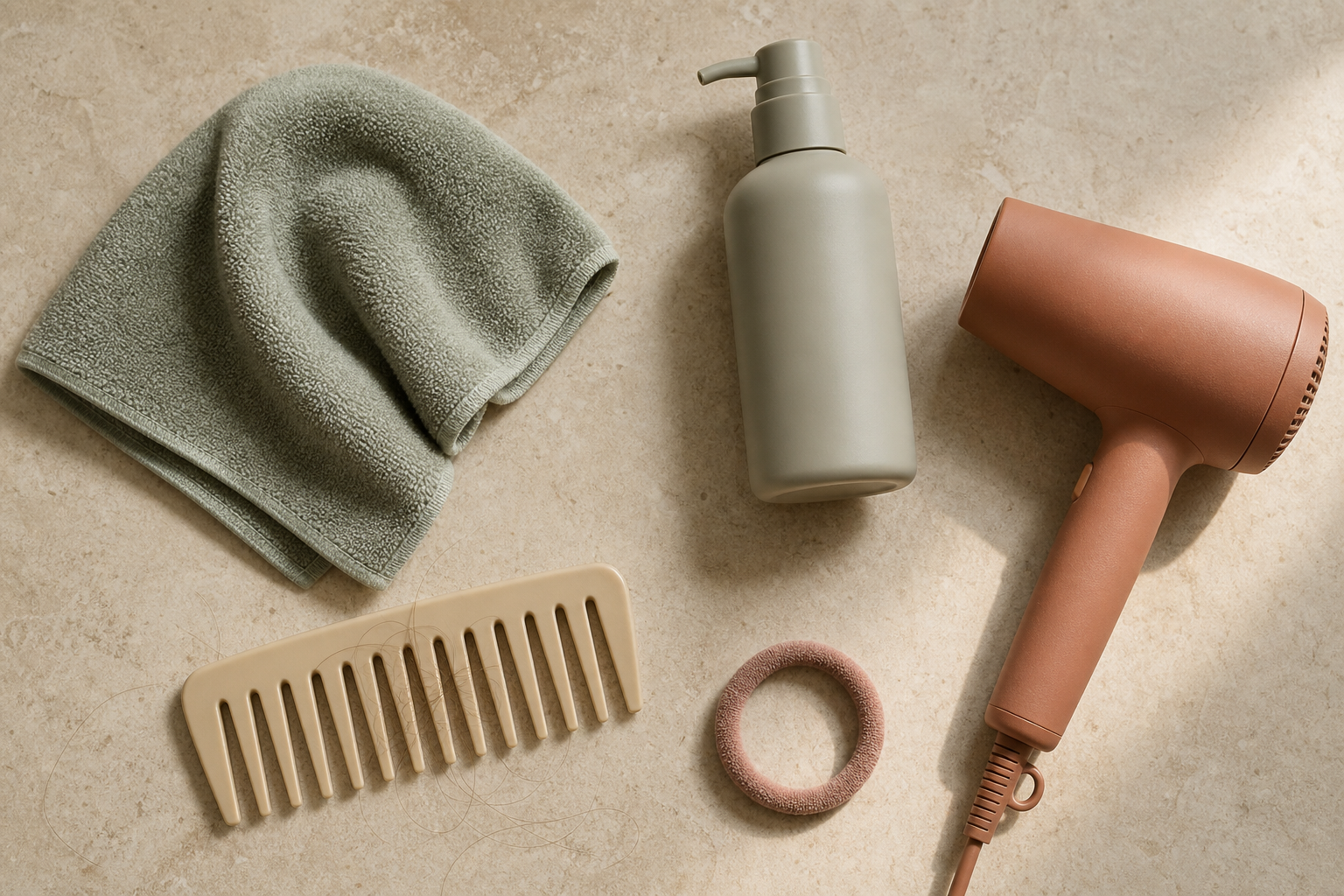
- Choose shampoo for the scalp problem you actually have. If there is no dandruff or itch, a gentle volumizing shampoo may help hair look fuller. A medicated cleanser is not automatically better.
- Keep conditioner on the lengths and tips. This is especially useful when the scalp is oily or flaky. Conditioning shampoos and intensive conditioners can weigh hair down, making reduced volume look more obvious.
- Handle wet hair with less tension. Avoid forceful tugging or repeated passes through tangles. The goal is not to stop normal shedding, but to avoid adding mechanical damage.
- Loosen the hairstyle. Tight ponytails, buns and braids place extra tension on already vulnerable-looking hair. Choose a style that does not pull at the hairline.
- Reduce heat where practical. Hot tools can add damage without changing the biological shedding process. If appearance is the immediate concern, try a lower-tension, lower-heat style before adding another treatment.
Volumizing formulas, lighter conditioning and less pulling are appearance and protection strategies. That distinction matters: a routine can be worthwhile even when it does not alter the underlying postpartum cycle.
Match scalp care to flakes, oiliness or itch
If you have flakes and an oilier scalp, look at the active ingredient rather than the promises on the front of the bottle. Over-the-counter anti-dandruff shampoos containing selenium sulfide or zinc pyrithione may help with postpartum dandruff and its associated itch. Follow the product directions rather than using it more often in the hope of speeding things up.
Keep regular conditioner away from the scalp when oiliness and dandruff are present. Applying it to the tips gives the drier parts of your hair slip without adding more residue at the roots.
An itchy scalp without flakes calls for more caution. Scalp-formulated anti-itch treatments exist, including liquids containing 1% hydrocortisone, but the right choice depends on what is causing the itch. A pharmacist, family doctor or dermatologist can help you decide whether a medicated product is appropriate instead of having you cycle through dandruff shampoos, oils and anti-itch treatments at random.
If you are breastfeeding, check any new medicated or topical scalp treatment with your health-care provider before using it. Many over-the-counter topical products may be compatible with breastfeeding, but not every chemical is automatically appropriate. The label alone may not account for your health history, the product strength or how much you plan to use.
Change one part of the routine at a time when symptoms are mild. If you start a medicated shampoo, a scalp liquid and a new conditioner together, you will not know which one helped or which one caused more irritation.
Know when product testing should stop
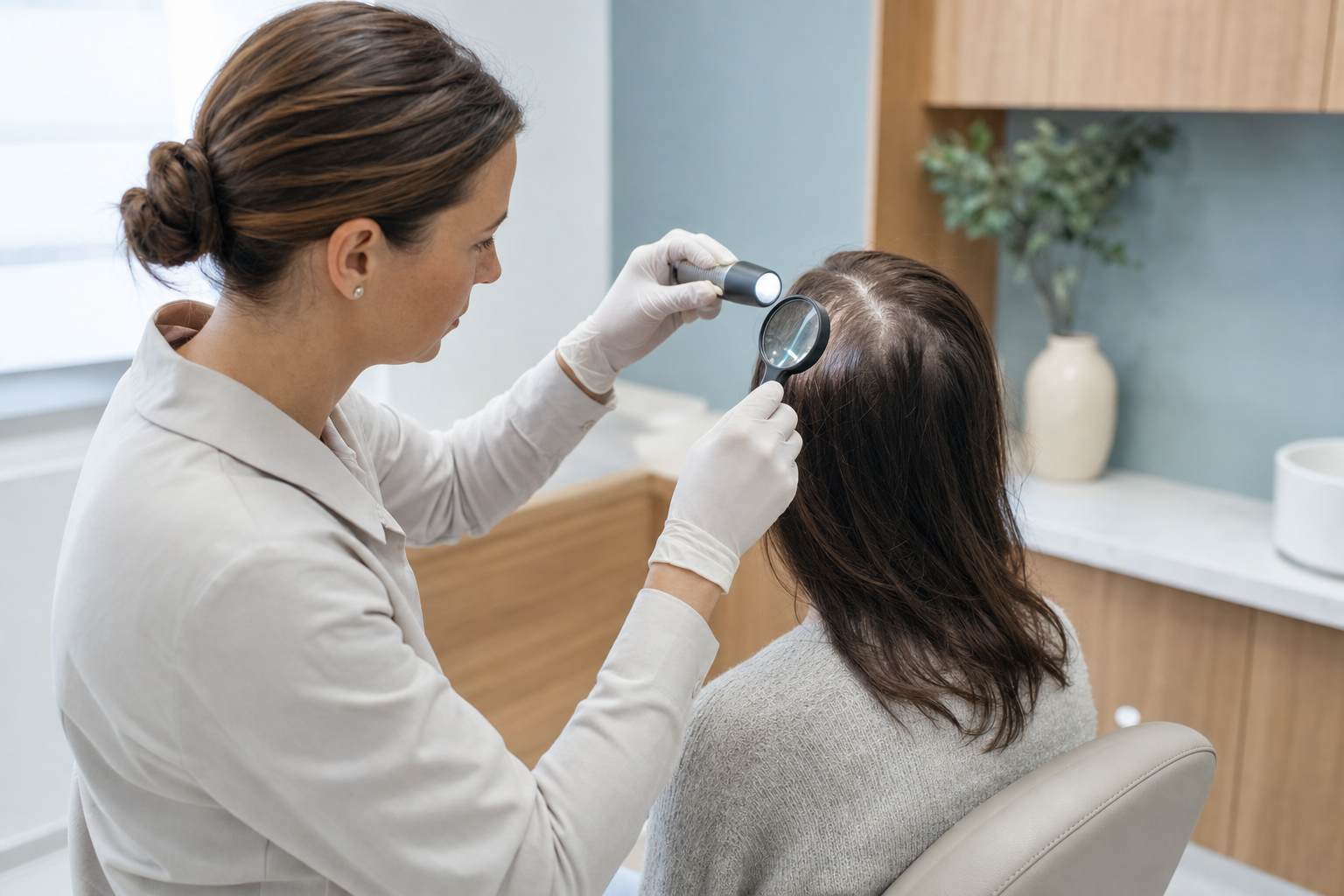
Postpartum hair and scalp changes are often temporary, but persistence matters. Contact your family doctor, postpartum care provider or a board-certified dermatologist when simple measures are not making a meaningful difference, the itching keeps returning, or discomfort is interfering with sleep or daily life.
Six months after delivery is a useful review point for hair volume, not a deadline or a diagnosis. If shedding is not beginning to settle, you see no sign of recovery, or the pattern does not resemble the diffuse postpartum shedding described above, bring it to a clinician rather than assuming hormones explain everything.
Persistent itch also deserves assessment because the cause may not be limited to the scalp. A dermatologist may examine the skin and, when the symptoms warrant it, test for underlying causes such as certain liver conditions. That does not mean a serious condition is likely; it means an unexplained symptom should not be managed indefinitely with cosmetic products.
For difficult, ongoing itch, a dermatologist may discuss supervised phototherapy. Ultraviolet light reaches the epidermis and dermis and may affect the nerve networks involved in itching, although the precise mechanism remains uncertain. It can require several treatment sessions, so it is a clinician-directed option for persistent symptoms, not a home substitute for medical evaluation.
If scalp discomfort is disrupting your sleep or affecting your mood, mention that explicitly when you seek care. The impact on your day matters even if the visible skin changes look minor.
Key takeaways
- Postpartum shedding and scalp irritation can occur together, but they are separate problems and may need different care.
- Hormone-linked shedding is commonly most noticeable during the first three to four months after delivery and is usually temporary.
- Use light volumizing products, avoid tight styles and hot tools, and reduce tugging on wet hair. These steps protect the hair and improve its appearance; they do not instantly change its growth cycle.
- For oily flakes, check for selenium sulfide or zinc pyrithione in an anti-dandruff shampoo and keep conditioner on the hair tips.
- Check new medicated scalp products with a health-care provider if you are breastfeeding.
- Book an evaluation when itch persists, self-care is not helping, symptoms affect sleep or mood, or hair volume is not beginning to recover around the six-month postpartum checkpoint.
For now, choose the track that best matches what you see: shedding, oily flakes or unexplained itch. Make one targeted change, remove one source of pulling or heat, and watch the pattern. If the problem is persistent or disruptive, let a clinician investigate it instead of asking another bottle to provide the diagnosis.
References