A 2T can slide off your toddler in one brand and feel too short in another. That does not mean you measured badly. Toddler size labels narrow the search, but they do not define a consistent fit across brands, garment types or body proportions.
You can make the decision much easier by combining three things: your child’s current measurements, the chart for the exact brand you are buying, and a quick movement check. That approach is more reliable than choosing by age or automatically moving up whenever something looks snug.
The quickest way to choose a toddler size
Start with the chart on the product page or the brand’s website. Toddler clothing is commonly organized around age-based T labels, but age is only a starting point for choosing a size. Children of the same age can have different heights, weights and proportions, while brands can assign different measurements to the same label.
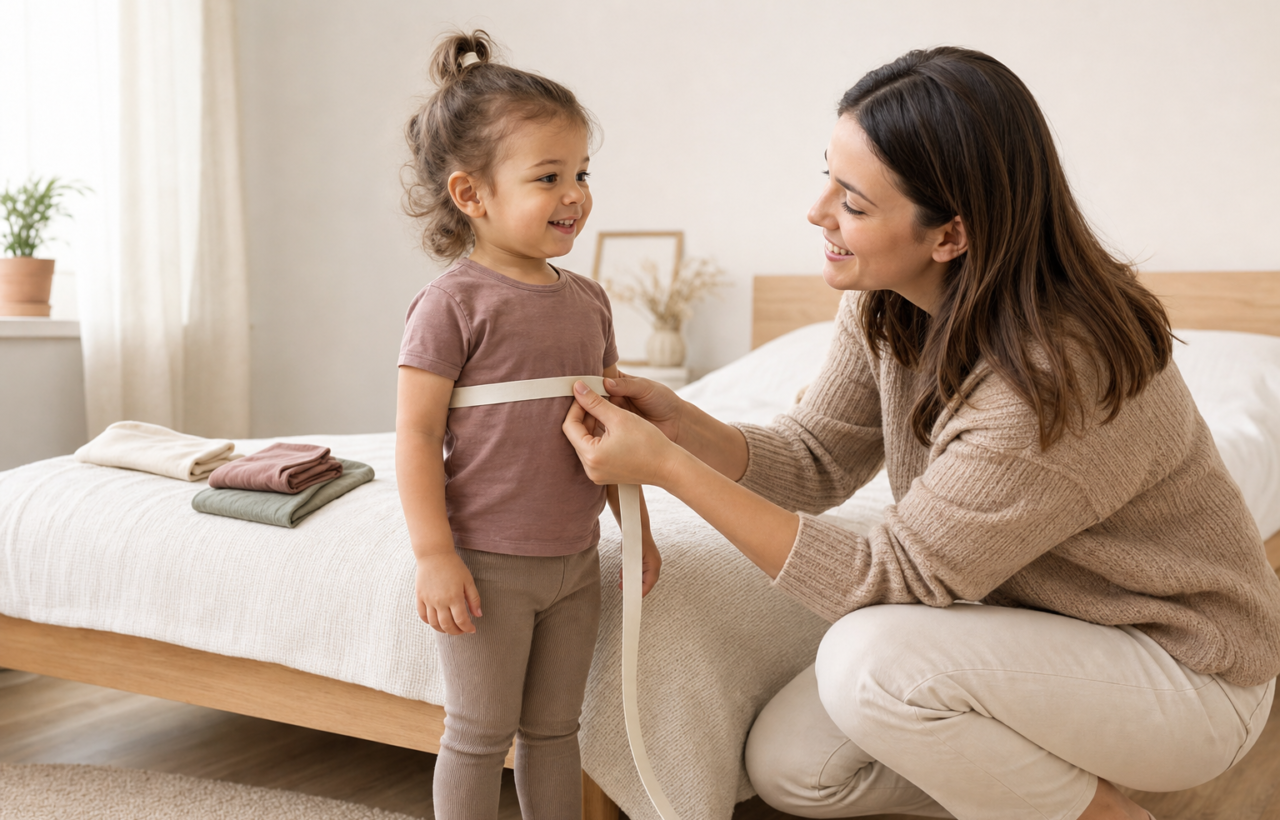
Measure your child only for the dimensions the chart uses. Have them stand barefoot in thin clothing, keep the tape level, and let it rest against the body without pulling it tight. Record the date beside the measurements so you do not rely on an old note after a growth change.
- Measure height: Have your child stand straight against a wall, looking forward. Mark the top of the head with a flat book, then measure from the floor to the mark.
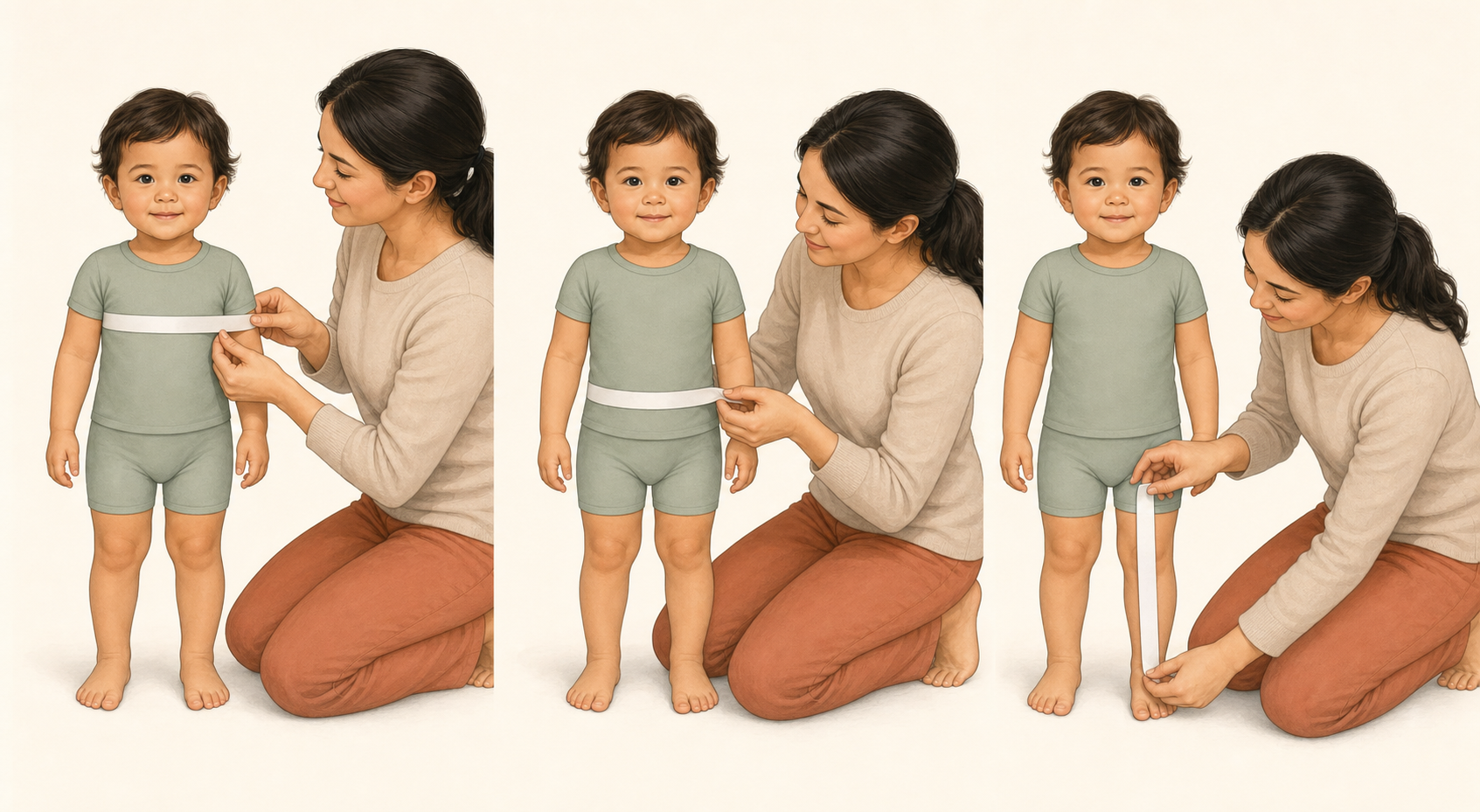
- Measure the chest: Wrap the tape around the fullest part of the chest and under the arms. Keep your child’s arms relaxed.
- Measure the waist: Follow the brand’s measuring diagram when one is provided. Otherwise, measure around the area where the garment’s waistband will naturally sit.
- Measure the hips or seat if requested: Place the tape around the fullest part, keeping it parallel to the floor.
- Check height, weight or inseam when listed: Some charts depend more heavily on these measurements than on chest or waist. Do not substitute age for a measurement the chart specifically provides.
If your child’s measurements land in different rows, identify the dimension that controls the garment. Chest and shoulder fit matter most for a structured top or coat. Waist, seat, rise and leg length matter more for trousers. Torso length is especially important for rompers, overalls and other one-piece clothing.
Do not automatically choose the largest size shown by any single measurement. A long-legged child may need a larger trouser size without needing a larger sweatshirt. Separates let you solve those differences more accurately than buying one label for an entire outfit.
How baby and toddler labels overlap
The transition from 24M to 2T can be confusing because the labels may overlap. They belong to different sizing ranges rather than forming a perfectly continuous sequence. A 24M garment can be shaped with more room for a diaper, while a 2T garment may be longer or cut more like clothing for a child who is beginning to leave baby proportions behind. That distinction is common, not universal.
If both labels appear to fit on paper, look at the garment rather than assuming 2T is simply the next, larger version of 24M. Compare the rise, waist shape, torso length and leg opening. For a child still wearing a bulky diaper, extra room through the seat may matter more than the label. For a taller child with a narrower build, the proportions of the toddler cut may work better.
The same caution applies when a retailer switches from T sizes to numbered children’s sizes. A familiar-looking number does not guarantee the same dimensions or cut. Return to the chart whenever the sizing system, brand or product line changes.
Even within one brand, two garments carrying the same label may fit differently. Leggings, relaxed trousers, woven shirts and stretchy T-shirts are built with different amounts of ease. Fabric stretch, waistband construction and the intended silhouette can change the usable fit without changing the size printed on the tag.
Fit the garment, not just the chart
A chart gets the garment into the fitting room. Movement tells you whether it belongs in the closet. Once your child is dressed, let them sit, squat, reach up and walk. Watch the garment rather than asking a young toddler to explain a fit problem they may not be able to name.
- Tops and sweaters: Check that the neckline goes on without a struggle, the shoulders sit reasonably close to the child’s shoulders, and the cuffs do not cover the hands. When your child reaches up, the body should not pull sharply across the chest or ride excessively high.
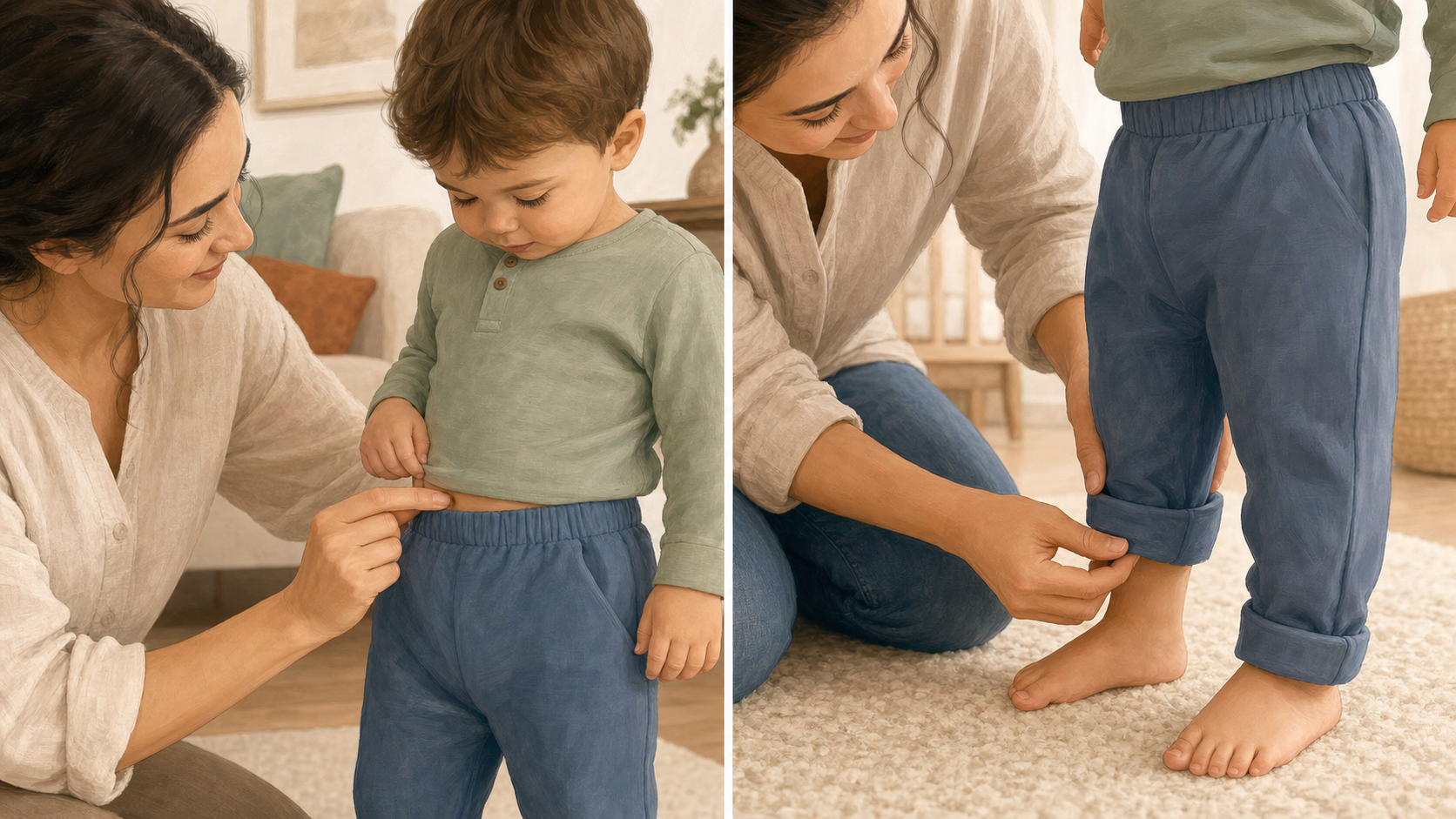
- Trousers and leggings: The waistband should stay up without digging in or requiring constant adjustment. Check the fit while your child is sitting as well as standing. The back should continue to cover the diaper or underwear, and the hem should stay clear of the floor.
- Rompers and overalls: Pay close attention to torso length and rise. Pulling at the crotch, strained fasteners or shoulder straps that dig in indicate a proportion problem even when the width looks generous.
- Dresses and tunics: Check arm movement, neckline comfort and the actual hem position during play. A roomy body does not compensate for tight armholes or shoulders.
- Coats and outer layers: Try them over the kind of clothing your child will normally wear underneath. Your child should still be able to bend the arms, reach forward and move comfortably.
Clothing is probably too small when seams pull, closures strain, the waistband rolls or digs in, the rise will not stay in place, or ordinary movement makes the garment ride up. It is probably too large when the waistband falls, the shoulders collapse far down the arms, hands disappear inside sleeves, or hems reach the floor.
Room to grow is useful only while the garment remains functional. Excess fabric around the feet can cause trips, while sleeves covering the hands can interfere with eating and play. If the next size is much too large, choose a different cut, an adjustable waistband or an inexpensive bridge item instead of forcing a poor fit to last longer.
A better system for online shopping and buying ahead
For online orders, your best reference may be a garment that already fits well. Lay it flat without stretching it and record the relevant dimensions: underarm width, shoulder-to-hem length, waistband width, rise and inseam. Compare like with like whenever the retailer provides garment measurements.
First determine whether the retailer is showing body measurements or finished garment measurements. A body chart tells you which size is intended for a child with certain measurements. A garment chart tells you the dimensions of the clothing itself. Those numbers are not interchangeable because a finished garment normally includes some amount of room for movement and may also stretch.
Be especially careful with flat widths. A waistband measured straight across a pair of trousers is not the same kind of measurement as a waist circumference taken around the body. Compare the retailer’s numbers only after confirming where and how each measurement was taken.
- Open the size chart attached to the exact product, not a chart saved from another retailer.
- Check whether it describes the child’s body or the finished garment.
- Compare the dimensions that control the fit of that item.
- Read the fabric details and product description for words such as fitted, relaxed, stretch or adjustable.
- Check return conditions before buying several pieces in an unfamiliar brand.
- When practical, order one representative item before duplicating it in several colours or prints.
Keep a short note on your phone with the brand, product type, size and fit result. “Brand A leggings, current size, good waist but short leg” is more useful than a list of labels alone. Over time, that note becomes a personal size chart based on your child’s proportions.
Buying ahead requires more restraint. A larger label does not tell you when your child will fit it, whether the proportions will work, or whether the clothing will suit the season when it finally fits. If the discount is only worthwhile when every item gets worn, avoid buying a large batch in an untested cut. Adjustable waists, flexible layers and items that are not tied to a narrow season give you more margin.
When storing future sizes, separate them by both size and clothing type. Put the next likely-to-fit layer at the front, label the container clearly, and review it whenever current sleeves, rises or hems begin to look short. This prevents useful clothing from remaining packed away until it is already too small.
Key takeaways
- Toddler size labels are starting points, not standardized promises of fit.
- Use the chart for the exact brand and product whenever possible.
- Choose according to the measurement that controls the garment: chest for many tops, waist and rise for many bottoms, and torso length for one-piece clothing.
- Treat 24M and 2T as overlapping cuts that may have different proportions, not as guaranteed smaller-and-larger versions of the same garment.
- Confirm whether an online chart lists body measurements or finished garment measurements before comparing numbers.
- Finish with a movement check. A useful fit lets your toddler sit, squat, reach and walk without pulling, slipping or excess fabric underfoot.
Measure your child before the next order, choose one garment using the brand’s current chart, and test its movement and proportions before buying more. That small trial will tell you more than a drawer full of matching size labels.

References