

When one product promises to cover both stroller outings and trike years, the real question is not whether the idea sounds convenient. It is whether the product can handle the parts of your routine that matter: fitting your child properly, navigating your usual routes, folding into your vehicle and changing modes without becoming a nuisance.
The smarTrike Traveler is presented as a 4-in-1 product that changes from a compact stroller to a trike for children from 6 months to 4 years old. Our verdict is straightforward: it is worth shortlisting if you want one adaptable product across several stages, but it is not a sensible blind buy. The age range and convertible design establish the concept; they do not tell you whether the Traveler fits your child, storage space or everyday route.
The verdict: worth a shortlist, not a blind buy
The Traveler’s strongest idea is continuity. Instead of treating the stroller stage and the trike stage as unrelated purchases, it is designed to move between them. That could be genuinely useful in a home where storage is limited or where you would rather adapt a familiar product than find room for separate pieces of gear.
But “4-in-1” is a configuration count, not proof that every configuration will be equally useful to your family. Before giving the label much weight, ask the seller to show you exactly what changes between the advertised modes. Look for meaningful differences in how your child sits, how you control the product and what your child can do. A small adjustment should not be treated as a major new function unless it solves a real need for you.
The broad stated lifespan is also potential value rather than guaranteed value. A convertible product only replaces other gear if its early configuration works well enough as your everyday stroller and its later configuration remains comfortable and practical as your child grows. If you would still need a separate primary stroller, the Traveler may make more sense as recreational gear than as an all-purpose replacement.
Several purchase-critical details need to be confirmed for the exact unit available to you. These include its folded measurements, product weight, child limits for each configuration, restraint requirements, braking system, wheel design, storage capacity, included accessories and warranty. Do not infer any of those details from the words “compact” or “4-in-1.”
Treat the age range as a boundary, not a fit guarantee

The stated starting point is 6 months. That does not mean every baby becomes ready for every configuration on the day they reach that age. Use only the configuration approved in the manual for your child’s age, size and developmental stage. Check that your baby can maintain the posture required by that configuration and that the supplied restraint can be adjusted securely.
If your baby was born prematurely, has low muscle tone or has any condition affecting posture or head control, ask an appropriate health professional about positioning before using unfamiliar seated gear. A convertible stroller-trike is not a substitute for equipment recommended for a child’s individual needs.
Do not try to extend the lower age boundary with cushions, unapproved inserts or improvised supports. Added padding can change how a restraint fits, while an accessory that appears physically compatible may not be approved for that product. The manual supplied for the exact model being sold to you should control the decision.
The upper end of the range needs a physical fit check too. Children of the same age can differ considerably in height, proportions and confidence. Seat depth, back support, leg position and available adjustment matter more than the birthday printed on the box. Place your child in the later configuration if a demonstration is permitted. Check whether they look comfortably supported, whether their knees and feet have clear space and whether all required restraints still fit as intended.
Ask for the limit attached to each mode rather than accepting one overall age range. The point at which a child outgrows a stroller configuration may not be identical to the point at which they outgrow a trike configuration.
Make “compact” prove itself in your routine

Compact is a relative description. A product can look small beside a full-size stroller and still be awkward in a shallow trunk, crowded entrance or narrow apartment cupboard. Your measurements are more useful than the label.
- Measure the opening as well as the storage area. A folded product may fit inside a vehicle’s cargo space but fail to pass comfortably through the hatch. Check the narrowest width and height along the loading path.
- Map the space at home. Use the confirmed folded measurements to mark its footprint where you intend to keep it. Include any clearance needed to lift it in, stand it upright or access items stored beside it.
- Confirm what must be removed before folding. A reasonably small fold becomes less convenient if part of the product has to be detached and stored separately. Ask where any removed components are meant to go.
- Try the lift, not only the fold. If stairs, a vehicle or public transport are part of your routine, confirm the product’s weight and lift the demonstration unit safely. Test it without holding your child.
- Include the diaper bag in the decision. Inspect the usable storage in every configuration you expect to use. Check whether the storage remains accessible when your child is seated.
Your usual route matters just as much as storage. Push the demonstration unit through tight turns and over any permitted sample surfaces. Notice the force needed to start, stop and change direction. If your routine includes broken pavement, gravel, grass, steep paths or winter conditions, obtain explicit confirmation that the relevant configuration is intended for that use. A product described as adventure-oriented is not automatically suitable for every surface or weather condition.
If public transport is central to your week, rehearse the parts that usually cause trouble: entering a narrow space, turning while loaded, operating the parking control and folding while managing your other belongings. If air travel is the priority, compare the confirmed folded dimensions and handling requirements with the rules of the carrier you actually use. “Compact” does not by itself mean cabin-approved or even easy to gate-check.
Check the exact unit before it follows you home
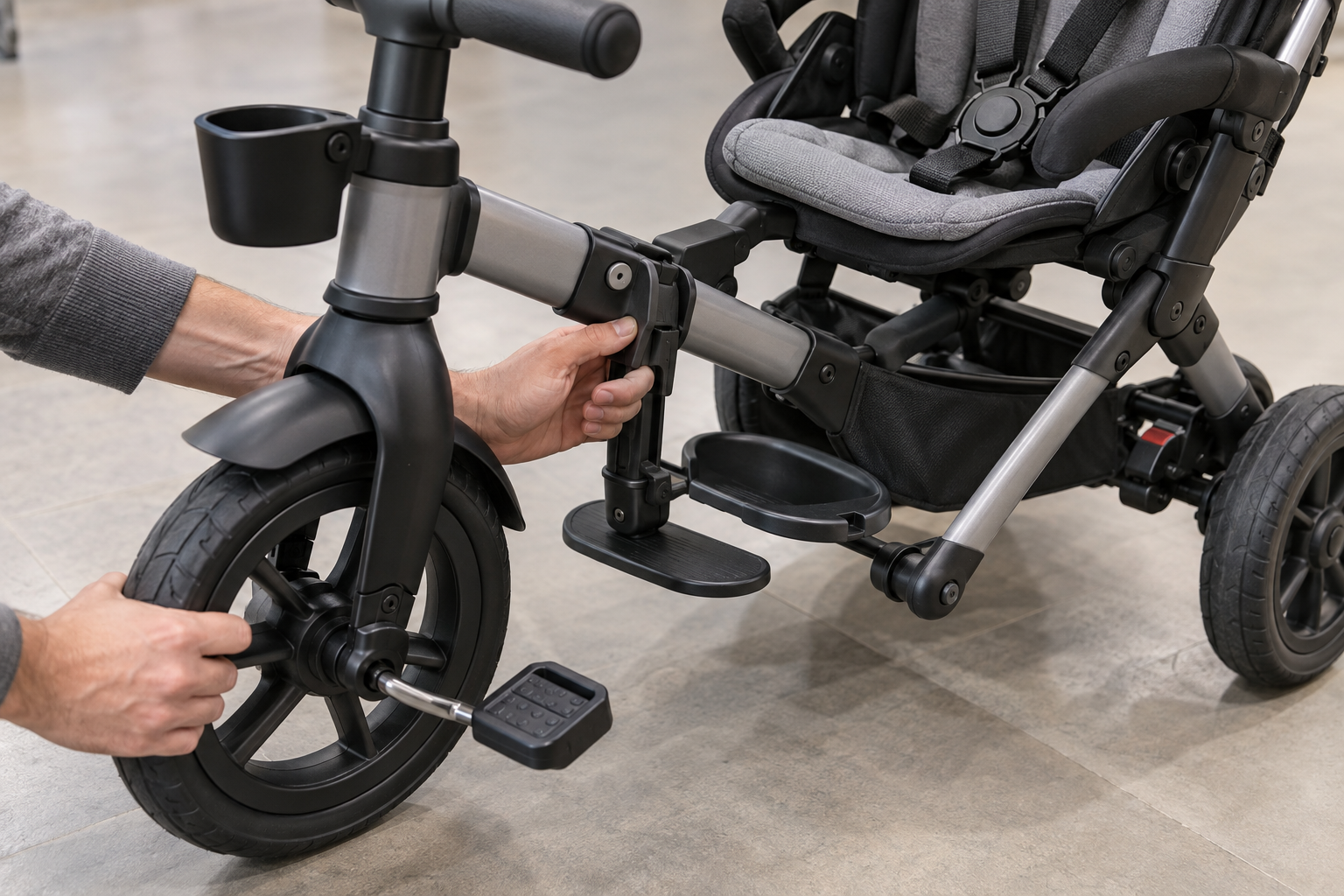
Work through the modes yourself
A polished demonstration can hide the part that will frustrate you later. Ask to perform the normal adjustments yourself, using the supplied instructions. You should be able to identify what locks, what moves and how you know a configuration is fully engaged.
- Confirm the exact model and its identifying label. Save a photo so that specifications or accessories from a similar Traveler version are not mistaken for those of your unit.
- Ask the retailer to identify every advertised configuration in the manual. Confirm the permitted age or size conditions attached to each one.
- With your child out of the product, change between the configurations you expect to use. Notice whether the process requires loose pieces, significant force or a place to set components down.
- Fit your child in the currently approved configuration. Adjust every required restraint according to the manual and check posture, support, leg position and available growing room.
- Operate the steering, parking control and fold yourself. Do not test a parking control on an incline with your child seated; use the safe demonstration method specified by the retailer or manufacturer.
- Confirm what is included in the box. Write down the names of any accessories you consider essential, then check their compatibility and total cost rather than assuming they are standard equipment.
- Read the return, warranty and spare-parts terms before purchase. This matters more for convertible gear because one broken or missing component can affect several configurations.
If you are buying online, ask the retailer for the same information in writing. Compare the model identifier, manual, folded dimensions and included components with the listing you are about to order. Keep screenshots of the listing and compatibility claims with your receipt.
Who is most likely to appreciate it
The Traveler makes the most sense when the stroller-to-trike transition is itself the feature you want. It is a plausible match if your child is within the approved range, you have limited room for separate wheeled products and the actual unit passes your fit, route and storage checks.
It is a weaker match if you need equipment for a baby younger than the stated starting age, require a specific newborn or car-seat setup, regularly tackle demanding surfaces, or need a fold that meets strict transport dimensions. Those needs may still be compatible with a particular Traveler model, but they require explicit confirmation; the broad product description does not establish them.
Also be honest about how you will use it. If you mainly need a highly specialized everyday stroller, a convertible design should win on stroller performance before its later possibilities receive any credit. If the trike function is the main attraction, judge whether you will genuinely use the stroller configurations enough to justify buying a combined product.
Key takeaways
- The smarTrike Traveler’s documented appeal is its change from compact stroller to trike across a stated 6-month-to-4-year span.
- The age range does not guarantee physical or developmental fit. Follow the limits and positioning requirements for each configuration.
- The 4-in-1 label only matters if the individual modes solve needs your family actually has.
- Verify folded dimensions, weight, child limits, restraints, brakes, wheels, accessories and warranty for the exact model offered.
- Test the conversion, fold, lift and child fit yourself whenever possible. Convenience on a product page is not the same as convenience during a real outing.
- Shortlist the Traveler for adaptability, but buy it only after it passes your route, storage and fit checks.
If the Traveler still looks right for you, take your child’s current measurements and your vehicle or storage measurements to the retailer. Ask for the exact manual, work through the configurations and leave without buying if any essential limit remains unclear. A convertible product is useful when every important transition works in your real life, not merely when the modes look appealing in a demonstration.
References




