

You can plan for a vaginal birth and still leave the hospital with a C-section incision, a different bill than you expected, and new limits on what you can comfortably do at home. A useful plan leaves room for that uncertainty. It gives you written cost estimates, a household recovery budget, and a clear way to monitor bleeding without assuming that every change is either harmless or an emergency.
The cost questions below use US insurance terms. If you live elsewhere, the same planning framework can help, but you will need to replace those questions with the rules of your public, private, or supplemental coverage.
Ask for two birth estimates, not one perfect number

There is no single hospital-birth price that can tell you what your family will owe. In the US, the total can be affected by prenatal care, pain relief such as an epidural, preterm delivery, and the hospital stay. Your insurance plan, provider network, delivery route, and the care needed by you and your baby also shape the amount that reaches you.
Treat any estimate as a scenario, not a promise. Ask for one estimate based on an uncomplicated vaginal delivery and another based on a C-section. Even if you are not planning a C-section, the second number shows you the financial difference your backup plan may need to absorb.
Start by separating the cost into three buckets:
- Known costs: the deductible you have already paid, your current coinsurance or copay rules, and any confirmed prenatal charges.
- Estimated costs: the facility and professional charges expected under the vaginal-birth and C-section scenarios.
- Variable costs: changes in the delivery, anesthesia, a longer stay, preterm care, additional tests, or care your newborn may need.
Then make two calls. Ask your insurer:
- How much of your deductible and out-of-pocket maximum remains.
- Whether the hospital, obstetric clinician, anesthesia services, and newborn care each need separate network verification.
- Whether any part of the admission requires authorization or notification.
- Whether your plan year could reset between prenatal care and delivery.
- How and when the newborn must be added to coverage.
Ask the hospital billing team:
- For written vaginal-delivery and C-section estimates based on your insurance information.
- What each estimate assumes about anesthesia, length of stay, routine newborn care, laboratory work, and professional fees.
- Which clinicians or services might bill separately.
- How an advance payment is reconciled if the final claim is lower or higher.
- What financial assistance, self-pay discounts, or payment arrangements are available if the estimate is unaffordable.
Save the estimates, the date of each call, the representative’s name, and any reference number. If an answer changes later, a written record gives the billing office something concrete to review. It also prevents you from having to reconstruct every conversation while caring for a newborn.
Put recovery expenses beside the medical estimate

The hospital bill is only one part of the financial plan. A C-section can also change what you need at home. Your discharge team may place temporary limits on driving, lifting, exercise, or other activities, and those limits can create costs even when the medical care itself is covered.
Make a separate recovery budget with line items for:
- Prescribed medicines and clinician-approved recovery supplies.
- Postpartum pads and comfortable clothing that does not press on the incision.
- Transportation to follow-up appointments until you are cleared to drive.
- Meal delivery, prepared groceries, or simple foods that another person can serve.
- Laundry, cleaning, pet care, and help with an older child.
- Unpaid leave, reduced hours, or extra caregiving time for your support person.
- Additional appointments if your recovery or your baby’s care requires them.
You do not need to buy every possible recovery product before birth. Keep a flexible reserve instead. Purchase the basic items your maternity team recommends, identify a pharmacy and grocery option that delivers, and decide who can collect anything prescribed after discharge. This avoids spending money on specialized products you may never need while preserving a quick way to get what you do need.
Your support plan should be as specific as your budget. Assign one person to manage medicines and pharmacy pickups, one to handle meals and household work, and one backup person who can step in if recovery is harder than expected. These roles can belong to the same person, but naming the tasks now is more useful than a general promise to help later.
Set up frequently used items within comfortable reach before delivery: your phone and charger, water, pads, medication log, feeding supplies, and the baby’s immediate essentials. Follow your own discharge instructions for movement and lifting. A generic recovery timeline should never override restrictions given by the team that performed your surgery.
Vaginal bleeding after a C-section is part of postpartum recovery
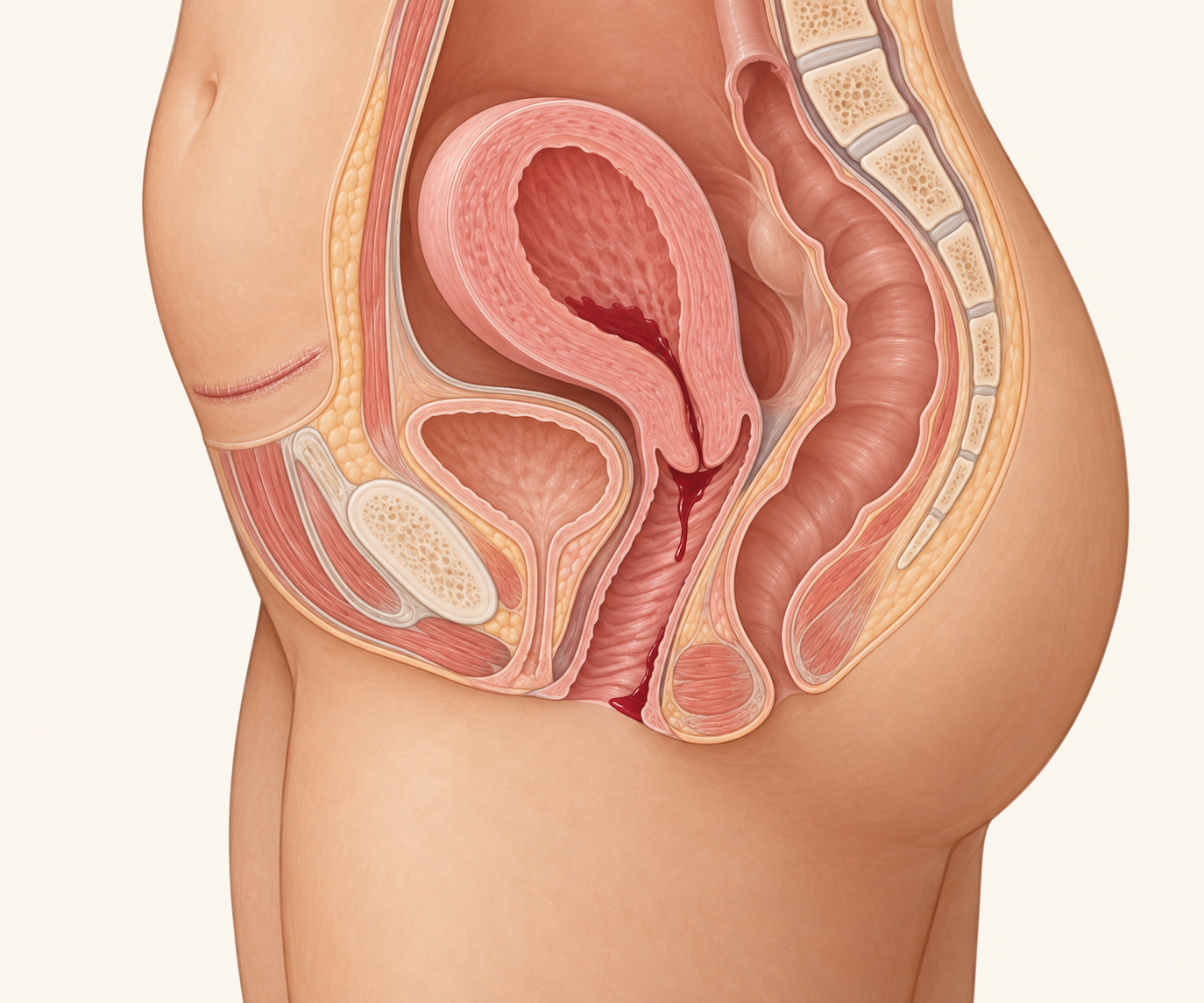
A C-section changes how your baby is delivered, but it does not eliminate postpartum vaginal bleeding. Vaginal bleeding occurs after both vaginal and Cesarean births, and its duration varies. The uterus is still recovering from pregnancy and shedding blood and tissue, regardless of the location of the surgical incision.
That distinction matters: vaginal flow and the abdominal incision are two separate recovery sites. Vaginal bleeding does not by itself mean the incision has opened. Conversely, an incision that is bleeding, separating, increasingly red, or producing concerning drainage needs attention even if vaginal bleeding seems light.
Look at the pattern rather than comparing yourself with another parent’s exact timeline. A simple daily note can help you notice a meaningful change and describe it clearly to your maternity team. Record:
- Whether the bleeding is easing, staying similar, or becoming heavier.
- How quickly you are saturating the postpartum product your care team recommended.
- Whether clots have appeared or become larger or more frequent.
- Any unusual or foul odor.
- Whether you feel feverish, chilled, dizzy, faint, unusually weak, or short of breath.
- Where pain is located and whether it is improving or worsening.
- Any change in the incision, including opening, bleeding, redness, swelling, or drainage.
- Whether a change followed increased activity.
Bleeding that continues for weeks is not automatically proof of a complication, because duration varies. Duration alone cannot establish that everything is fine, either. Bring ongoing bleeding up at your postpartum appointment, and contact the maternity team sooner when the amount increases, the overall recovery reverses direction, or another symptom appears.
Know which recovery changes should not wait

Your hospital’s discharge instructions and contact thresholds take priority because they reflect your delivery, medical history, medicines, and complications. Keep the maternity triage number and your local emergency number in your phone before you go home.
Contact your maternity team promptly if:
- Bleeding becomes heavier after it had been easing.
- You develop large or increasingly frequent clots.
- You have fever, chills, a foul odor, or worsening abdominal or pelvic pain.
- Your incision begins opening, bleeding, producing drainage, or becoming more red, swollen, or painful.
- Your pain or overall condition is getting worse instead of gradually improving.
- You are concerned about bleeding that persists, even without another obvious symptom.
Seek emergency care for sudden, very heavy bleeding; fainting or near-fainting; chest pain; trouble breathing; confusion; or severe weakness. Do not wait for a routine postpartum visit when you feel acutely unwell. If you are unsure how urgent the situation is, call maternity triage and describe what is happening rather than trying to diagnose it yourself.
Give the clinician concrete information: when the change began, whether bleeding had previously eased, how quickly your pad is becoming saturated, whether clots are changing, your temperature if you measured it, your pain pattern, any dizziness or breathing difficulty, and what the incision looks like. That description is much easier to triage than asking only whether bleeding is normal.
Key takeaways
- Request written estimates for both a vaginal delivery and a C-section; neither estimate is a guarantee.
- Verify the hospital, clinicians, anesthesia services, and newborn coverage instead of assuming one network answer covers everything.
- Keep household help, transportation, food, leave, and recovery supplies in a separate budget from the hospital estimate.
- Expect vaginal bleeding after a C-section, but track whether it is easing or becoming heavier and note any additional symptoms.
- Use your discharge instructions for personalized thresholds, and seek urgent help when heavy bleeding or serious symptoms develop.
Before your next prenatal visit, request the two cost scenarios and ask where your maternity team wants you to call with postpartum concerns. Save both answers in the same phone note. Those two small tasks give you a usable plan when a bill changes, recovery takes an unexpected turn, or you are too tired to search for the right number.
References
- Parents – Making Sense of Hospital Birth Costs: Support for Expecting Families
- Parents – How Long Can You Expect Vaginal Bleeding After a C-Section to Last?




