
If your midwife or doctor says you are “measuring ahead,” it is easy to hear something more definite: your baby is very large, birth will be difficult, or your plans need to change. That single measurement does not establish any of those things.
A larger fundal-height measurement, extra amniotic fluid, an ultrasound estimate, your pregnancy history, and gestational diabetes can all raise the possibility of a larger baby. None can predict birth weight with complete accuracy. Here is how to understand each clue and turn a vague comment about size into useful questions for your maternity care provider.
First, separate a prenatal estimate from birth weight
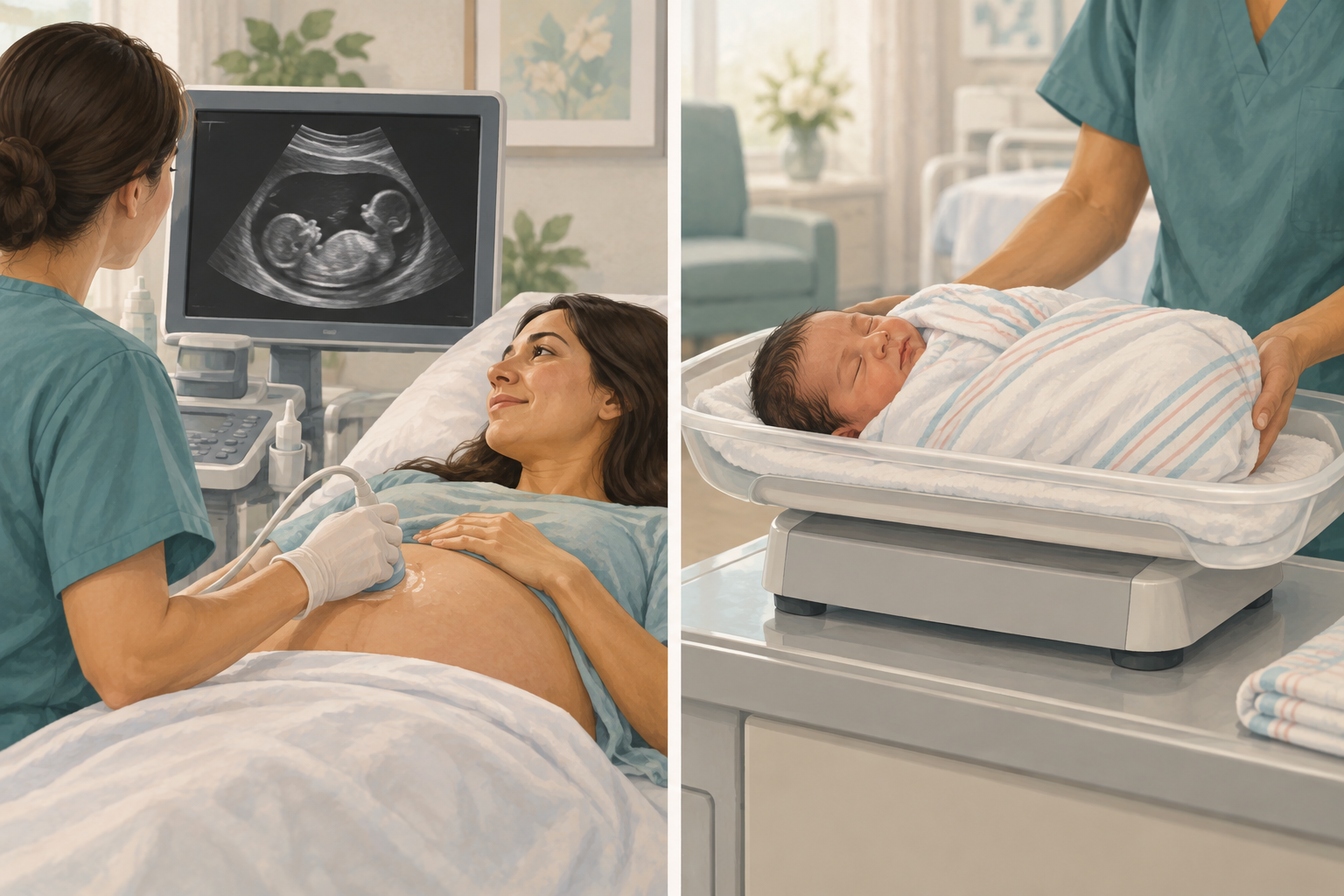
Two terms often get mixed together. Large for gestational age describes a fetus measuring larger than expected for the stage of pregnancy. Fetal macrosomia generally refers to a baby born weighing more than 4,000 grams, or 8 pounds, 13 ounces.
That distinction matters because birth weight is known only after birth. During pregnancy, your care team is working with measurements and estimates. A baby can measure ahead without eventually meeting the definition of macrosomia, and a suspected larger baby can be born smaller than an ultrasound predicted.
When you hear “big baby,” ask which term your provider actually means. Are you measuring large for your current gestational age? Is an ultrasound projecting a higher birth weight? Or is your provider discussing a risk factor rather than a measurement? The answer tells you how much weight to give the comment.
The five clues clinicians use before birth
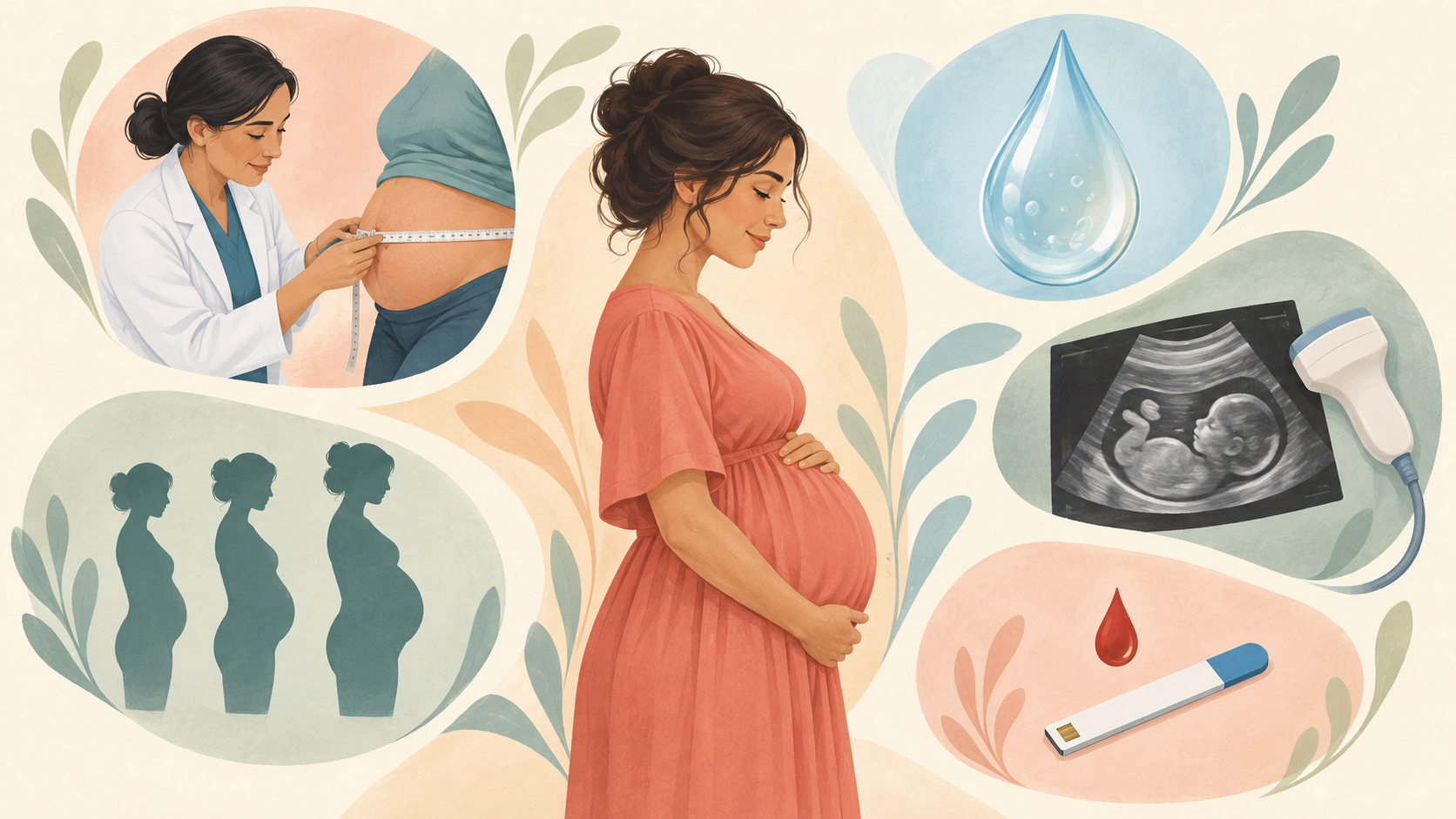
These clues are not five symptoms you can check at home. Some are clinical measurements, while others come from your medical and pregnancy history. Each has limitations.
1. Your fundal height is larger than expected
Fundal height is the distance from your pubic bone to the top of your uterus. Your provider may use it to follow growth over time. If that measurement is larger than expected for how far along you are, a larger baby is one possible explanation.
It is not the only explanation. Obesity and uterine fibroids can make fundal-height measurements less reliable. Extra amniotic fluid can also make your uterus measure larger. This is why a repeated pattern matters more than one measurement. If you measure large more than once, your provider may recommend an ultrasound to gather more information.
What to ask: “Is this the first larger measurement, or has my fundal height been trending ahead? What else could account for it?”
2. You have more amniotic fluid than usual
A higher-than-usual amount of amniotic fluid is called polyhydramnios. It has been associated with roughly three times the risk of fetal macrosomia, so it may prompt closer attention to fetal growth.
Polyhydramnios is still not proof that your baby is large. It has several possible causes, including gestational diabetes, and it may need monitoring for reasons beyond fetal size. Ask whether the concern is the fluid level itself, your baby’s estimated growth, or both.
What to ask: “How will you monitor the fluid, and does this finding change any other part of my care?”
3. An ultrasound estimates a larger baby
Ultrasound provides more information than the appearance of your bump or a fundal-height measurement alone. It can estimate fetal size, but it is not a prenatal weighing scale. Ultrasound estimates can overestimate how large a baby will be at birth.
Do not stop at “the scan says the baby is big.” Ask for the actual finding: what was estimated, how it compares with what is expected at this stage, and how much uncertainty surrounds that estimate. Also ask whether your provider wants another measurement later or whether the current result changes anything now.
What to ask: “What exactly did the ultrasound estimate, and how confident are you that the estimate will affect the birth plan?”
4. You have previously given birth to a large baby
Your previous pregnancy history gives your care team useful context. If you have already delivered one or more large babies, your chance of having another may be as much as 10 times higher. That is an increase in likelihood, not a guarantee.
Make sure your current provider knows the previous baby’s birth weight and whether the delivery involved complications. Those details are more useful than simply saying the baby was “big.” If you do not remember the exact weight or events, ask whether your previous maternity record is available.
What to ask: “How does my previous baby’s size and delivery history affect monitoring or planning in this pregnancy?”
5. You have gestational diabetes
Gestational diabetes increases the likelihood of a larger-than-average baby, particularly when blood glucose is not well controlled through the care plan. It is best understood as a risk factor, not proof of your baby’s current size.
The useful action is to follow the glucose-monitoring, nutrition, activity, and medication instructions your diabetes or maternity team has given you. Do not sharply restrict food, change insulin, or alter other medication in an attempt to reduce fetal growth on your own. Contact the team if your readings are repeatedly outside the targets they set for you.
What to ask: “Are my glucose results where you want them, and does my baby’s growth estimate change the diabetes plan?”
Turn “measuring big” into a concrete care plan

The five clues do not add up like a home scoring system. One may have an alternative explanation, and even ultrasound cannot confirm a future birth weight. Your provider needs to interpret the pattern: repeated measurements, imaging, fluid level, health conditions, and previous pregnancy history.
Bring these questions to your next appointment:
- Which finding raised the concern? Ask whether it was fundal height, amniotic fluid, an ultrasound estimate, gestational diabetes, or your previous history.
- Was it a one-time result or a trend? Find out what earlier measurements showed.
- What else could explain it? This is particularly useful when the concern began with fundal height or extra fluid.
- What will be checked next, and when? Ask whether the plan is routine follow-up, another ultrasound, fluid monitoring, or a review of glucose management.
- Does this change the birth plan now? Clarify whether the information affects monitoring only or whether your provider wants to discuss the timing, setting, or method of birth.
Write down the answers. “Baby may be large” is easy to remember as a conclusion while forgetting that it began as an uncertain estimate. Keeping the actual measurement and follow-up plan in view can prevent that possibility from turning into a certainty in your mind.
Why your care team pays attention to fetal size
Larger babies are associated with a higher likelihood of certain complications, and that likelihood rises as birth weight increases. For the birthing parent, possible complications include prolonged labour, perineal trauma, postpartum hemorrhage, and an increased chance of Caesarean birth.
For the baby, possible complications include shoulder dystocia, fetal distress, birth injuries, breathing problems, low blood sugar, and jaundice. Shoulder dystocia means the baby’s shoulders become stuck during birth and requires immediate clinical management.
This list explains why your team may recommend additional monitoring or a more detailed delivery discussion. It does not mean a suspected larger baby will experience these problems. The size estimate itself is uncertain, and many larger babies are born without complications.
Keep your prenatal appointments, manage any health condition with your care team, and follow their recommendations for nutrition and activity. If the estimate changes the proposed delivery plan, ask what specific risk the change is intended to reduce and how much the uncertain weight estimate is influencing that recommendation.
Frequently asked questions
Should I eat less if my baby may be large?
No. Do not start a restrictive diet to try to change your baby’s size. Eat a nutritious diet, exercise only as recommended for your pregnancy, and follow any individualized gestational-diabetes plan. Ask your provider or dietitian for help if you are unsure how to apply that plan.
Does a suspected large baby mean I will need a C-section?
Not automatically. A larger baby is associated with an increased chance of Caesarean birth, but a prenatal size estimate does not determine the outcome by itself. Your maternity care provider must weigh the estimate alongside your health, pregnancy history, current findings, and other clinical considerations.
Will my baby need extra checks after birth?
If your baby is larger than average at birth, the clinical team will likely check the baby’s blood glucose to make sure it stabilizes. Any further observation or testing will depend on the baby’s condition and the circumstances of the birth.
At your next appointment, take the exact concern back to its starting point: the fundal-height trend, fluid level, ultrasound estimate, diabetes status, or previous birth history. Ask what will be rechecked and when. That gives you a plan based on your pregnancy, rather than on the word “big.”
References