

You notice spots while changing your toddler, and the questions arrive at once: Is this heat, an allergy, an infection, or something contagious? A photo search may produce a convincing match, but many childhood rashes look alike.
Your safest goal is not to name the rash from appearance alone. It is to check how your child is doing, record the rash’s pattern, and decide whether to watch it, call a clinician, or get urgent help. Most toddler rashes are not serious, but the symptoms around the rash matter as much as the marks themselves.
First decide whether to watch, call, or get urgent help

Look at your child before examining every spot. A toddler who is playing, drinking, breathing comfortably, and behaving normally is in a different situation from a child who is struggling to breathe or becoming unusually drowsy.
Get emergency help now
- Your child has difficulty breathing with the rash or hives. Call your local emergency number rather than driving around or waiting for a callback.
- Your child is difficult to wake, markedly less responsive, or rapidly becoming more unwell. A significant behaviour change should not be dismissed as tiredness caused by the rash.
Contact a clinician promptly
- The rash appears with a high fever, repeated vomiting, chills, or a noticeable change in behaviour.
- One area is hot, swollen, tender, or rapidly expanding. Cellulitis can appear as a clearly defined red, hot, swollen area and can spread quickly.
- A sore or broken area is moist, producing pus, developing yellowish crusts, or surrounded by increasing swelling.
- Mouth sores make eating or drinking difficult.
- Hives appeared after a food, medicine, insect sting, or bite, even if your child is currently breathing normally.
- The rash is worsening rather than settling, or you are concerned about how your child looks or acts.
When watching briefly may be reasonable
If your toddler has no other symptoms, is otherwise well, and the rash is not rapidly changing, you can often observe it for a few days. Many uncomplicated viral rashes clear without treatment, commonly within about a week. Contact your child’s clinician if it has not improved within that time, begins to spread or worsen, or new symptoms appear.
Fever rules are stricter for young infants than for toddlers. If the child with the rash is still a young infant, use the fever instructions previously given by their clinician rather than relying on toddler guidance.
Build a rash fingerprint before trying to name it
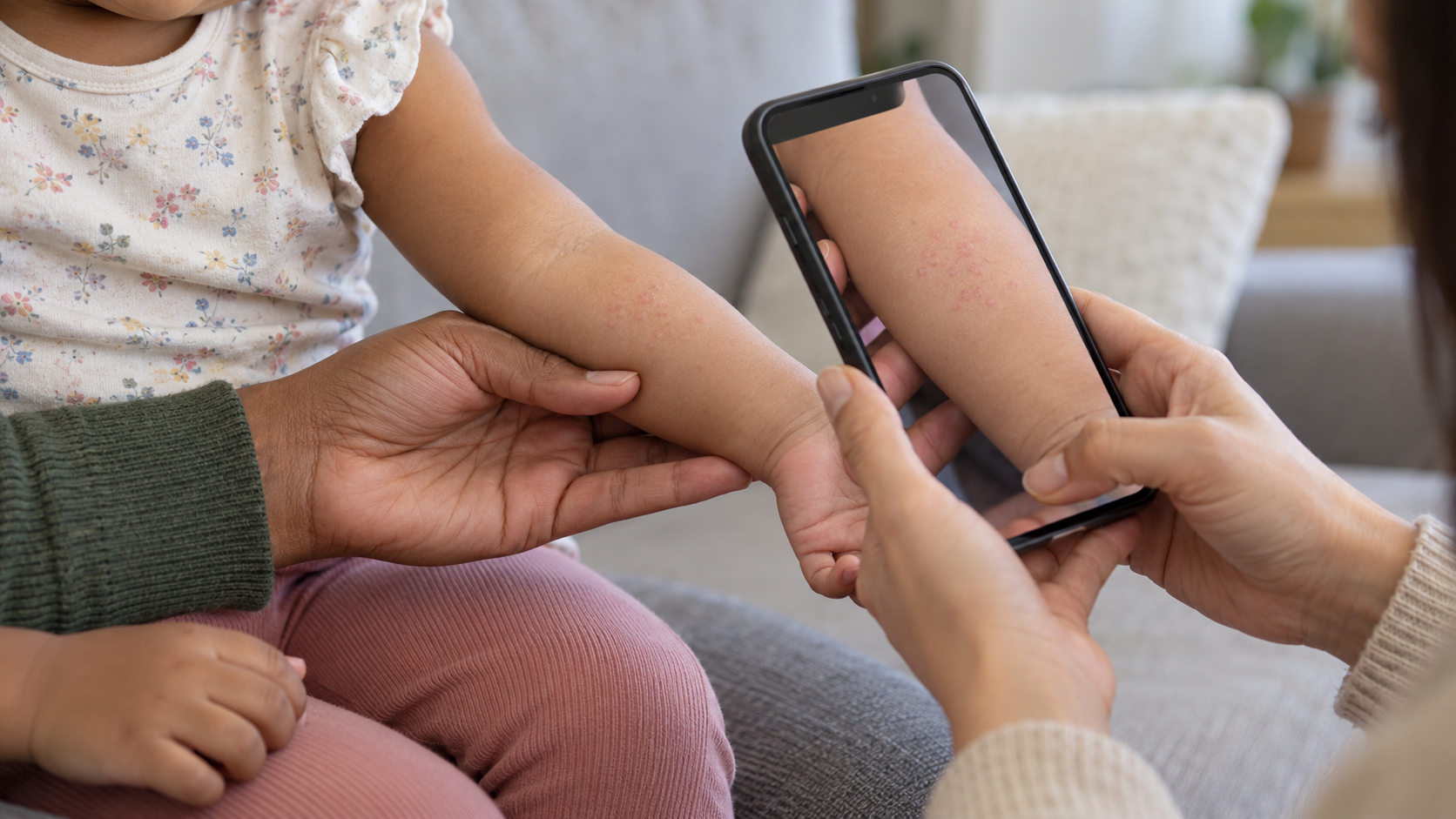
The same-looking rash can have several causes. A useful description combines appearance, location, timing, sensation, exposures, and the child’s overall condition. Take one minute to record these details:
- Check the whole child. Note fever, breathing, vomiting, energy, behaviour, appetite, drinking, sore throat, cough, congestion, or body aches.
- Describe the surface. Is it flat, raised, rough, scaly, moist, crusted, blistered, or made of welts? Colour alone can be subtle across different skin tones, so include warmth, swelling, and texture.
- Map the location. Record where it began and where it is now. Include skin folds, the diaper area, palms, soles, fingers, feet, scalp, mouth, and the skin around a scratch or bite.
- Write down the sequence. Did fever come before the rash, at the same time, or after it? Did spots turn into blisters? Did one patch become several?
- Ask what your toddler feels. Watch for scratching, tenderness, pain, or discomfort when you touch the surrounding skin gently.
- Review recent exposures. Note new foods, medicines, detergents, creams, jewellery or metal fasteners, plants, insect bites, tick exposure, illnesses in the household, and daycare notices.
- Take clear photos. Photograph the whole affected area and a closer view in natural light, without filters. Place a ruler beside the rash without pressing it into the skin. Repeat the photo from the same distance if the rash changes.
This record is often more useful to a clinician than a single close-up. It shows direction: stable or spreading, fading or blistering, isolated or accompanied by illness.
Match the pattern to a sensible next step
Use these patterns to organize what you see, not to make a final diagnosis. Texture, distribution, timing, and accompanying symptoms are more informative than one familiar-looking feature.
| Pattern you notice | Possible explanation | What to do next |
|---|---|---|
| Very itchy, raised welts, often round with a paler centre | Hives can follow food, medicine, a viral infection, an insect sting, or a bite. | Check breathing first. Difficulty breathing is an emergency. Otherwise, record recent exposures and contact a clinician if an allergy is possible. |
| An itchy red patch where skin met detergent, cream, a plant, jewellery, or a metal fastener; small bumps or blisters may appear | Contact dermatitis or a nickel reaction | Stop contact with the suspected irritant when it is safe to do so. Seek advice if the reaction is extensive, blistering, persistent, or worsening. |
| Moist, red, irritated skin in the diaper area | Ordinary diaper irritation can result from prolonged contact with urine and stool. | Change soiled diapers promptly and keep the area gently clean and dry. Broken skin can allow a secondary bacterial or fungal infection, so get advice if the rash worsens. |
| A shiny red diaper-area rash, especially in moist folds | Candida, a fungal infection, can cause an infected diaper rash. | Have a clinician confirm the cause and recommend age-appropriate treatment rather than guessing with leftover creams. |
| Dry, red, itchy, scaly skin that recurs | Eczema | Reduce scratching and discuss a skin-care plan with your child’s clinician. Broken skin, pus, yellow crust, increasing pain, or fever can indicate a secondary infection. |
| An oval or ring-shaped patch with clearer-looking skin in the middle and an itchy, scaly, slightly raised edge | Ringworm, despite its name, is a fungal infection. | Arrange an assessment, particularly when the scalp or nails are involved. A ring shape alone does not confirm ringworm. |
| A spreading circular area after possible tick exposure, sometimes with fever, headache, or body aches | Lyme disease can produce a target-like expanding rash two to six weeks after a tick bite, but it can also occur without a rash. | Contact a clinician promptly and mention the exposure date and location. Do not assume every circular rash is ringworm. |
| Intense itching with possible tiny grey tracks between fingers, around wrists or armpits; babies may have spots on palms or soles | Scabies | Seek prompt medical treatment. Scabies is contagious, and scratching can lead to a bacterial infection. |
| Tiny, raised, skin-coloured bumps with a small dent in the centre | Molluscum contagiosum; individual bumps are often about 2 to 5 millimetres across. | Do not pick the bumps. Ask a clinician to confirm the diagnosis, especially if they are tender, itchy, spreading, or becoming infected. |
| A red, moist sore with pus or yellowish crust; nearby skin may be swollen or tender | An infected wound or impetigo | Contact a clinician. Scratching can spread bacteria and create additional sores. |
| One red area that is hot, swollen, painful, clearly different from nearby skin, or spreading | Possible cellulitis | Seek prompt medical assessment. Rapid spread, fever, or chills requires urgent attention. |
Do not deliberately give a suspected food or medicine again to test whether the rash returns. Do not share another person’s prescription cream or use leftover medication to see what works. A temporary change after a cream does not reliably identify the cause and can delay the right assessment.
With fever and rash, the order of symptoms matters

Several childhood illnesses can produce both fever and a widespread rash. The sequence can help a clinician narrow the possibilities, but it still cannot confirm an illness at home.
- Roseola: A very high fever typically lasts three to four days and then drops suddenly. A pale pink rash appears within hours, mainly on the neck and chest. It is usually not itchy and often disappears within one to two days.
- Fifth disease: Mild cold symptoms and fever come first. About a week later, the cheeks can become strikingly red while the area around the mouth remains pale. A lacy, sometimes itchy rash may then spread down the body and last one to three weeks.
- Hand, foot, and mouth disease: Fever may occur with small blisters in the mouth, on the fingers, or on the feet. Mouth sores can make eating difficult. It is common in children under four, and a child can have it more than once.
- Chickenpox: Red marks that resemble mosquito bites can become fluid-filled blisters within hours, then break and form scabs. Fever, congestion, and mouth blisters may also occur.
- Scarlet fever: A sore throat and high fever can accompany a fine, sandpaper-like rash that begins around the neck and face before moving down the body. A clinician should test for strep throat because confirmed scarlet fever requires antibiotic treatment.
- Measles or rubella: A widespread rash of small, flat red spots may occur with fever, feeling unwell, and cough. Contact a healthcare service for instructions before entering a shared waiting room if measles is possible.
Keep your toddler from scratching or picking at blisters and sores as much as practical. Short, clean nails can reduce skin damage, but they do not treat the underlying cause. Ask your clinician or local public-health service about daycare attendance when a contagious infection is suspected; exclusion rules depend on the illness, symptoms, and local policy.
Key takeaways
- Check breathing, behaviour, fever, vomiting, pain, and drinking before trying to identify the rash.
- Difficulty breathing with a rash or hives requires emergency help.
- A hot, swollen, tender, rapidly spreading, pus-producing, or yellow-crusted area needs prompt medical assessment.
- Record the rash’s texture, location, timing, spread, itch, and recent exposures; take clear, unfiltered photos.
- A well toddler with an isolated, stable rash can often be watched briefly, but call if it worsens, new symptoms appear, or it has not improved within about a week.
If there are no warning signs, take a photo now, note the time and symptoms, and check the rash again later under the same lighting. If its direction changes – more areas, more swelling, more pain, fever, vomiting, breathing trouble, or a child who is no longer acting normally – stop watching and seek medical advice.
References




