

If breastfeeding only works when you hunch over, hold your breath, or prop your arm in exactly the right place, the position is asking too much of your body. You do not have to keep using a hold simply because it is the first one you learned.
The best position is the one that keeps your baby close and aligned while letting your shoulders, back, wrists, and abdomen stay comfortable. Even small changes in positioning can affect latch, comfort, and ease. Use the five holds below as adjustable starting points, not poses you have to copy perfectly.
Set up your body before you work on the latch

A feeding position has two parts: where your body is supported and how your baby meets the breast. If the chair, bed, or pillows leave you reaching forward, even a good latch may become uncomfortable as the feed continues.
- Settle into the position first. Support your back, forearms, and feet as needed. Let your shoulders drop instead of holding them up toward your ears.
- Turn your baby’s whole body toward you. Aim to keep the ear, shoulder, and hip in a comfortable line so the head is not turned away from the torso.
- Bring your baby to the breast rather than leaning the breast and your upper body toward the baby. Use pillows to fill a gap, not to balance the baby without your hands.
- Begin with the nose near the nipple. Allow room for the head to tip back slightly as the mouth opens, then guide the shoulders and upper back toward you.
- After the latch settles, check your own body again. Release your jaw, lower your shoulders, and make sure you are not supporting the baby’s full weight with a bent wrist.
Your hand can support the shoulders and the base of the neck without pushing the back of the head. Firm pressure on the skull may make a baby pull away or struggle to adjust. Whatever hold you use, keep the face visible enough to confirm that breathing is easy.
Five breastfeeding positions and what each one solves
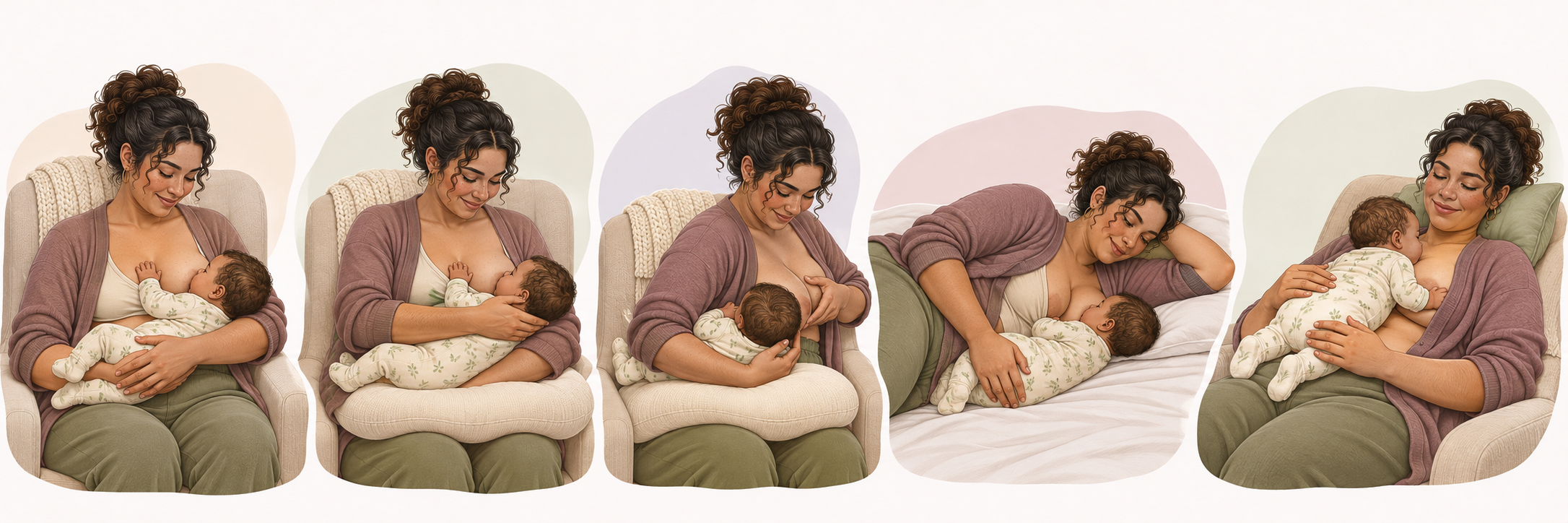
Cradle hold: simple once the latch is established
Hold your baby across the front of your body, with the head resting in the crook of the arm on the same side as the feeding breast. Your forearm supports the back and your other hand can support the body or breast as needed.
This hold often feels natural when a baby can find and maintain the latch without much guidance. Its limitation is that the same arm is supporting the body and cradling the head. If you need a clearer view or more control during attachment, begin in cross-cradle and slide into cradle after the sucking pattern settles.
Watch your feeding-side elbow. If it drifts away from your body, the baby may slide toward the nipple and your shoulder may begin to carry the weight. A pillow under the forearm can close that gap.
Cross-cradle hold: more control while learning
Support your baby with the arm opposite the feeding breast. At the left breast, for example, your right forearm supports the body and your right hand rests around the shoulders and base of the neck. Your left hand remains available to support the breast if needed.
Cross-cradle gives you a clear view of the mouth and lets you guide the baby’s body toward you during a latch or relatch. Keep your palm off the back of the skull so the head can tilt naturally. Once the latch feels comfortable, you can continue in this hold or carefully transfer the head into the crook of the other arm.
Football hold: keeps the baby beside you
Tuck your baby alongside your ribs on the feeding side, with the legs extending behind you. The body rests along your forearm while your hand supports the shoulders and base of the neck. Raise the baby to breast height with firm support under your arm instead of lifting your shoulder.
This position can give you a close view of the latch and keep the baby’s weight away from a tender abdomen. If you are recovering from surgery, keep pressure away from the affected area and follow the positioning advice given by your clinician.
Make sure the baby is far enough forward that you are not pulling the breast sideways to reach the mouth. If the feet press against a chair or headboard, reposition them so a kick does not push the baby away mid-feed.
Laid-back hold: lets your torso carry more weight
Recline with your head, shoulders, and arms supported rather than lying completely flat. Place your baby against the front of your body, either diagonally or more upright, with the whole torso supported and the head near the breast.
This hold can reduce the work done by your arms because your body supports more of the baby’s weight. It is worth trying if sitting upright makes you tense or if the baby repeatedly rolls away in a cradle hold. Keep a hand ready to support the shoulders and hips, and keep the face visible with the airway clear.
Side-lying hold: an alternative when sitting hurts
Lie on your side with your baby facing you and both bodies parallel. Position the nipple near the baby’s nose, then bring the shoulders and body close as the mouth opens. Support your own head and back, but keep pillows, blankets, and other loose items away from the baby’s face.
Side-lying can take pressure off your back, abdomen, or pelvic area when sitting is uncomfortable. Treat it as a feeding position, not as a plan for sleep: remain able to observe your baby, do not leave the baby unattended on an adult bed, and move the baby to the intended safe sleep space when the feed ends.
Match the hold to the problem you are trying to fix

Changing positions works best when you change for a reason. Choose the problem that is happening during the feed, then test the smallest adjustment that addresses it.
| What is happening | Position to try | What to check |
|---|---|---|
| You need a clearer view and more guidance during attachment | Cross-cradle | Support the shoulders and base of the neck without pressing the head forward |
| You want to keep weight away from a tender abdomen | Football or laid-back | Confirm that neither the baby nor a pillow presses on the tender area |
| Your arms or shoulders tire during the feed | Laid-back or a well-supported cradle | Fill the space under your forearms so you are not holding the baby’s weight in the air |
| Sitting is uncomfortable | Side-lying | Stay able to observe the baby and plan the move to a safe sleep space after feeding |
| Your baby keeps rolling or twisting away | Cross-cradle or football | Turn the shoulders, torso, and hips toward you instead of rotating only the head |
You do not need to use the same hold at both breasts. Your comfort, breast shape, healing areas, and the baby’s preferred direction may differ from side to side. For an older, more mobile baby, the position may also look less formal; closeness, support, and freedom from twisting matter more than a textbook pose.
Persistent difficulty on only one side deserves attention. If your baby repeatedly refuses one breast, cannot turn comfortably in one direction, or latches well on one side but never on the other, avoid forcing the position and ask a lactation professional or your child’s clinician to observe a feed.
Reset a painful latch instead of enduring it

A position can look right and still feel wrong. Strong pulling can occur as feeding begins, but pinching, burning, or sharp pain that continues is a reason to stop and reassess. Staying in a painful latch may increase nipple compression and damage.
- Support your baby’s body so the weight does not pull on the nipple.
- Use a washed finger at the corner of the mouth to release the seal gently. Do not pull the breast straight out of a closed mouth.
- Settle your own body again. Bring support under the arm or baby before attempting another latch.
- Return the baby to a close, front-to-front position with the nose near the nipple and the head free to tip back slightly.
- Wait for a wide-open mouth, then bring the shoulders and upper body toward the breast rather than pushing the head.
- Once sucking settles, check for continuing pain, easy breathing, and rhythmic jaw movement. If either of you is becoming upset, pause and settle before trying again.
Notice what the nipple looks like afterward. Repeated flattening, creasing, blanching, cracking, or bleeding is useful information to share with a lactation professional or clinician. Positioning may contribute, but pain can have other causes, so repeated relatching is not a substitute for an assessment.
Breastfeeding position FAQ
Which breastfeeding position is best for a newborn?
There is no single best hold for every newborn. Cross-cradle can be useful when you want to see and guide the latch, while laid-back feeding lets your torso support more of the baby’s weight. Start with the option that keeps the baby close without making you strain. A premature or medically complex baby may need individualized positioning from the baby’s care team.
Do I have to use the same position for a whole feed?
No. You can attach the baby in cross-cradle and move into cradle once the latch is stable, or change positions when your body becomes uncomfortable. Support the baby’s weight and protect the latch during any transition. If moving creates pulling or pain, release the latch first and start again.
What if side-lying makes me sleepy?
Choose a different feeding arrangement if you cannot stay alert enough to observe your baby. Side-lying describes how you feed; it does not make an adult bed a safe infant sleep space. Keep loose bedding away from the baby and move the baby to the designated safe sleep surface when feeding is finished.
When should I get hands-on feeding help?
Arrange an assessment with a lactation professional or feeding clinician if feeds remain painful after repositioning, nipple damage develops, your baby repeatedly slips off or struggles to stay latched, or you are concerned about intake or weight. Contact your child’s clinician promptly if your baby is unusually difficult to wake, seems unwell, or feeds markedly less than usual. Breathing difficulty or a change in colour requires emergency help.
At the next feed, choose one source of friction – your unsupported arm, the baby’s twisted body, pressure on your abdomen, or pain at the nipple – and change the hold around that problem. If the same problem remains, bring that specific observation to someone who can watch a feed and help you adjust it in real time.
References



