
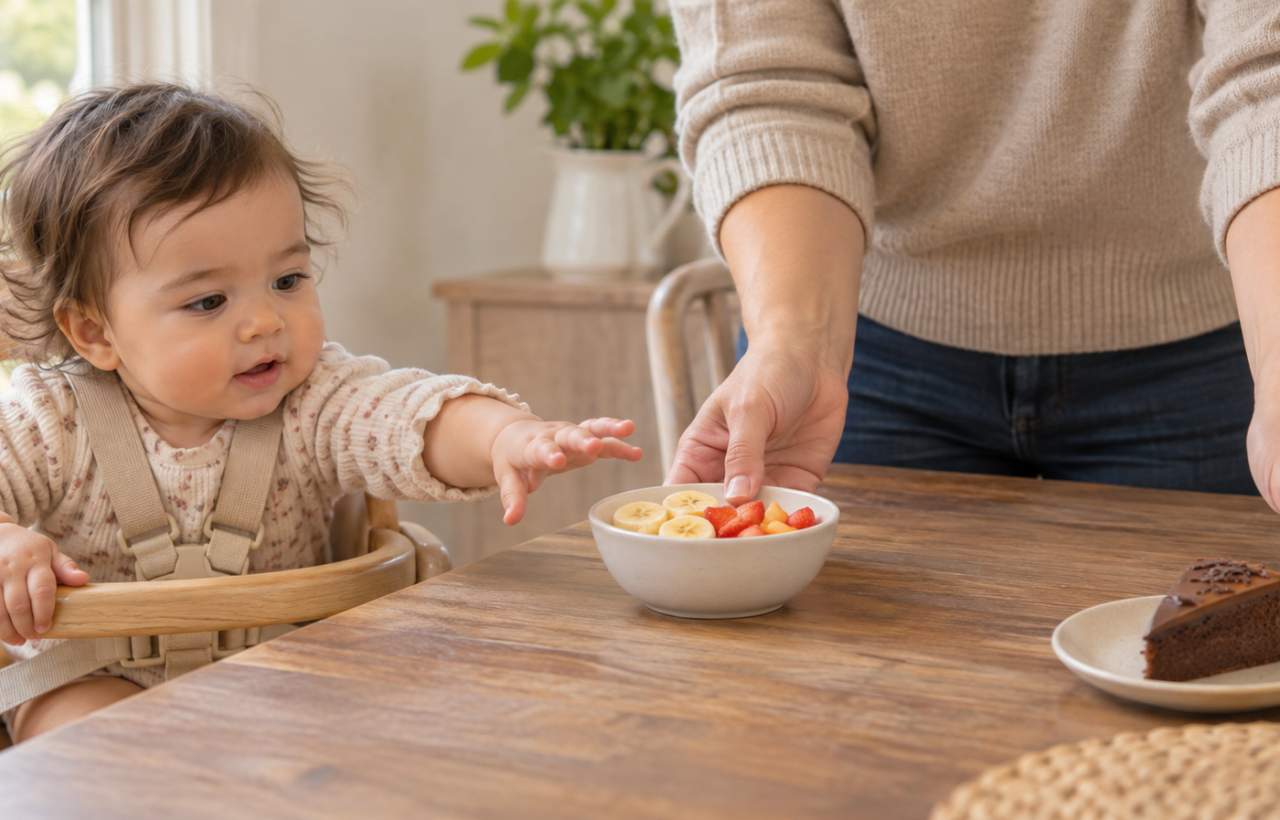
Your baby reaches for a bite of chocolate cake, or a relative asks whether one small taste could really matter. You need a usable answer, not a debate over whether chocolate is technically allowed.
The clearest household rule is to wait until your child is at least 2 before intentionally offering chocolate. There is no official starting age for chocolate itself, but doctors commonly suggest avoiding foods with caffeine and added sugar until at least age 2.
The short answer: wait until at least age 2
The absence of an official chocolate-specific rule is not the same as a green light for babies. Chocolate commonly brings the two things behind the wait-until-2 advice: caffeine and added sugar. Using age 2 as your minimum keeps the decision simple across chocolate bars, baked goods, puddings and chocolate-flavoured snacks.
Age 2 is a floor, not an appointment. Your child does not need chocolate on their second birthday, and waiting longer is fine. Chocolate is not a developmental food that must be introduced within a particular window.
This distinction also prevents a common misreading: reaching age 2 does not make every chocolate product or portion automatically appropriate. It simply moves you past the age when doctors generally recommend avoiding caffeine and added sugar.
Read the product, not just the word chocolate

Chocolate is not one uniform food. The word can refer to cocoa powder mixed into a recipe, a confection, a dessert or a chocolate-flavoured packaged food. Those products can differ considerably, so the label matters more than the name on the front.
- Check whether the food contains cocoa or chocolate ingredients. A product can still raise the caffeine question even when it is not very sweet.
- Look for added sugar in the ingredient list. Do not rely only on words such as dark, natural or lightly sweetened.
- Treat no added sugar as an answer to only one question. It does not necessarily mean the product is caffeine-free or suitable for a child younger than 2.
- Consider the complete food. Chocolate desserts and snacks may contain other ingredients your child avoids, so check the full label rather than evaluating the cocoa alone.
- Make sure the form and texture are manageable for your child. Reaching the recommended age does not replace normal seated, supervised eating.
A tiny amount hidden in a recipe does not create a separate age rule. If you are deliberately serving a food that contains chocolate, apply the same wait-until-2 boundary instead of trying to decide whether the amount is small enough to disregard.
An early taste is not the same as a planned introduction
If your child licks a spoon or takes a bite before you can intervene, do not treat that moment as a reason to begin serving chocolate regularly. Remove the remaining food, identify what the product contained and return to your usual feeding plan.
The recommendation to avoid chocolate before 2 is preventive guidance, not a way to predict what will happen after one taste. If you are concerned about what your child ate, keep the packaging or ingredient list available when you contact a healthcare professional. Seek emergency help for trouble breathing or swelling of the face or tongue.
Other adults are easier to manage when the boundary is specific. You can say, “We are waiting until age 2 for chocolate because of the caffeine and added sugar. Please offer one of their usual foods instead.” That gives a caregiver both the rule and an immediate alternative.
After age 2, make the first serving ordinary
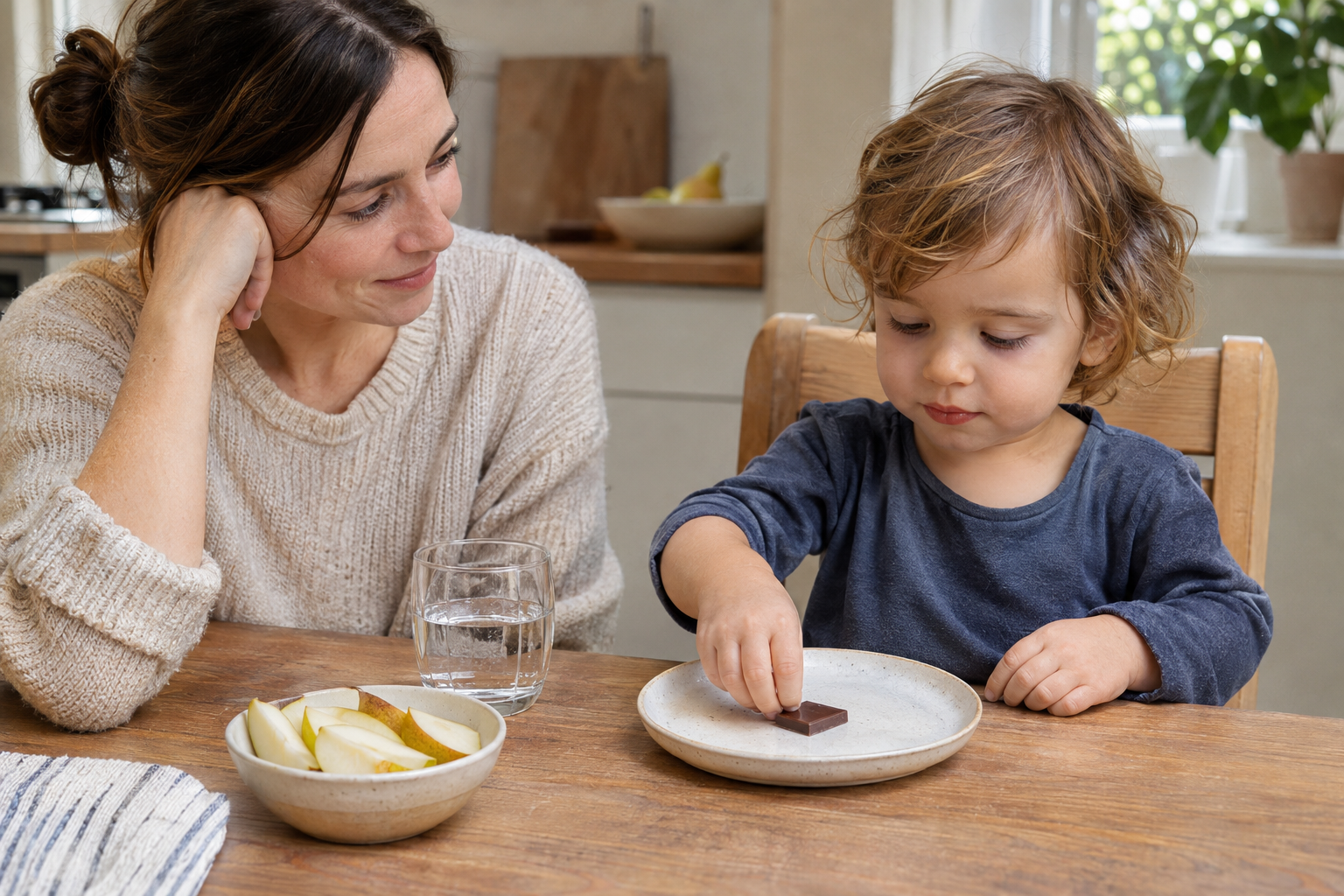
Once your child is at least 2, you can introduce chocolate without turning it into a major milestone. A calm, ordinary eating occasion makes it easier to control the portion, supervise the texture and see exactly what your child has been offered.
- Choose a time when your child is seated and an adult can supervise.
- Offer a small, manageable portion rather than an oversized or difficult-to-handle piece.
- Use the product’s ingredient list to check for cocoa, added sugar and any other ingredients your child needs to avoid.
- Keep the food within your normal meal or snack boundaries. Age 2 does not mean unrestricted access.
- Tell regular caregivers what you have decided so chocolate is not introduced repeatedly or in forms you have not chosen.
If your child’s clinician has given you an individual feeding plan because of a medical condition, symptoms or dietary restriction, follow that plan instead of a general age rule.
Key takeaways
- There is no official starting age written specifically for chocolate.
- Waiting until at least age 2 is the clearest practical rule because doctors advise avoiding foods with caffeine and added sugar before then.
- No added sugar does not automatically mean caffeine-free or appropriate for a baby.
- An accidental taste does not require you to make chocolate part of your child’s diet.
- After age 2, use a small, manageable serving, read the full label and supervise your child while eating.
For now, choose the boundary that is easiest to apply consistently: no intentional chocolate before 2. When you eventually offer it, let it be a small part of an ordinary eating routine rather than a deadline you have to meet.
References



