
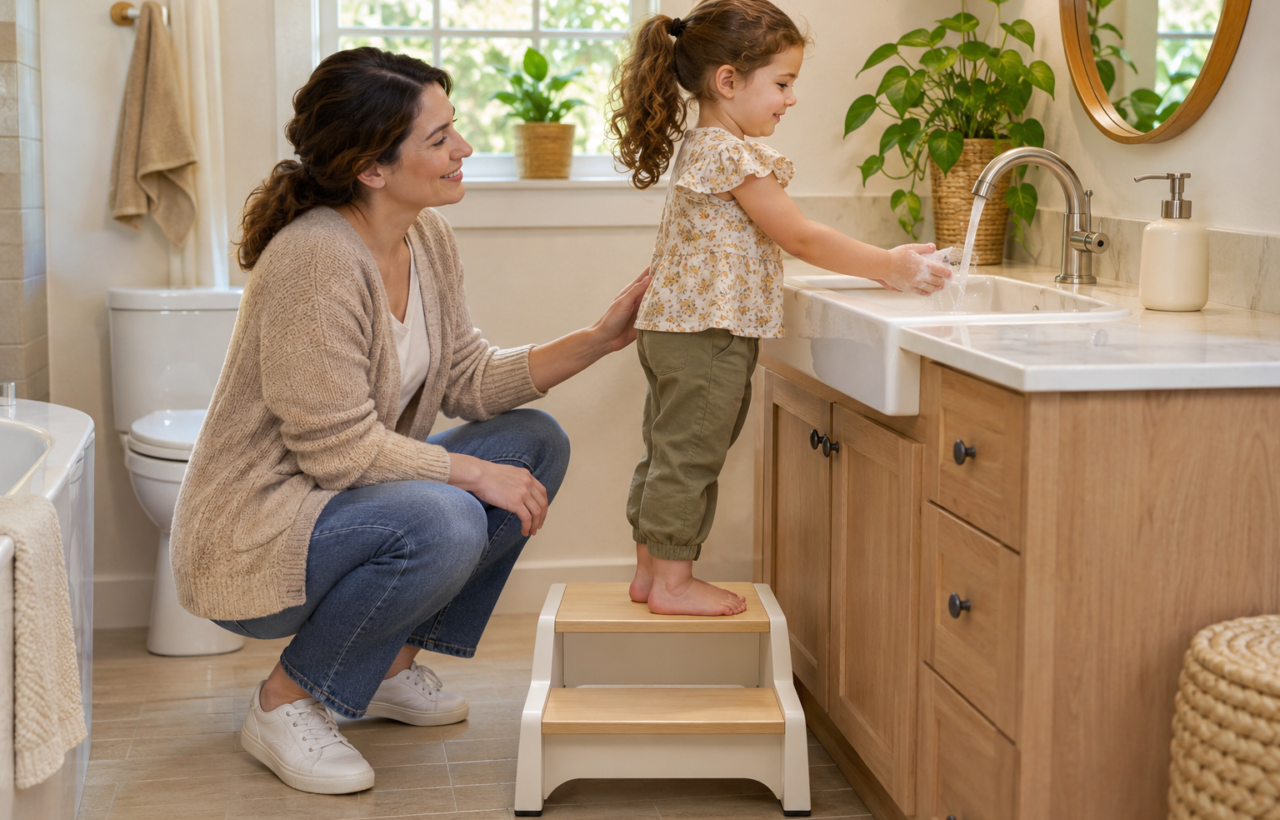
Your toddler wants to wash their own hands, reach the toothbrush, or help at the counter. A step stool can make those routines easier, but it also gives your child access to places and objects that were previously out of reach.
The right stool is not simply the tallest one that fits beside the sink. It should suit one specific task, remain steady in the room where you will use it, and match what your child can safely do with you nearby.
Choose the stool for a task, not for every room
Start by deciding exactly where the stool will go and what your child will do there. Step stools are especially useful for hand washing, tooth brushing, and supervised kitchen help, but each setting creates different constraints.
- At a bathroom sink: Check that the stool fits with the door, vanity drawers, and cabinet doors closed and open. It should sit entirely on a hard, level surface rather than partly on a bathmat.
- At a kitchen counter: Place it away from the stove, hot appliances, knives, breakable objects, and anything that could spill onto the child. A safe position for stirring cold ingredients may not be safe for cooking.
- Beside a bed or toilet: Consider whether the stool would become an unsupervised climbing aid. A useful object in one routine can create access to water, windows, furniture, or storage at another time.
Choose the lowest platform that lets your child complete the task with both feet flat and without standing on tiptoe. If the child still has to lean over the sink or stretch their whole body toward the counter, the stool does not solve the reach problem. If it raises their body unnecessarily high, it adds climbing and fall exposure without adding useful independence.
Do a supervised dry run in the actual location before making the stool part of the routine. Watch the child’s feet, hips, and shoulders. Reaching should come mostly from the arms. If the hips leave the centre of the platform or one foot begins to lift, the target is too far away.
Look for stability you can verify at home
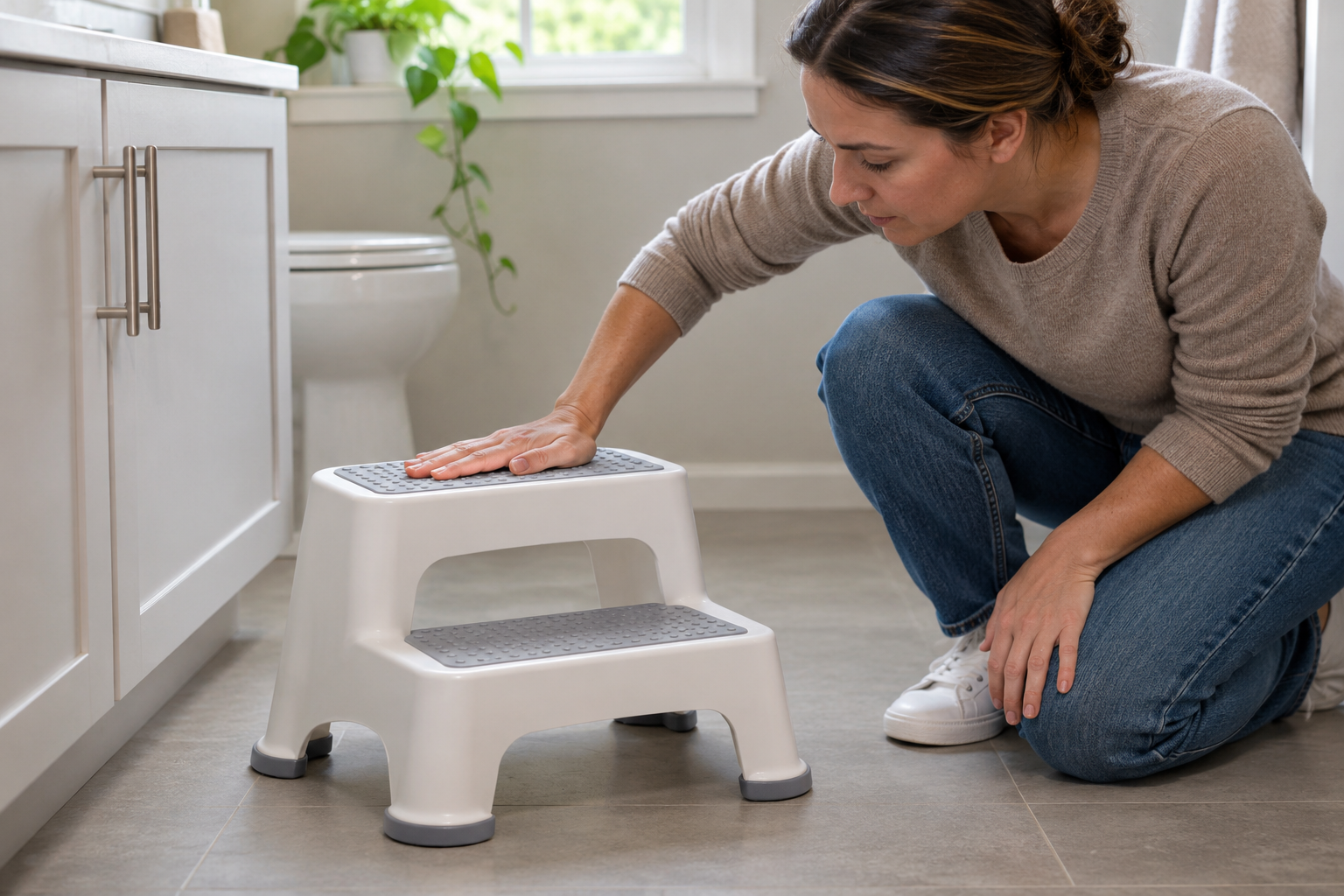
Words such as sturdy and non-slip are not enough on their own. Stability depends on the stool, the floor, the child’s movement, and the way the stool is positioned. A product that grips tile may behave differently on wood, vinyl, or a damp bathroom floor.
A base that stays fully in contact with the floor
Set the empty stool in place and press down on each corner. It should not rock, twist, or lift at another corner. All feet or gripping surfaces should make full contact with the floor. A bathmat, uneven grout line, floor vent, or cabinet trim can keep one part of the base from landing properly.
Then apply gentle sideways pressure with your hand. This is not a guarantee that the stool cannot slide, but obvious movement is a reason to stop and reposition it. Never try to fix a sliding stool by placing a towel or loose rug underneath; that adds another surface that can shift.
Steps and platforms that fit the child’s feet
Your child should be able to place the useful part of each foot on a step rather than balancing on the edge. On the top platform, there should be room for both feet to rest flat in a natural stance. A textured or grippy standing surface is more useful than a decorative finish that becomes slick when wet.
More steps are not automatically better. Every additional level adds another transition to manage. If one low step provides enough reach, a taller design may add complexity without solving a real problem.
Locks, hinges, and handholds that do not create new hazards
If the stool folds, confirm that the locking mechanism is fully engaged every time it is opened. Inspect the hinge area for places where small fingers could be pinched. A folding stool should never begin to close while weight is on it, and a child should not be responsible for setting it up.
A handle or rail can help a child orient their body, but it cannot compensate for an unstable base or an out-of-reach sink. Check that a handhold does not invite the child to pull the stool sideways while climbing.
Instructions and limits you can actually follow
Read the manufacturer’s age, weight, setup, and use instructions before letting your child climb. Do not assume that a stool marketed for children is appropriate for every child under three. Do not add blocks, cushions, books, or another stool to gain height, and do not use a damaged product because it still appears to stand.
Check regularly for cracks, loose fasteners, worn gripping material, bent hinges, and feet that are missing or peeling away. Retire the stool if its stability depends on a repair or modification not permitted by the manufacturer.
Match the privilege to your child’s readiness
Readiness is not determined by age alone. Two children of the same age may have different balance, coordination, impulse control, and ability to follow a short instruction. Watch what your child can do consistently, not what they managed once.
A child using a step stool should be able to approach it steadily, place each foot deliberately, remain standing without hanging from the sink, and climb down rather than jump. They also need to respond to simple limits such as wait, feet still, and climb down.
If your child cannot yet do those things reliably, you can still involve them in the routine at floor level. Bring a basin, towel, mixing bowl, or other safe part of the task down to them instead of using height as the price of participation. If your child has a mobility, balance, or developmental concern, ask their pediatrician, physiotherapist, or occupational therapist about an appropriate setup for their individual needs.
Timing matters too. A child who can use the stool calmly may climb very differently when tired, upset, excited, or rushing. Pause the routine when cooperation or balance has changed. Independence is not lost because an adult completes the task on a difficult day.
Teach one repeatable way to climb and stand
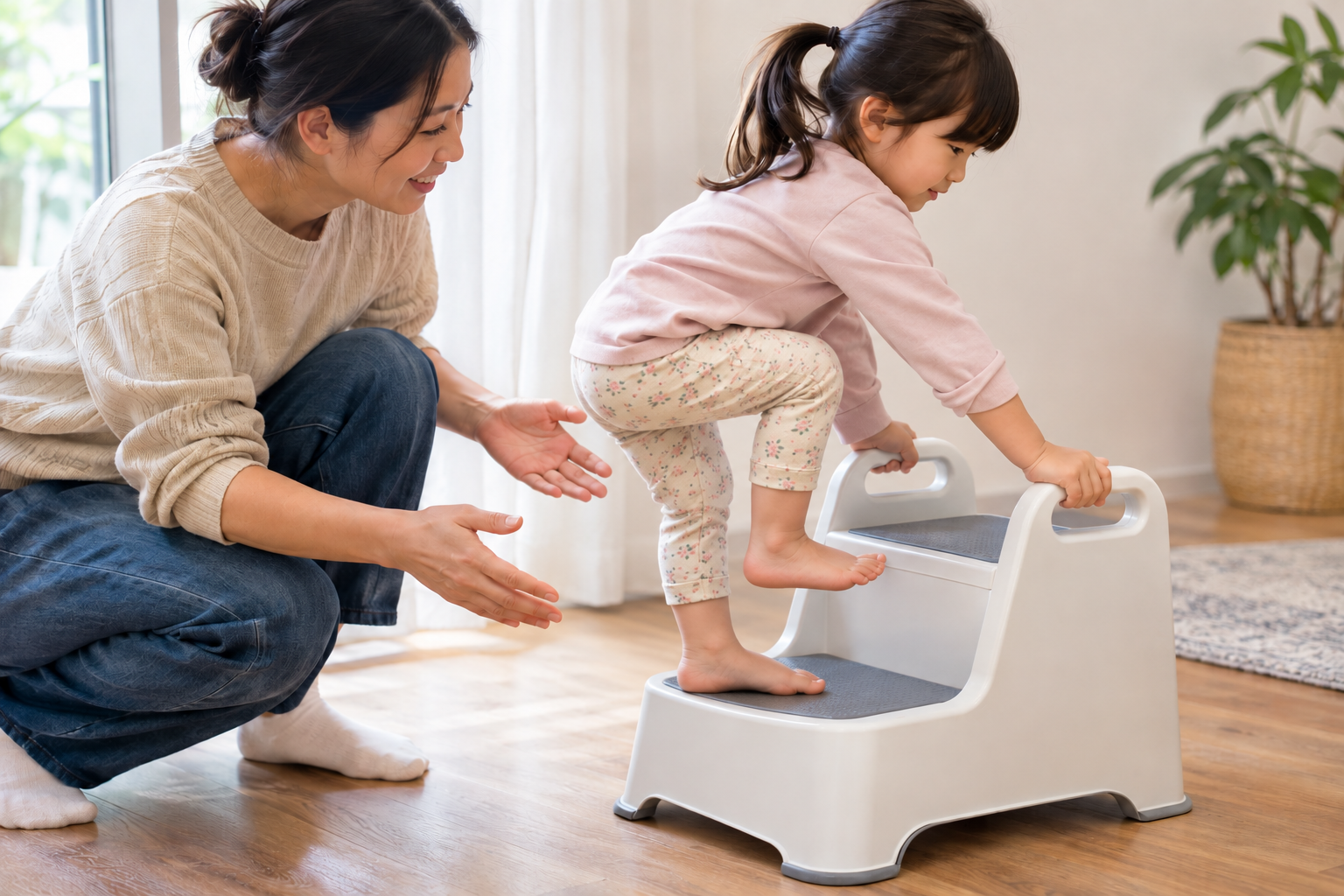
Young children do better with a short routine that stays the same. Use the same words and sequence each time rather than correcting several movements after the child is already on the platform.
- The adult positions the stool. Check that the floor and the stool’s gripping surfaces are clean and dry.
- The child approaches with empty hands. Put the toothbrush, cup, or cooking tool at the work area before the climb.
- The child faces the stool and steps up one level at a time. Stay close enough to intervene immediately without using the child’s body as the stool’s normal support.
- Both feet remain flat on the platform. If something cannot be reached without leaning, move the task closer or help with it.
- The child climbs down facing the stool. Discourage jumping, turning around on a narrow step, or stepping backward without looking.
- The adult parks or stores the stool. Do not leave it in position as open access to the sink, counter, toilet, windows, or cabinets.
Keep climbing separate from carrying. A child concentrating on a cup, toy, or bowl has fewer hands and less attention available for balance. Place the object first, let the child climb, and then begin the activity.
Recheck childproofing from the new standing height
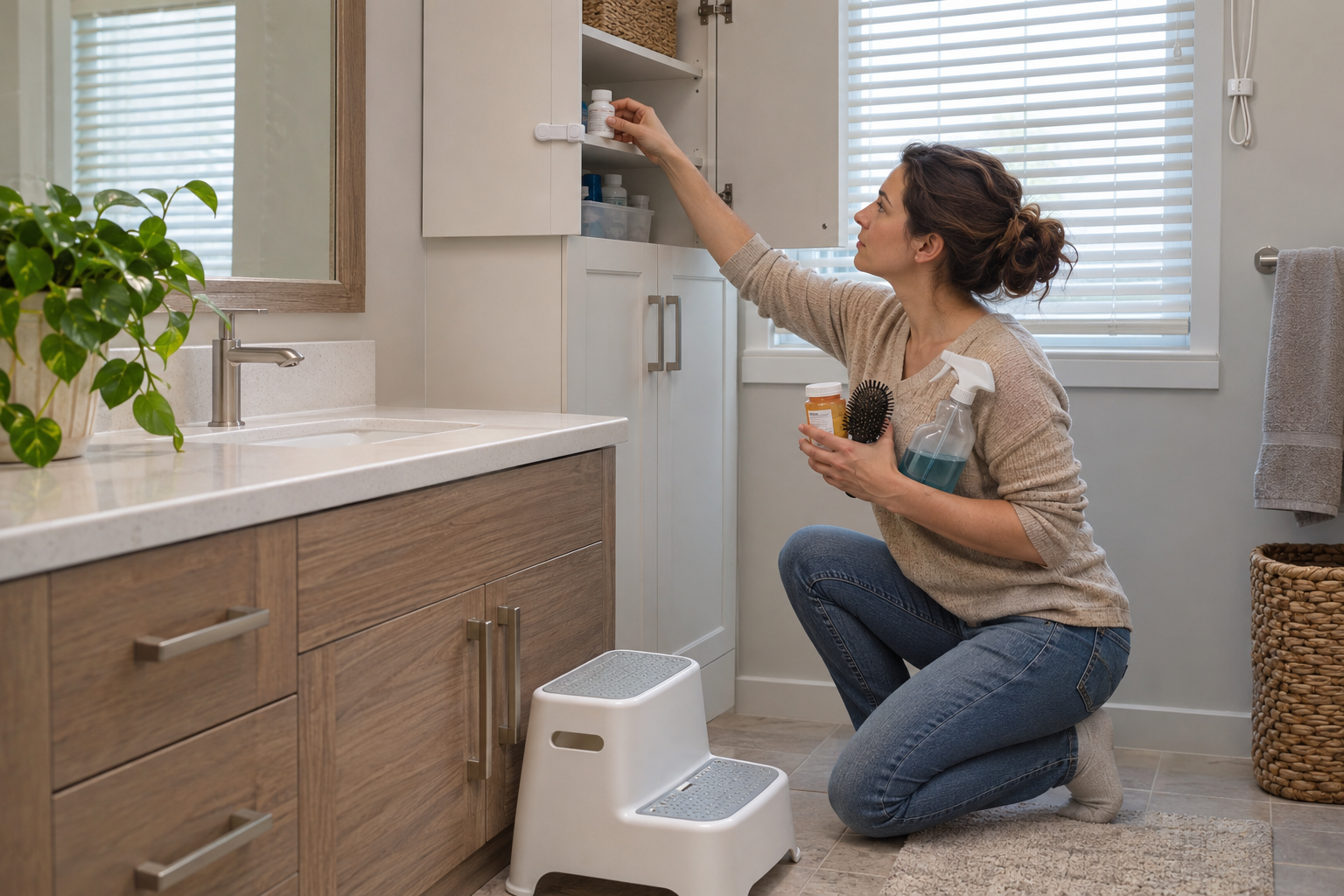
A step stool changes the boundary of your child’s environment. Items that were safely out of reach yesterday may now be reachable, even if the stool is intended for only one activity. Review the room while standing where your child will stand.
- Move medicines, cleaning products, cosmetics, razors, knives, matches, hot appliances, and breakable objects out of the expanded reach zone.
- Keep cords, blind pulls, and appliance cables away from the platform and climbing path.
- Check whether the child can now reach a faucet control and turn on water without help.
- Do not position the stool near a stove, open window, balcony barrier, shelving unit, or furniture the child could climb next.
- Secure nearby cabinets and drawers as needed. A drawer can become a handhold, a pinch point, or another step.
Storage is part of the safety plan. If the stool is light enough for your toddler to carry, assume they may move it to a more interesting location. Give it a parking place that remains under adult control, or put it away between supervised uses. A stool that is always available cannot realistically be limited to hand washing by verbal rules alone.
Key takeaways
- Buy for one defined task and one real location rather than choosing by height or appearance alone.
- Use the lowest platform that allows comfortable reach with both feet flat and the child’s body centred over the stool.
- Verify that the base does not rock and that every foot contacts a clean, dry, level floor.
- Follow the manufacturer’s limits, inspect the stool regularly, and never add objects underneath or on top to increase its height.
- Keep your child close enough for immediate help and teach the same climb, stand, and descent routine every time.
- Reassess the entire room from the child’s new standing height, then store the stool where it cannot become an unsupervised ladder.
Start with one calm, supervised routine, such as washing hands. If the stool stays steady and your child can follow the sequence without stretching, jumping, or wandering with it, you can gradually use the same setup for another suitable task. The goal is not unrestricted access; it is a small, well-designed opportunity to do one more thing safely.
References



