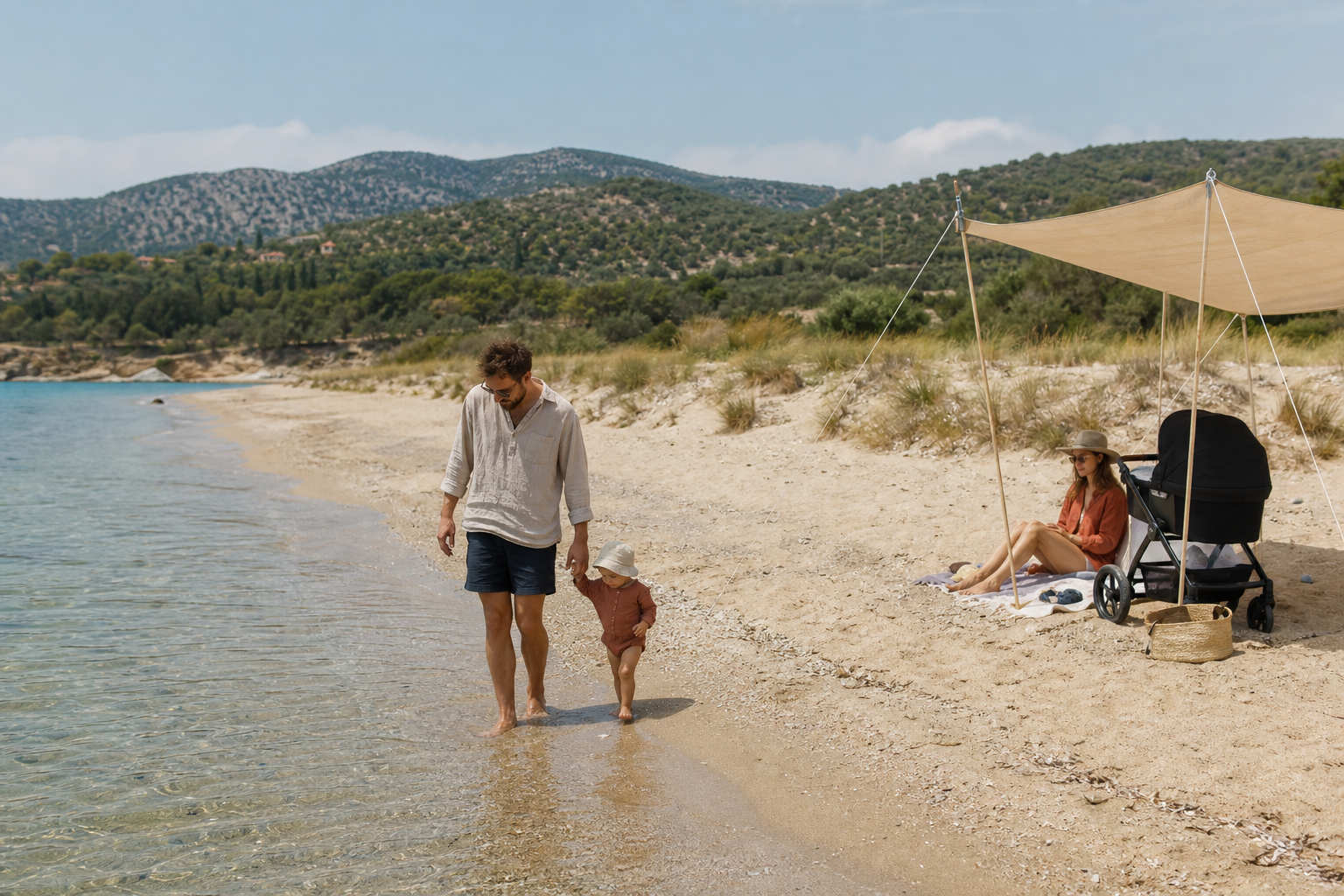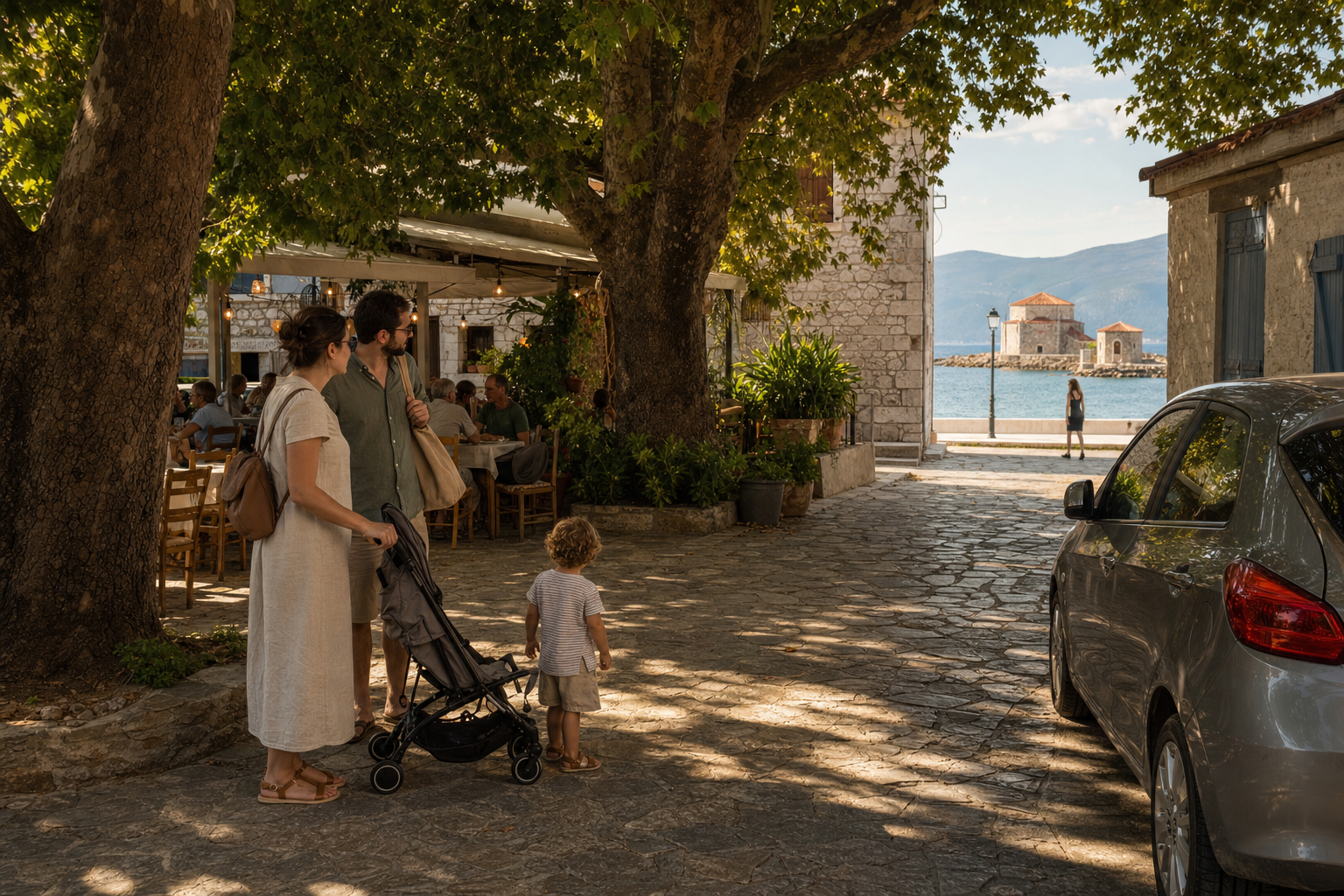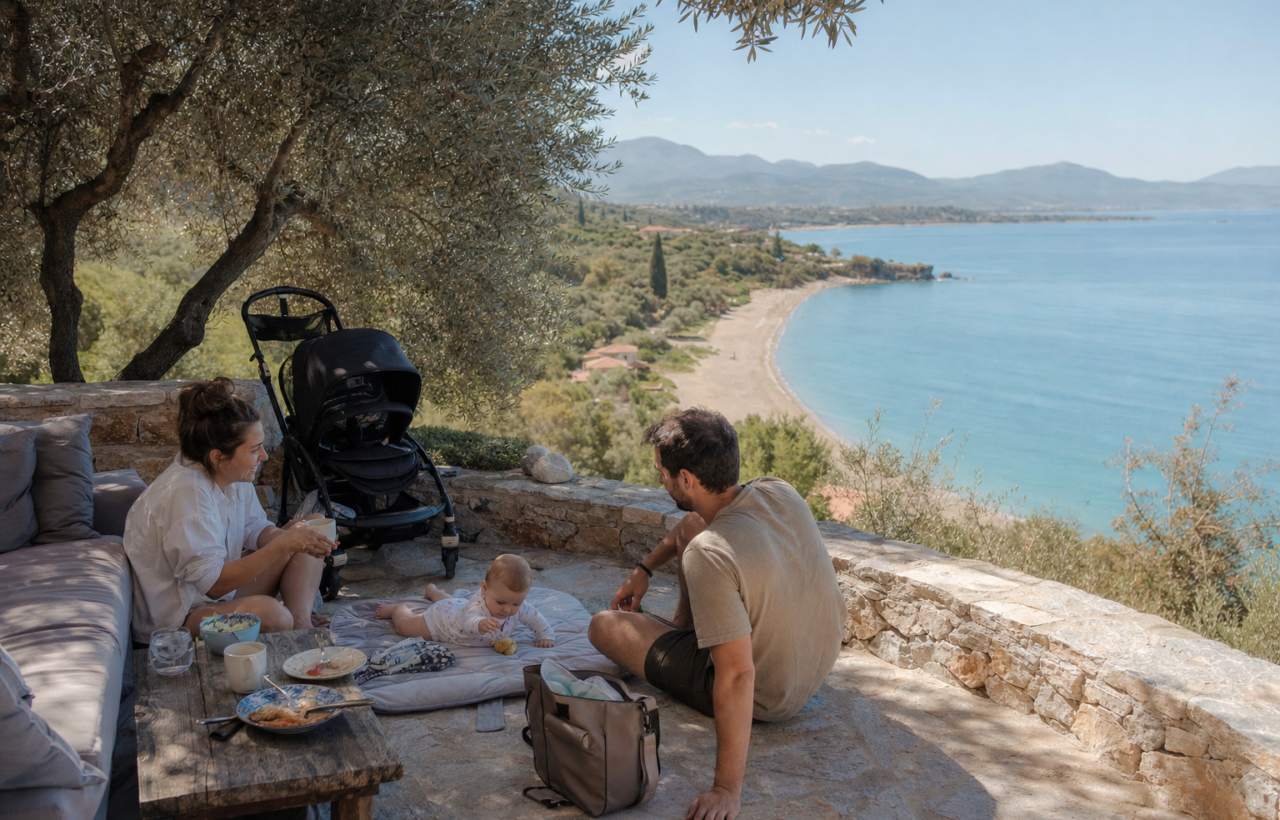
You want a Greek holiday, but you do not want every beach visit, meal and outing to become a negotiation with naps, bottles, snacks and a tired toddler. Costa Navarino can work well at this stage when you use it as a comfortable base and make the practical details part of the booking decision.
The aim is not to fit as much as possible into each day. It is to remove the predictable friction, choose one worthwhile experience at a time and leave yourself an easy route back to the room.
Decide whether Costa Navarino suits this trip
Costa Navarino is in Messinia, on the southwest side of the Peloponnese, beside the Ionian Sea. Its appeal for families is the combination of a calm setting and several kinds of days: beach time, nature, old towns, ancient places and adult interests such as golf.
It is a strong match when your version of a good holiday looks like this:
- You want to unpack once and keep a familiar sleep environment for your child.
- You would be happy with one main outing or activity per day.
- You value outdoor time and scenery more than a packed sightseeing list.
- You are willing to choose the exact property and room by family logistics, not just by photographs.
- You want adults to have options without moving the whole family every time.
It is a weaker match if your priority is changing hotels frequently, covering several islands or spending most of each day away from your base. Those plans can be enjoyable, but every move adds another transfer, another unfamiliar sleep setup and another round of unpacking. With a baby or young toddler, that overhead can consume the part of the day when everyone has the most energy.
Your child’s current stage should shape the decision more than their age on paper. With a pre-mobile baby, room setup, feeding and temperature control may matter most. With a crawler or a child pulling to stand, floors, steps, balconies and places to contain movement become central. With a confident walker, look closely at traffic separation, walking surfaces and how quickly you can leave an activity when patience runs out.
Confirm the details that can disrupt the whole stay
The destination name on your reservation does not tell you how far your room is from breakfast, whether a cot is guaranteed or what kind of child seat will arrive with your transfer. Ask the property and transfer provider direct questions, and keep the answers in writing.
- Map the arrival. Ask for the expected door-to-door journey, where you will meet the driver, whether stops can be made and who will help with luggage. If a child seat is being supplied, ask for its exact type, whether it suits your child’s current height and weight, whether it can be rear-facing when required and who installs it. A promise that a child seat is available is not specific enough.
- Secure the sleep setup. Ask whether the cot or crib is guaranteed rather than merely requested, whether it will be assembled before arrival and what mattress and bedding are supplied. Confirm whether the sleeping area can be darkened and whether your proposed room is close to evening entertainment, service areas or other likely noise.
- Check feeding facilities. Ask what is available for washing bottles or feeding equipment, heating food and obtaining plain foods your child already accepts. If you need cold storage for expressed milk or medicine, do not assume that a minibar is suitable. Ask exactly what appliance is provided and confirm the required storage conditions with the relevant clinician or pharmacist.
- Trace the routes you will use repeatedly. Ask for the shortest route from the room to breakfast and the beach. Confirm whether it is step-free, shaded or manageable with your chosen stroller. A property can be family-friendly overall while a particular room creates several awkward journeys every day.
- Locate essential backup. Find out where you could obtain your child’s usual nappies, wipes, formula or familiar foods if luggage is delayed or supplies run low. Before travelling, also identify how to reach appropriate medical care and how your travel insurance expects you to seek help.
A useful request is: Please confirm the exact cot, cold-storage, child-seat and step-free access arrangements attached to this reservation. That wording encourages a concrete answer. Save the reply somewhere you can reach without relying on hotel Wi-Fi.
If a safety-critical answer remains vague, solve it before you travel. That may mean reserving a different transfer, bringing equipment you already know how to use or choosing another room category. Do not leave a suitable car seat, safe sleep space or necessary medicine storage to an assumption at check-in.
Build each day around one anchor, not a checklist
The useful feature of Costa Navarino is having beaches, old towns, golf, nature and ancient sites within reach. You do not need to combine them all. Pick the day’s anchor according to your child’s best awake period and preserve a low-effort second half of the day.
- Use the most reliable awake period for the main activity. That could be the beach, a nature outing, an old town or an ancient place. Choose one, and decide your turnaround point before leaving.
- Treat the usual nap environment as the default. A stroller or vehicle nap can be a useful contingency if it already works for your child, but it should not be the only way a tightly scheduled day succeeds.
- Keep the later activity close to your room. A short return to the beach, a walk around the property or unstructured play is easier to abandon than a distant reservation.
- Choose the simplest verified dinner option before everyone is depleted. Know in advance where your child can eat something familiar and what you will do if restaurant timing no longer works.
Evaluate outings by how easily you can exit them. For a beach, check shade, changing facilities and the walk back. For an old town or ancient place, ask about surfaces, stairs, places to pause and the distance from your drop-off point. For a nature outing, confirm whether the route actually suits your stroller; the word walk can describe very different terrain.
Golf and longer adult outings need their own plan. If another adult is travelling with you, agree on protected solo time instead of expecting a baby or toddler to tolerate an adult-length activity. If you are the only travelling adult, arrange childcare only after checking the provider, supervision model, age rules and emergency procedure yourself. Availability alone does not establish that a service is right for your family.
Build one deliberately empty period into every day. It gives you somewhere to put a late nap, an unexpectedly long meal or a child who simply needs familiar play. If everything runs smoothly, that period becomes relaxed beach or room time rather than another appointment.
Pack for the transitions that usually create friction
A useful packing system follows the moments when you will need things, rather than putting every baby item into one large suitcase.
- Keep an arrival kit with you: travel documents, essential medicine, feeding supplies, nappies, wipes, bags for wet or dirty items, and a complete change of clothes for both child and adult. Include the sleep cue your child relies on, such as their usual sleep sack, if it is safe and appropriate for their routine.
- Make a first-night pouch: sleepwear, bedtime toiletries, the next morning’s clothes and the minimum feeding equipment needed before you unpack. You should be able to settle your child even if the rest of the luggage remains closed.
- Build one grab-and-go day bag: changing supplies, familiar food, the drinks or feeding supplies your child normally uses, sun protection appropriate for them and a lightweight change of clothing. Restock it when you return rather than searching for each item before the next outing.
- Carry a small reset kit: laundry soap suitable for hand-washing, sealable bags and enough familiar snacks or feeding supplies to bridge a missed shopping stop. This is more useful than several bulky items that the property has already confirmed it can provide.
Choose your stroller after you understand the routes. A larger stroller may offer storage, shade and a familiar nap space, while a compact one is easier around vehicles and steps. A carrier can help where wheels cannot, but use one that both you and your child already tolerate and follow its fit and usage instructions. A holiday is a poor time to discover that a new piece of essential gear does not work for either of you.
Test the complete setup at home. Pack the day bag, load the stroller, put the child into the travel seat or carrier you plan to use, and walk for the length of an ordinary outing. The rehearsal reveals practical problems – inaccessible snacks, an overloaded handle or missing rain and sun coverage – while they are still easy to correct.
Key takeaways for a calmer Costa Navarino trip
- Choose Costa Navarino as a stable base, not as the starting point for an overloaded regional itinerary.
- Select the exact property and room by sleep, feeding and step-free access needs.
- Get written confirmation of the cot, child seat, cold storage and repeated room-to-amenity routes.
- Plan one main experience during your child’s best awake period and protect an easy exit.
- Carry what would be difficult or unsafe to improvise, but confirm available equipment before packing bulky duplicates.
Your next step is simple: send one message covering the cot, transfer seat, feeding setup, room location and route to the beach. Once those answers are clear, choose the first day’s single anchor and leave the rest of that day open. That is enough structure to arrive prepared without scheduling the calm out of the holiday.