

If your toddler asks for Peppa Pig again, you may be wondering whether the episode can do more than hold their attention. It can become a useful prompt for talking about feelings, wants, conflict and repair, but the learning is not automatic. Your short comments and everyday follow-through are what turn a story into practice.
Peppa Pig keeps family dynamics and social skills close to the centre of its stories. That gives you plenty of openings. You do not need to explain an entire plot or extract a tidy moral. Help your child notice one social moment, give it simple language and show what someone could do next.
Focus on noticing, naming and responding

Emotional learning before age three is not about identifying every feeling correctly. A more practical goal is to help your child build a small, reusable sequence:
- Notice: Something changed in a face, voice, body or interaction.
- Name: A character might feel happy, sad, cross, worried, surprised or excited.
- Respond: The character can ask for help, use a short phrase, wait, try again, offer comfort or reconnect.
Start with what is visible. Saying, “Peppa’s voice got louder,” separates observation from interpretation. You can then add, “She looks cross.” This matters because a feeling label is your best reading of the moment, not a fact you can see directly.
A character does not have to behave perfectly for the scene to be useful. A misunderstanding, an impulsive reaction or a disappointed response gives you something concrete to discuss. The goal is not to sort characters into “good” and “bad.” It is to show that feelings influence behaviour and that people still have choices about what happens next.
Match your language to your child’s stage
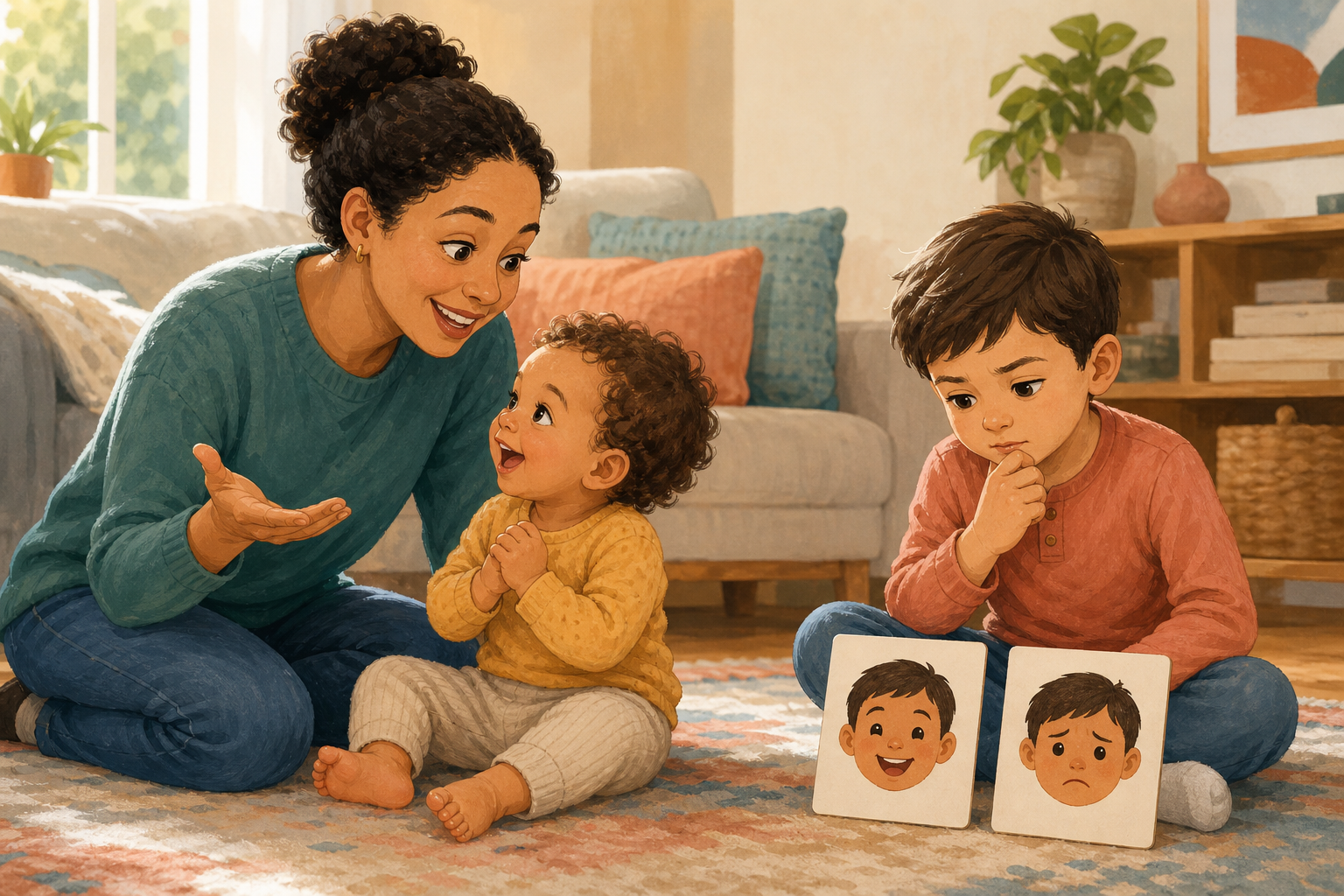
Children between birth and 36 months vary widely in attention, language and temperament. Use these age bands to simplify your side of the conversation, not as milestones your child must meet.
For babies under 12 months: pair words with expression
If Peppa Pig is already part of your family’s routine, sit close and narrate sparingly. Match a short feeling word to a clear facial or vocal cue: “Peppa is happy. Big smile.” You can mirror the expression or use a warm change in your own tone.
Do not turn the moment into a comprehension test. Your baby does not need to point, repeat the word or prove that they understood it. You are simply letting the word, expression and tone occur together.
For young toddlers from 12 to 24 months: describe before asking
Use a feeling word followed by the cue you noticed: “Peppa looks sad. There are tears.” Then model a possible response with language your toddler could eventually use, such as “Help, please,” “My turn” or “Hug?”
A gesture, sound or point can be a complete response at this stage. If you offer a choice, use words your child already encounters: “Sad or happy?” Avoid repeatedly asking “Why?” when the cause requires more plot or language than your child can manage. State the connection instead: “She is sad because the game stopped.”
For older toddlers from 24 to 36 months: add cause and choice
Now you can try a short sentence that links feeling and cause: “Peppa feels cross because she wanted a turn.” Follow it with a practical prompt: “What could she say?” If that question is too open, offer two usable options: “Could she say ‘my turn next’ or ask for help?”
Accept a point, a single word or an answer that does not match your interpretation. If your child talks about a toy or sound instead, acknowledge what caught their attention and restate your line without correction. You are building a conversation, not checking an answer sheet.
Use a short watch-pause-talk-replay routine

You do not need to stop every scene. Choose one clear moment involving a want, a disappointment, a misunderstanding, an attempt to help or a return to friendly play. Too much commentary makes it harder to enjoy the story and harder to tell which idea matters.
- Watch for the change. Notice when a character’s expression, voice or behaviour shifts after something happens.
- Let the social beat become clear. If possible, wait long enough to see what prompted the reaction. Pause only if doing so does not upset or distract your child.
- Describe the cue. Say what you can observe: “Her face changed,” “He moved away” or “Her voice got loud.”
- Add a feeling and cause. Use a compact sentence: “She looks disappointed because the game ended.” If the feeling is uncertain, say “might feel” or use the broader word “upset.”
- Give the character a next move. Model something specific: “She can ask for another turn,” “He can say stop” or “They can try again.”
- Return to the story. Let your child enjoy the rest. The conversation does not have to continue unless they bring it back.
The most useful phrase is often the one you can reuse later. If you said, “You can ask for help,” repeat the same wording when a block tower falls or a shoe will not go on. That creates a bridge between the character’s problem and your child’s real choices.
Avoid turning Peppa into a lecture

The difference between emotional coaching and a quiz is usually visible in the questions you ask. “How do you think she feels?” leaves room to notice. “You know how she feels, don’t you?” asks your child to perform the answer. When you have already asked one question, give them time to respond instead of filling the silence with several more.
Watch for these common traps:
- Using too many labels: Your child does not need a long vocabulary lesson during one scene. Choose the simplest feeling word that fits.
- Presenting your interpretation as certainty: When the cue is ambiguous, say the character “looks” or “might feel” upset.
- Making obedience the lesson: Move beyond whether someone behaved well. Ask what the character wanted, what affected another person and what could repair the interaction.
- Comparing your child with the character: “Peppa shares, so why don’t you?” turns the scene into criticism. Keep the first conversation about the characters, then use the same neutral language when a similar situation naturally occurs.
- Talking through the whole episode: Select the clearest moment and let the rest remain entertainment.
- Expecting immediate transfer: A toddler may identify sadness on screen and still struggle during their own disappointment. In the real moment, supply the words again and help with the next action.
It is also fine when your child does not want to discuss the scene. You can model the language without demanding participation: “Peppa looks frustrated. She can ask for help.” Then move on. Repetition across ordinary moments matters more than getting a response on cue.
Key takeaways
- Peppa Pig’s family and friendship moments are conversation material, not an emotional curriculum that works by exposure alone.
- With babies, pair a simple feeling word with a visible expression or change in tone.
- With young toddlers, describe what happened and model a short phrase they could use.
- With older toddlers, connect the feeling to a cause and offer a realistic next action.
- Describe observable cues before interpreting a character’s inner state.
- Reuse the same words later during play, waiting, frustration, helping and reconnection.
During the next episode, choose the first clear social snag. Say one sentence about what changed, one about the possible feeling and one about what the character could do next. Then resume the story. That small, repeatable exchange is enough to make watching more useful without taking the pleasure out of it.